
Andy Burnham is about to become prime minister on the strength of what he built in Manchester. Before the country signs up to the national version, it is worth reading exactly what he built, and what even his own sympathetic economists admit it cannot yet do.
By the time you read this, Andy Burnham may be closer to Downing Street than any man has come without a contested election since Gordon Brown glided into it in 2007, then spent three years never quite finding the nerve to ask the country if it agreed. This is not even the open chaos of Tory internal warfare, where the country at least got to see the challengers and hear something of what they claimed to represent. This is a changing of the guard conducted in silence, a straight swap. Meet the new boss. Same as the old boss.
We have written elsewhere about what that kind of succession says about the state of the Labour Party, a leadership settled by a machine that could not produce a challenger from four hundred MPs. That argument stands. We are not going to make it again here.
What has had far less scrutiny is the thing Burnham is actually offering in place of an argument: a decade of Manchester’s economic record, presented as proof of concept for the whole country. That is a testable claim, not a mood. So test it.
The Manchester School: Free Trade Then, Public Control Now
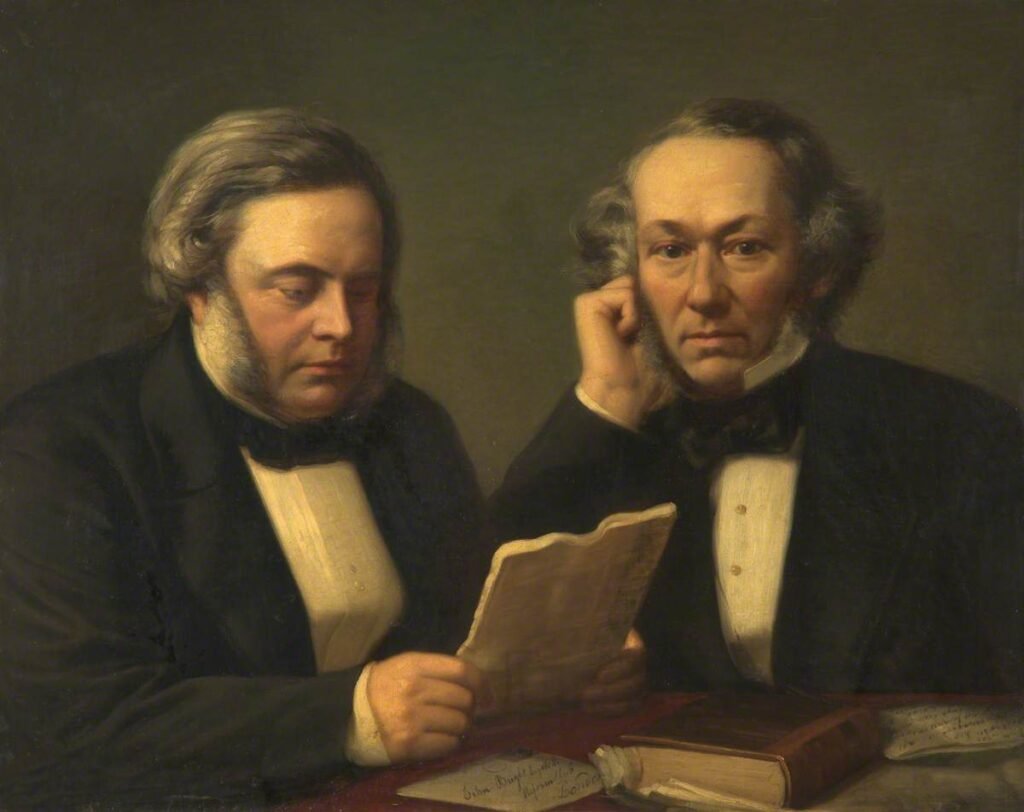
There is a nice irony buried in the word itself. The Manchester School of Richard Cobden and John Bright stood for unfettered free trade and the removal of any state hand from the market. Burnham has taken the same word and turned it inside out: public control of the buses, council housing, active use of the state to attract and steer capital, all offered as the cure for what he calls Britain’s low-growth, high-inequality trap.
Words get recycled in politics more often than convictions do. What matters is not what he calls it. What matters is what it does.
The Bee Network, Good Growth Fund and the Productivity Miracle
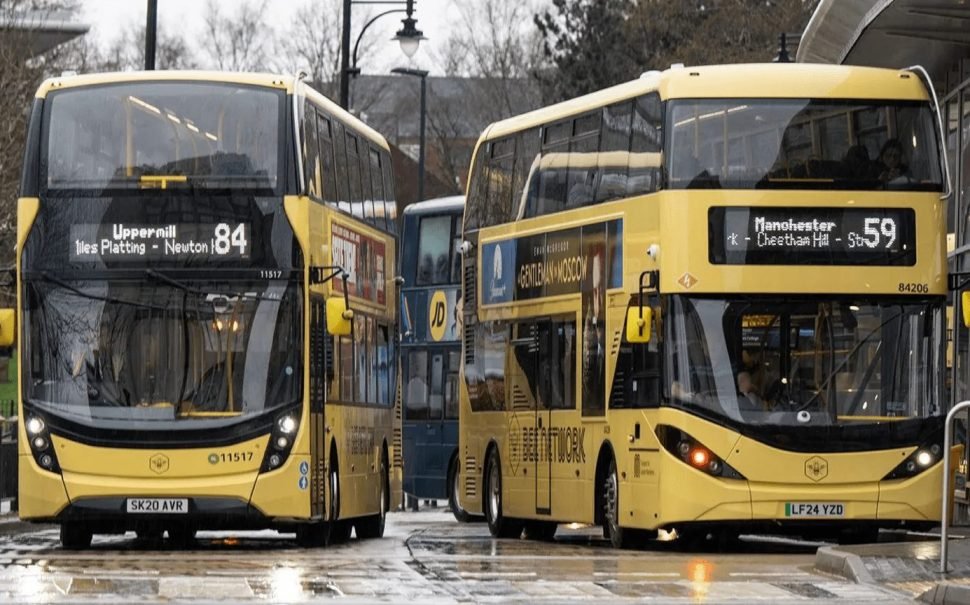
On the figures Greater Manchester supplies about itself, the record is genuinely strong, and in places startling. The city region has averaged 3.1 per cent annual growth since 2015, roughly double the national rate. The Productivity Institute’s own analysis of the underlying ONS data sharpens that further: GVA per hour worked in the City of Manchester rose 42.0 per cent between 2015 and 2023, against 29.2 per cent for the average of the nine other large UK cities outside London and 28.1 per cent for the UK as a whole. Manchester’s output per hour now stands at 115 per cent of that nine-city average, up from 104 per cent in 2015. It is, on this measure, the most productive large English city outside the capital.
The Bee Network brought buses back under public control through franchising, knitting buses and trams into one integrated system in a way no English region outside London had managed. The Good Growth Fund began as a billion-pound revolving investment platform and has since won a further commitment of at least £500 million from the National Wealth Fund, aimed at pulling private capital into transport, regeneration and clean energy. Five growth clusters organise the industrial strategy; Live Well, the region’s prevention programme, tries to shift spending from crisis response to early intervention in health and work.
Even those figures need a caveat Manchester’s boosters rarely supply themselves. The Economics Observatory has warned that part of the apparent productivity miracle rests on shaky data out of Trafford, and that correcting for how hours worked are measured cuts the recent growth figures considerably. That does not erase Manchester’s real success. It does mean the most triumphant version of the story does not survive contact with its own footnotes.
Burnham Inherited Manchester’s Success – He Didn’t Build It

There is a second caveat, and it matters more to the argument about Burnham personally than to the argument about the model. Burnham did not build this. He inherited it and ran it well. Greater Manchester’s advantage rests on four decades of policy continuity that predates him by a generation, on the work of earlier leaders such as Howard Bernstein and Richard Leese, on the Oxford Road Corridor’s universities and research institutes, on airport connectivity most English cities do not have.
Burnham did not build this. He inherited it and ran it well.
The Productivity Institute is careful on this point. It does not claim devolution alone caused Manchester’s productivity, only that a particular configuration, the university-industry interface built around the Corridor, UMIP and Bruntwood SciTech, differentiated Manchester from Birmingham, Leeds and its other peers. That is a narrower and more honest claim than “Manchester grew because Burnham arrived,” and it is worth remembering exactly as the country is asked to hand him the premiership on the strength of a personal record that was, on the evidence, mostly institutional.
Can Manchesterism Be Exported? The Economists Weigh In

None of this makes the case for national transfer absurd, and Heartlands readers should hear it stated as its supporters would put it, not as a straw man. Burnham’s own argument is that Britain’s stagnation is inseparable from over-centralisation, and that moving decisions on transport, housing, skills and utilities closer to the places they affect is a genuine fix, not a gimmick. Centre for Cities, no soft touch on regional policy, argues that big cities have to be the starting point for any national growth strategy because they hold the densest concentrations of skilled labour and productive industry. Philip McCann’s research goes further, concluding that scaling elements of the model, transport integration, cluster-based industrial policy, could reduce regional disparities if paired with reform of how infrastructure is financed and planned. Even the Institute of Economic Affairs, in a piece pointedly titled “Whither Manchesterism?”, credits the decentralisation and the planning flexibility with improving outcomes, while noting drily that the word itself was borrowed from nineteenth-century free traders and turned to precisely the opposite purpose.
Grant Burnham all of that. It still leaves the harder question unanswered: does what worked in one city region, with a bespoke settlement and forty years of continuity behind it, transfer to a whole country that has none of those advantages built in?
The Replication Problem: Not Every Place Is Manchester

The evidence says, cautiously, not easily. Diane Coyle, no critic of devolution, has written plainly that the Manchester model with its foreign inwards investment cannot be precisely replicated at the national level, because a city region’s development strategy and a national government’s macroeconomic programme are different instruments answering to different problems: taxation, defence, trade, the sequencing of infrastructure across a whole country rather than one conurbation. Centre for Cities puts the obstacle in blunter terms: the UK remains the least fiscally devolved country in the G7, and any serious transfer of the Manchester model would require a design for tax-sharing and equalisation that does not yet exist on paper anywhere in Whitehall. Reuters and the Associated Press have both noted, in their reporting on Burnham’s own speeches, the absence of detail on how a national version would balance tax, spending and borrowing. The Financial Times has gone further, arguing that radical localism on its own will not solve a national malaise this deep.
Nor is every place Manchester. The research is fairly consistent that replication is plausible chiefly where cities already have the mass for agglomeration and the institutional stability to bring private capital in behind them, places such as Birmingham, Leeds, Bristol, Glasgow or the Liverpool City Region. It is far less plausible where the research base, the transport network or the institutional capacity simply is not there, which in England is most places.
Even inside Greater Manchester itself, growth has stayed stubbornly concentrated in the city centre. Oxford Economics found that outer boroughs have generally outperformed the national average, but not on anything like the scale that spillovers reach London’s outer boroughs. The Good Growth Fund’s own existence is the clearest evidence of that. It was built, on Centre for Cities’ own account, because the earlier pattern of growth was not spreading fast enough across Greater Manchester’s ten boroughs on its own. A fund built to fix a spillover problem is not proof the spillover problem has been solved. It is proof it has been noticed.
A fund built to fix a spillover problem is not proof the spillover problem has been solved. It is proof it has been noticed.
Neoliberalism, or Something Else

That brings the argument to the word the online left keeps reaching for, and keeps getting only half right. The case that Manchesterism is simply neoliberalism in a hard hat starts with what the money actually does: dense city-centre development, commercial office and lab space, private developers, an explicit courtship of global capital. Manchester City Council’s own Good Growth material shows a large share of the fund going into city-centre offices, science space and mixed-tenure housing built to keep the commercial pipeline moving. Left critics, not only the right, have called Manchester a site of state-led gentrification and working class displacement dressed up in devolution’s language. The New Statesman put it in five words worth remembering: Manchesterism is not socialism.
The counter is that Burnham’s own language is genuinely, not cosmetically, anti-privatisation. He frames the whole project as a reaction against deindustrialisation, austerity and the sell-off of essential services. Bus franchising is presented, correctly, as a return of public control. On the campaign trail in Makerfield he put it in his own words: a plan for “more public control over water, energy, transport” to bring bills and fares down and give people and businesses what he called breathing space. He backs more council and social housing, and links growth explicitly to prevention in health and community support. That is not the vocabulary of a man simply repackaging Thatcherism for the north.
It is worth pausing on the small print of that phrase, because control and ownership are not the same thing, and the difference is measured in wage packets. A government can set the rules for a service and still contract the work out to whichever firm bids lowest, which means the cleaner, the care worker and the depot hand stay outsourced, on worse pay, worse pensions and weaker job security, while the profit leaves the service at the end of every quarter. Ownership brings those same workers in-house and keeps the surplus inside the service that generated it. Bus franchising is real, and it is a genuine improvement on deregulation. It is also, on Burnham’s own careful wording, control rather than ownership, and nothing he said in Makerfield commits him to the second. The distance between those two words is exactly where a future government could quietly decide how much of good growth ever reaches the people who produce it.
The distance between those two words is exactly where a future government could quietly decide how much of good growth ever reaches the people who produce it.
The honest verdict sits between the two readings, and the evidence does not let either side claim the whole prize. Manchesterism is neither straightforward neoliberalism nor a clean break from it. It is a hybrid: state-steered, genuinely more concerned with public control and prevention than the orthodox model, but still dependent on manly foreign investment in one urban core and hoping, eventually, that enough of it walks out to the boroughs that did not get the towers.
Call that trickle-down if the phrase pleases you. It undersells the machinery Burnham has actually built to move money outward. But it also flatters what that machinery has not yet achieved.
Manchester itself, by its own government’s admission, has not yet managed good growth in every postcode within one city region. The fund exists precisely because it has not.
No Contest, No Scrutiny: The Questions Burnham Won’t Answer
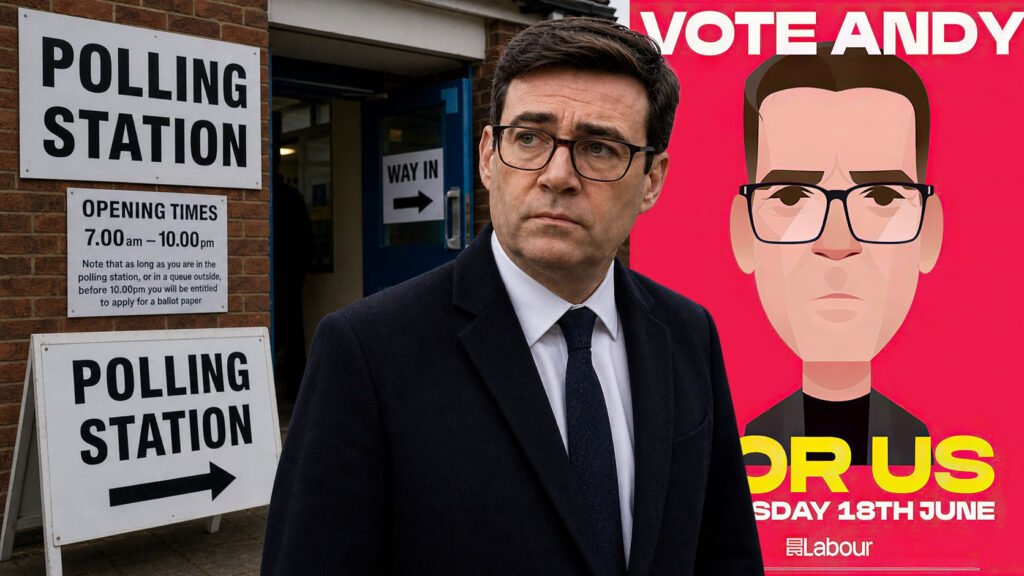
Nominations for the Labour leadership open on 9 July and close a week later. In the time between, no one in the parliamentary party has forced Burnham to answer for any of this the way an opponent would: how the fiscal plan survives contact with the Treasury, where the equalisation money comes from that his own sympathetic economists say national transfer requires, and whether Birmingham, Bristol or Glasgow have anything like Greater Manchester’s forty years of institutional continuity to draw on before being asked to repeat the trick.
Al Carns, the one Labour MP still weighing whether to stand, has spent the fortnight since Starmer’s resignation asking Burnham to publish that vision rather than committing to make him defend it in a contest. Darren Jones did not even wait to be asked. “Andy Burnham is going to be the next prime minister,” he told Sky News, and stood aside. Wes Streeting endorsed him within hours.
What is happening here is not a leadership election. It is a transfer of the baton from Starmer to Burnham, and without a meaningful challenge before the sixteenth, he enters Number 10 without any real scrutiny at all: the fiscal plan unpublished, the equalisation question unanswered, forty years of Manchester’s collective institutional effort quietly repackaged as one man’s personal gift to the nation.
A genuine contest would have made these questions unavoidable. A coronation lets a popular man become prime minister on the strength of what a city built collectively over four decades, without ever being made to explain, under real pressure, how the rest of the country gets the same deal without the same universities, the same continuity, the same Treasury indulgence that took generations to accumulate.
Good growth in every postcode is a fine slogan. Manchester does not have it yet, which is why the fund exists.
Burnham wants three years to deliver in the whole country what a decade has not delivered in the ten boroughs he already ran...that’s some ask.
Enjoyed this read? I’m committed to keeping this space 100% ad-free so you can enjoy a clean, focused reading experience. Crafting these articles takes a significant amount of research and heart. If you found this helpful, please consider a “small donation” to help keep the lights on and the content flowing. Every bit of support makes a huge difference.