Starmer’s Authoritarian Britain…
In two years, this government has arrested more than three thousand people for holding placards, made it a crime to stand outside a politician’s front door, moved to take the jury box away from defendants, and handed a surveillance contractor the keys to our medical records. He promised to tread lightly. He meant on the powerful. On the rest of us, the gavel has been coming down one law at a time.
The Lightness of the Gavel…
Two years ago today, standing on the threshold of Downing Street, Keir Starmer looked into the cameras and promised an exhausted nation that his government would tread more lightly on our lives. It was an elegant phrase, built to soothe. Yet as we survey the wreckage of the last twenty four months, we must ask the only question that matters. Lightly for whom? The answer to that promise has become Orwell’s boot.
The gavel has come down on liberties that the working class fought generations to win: the right to protest, the right to speak freely, the right to organise, the right to dissent without being treated as a threat to the state. Under Starmer, powers inherited from the Tories have not been dismantled. They have been used, defended and folded into a wider machinery of control. Our bank accounts are being opened to state inspection in the name of fraud. Our online speech is being pushed through the filter of regulation, surveillance and private enforcement. Protest is being narrowed, monitored and criminalised. What was promised as a lighter touch has become something far heavier: a permission state, where citizens are watched, managed and warned to stay inside the lines.
Let me show you what it looks like. On 15 June this year, outside the Royal Courts of Justice, more than a hundred people were arrested for holding signs. Not for breaking windows. Not for blocking ambulances. For holding signs, while inside the building five judges ruled that the government was entitled to call the organisation named on those signs a terrorist group.
That is not an accident of policing. It is what two years of patient legislating were always building toward: a country in which, by the time the working class finally decides it has had enough, every tool it once used to fight back has already been taken from the cupboard.
That is the argument of this column. Not that Keir Starmer is secretly a tyrant. Something worse, and more familiar. A Labour government, elected by working class votes on a promise to tread lightly, has instead built the apparatus of a government that knows exactly what happens when disappointment turns to anger, and is getting ready for that day. The street, the placard, the jury box, the anonymous crowd, even the privacy of your own medical file. One by one, taken off the table. Let us go through them.
FIRST THEY TOOK THE STREET
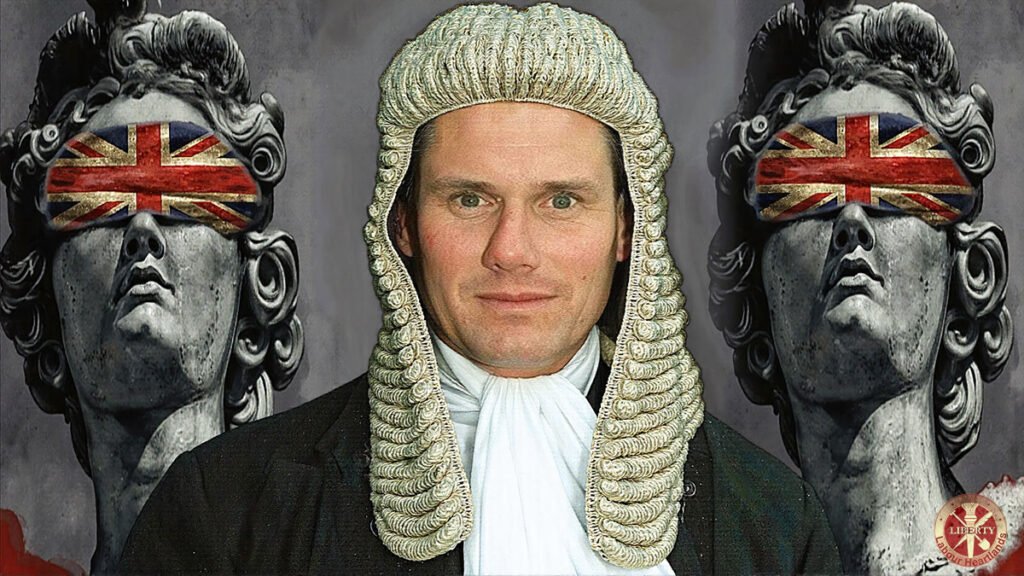
The Crime and Policing Act 2026 received royal assent on 29 April. Its protest provisions came into force on 29 June, five days before this column went to press, and they read like a manual for making demonstration legally impossible.
A police inspector can now declare any area a mask free zone for 24 hours, and covering your face inside it, a scarf against the cold, a mask against a camera, becomes a criminal offence carrying a month in prison. Carrying a flare, a fixture of marches for half a century, is now a crime. Climbing on a listed memorial is now a crime whether or not a protest is even happening. Standing outside the home of any public office holder, from a cabinet minister down to a parish councillor, to tell them what you think of a decision they made, now carries up to six months.
And then the quietest, most dangerous provision of all. Senior officers must now weigh the cumulative disruption of protests in an area when deciding whether to impose conditions. Your march can be restricted because of someone else’s march, last month, about something else entirely. The nurses’ picket pays for the climate blockade. The tenants’ demonstration pays for the Gaza vigil. Protest itself, as a category, becomes the disruption, and every campaign becomes jointly liable for all the others.
This is the second major rewrite of public order law in four years, and the government’s own justification for the pace is candid to the point of chilling. Evolving tactics require evolving powers. Which is another way of saying that the more inventive you become at being heard, the more law will be written to silence you.
THEN THEY TOOK THE PLACARD
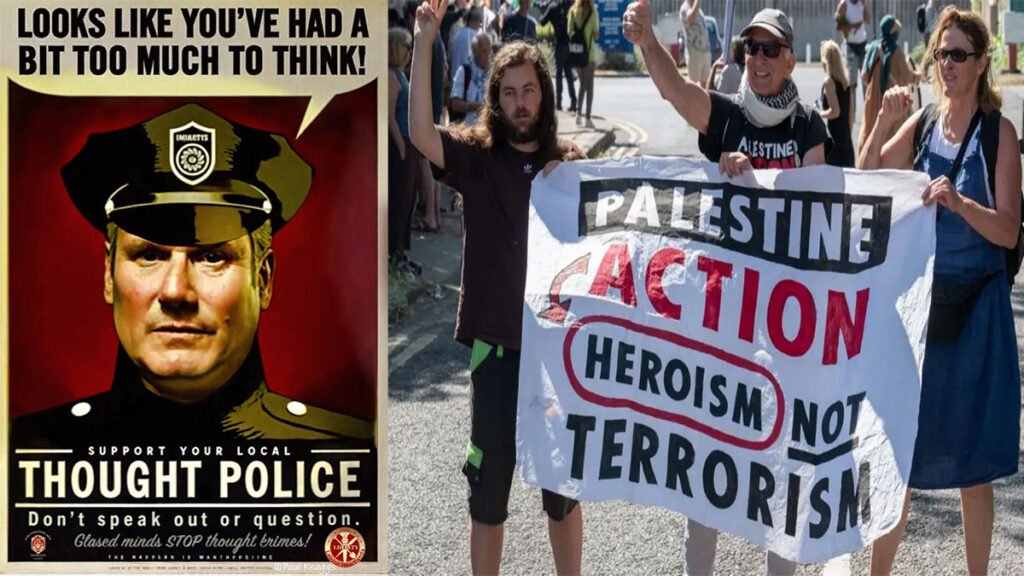
On 5 July 2025, Yvette Cooper proscribed Palestine Action as a terrorist organisation, after its members sprayed paint on military aircraft at RAF Brize Norton. Paint. Under the Terrorism Act 2000, expressing support for the group now carries up to fourteen years, the same maximum the law reserves for people who fund actual bombs.
What followed was the largest wave of political arrests in modern British history, more than three thousand of them, most for placards and silent vigils. In February the High Court ruled the proscription unlawful and disproportionate. The government’s response was to keep the ban in force, appeal, and keep arresting, so that on the day the Court of Appeal handed it victory in June, the Metropolitan Police could celebrate by detaining more than a hundred people outside the courtroom.
Four of the activists who raided Elbit Systems’ factory in Filton were sentenced that same fortnight to more than twenty six years between them. Be honest about what happened there first, because the honesty is what makes the rest of this argument unanswerable. One of them, Samuel Corner, struck a police officer with a sledgehammer and fractured her spine, an injury she is still being treated for two years on. That was rightly charged and rightly punished as grievous bodily harm. Nobody, least of all this column, pretends otherwise.
Be honest about what happened first, because the honesty is what makes the rest of this argument unanswerable.
But he was one of four. The other three, Charlotte Head, Leona Kamio and Fatema Zainab Rajwani, were convicted of nothing but criminal damage to property. Drones and machinery smashed. Nobody struck. And for that alone, a judge applied a terrorist connection finding that lengthened their sentences: the first time in the entire history of the Terrorism Act that damage to property, with no violence against a single human being, has been sentenced in Britain as an act of terrorism. That is the fact that should stop you cold. A power that stretches this far to reach three protesters convicted of nothing but vandalism fits a striking union or a rent strike committee just as easily tomorrow. Proscription has never, in the history of that Act, been handed back once taken.
THEN THEY CAME FOR THE JURY BOX

Here is the piece of this that has had the least attention and deserves the most. In February, Justice Secretary David Lammy introduced the Courts and Tribunals Bill. Strip away the language of backlogs and efficiency and it does something no government has dared do in this form before. It abolishes the defendant’s right to choose trial by jury for the entire middle band of criminal offences, sending any case expected to draw a sentence of three years or less to a judge sitting alone.
Now hold that next to everything above. The government has just spent a year creating new protest offences: masks, flares, memorials, front doors, placards. Almost all of them fall exactly into the band this bill takes away from juries.
The jury is not a procedural nicety. It is the one place in the criminal justice system where the state must convince twelve ordinary people, not a salaried judge, that a prosecution deserves to succeed. In 1985, a jury acquitted the civil servant Clive Ponting under the Official Secrets Act after the judge directed them there was no defence in law available to him. In 2022, a jury acquitted the Colston statue defendants outright. Juries have been getting in the state’s way for as long as there have been political trials, precisely because ordinary people can smell a political prosecution at a hundred yards. This government is the first in living memory to legislate that instinct away, at the exact moment it has multiplied the offences a protester can be charged with.
This is not a fringe reading. At second reading, a hundred Labour MPs failed to back their own government’s bill, ten voting against it outright and ninety more simply not turning up to vote for it. Karl Turner, a Hull solicitor on Labour’s own benches, led that rebellion. The party suspended him for it. The Criminal Bar Association tore the government’s supporting evidence apart. The bill passed the Commons anyway and is now in its final stages in the Lords. If it becomes law in its current form, the courtroom stops being a place where the state can lose.
THEN THEY CAME FOR THE CROWD ITSELF

A protest movement survives on one more thing beyond the street, the placard and the jury: the ability to exist without the state knowing exactly who you are. That is what is being dismantled last, and most quietly.
In September 2025 Starmer announced a digital ID and told the country it would be mandatory for the right to work. Nearly three million people signed a petition against it. Streets filled. The government retreated, or appeared to. By January the mandatory element was gone, and the Digital Access to Services Bill now before Parliament legislates only a voluntary ID for public services. The government’s own papers make no secret of where this is heading, though. Mandatory digital right to work checks by the end of this Parliament remains the stated ambition. The scheme the public threw out the front door is being carried back in through the tradesman’s entrance, one eligibility check at a time. First to work. Then to rent. Then to claim. The people asked for their papers first will not be barristers or newspaper columnists. They will be cleaners, carers, warehouse workers and the migrant workforce every employer will be deputised to police.
Alongside it sits the Online Safety Act, and honesty requires saying plainly that this was a Conservative law, passed in 2023 before Starmer took office. What this government owns is the choice to enforce it at full speed, and now to build directly on top of it. When Phase 2 of the Act came into force last July, requiring highly effective age assurance from any service likely to be accessed by children, age checks began running at more than five million a day, the overwhelming majority of them on adults reaching for nothing more than the ordinary internet. Sign ups for VPNs, the traditional escape route from exactly this kind of check, rose by well over a thousand per cent within days.
This month the government announced a full ban on under sixteens using the major platforms, dressed, as these things always are, in the unimpeachable language of child safety. But ask the only question the announcement was built to make you forget. How do you stop a fifteen year old opening an app without first confirming the age of the adult standing next to her in the queue? You cannot. There is no filter that quietly checks the child and waves the adult through unseen. To catch the child, the system must interrogate everyone, and everyone now includes you. We already know how well that goes when it is entrusted to private hands. In October, hackers breached a vendor handling Discord’s identity checks and walked off with the government issued documents of some seventy thousand people. Discord’s response to a leak caused by collecting identity documents was to expand identity collection to every user on the platform. That is the entire logic of this project in miniature. The harm done by demanding your papers is answered, every time, by demanding them more often.
And there is one more layer. The National Security (State Threats) Bill completed every one of its Commons stages in a single sitting this June and cleared the Lords within three weeks of being introduced. It hands the Home Secretary the power to designate organisations, on the terrorism proscription model, for foreign power threat activity, and makes it an offence, fourteen years again, to support them or express an opinion supportive of them for a purpose prejudicial to interests of the United Kingdom that the law nowhere defines. Some of this genuinely is about Iranian plots and Russian sabotage. But undefined interests, decided by one minister, enforced with terrorism scale sentences, is not a national security law. It is a blank cheque with a national security watermark. Ask the three thousand people arrested over placards how confident they are that a blank cheque stays in the drawer.
AND ALL THE WHILE, PALANTIR READS YOUR MEDICAL NOTES

If you want to know who a government is building the machinery for, look at who it hires to run the data. The NHS Federated Data Platform is operated by Palantir, a US firm whose business is surveillance: battlefield targeting, predictive policing, and software that helps American immigration agents find people to deport. Its co-founder, Peter Thiel, told the Oxford Union in 2023 that the NHS makes people ill and needs market mechanisms, by which he meant privatisation. The £330 million contract was signed by the Conservatives in November 2023. This government inherited it, and at every decision point since, has chosen to keep it.
It has done more than keep it. In May, an internal briefing revealed plans to grant Palantir and other contractor staff admin level access to identifiable patient data, sweeping away the old case by case approvals. In December, the Ministry of Defence handed Palantir a further £240 million deal without competitive tender. Across at least ten departments, councils and police forces, the company now holds British state contracts worth upwards of £670 million.
Parliament’s own Science, Innovation and Technology Committee, cross party, has now told the government in terms to cancel the contract and use next year’s break clause to build a British replacement. The resistance has come from below too. The British Medical Association has voted to oppose the platform’s rollout entirely. And on 24 June, Sheffield became the first council in England to formally oppose it, when councillors voted 62 to 1 to call on their local NHS bodies to freeze integration. The motion’s proposer, Toby Mallinson, made the point that deserves to be heard in every trust boardroom in the country. Reform UK has already pledged to use exactly this kind of data infrastructure for mass deportations.
The same government asking you to hand over a placard is asking you to hand over your medical file to a firm that helps deport people for a living. That is not two stories. That is one government, in two uniforms.
THE ENEMY IS NOT INCOMPETENCE

The comfortable explanation for all of this is drift. A weak Prime Minister, a panicking party, each law an isolated overreaction to an isolated headline. Take each one alone and each has its alibi.
Refuse to take them alone. Put them in one column, dated, and read down the list. Every measure lands on the same people: the ones who march, who picket, who hold placards, who sit on juries, who cannot buy their way around an ID check, whose data sits in an NHS file rather than a private clinic’s. Not one of these laws inconveniences a landlord, a hedge fund or an arms exporter. Two years of frantic legislation and not one new power points upward. That is not drift. That is aim.
The enemy of this argument is not one man in Downing Street. Starmer will go, probably sooner than later, and the powers will remain, filed and ready for whoever comes next, and the polls tell us plainly who that might be. The enemy is a political class, blue and red alike, that has stopped believing it can win the working class’s consent and has decided to manage its anger instead. A confident government persuades. A frightened one builds designation regimes, judge only courts and biometric databases. Every one of these laws is a confession.
THE BOOT AND THE BALLOT

Orwell warned that the future of power was a boot stamping on a human face, forever. The detail everyone forgets is that in his telling, the boot did not arrive by coup. It arrived by increments, each one reasonable, each one lawful, each one passed by people who told themselves it would only ever be used on someone else.
The working class of this country has faced down worse than Keir Starmer’s statute book. It broke the Combination Acts. It survived Peterloo and got the vote anyway. It buried the Poll Tax and the government that introduced it. Every tool it used to do those things is precisely what is being confiscated now, and that should be read not as our weakness but as their fear. Governments do not disarm people they expect to stay quiet.
So do not stay quiet. The Courts and Tribunals Bill is in the Lords now, this month, and a letter to a peer takes ten minutes to write. The Palantir contract comes up for review this year, before the break clause even falls due, and Sheffield has shown that sixty two councillors in one chamber can put a £330 million contract on notice. Write to yours and ask why they haven’t.
They promised to tread lightly. Two years on, the gavel falls heavier than the boot ever did, and it is falling on exactly the people who put them there. Make them regret ever teaching us to count the blows.
Enjoyed this read? I’m committed to keeping this space 100% ad-free so you can enjoy a clean, focused reading experience. Crafting these articles takes a significant amount of research and heart. If you found this helpful, please consider a “small donation” to help keep the lights on and the content flowing. Every bit of support makes a huge difference.