Smyrtos Tanker Boarding: Theatre, Not Defence: Another Step Up The Escalation Ladder
A government that cannot fund its own defence sends commandos into the Channel to prove that it can. Watch the footage if you like. Just understand it is the hand you are meant to watch.
42 Commando Abseils: Inside the Channel Tanker Raid
Three days. That is the entire distance between a Defence Secretary walking out because Britain can no longer afford to defend itself, and the same government sending Royal Marines abseiling onto a tanker in the dark to persuade you that it can.
In the small hours of Sunday, commandos of 42 Commando fast-roped from RAF Chinooks onto the deck of an ageing oil tanker in the English Channel. The six-hour operation pulled in Royal Navy ships, military helicopters and an RAF P-8 maritime patrol aircraft. The vessel, the Smyrtos, was sailing under a Cameroonian flag, boarded by Royal Marines and National Crime Agency officers with support from helicopters, a frigate and a minehunter. She had left the Russian oil terminal at Ust-Luga on 1 June, heading west with cargo most likely bound for Asia. By breakfast the Prime Minister had his line ready, delivered to camera with the practised gravity of a man who has found, at last, a piece of good news: the operation delivers yet another blow to Russia and reminds those fuelling Putin’s war in Ukraine that Britain will not let them hide. The BBC dutifully repeating the line.
They cannot find the money to defend Britain, but luckily, they can find a tanker to board for the cameras piloted by a dead cat.
Let us be fair before we are unkind, because an argument worth your time does not duck the strongest version of the thing it opposes. The shadow fleet is real. Britain has sanctioned more than 500 of these ageing, dubiously flagged, dubiously insured vessels, and the measures appear to bite, with Russian oil and gas revenues down 24 percent last year. These are not phantom ships. Nobody serious wants them waved through. And let us be honest about the operation itself: 42 Commando did the job, and did it well. Fast-roping onto a moving deck in a Channel swell before dawn is not theatre to the men who carry it out, whatever it is to the men who ordered it. A clean, professional piece of soldiering, and as one who once wore the uniform I will say it plainly: well done, lads. My quarrel has never been with the marines on the rope. It is with the politicians who decide, from a safe distance, when and why that rope goes down.
So far, so defensible. And then you look at the calendar.
Dead Cat On The Deck

The power to seize these ships in British waters was granted in March 2026. It was announced on 27 March, and then sat unused for the better part of three months, until the early hours of 14 June, three days after the Defence Secretary resigned. Three months of legal authority, and the trigger is finally pulled in the precise window the government most needs your eyes anywhere but on its own books.
There is a name for this in politics. The dead cat. When the conversation is going badly, you throw something dramatic onto the table, and everyone stops arguing about the thing that was hurting you to stare at the corpse instead. A commando raid is a very good dead cat. It is cheaper than an air-defence battery and it photographs far better.
Regular readers know the backdrop, because we set it out only days ago in No Defence for Starmer. John Healey did not resign as a plotter. He resigned as the loyalist’s loyalist, telling the Prime Minister to his face that the Treasury would not fund the defence of this country at a time of rising threat. Al Carns, a decorated Royal Marine, walked out beside him. Seven ministers gone in a month, the Ministry of Defence in open revolt. And into that wreckage, like a silk handkerchief drawn from a sleeve, comes a tanker boarding in the Channel.
That is the first half of the story, and the simpler half. A government that cannot pay for its own defence reaches for the one weapon it can still afford, which is theatre.
WAR IS A RACKET
The second half is graver. War is a racket, wrote Smedley Butler, the most decorated US Marine of his day, in 1935. It always has been. It is possibly the oldest, easily the most profitable, surely the most vicious. He had noticed what the recruiting posters never mention: that the people who profit from a war and the people who pay for it are rarely the same people, and never sit in the same rooms.
Look at the arithmetic and tell me he was wrong. We are told, flatly, that there is no money to defend Britain. We are told it by the Treasury, by the Prime Minister, by a Defence Secretary who resigned rather than put his name to the shortfall. And in the same breath this government has found, by our own accounting, some £21.8 billion for Ukraine since February 2022, around £13 billion of it military, with billions more in guarantees stacked behind it.
No air defence for Hull, but a forever budget for the Donbas. The money was never missing. It was only ever a question of whose war it was spent on.
This is the part the war party cannot say aloud, so we will say it for them. This is not, at bottom, about resolving anything. A conflict that resolves is a conflict that stops paying. The contracts, the replacements, the cost-plus orders to the same handful of primes we catalogued last week, the revolving door that lets a general retire on Friday and invoice his old department on Monday: none of it survives peace. The racket needs the war to continue, and so the war continues, and the invoice, as Butler said, is reckoned in lives at one end and in dollars at the other.
Where Are the Doves? Westminster’s War Consensus
Here is a question this publication will keep asking long after Westminster has agreed not to. When the resignations came, every party in the Commons demanded the same thing, faster, through the same broken pipe: more money. Badenoch called Healey honourable. Jenrick cheered him on. Not one front-bench voice rose to ask whether endless escalation against a nuclear-armed state is wisdom or merely momentum.
Where are the doves? A democracy with no audible peace party is not a democracy debating a war. It is a country being marched somewhere it was never asked about, by people who have agreed in advance that the only argument permitted is how fast to go.
If Russia Pulled Out Today Would Ukraine go back to Civil War tomorrow?
Ukraine 2014–2026: The War We Are Not Supposed to Mention…
And there is the hardest question, the one that earns the angriest post, which is usually the sign it is worth asking. This war did not begin in February 2022. Until the day Russian columns crossed the border, eastern Ukraine was a country at civil war, and had been since 2014. That war was armed from both directions. Russia backed and reinforced the separatists. The West armed and trained Kyiv, a fact NATO has never bothered to hide when it suits the alliance to boast of it. Stoltenberg himself stated that NATO allies had been supporting Ukraine with training and equipment since 2014, support he later dated, in plainer words, to actually starting back in 2014. When the man who ran the alliance tells you the preparation began eight years before the invasion the public was told arrived from nowhere, the tidy story does not survive contact with the record.
So ask the question they will not. If the Russians pulled out tomorrow, does Ukraine put down its arms, or does it go back to the war it was already fighting in 2014, the one we are no longer supposed to mention? And ask its darker twin, the one that should sober every armchair strategist in Whitehall. What happens the day Moscow stops calling this a special military operation and starts calling it a war? A Russia that is, by its own framing, not yet fully at war is a Russia with room left to escalate. Every tanker we board, every missile we help guide, every commando we drop onto a deck is an invitation to discover where that room ends.
Mutually Assured Destruction: The Lesson We Forgot
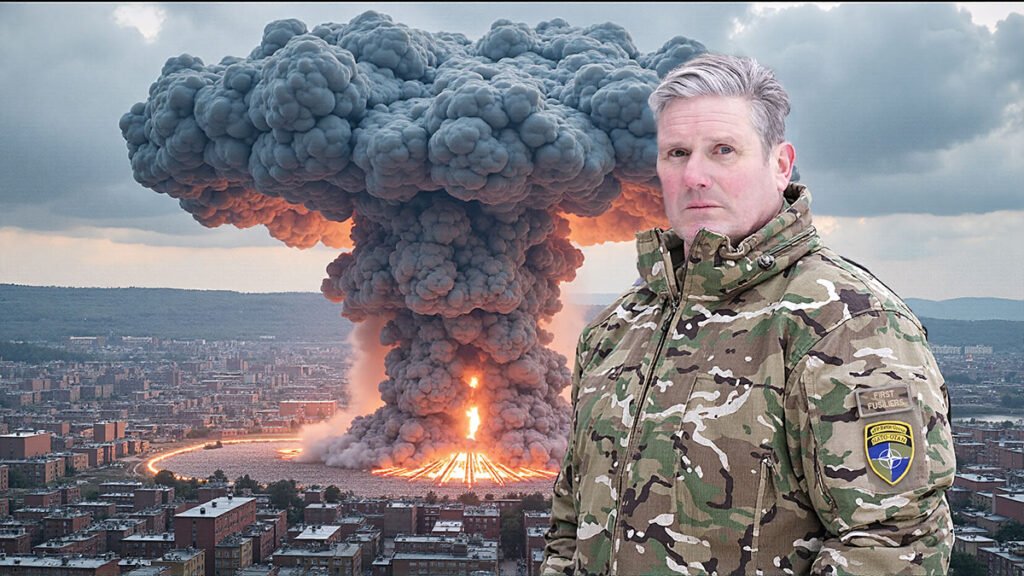
There was a time we understood this in our bones. The Cold War was many things, most of them ugly, but it was governed by one piece of grim arithmetic that everyone from the Kremlin to the Pentagon could recite in their sleep: mutually assured destruction. Push too far and there is no winner, no defence budget large enough, no bunker deep enough. That knowledge, terrible as it was, kept the peace for forty years. It made hard men cautious.
We seem to have mislaid it. We escalate by press release now, one rung at a time, each step sold as defensive, each step becoming the floor for the next, and nobody in power will say where the staircase ends, because to say it aloud would be to admit how high we have already climbed. The men who remembered Cuba are gone. What has replaced them is a class of ministers who treat a nuclear power as a campaign prop, and a public kept too busy watching the dead cat on the deck to ask the only question that has ever mattered: and then what?
None of this means the shadow fleet should sail free. It means you are owed the truth about what Sunday actually was. It was a diversion, staged by a government that lost two defence ministers last week, timed for the cameras, and another deliberate step up an escalation ladder whose summit no one will name. It may be lawful. It may even be effective. It is still escalation, it is still being done in your name, and you were never once asked.
We forgot the only lesson the Cold War ever taught us, paid for in four decades of fear: against a nuclear power, there is no winning move, just a dead cat on the deck and the question no minister will answer. And then what?
Enjoyed this read? I’m committed to keeping this space 100% ad-free so you can enjoy a clean, focused reading experience. Crafting these articles takes a significant amount of research and heart. If you found this helpful, please consider a “small donation” to help keep the lights on and the content flowing. Every bit of support makes a huge difference.

Cross-reference: see our companion piece, “No Defence for Starmer: Seven Ministers Gone,” for the funding collapse behind this week’s theatre.