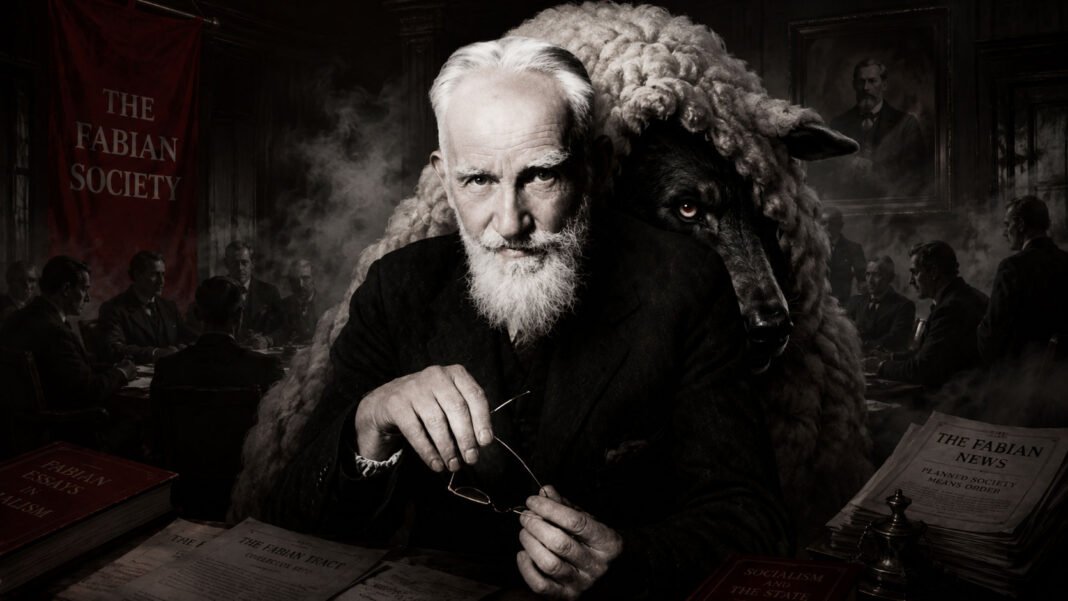
Fabian Society Exposed: Labour’s Original Sin
How Labour chose warfare over welfare, and why its founders would approve
On 4 January 1884, in a London drawing room, a handful of middle‑class intellectuals founded the Fabian Society. They were not workers. They were clerks, writers and academics. Within two years they had acquired the pair who would define them: a playwright named George Bernard Shaw and a civil service examiner named Sidney Webb.
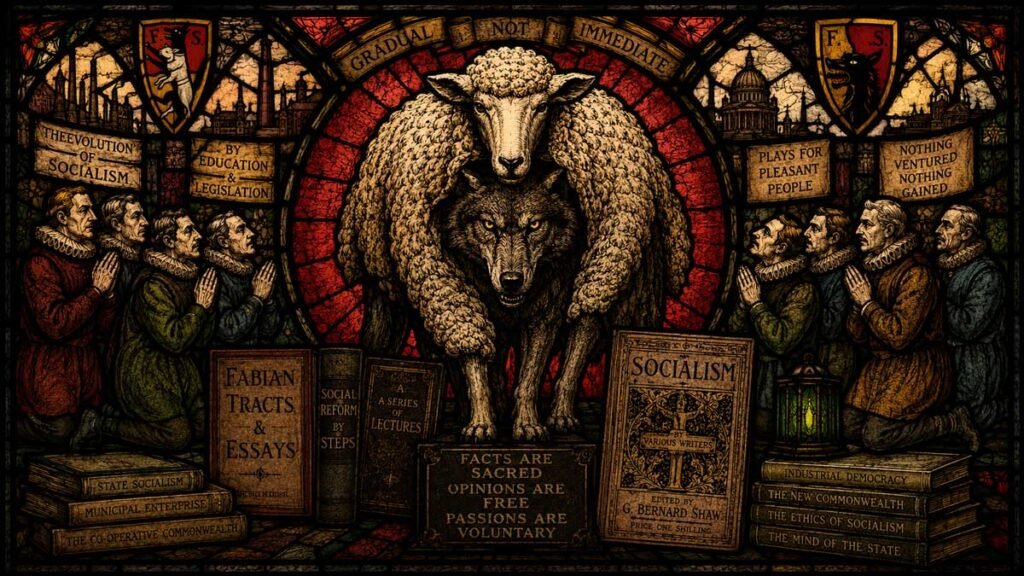
They chose their emblem with candour: a wolf in sheep’s clothing. Shaw had it fired into a stained glass window in 1910, showing himself and Webb hammering the world into shape on an anvil beneath the wolf in its borrowed wool, under the motto “Remould it nearer to the heart’s desire”. The window hangs today in the Shaw Library at the London School of Economics. It was never a secret. It was a promise.
That promise is being kept this very week…
This Thursday, barring a late nomination, Britain gets a Prime Minister nobody voted for, chosen by a method the Labour Party would call a stitch-up if the Tories did it. They did it in 2022. Starmer said so at the time, loudly, and demanded a general election. Consult the record of what he is demanding now.
Andy Burnham stands as the sole declared candidate. Wes Streeting has stepped aside with his endorsement. Should no other challenger emerge, the crown passes at the close of nominations on 16 July without a single ballot cast by the membership. And what is the opening bid of the man presented to us as the soft left rescue, the anti-Starmer, the Beveridge of Manchester? In June, after the Defence Secretary and his armed forces minister resigned because Britain’s rearmament was not big enough, Burnham told LBC that “the world has changed”, that the government would obviously have to raise its assumptions on defence spending, and that his plan would be to free up the money for defence from welfare.
Read that again. The sick will pay for the missiles. That is the rescue.
This column is about why nobody should be surprised. Not because politicians disappoint, which is a truism, but because of something harder and older: the Labour Party’s intellectual founders built it this way, told us they were building it this way, and put the confession in stained glass where it hangs to this day. The working class was never meant to be represented. It was meant to be managed.
THE LEDGER

Start with the record of the government now dissolving, because the pattern matters more than the man.
In February 2025 this Labour government cut the aid budget from 0.5 per cent of national income to 0.3, the lowest level since 1999, explicitly to fund the rise in defence spending. By 2027 that transfers £6.5 billion a year from the world’s poorest to the arms budget. Funding for Gavi, the vaccine alliance, and the Global Fund against AIDS, TB and malaria falls. British funding for polio eradication ends altogether. A development minister resigned. The money moved anyway.
Then the same government came for the sick at home, with a plan built around £5 billion in cuts to disability benefits. £4.1 billion of it from changes to PIP. What followed was one of the great backbench revolts of the modern era: 49 Labour MPs voted against their own government even after every concession, and the notorious four-point rule was torn out of the bill in almost the final hour of the debate. The rebels won a real victory and it should be honoured. But mark what survived. From April 2026, the health element of universal credit is cut for new claimants by £47 a week. A two-tier system, in which a person disabled next year is worth roughly half a person disabled last year, is now law. During the debates, the United Nations disability committee took the extraordinary step of writing to His Majesty’s Government about ministers publicly portraying claimants as profiteers and as “being a burden to society”.
A burden to society. Hold that phrase. We will meet its author shortly.
And now the direction of the next government is being set in the same ink. The Defence Secretary, John Healey, resigned in June 2026 over defence funding; his armed forces minister Al Carns walked with him, telling the BBC the shortfall could be met by reforming welfare, offering “a hand up, not a hand out”. Lord Robertson, Labour’s former defence secretary, joined two Tory predecessors to propose that increased defence spending be paid for by cuts to welfare. The Chancellor has cast defence as the “number one priority” for the next spending review. This very week, the Commons debates “rearmament and warfighting readiness”. Across the political class, blue rosette and red, the consensus has hardened into a single sentence: welfare for warfare.
TRIBUTE TO THE NEW ROME

Let’s be honest about where the order came from. Starmer’s pledge to reach 2.5 per cent of GDP by 2027, with 3 per cent to follow, was a response to Donald Trump’s return to the White House. The further commitment to 3.5 per cent by 2035 was made in line with a new NATO target adopted under sustained American pressure.
Washington set the figure; the provinces are finding the money. This is not strategy; it is tribute, carried to the new Rome, the empire of the eagle, while the coin it is paid in is the weekly income of the sick and disabled.
But there is a bitter little joke buried in this, and it belongs to the Fabians. They named their society after a Roman general. A century and a half later, their heirs govern a province remitting taxes to an emperor across the water, and the levy falls, as it always fell, on those least able to refuse it.
The old Rome, at least, was honest about its arrangements. The provinces knew they were provinces. We are asked to call the tribute “leadership”, the levy “reform”, and the tax collector a socialist, all in aid of Pax Americana.
THE CONFESSION IN GLASS

Because here is the turn, and it is the whole point of this piece. What looks like Labour betraying its tradition is Labour obeying it. You have simply been sold the wrong tradition.
The wolf was always in the wool. The “burden to society” is not a phrase that escaped in the heat of debate. It came from the same stable that bred the Fabians, the same seminar room where Shaw and Webb decided that some lives were stock to be managed and others were waste to be written off. It arrives as promised. Meet the author.
What the founders built is genuinely astonishing. With a £20,000 bequest they founded the London School of Economics to supply the state with sympathetic administrators. The Webbs founded the New Statesman. In 1900 the Society helped found the Labour Party itself, and it was Webb who in 1917 drafted the original Clause IV, the socialist soul of Labour’s constitution, a history this publication has traced before.
They never hid their method. The Society took its name from Quintus Fabius Maximus, called Cunctator, the Delayer, who wore Hannibal down by patience and attrition rather than pitched battle, and the note on its very first pamphlet counselled waiting as Fabius waited, then striking hard when the moment came, lest the waiting be in vain.
The window that celebrates all this was unveiled in its present home on 20 April 2006 by the Prime Minister of the day, Tony Blair, who had every opportunity to explain it. He did not. He celebrated it, telling the room how much of the Fabian inheritance would still be recognisable in the Labour Party he led. A serving Labour Prime Minister stood beneath the image of a predator in disguise and called it the family crest. Nobody in the room found it strange.
A serving Labour Prime Minister stood beneath the image of a predator in disguise and called it the family crest. Nobody in the room found it strange.
JUSTIFY YOUR EXISTENCE
Now let the founder speak for himself, because the film survives and no paraphrase can improve on it.
In a newsreel shot by Paramount British Pictures in March 1931, Shaw looks into the camera and explains, genially, that he does not want to punish anybody, but that there are an extraordinary number of people whom he wants to kill. “Not in any unkind or personal spirit,” he assures us. Everyone must know half a dozen people who are no use in this world, who are more trouble than they are worth. His remedy is administrative: bring everybody before “a properly appointed board”, just as one comes before the income tax commissioners, every five or seven years, and put the question:
“Sir, or madam, will you be kind enough to justify your existence?”
Those not producing as much as they consume cannot expect the great organisation of society to keep them alive. “Your life does not benefit us,” Shaw explains, and it cannot be of much use to you.
Listen to the register. Not rage. Not hatred. The calm voice of a man doing sums, an accountant reviewing an underperforming asset, and the asset is a human being. It is the exact tone, you will notice, of a modern ministerial statement about the welfare bill.
Nor was it one man’s eccentricity. Lecturing to the Eugenics Education Society in 1910, in a speech reported by the Daily Express, Shaw predicted that eugenic politics would finally require “an extensive use of the lethal chamber”, because so many people wasted other people’s time. Webb, the man who wrote Clause IV, had already warned in an 1896 Fabian tract about the breeding of “degenerate hordes”, a demoralised residuum he pronounced unfit for social life. The Webbs supported eugenic planning as fervently as town planning, and Beatrice Webb declared eugenics the most important question of all. Historians describe it not as a fringe embarrassment but as the scientific foundation of the early Fabian project, with the Webbs, Shaw and H. G. Wells arguing that a planned socialist state required the improvement of the human stock through compulsory sterilisation and segregation.
And the Society, to its credit, denies none of it. Its own history page admits today that leading members held racist prejudices, that Fabians “engaged in debates on eugenics”, and that they were racist towards Jewish, black and Asian people.
Read that admission in both directions. The modern Society is honest about its past. And the past is not in dispute: the most consequential intellectual network in the history of the British left regarded the working class not as comrades but as stock. Material to be sorted, improved, managed and, where the sums failed, written off. Their socialism was never solidarity rising from the pit village. It was administration descending from the seminar room. That is the charity the Fabian tradition extends to people like us: the charity of the breeder toward the herd.
THE BOARD NEVER LEFT

Shaw’s board was never rejected by the British state. It was renamed.
he Work Capability Assessment is a properly appointed panel before which a citizen must appear, at intervals, to justify the cost of their continued support. The Personal Independence Payment assessment scores a human life against a productivity rubric in under an hour. The claimant answers to no one they can vote out. They answer to an assessor with a scoring sheet, exactly as Shaw prescribed, minus only his candour about what happens to those who fail.
And the next version of the board is being drafted as you read this. The Timms Review, which will rewrite the PIP assessment criteria, reports in the autumn of 2026, its conclusions unknown, its savings targets unspoken, the new criteria arriving just as the new leader settles in. Behind it, digital right to work checks are still scheduled to become mandatory by the end of this Parliament, with the wider digital ID framework waiting in consultation behind them, a story we have already told and will keep telling.
The Society itself boasts that every Labour prime minister has been a Fabian, and after the 2024 landslide it celebrated “a Fabian prime minister and 141 Labour MPs who are Fabian members”, with Fabians making up half the Cabinet. Permeate the state. Wait. Strike. It worked.
THE CASE FOR THE DEFENCE

Fairness demands that the objections be met.
Today’s Fabian Society has disowned eugenics in its own plain words, and nothing in this article claims otherwise. The world has changed too. Russia is a real menace, and even those of us who reject the panic merchants of permanent war should admit that some rearmament arguments deserve honest debate. Somebody, finally, must administer a modern state, and the paper bureaucracy we already have fails poor people daily through delay and incompetence. All of this is true, and pretending otherwise would be the mirror image of the dishonesty this column condemns.
But every one of those objections answers the wrong question. The charge is not that the heirs inherited the eugenics. The charge is that they inherited the instinct underneath it: the settled belief that the people best placed to decide who deserves support, who counts as productive, what the nation can afford and who must pay for it, are administrators and insiders rather than the public itself. The eugenics was disowned. The board was kept. The window still hangs.
CUNCTATOR RISES

There is an old Roman story worth sitting with, and Plutarch preserved it for exactly this use. Quintus Fabius Maximus, the original Cunctator, once encountered his own son on a public highway. The son had just been elected consul of Rome, the highest office in the republic. The old general stayed on his horse, deliberately testing whether the ties of family blood would outrank the constitutional authority of the state. The young consul did not flinch. He sent a lictor to order his father down.
Fabius dismounted.
Not in humiliation, but in delight. He embraced his son and praised him for putting the dignity of the office above the claims of family. The son had not broken with the father. He had simply proved he was made of the exact same unyielding patrician material: the same discipline, the same code, the same direction of rule.
It is in this exact guise that Andy Burnham is now presented to a weary public: the northern antidote to Westminster decay, the soft left rescuer sent to heal the scars of the grey managerial years. And let it be said plainly: as Mayor of Greater Manchester, Burnham did real good, on homelessness above all, and no serious person claims he shares Shaw’s views on human worth. But we must not confuse a change of personnel with a change of direction. Sometimes succession is not rupture. Sometimes it is the proof of continuity. The new consul orders the old man down from the horse, the old man smiles as he goes, and the procession moves on exactly as before.
So examine the wool of our modern Delayer. Sixteen years a Labour MP, Chief Secretary to the Treasury, Culture Secretary, then Health Secretary under Gordon Brown: a loyal minister through the entire New Labour project, formed in the very same elite orbit that brought us to this pass. He wrote his leadership essays for the Fabian Society’s own collections, delivered its platform speeches, gave its house journal his soft-focus interviews.
And then, in January of this year, he gave us the single most honest image in modern British politics. With a by-election deadline expiring at five o’clock, Burnham chose to declare his return to Westminster at the last possible moment, from the floor of the Fabian Society’s annual conference at the Guildhall. The New Statesman’s sketch writer, watching the Delayer strike at the final pip of the deadline, reached for the Society’s own iconography, declaring “Cunctator surgit”, the Delayer rises, and describing Burnham, in the headline, as the wolf in sheep’s clothing.

Their conference. Their strategy. Their words. And his first substantive policy as leader-in-waiting is to fund the tribute to Washington from the welfare budget, the same budget his party spent 2025 telling the United Nations it was not stigmatising.
But the question for the working class is not whether the new man dismounts with better manners. It is whether he serves the same order.
Understand what this bloodless coronation completes. Starmer departs, but the architecture he spent years assembling remains intact. The punitive assessment boards remain. The digital gate remains. The rearmament remains. That matters not because it proves a conspiracy, but because it reveals a tradition. Wait. Permeate. Inherit. Then call the inheritance renewal.
So the demands of this column are concrete, and they are addressed to the man about to inherit. Put the leadership, and therefore the direction of the country, to a contested vote: a coronation is a confession. Rule out, in plain terms, any further transfer from disability benefits to the defence budget; if tribute must be paid, fund it from wealth, not weakness. Give Parliament and the public the Timms Review’s savings assumptions before it reports, not after. And state clearly whether the first Fabian instinct, that the people answer to the board, will finally be reversed, so that the board answers to the people.
Real socialism does not begin with a panel asking people to justify their existence, whether that panel sat in a stained glass workshop in 1910 or sits in an assessment centre in 2026. It begins with wages, housing, public ownership and rights that pass through no approved gate at all. It begins where the Fabians never did: with the working class as the author of its own life, not the raw material of somebody else’s plan.
The only thing changing this week is the shepherd’s coat, and the flock has not been consulted, because in the Fabian calculation the flock is never consulted. We are not meant to be represented. We are meant to be managed.
The wolf never needed the dark. It only ever needed a flock that doesn’t look up…
Enjoyed this read? I’m committed to keeping this space 100% ad-free so you can enjoy a clean, focused reading experience. Crafting these articles takes a significant amount of research and heart. If you found this helpful, please consider a “small donation” to help keep the lights on and the content flowing. Every bit of support makes a huge difference.