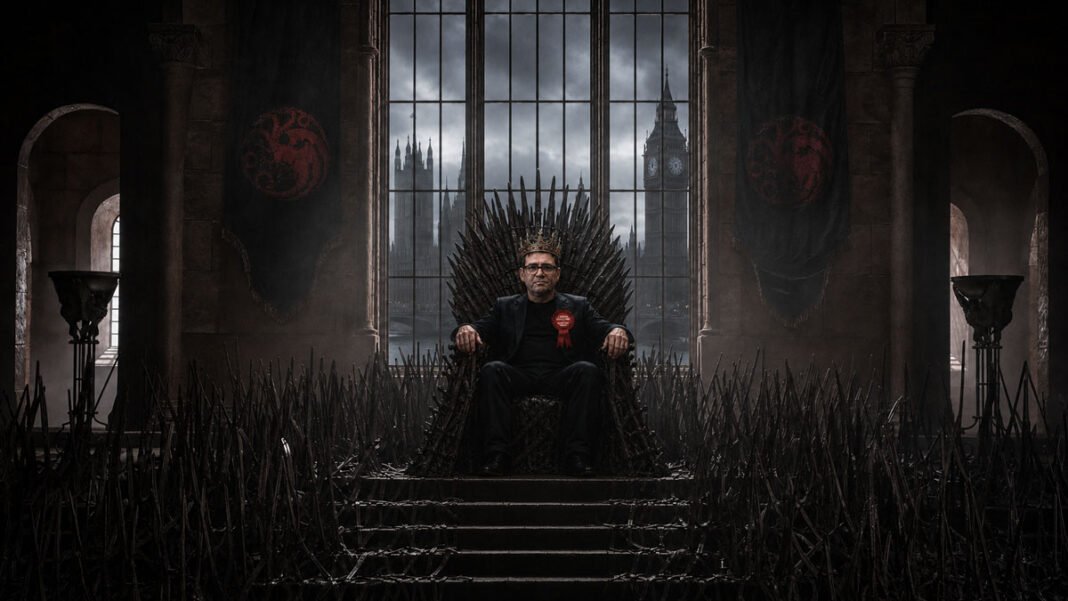
The King Is Dead. Long Live the King.
Andy Burnham is about to be handed the country on fewer than 25,000 votes, and a party with a landslide majority could not produce a leader from its own benches to stand against him. Look past the coronation. It is not the illness. It is the X-ray, and the bone beneath is broken.
They will tell you that Keir Starmer chose his moment and walked away with his head high. He did not. He was pushed, and he was pushed because his own party had become a thing the country could no longer bear to look at.
The wound had a name, and the name was Mandelson. Starmer chose him, called the appointment a stroke of genius, and sent him to Washington as ambassador. The vetting that should have come first came second, and when the security service raised the alarm, officials reached for a rare power to wave the appointment through, because the prime minister had already announced it. Then the emails surfaced. Peter Mandelson had stayed close to Jeffrey Epstein long after the conviction that should have ended every such friendship, and had sent him supportive messages. He was sacked. He has since been arrested on suspicion of misconduct in public office over documents passed to that same man. He has not been charged, and the courts have not ruled. But the political damage was done the moment the public understood what kind of company the leadership kept.

This was not the accident of one bad hire. Starmer himself spent years inside the Trilateral Commission, the off-the-record networking club of bankers, spies and transnational managers that treats mass democracy as a problem to be managed. He was one of only two sitting British MPs ever known to belong. He was not the only notable name on its rolls. By his own account in the Justice Department files now public, Jeffrey Epstein sat in the same Commission, a club that handed its card to a future Labour prime minister and a convicted child trafficker alike. We mapped the whole network when the files dropped. None of it makes Starmer a criminal.
All of it tells you the world he chose to live in, and the company that world keeps. The Mandelson affair did not reveal a new Labour. It confirmed the oldest suspicion we hold about it: that the people at the top of this party live in a world that has nothing to do with the people they were elected to serve.
The Mandelson affair did not reveal a new Labour. It confirmed the old suspicion.
So the mob came for a sacrifice. The parliamentary party that had cheered him into Downing Street turned and demanded a body. And here is the uncomfortable truth: in this one instance, the mob was right. The party was toxic, and the local elections had said so in numbers no amount of spin could soften. Someone had to go. Starmer went.
Now let me be clear about what does not trouble me, because it is where most of the commentary goes wrong. I am not scandalised that we do not elect our prime ministers. We never have. You vote for a party, and for a name on a ballot in your own town; you have never once put a cross beside a prime minister. Gordon Brown took the keys this way. So did John Major. That is the system, and on the whole it is the system as it should be.

My concern is sharper, and it is this. A party that won a landslide cannot find, anywhere on its own benches, a single person fit to lead it. It had to send outside Parliament for a rescuer. It had to persuade a sitting MP to resign a safe seat so that Andy Burnham could win a by-election and walk in through the side door, the first time a seat has been manufactured for an outsider this way since Leyton in 1965. And on the strength of that single contest, fewer than 25,000 votes in one corner of Greater Manchester, he is to be handed 68 million people. New crown, same head. Even Andrew Neil, no friend of ours, looked at the Burnham programme and found no policies in it.
That is the perversity. Not that he is unelected. That his party, with a supermajority, is so hollow it had to import him.
And the supermajority was never what it looked like. Labour did not win in 2024 so much as inherit the wreckage. 411 seats on 33.7 per cent of the vote, the lowest share any governing party has ever taken into office. That is not a movement. That is a vacancy, opened by a Conservative collapse and flattered by a voting system that turns a third of the vote into two thirds of the seats. Nobody marched for this government. They simply declined to march for the last one.
Labour did not win in 2024 so much as inherit the wreckage.

So let us stop pretending this is a Labour problem, or a Burnham problem, and name it for what it is. The rot runs through the whole machine. Corruption is not the property of one party; it moves freely between all of them. The vision is gone. The basic grasp of how an economy works, of how a country feeds and houses and warms itself, has gone with it.
What replaced it is a kind of managerial vanity. We have outsourced our industry, globalised our economy, and shrunk the entire national project down to a place in a table. Westminster frets over Britain’s standing in the G7 as though we were a football club scrapping to stay out of the relegation zone. And the cruel joke is that even top of the table would change nothing for ordinary people, because the levers that matter were given away long ago.
We govern on licence now. Licensed by the orthodoxy of the IMF, by the level playing field we were promised would set us free, by fiscal rules welded shut, by market forces, by the daily duty of keeping the bond markets soothed. The politician who swears he will transform your life has already agreed, in every room that counts, to touch none of the things that could.
Which leaves one question, the only one worth putting to any of them. Westminster has forgotten who it governs, and who it governs for. So ask the next leader, and the one after that, the question they are never made to answer: who do you serve?

Ask them the question they are never made to answer: who do you serve?
And do not imagine the other side is the answer. Before anyone offers Reform as the insurgency, look at who they are. All eight of their MPs have worn a Conservative rosette at one time or another. Four of them crossed the floor only in the last year. The great revolt against the establishment is staffed by the establishment’s cast-offs: recycled Tories in a new colour, selling the same managed decline. The choice on offer is a coronation on one side and a relaunch on the other. Neither asked you. Neither intends to.
This is what system failure looks like in its last stage, before the thing shakes itself apart. Not a coup, not a crisis you can photograph, but a machine driven long past its tolerance: a governing party that cannot govern, an opposition recycled from the people who governed before, a political class fluent in everything except the lives of the people it rules. Listen to it. The gears are grinding now, metal on metal, the whole apparatus juddering on its mountings. Change the face at the top as often as you like. You are not repairing the engine. You are standing beside it when it goes.
Because it is failing of the thing it has always lacked: care, vision, democracy, and any real understanding of who it was built to serve. A machine that has forgotten its purpose does not coast to a gentle halt. It runs hot, then hotter, and then it comes apart.
The king is dead. Long live the king. And the machine that’s shaking itself to pieces…
Enjoyed this read? I’m committed to keeping this space 100% ad-free so you can enjoy a clean, focused reading experience. Crafting these articles takes a significant amount of research and heart. If you found this helpful, please consider a “small donation” to help keep the lights on and the content flowing. Every bit of support makes a huge difference.