ON THIS DAY IN HISTORY…
Paris 1889: The Second International’s Founding Principle
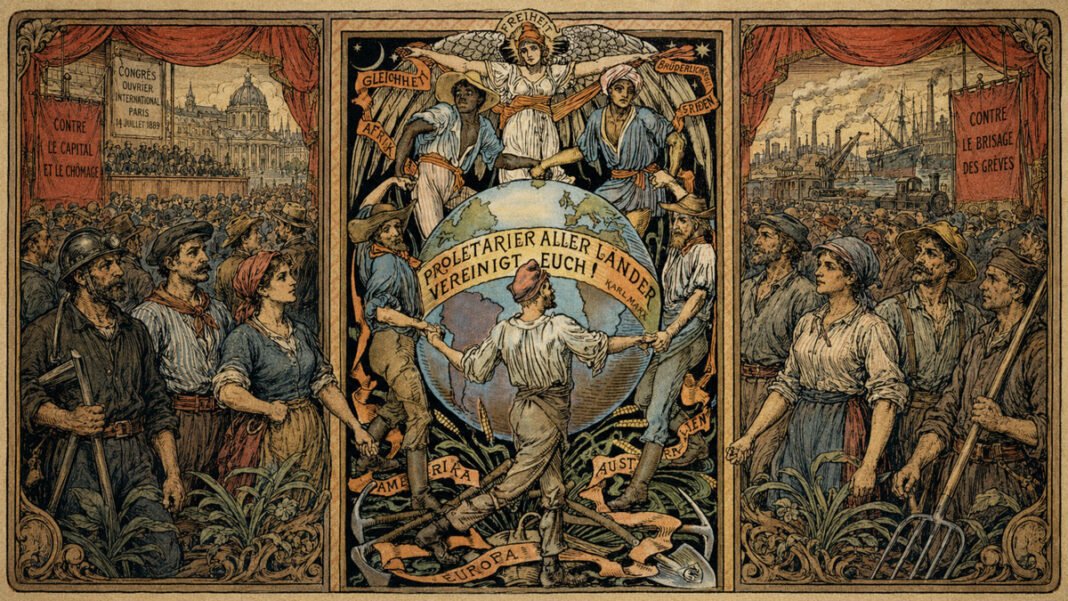
On 14 July 1889, socialist delegates from across the world gathered in Paris to form the Second International. Their principle was simple: “The worker’s struggle has no borders.” because capital crossed them too.
Modern liberals have spent decades twisting that principle into an argument for the unrestricted movement of cheap labour. They are wrong.
Ask them what internationalism means today and you will hear about open borders, labour mobility and the free movement of people as an unquestionable good. What you will rarely hear is the word that mattered most to the socialists who met in Paris: capital.
Nearly 400 delegates from around 20 countries attended the founding congress. They did not meet to abolish nations. They met to stop capital using nations, and the workers within them, as weapons against one another.
That distinction has been buried. The left has paid dearly for it.
Modern internationalism asks workers to celebrate a system in which corporations move money, factories and labour wherever wages are lowest. When that movement drives down pay and weakens unions, we are told the resulting competition is solidarity.
It is nothing of the sort. It is capital’s oldest trick, wrapped in the language of the people who first organised against it.
A German coal miner and a French textile worker in 1889 were not enemies. They spoke different languages and lived under different flags, but they breathed the same dust, worked the same brutal hours and watched the same class of owner grow rich from their exhaustion.
Internationalism meant refusing to let that owner turn them against each other.
When workers struck in one country, workers elsewhere were not supposed to fill the gap, move the scab goods or help break the picket line. When governments prepared for war, workers were urged not to slaughter one another for the profits of kings, bankers and industrialists.
The Paris congress did more than issue fine words. It demanded international action for the eight-hour day and fixed 1 May 1890 as a common day of workers’ demonstrations.
Every May Day march since carries the remains of that decision. It began as a demand aimed at employers, not at the worker standing beside you.

The movement’s position on migration was also far more serious than anything offered in British politics today.
In fact, when the International met in Stuttgart in 1907, they explicitly condemned the capitalist “importation of cheap labour” used by the bosses to destroy labour organisations and depress wages. They knew that unregulated migration was a weapon wielded by the employers, not a gift to the working class. link
Its answer was not racial exclusion. Nor was it a blind celebration of labour mobility. Its answer was class politics.
Stop employers trafficking strikebreakers across borders. Outlaw coercive contract labour. Set minimum wages. Cut working hours. Organise migrant workers into trade unions on equal terms.
The target was the boss importing cheap labour to undercut the union rate. The answer was organisation, not a border fence, and certainly not a blind eye.
Of course, liberals find it unsettling when left wingers like Bernie Sanders say the quiet part out loud: open borders is “a right-wing proposal” that right-wing people would love.
Today we are offered a false choice. On one side stands corporate globalism. It hollows out communities, suppresses wages and treats human beings as freight to be moved wherever the balance sheet demands.
On the other stands a cartoon nationalism that blames the worker who arrived yesterday while ignoring the employer who recruited him, underpaid him and used him to weaken everyone else’s bargaining power.
Both sides let capital off the hook. That is no accident.
The old socialists understood this more than a century ago. You can love your country, defend your community and demand democratic control over your economy while recognising that a delivery driver in Chesterfield, a warehouse worker in São Paulo and a nurse in Tokyo are being squeezed by the same corporate machinery.
Solidarity never meant abolishing nations. It meant workers in every nation refusing to be used against workers elsewhere.
Internationalism was never capital’s right to move labour around the world like freight. It was workers standing together against the people who profited from dividing them.
United we stand. Divided, we get robbed one wage packet at a time…
The question, 137 years later, is whether the left still remembers which side it was supposed to be on.
Enjoyed this read? I’m committed to keeping this space 100% ad-free so you can enjoy a clean, focused reading experience. Crafting these articles takes a significant amount of research and heart. If you found this helpful, please consider a “small donation” to help keep the lights on and the content flowing. Every bit of support makes a huge difference.