The BBC’s Original Sin: How Reith Sold Out the Workers in 1926
Guest article: By Daniel Lewis
The BBC did not lose its impartiality. It was born with a government hand on its shoulder.
In May 1926, as millions of workers stood with the miners against wage cuts and longer hours, Britain’s young broadcaster faced its first great political test. It failed it. Not by accident. Not through confusion. But because John Reith and the BBC chose order over truth, government over labour, and establishment stability over working-class struggle.
One minute before midnight on 3 May 1926, the largest strike in British history began. Triggered by a dispute over coal miners’ pay and working hours, it drew millions into strike action, including workers in iron and steel, on the docks, in transport and printing, gas and electricity. But less than nine days after it started, the General Strike was called off, and representatives of the Trades Union Congress visited Downing Street to admit defeat.
Those nine days in May were important for the BBC, which was then in its early years. At the time, the ‘British Broadcasting Company’ was being run as a private commercial institution with John Reith as its General Manager. Because of printing workers being on strike, most national newspapers were shut down, making the BBC’s radio bulletins an important source of information for the public.
Throughout the strike, the BBC displayed an egregious bias in favour of the government and against the strikers. In several of Reith’s statements, he was quite frank about this bias: he was clear that, at the end of the day, the BBC had to be “for the government” and that he would not allow anything to be broadcast “which might have prolonged or sought to justify the Strike”. In his diary, he admitted that the government “know that they can trust us not to be really impartial”.

This lack of impartiality manifested in a number of ways. The BBC regularly gave a direct voice to government ministers and other anti-strike politicians while refusing to do the same for trade unionists, or even for Ramsay MacDonald’s far-from-radical Labour Party. It also spread misinformation, claiming that there was a trend of railway workers going back to work, when in fact 97% stayed out on strike. Strikers learned not to trust what the BBC said after telegramming in corrections which were never broadcast, and for some it earned the name of ‘BFC’ – British Falsehood Company.
Two instances are particularly revealing. On Friday 7 May, the Archbishop of Canterbury, Randall Davidson, wanted to broadcast an appeal calling for the strike to end and for negotiations to continue. The Archbishop was no radical, having condemned the strike several days earlier. But because he called both for the strike to end and for negotiations to continue, rather than insisting the strike end first, the BBC refused to broadcast his appeal. The next day, Prime Minister Stanley Baldwin addressed the nation at Reith’s invitation, speaking from Reith’s own home rather than BBC headquarters. Reith even helped Baldwin with the speech, suggesting what he should and should not say.
One reason for this biased behaviour, and the excuse Reith often gave for it, was the threat of government takeover if the BBC did not toe the line. Some, like then-Chancellor Winston Churchill, were keen to run it as a direct government mouthpiece, and Reith was convinced that the only way this could be avoided was if the government was assured that the BBC was clearly on its side.

But pragmatism was not the only factor. Reith was ideologically on the side of the establishment and against the labour movement. He described himself as having a “distaste for organised labour”, and saw part of the BBC’s job as the preservation of order. Decades later, he wrote that “if there had been broadcasting at the time of the French Revolution, there would have been no French Revolution”, and his reactionary politics even extended to admiration for Mussolini and Hitler.
Reith’s view was that the BBC could best fulfil its role as protector of the establishment if it had a veneer of independence. He successfully avoided Churchill’s desired takeover in part because of the force of his argument that a takeover could lead to the loss of public trust and undermine the BBC’s “pioneer work of three and a half years”, weakening “an influence of almost unlimited potency”. Reith also recalled having told Churchill to his face that “if we put out nothing but government propaganda we should not be doing half the good we were”. In context, the “influence” and “the good” he was talking about clearly meant influencing the public to be against the strike.
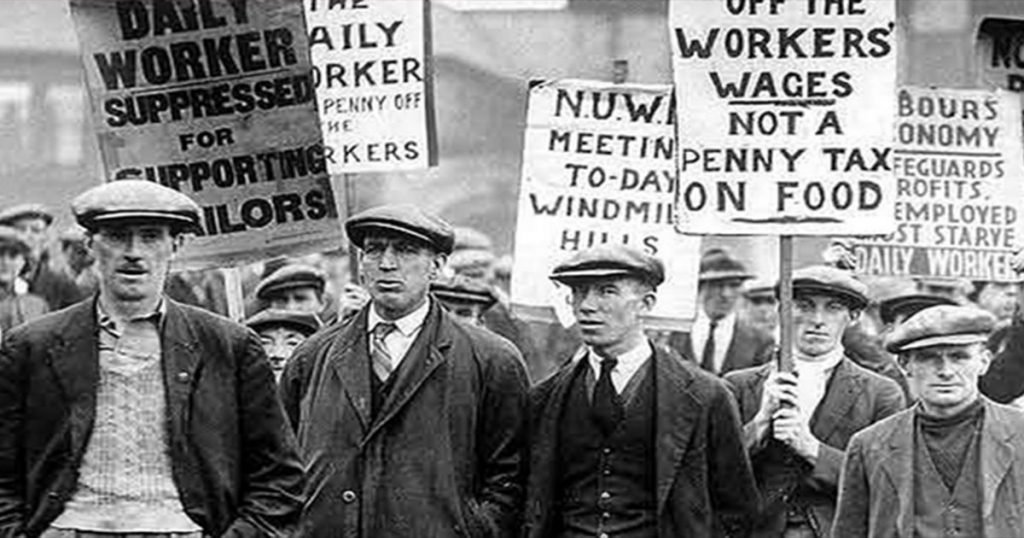
In the aftermath of the strike’s defeat, coal miners were forced to go back to work for longer hours and lower wages than they had previously. All over the country, workers who had gone on strike were victimised, and anti-trade union legislation was enacted in Parliament. For John Reith, however, this period brought considerable rewards. He was repaid for his services to the state with a knighthood, and got his long-held wish for the BBC to become a public institution. It was renamed the British Broadcasting Corporation, with a Royal Charter and Reith as its Director-General.
The lesson is not that every BBC journalist is a liar. That is too crude, and too easy to dismiss. The lesson is more serious. Institutions built to appear independent can still serve power. They do not need daily orders from ministers. They learn the limits. They absorb the assumptions. They know which voices are respectable, which are dangerous, and which can be safely ignored.
One century after the General Strike, leading BBC figures still invoke its ‘Reithian spirit’. But the Corporation has lost much of the public confidence it once enjoyed. Its coverage of Gaza, where Israel stands accused of genocide before the International Court of Justice, has only deepened that distrust. A look at the BBC’s early history should show us that institutional bias should not be a surprise, and that its independence from the state was compromised from the very start.
Guest article: Daniel Lewis is a writer and activist based in London.
Enjoyed this read? I’m committed to keeping this space 100% ad-free so you can enjoy a clean, focused reading experience. Crafting these articles takes a significant amount of research and heart. If you found this helpful, please consider a “small donation” to help keep the lights on and the content flowing. Every bit of support makes a huge difference.
Support Independent Journalism Today
Our unwavering dedication is to provide you with unbiased news, diverse perspectives, and insightful opinions. We're on a mission to ensure that those in positions of power are held accountable for their actions, but we can't do it alone. The Heartlands Tribune is primarily funded by me, Paul Knaggs, and by the generous contributions of readers like you. Your donations keep us going and help us uphold the principles of independent journalism. Join us in our quest for truth, transparency, and accountability – donate today and be a part of our mission!
Like everyone else, we're facing challenges, and we need your help to stay online and continue providing crucial journalism. Every contribution, no matter how small, goes a long way in helping us thrive. By becoming one of our donors, you become a vital part of our mission to uncover the truth and uphold the values of democracy.
While we maintain our independence from political affiliations, we stand united against corruption, injustice, and the erosion of free speech, truth, and democracy. We believe in the power of accurate information in a democracy, and we consider facts non-negotiable.
Your support, no matter the amount, can make a significant impact. Together, we can make a difference and continue our journey toward a more informed and just society.
Thank you for supporting Labour Heartlands