ECONOMY | DEMOCRACY | POWER
The Oldest Racket in the World
How the City of London Corporation operates in plain view, captures our democracy, and answers to no one but itself
Every November, the Lord Mayor of the City of London processes through the streets in a gilded coach, surrounded by a cavalcade of pikemen, soldiers, musicians, and the sort of elaborate pageantry that the British establishment deploys whenever it wishes to render power invisible beneath spectacle. Tourists photograph it. Newspapers cover it. Politicians attend. And almost nobody stops to ask the question that ought to be screaming from every editorial column in the country: what precisely is this institution, who gave it its authority, and in whose name does it exercise that authority over the beating financial heart of one of the world’s great democracies?
The answer is at once ancient and urgently contemporary. The City of London Corporation is not a modern local authority. It is not a quango, a regulator, or a department of state. It is something far older, far stranger, and, in the precise sense Tony Benn intended when he crafted his five essential questions of power, far more dangerous to democratic self-government than almost any institution that visibly carries that name.

It operates in plain view. Its Lord Mayor is photographed shaking hands with prime ministers. Its Remembrancer sits in a gallery of the House of Commons that is denied to every other lobbyist in Britain. Its Aldermen serve on the governing bodies of international banks and transnational policy-making networks. And yet, despite its medieval costume and ceremonial swagger, what the Corporation really represents is something entirely modern: the institutional architecture of a financial class that has perfected the art of exercising power without the inconvenience of democratic accountability.
“Over and over again, we have seen that there is a power in this country, other than that which has its seat at Westminster. The City of London, a convenient term for a collection of financial interests is able to assert itself against the Government of the Country. Those who control money, are able to pursue a policy, at home, and abroad, contrary to that which is decided by the people.” – Clement Attlee, Prime Minister, 1945-1951
Clement Attlee said that. Not a pamphleteer, not a street agitator, not a conspiracy theorist with a blog. The Prime Minister who won the greatest electoral mandate in twentieth-century Labour history understood, from the exercise of actual government power, that Westminster is not sovereign in any meaningful sense while the Square Mile remains ungoverned, unaccountable, and constitutionally entrenched beyond the reach of democratic correction.
To understand how this came to be, you must go back a very long way indeed. But first, a clarification that cuts to the heart of why this institution has remained so obscure for so long: the matter of its name, its title, and the deliberate confusion those generate in the public mind.
PROLOGUE: TWO MAYORS, TWO WORLDS

When most people in Britain hear the words Mayor of London, they think of Sadiq Khan. They are correct to do so. Sadiq Khan is the Mayor of London, directly elected by Londoners through a popular ballot, responsible for the Greater London Authority, for Transport for London, for the Metropolitan Police budget, and for the strategic planning and housing policy of a city of nine million people. He is a product of democratic elections, accountable to the electorate at the ballot box, and his authority derives from the people who voted for him. His office was created by the Greater London Authority Act 1999. It is twenty-six years old.
The Lord Mayor of the City of London is something else entirely. Not Sadiq Khan. Not elected by Londoners. Not responsible for transport, housing, or any of the ordinary functions of urban government. The Lord Mayor of the City of London is the ceremonial and political head of the City of London Corporation, governing the Square Mile alone, selected annually not by popular vote but by the Liverymen of the medieval trade guilds. His authority derives not from the people of London but from the ancient merchant class that has dominated the Square Mile since before Parliament existed.
This distinction matters enormously, and the confusion between the two offices is not accidental. Every major town and city in England and Wales has a Lord Mayor or Mayor: a councillor elected by their peers on the local authority, wearing the chain of office at civic functions, opening fetes, attending remembrance services. A decent person, usually, doing voluntary civic duty. When most British people picture a Lord Mayor, that is what they picture: a local representative doing their bit for the community. The title is so universal, so familiar, so reassuringly ordinary, that it provides the City of London Corporation with an automatic democratic camouflage it has done nothing to deserve and everything to preserve.
The Lord Mayor of the City of London is not that. the title holder does not represent a community of residents in any democratic sense. They conducts trade missions to Beijing, Washington, and Riyadh on behalf of the global financial industry. They addresses the Mansion House dinner, at which the Chancellor of the Exchequer and the Governor of the Bank of England speak each year to an audience of bankers, in language that is always careful to emphasise their shared understanding of what the markets require. The Lord Mayor chairs the Court of Aldermen, the upper house of a governing assembly to which no ordinary citizen elected them and from which no ordinary citizen can remove them. The Lord Mayor has held this kind of office since 1189, when the first Lord Mayor, Henry Fitz Eylwin, was appointed in perpetuity by royal grant. Eight centuries of unbroken continuity. Not one popular election in any democratic sense.

The Mayor of London’s office is a twenty-six-year-old creation of statute, subject to revision by Parliament. The Lord Mayor of the City of London is a nine-hundred-year-old constitutional fixture, immune from dissolution under the terms of an Act of Parliament passed before the concept of popular democracy existed in Britain. They share a title in the same way that a parish councillor and a Supreme Court judge share the description public official: technically accurate, practically meaningless as a statement of equivalence.
The confusion is useful. A financial class that has held power for nine centuries without a democratic mandate needs the public to look at its gilded processions and think: that is our mayor. It is not. It was never meant to be.
Keep that distinction clear in everything that follows. When this article refers to the Lord Mayor, it means the head of the Corporation of the City of London, selected by medieval guilds, serving a financial constituency of global banks. When it refers to the Mayor of London, it means the elected representative of nine million people. They live in different constitutional worlds, and the fact that they share a title is one of the more instructive sleights of hand in British public life.
I. THE INHERITANCE NOBODY VOTED FOR

In the winter of 1066, William the Conqueror stood at the gates of London and made a calculation that would shape British political life for the next thousand years. He had just conquered England at Hastings. He had the military power to seize the city outright. But London was wealthy, its merchant class entrenched, its trade networks already spanning the known world. So instead of conquest, William negotiated. In 1067 he issued a charter, brief and direct as a blade, confirming to the citizens of London all the laws and customs they had enjoyed under Edward the Confessor. He asked only for their loyalty and their taxes. They gave him both, and kept everything else.
That charter did not create the City of London Corporation. It confirmed it. The lawyers have a word for this: prescription. The Corporation’s authority is assumed by the courts to have existed from time immemorial, beyond the reach of any founding document, beyond the power of any monarch or parliament to trace its precise origin. It simply was, and therefore it is. Even before William’s ink was dry, Chapter 9 of Magna Carta in 1215 sealed the arrangement into constitutional stone: the City of London shall have all its ancient liberties and free customs.

This is not merely historical curiosity. It is the foundation of a claim that no other institution in Britain, not the monarchy, not the established church, not the courts, can precisely match: the claim that its authority predates, and therefore exists independently of, the democratic state. Parliament did not create it. Parliament cannot easily destroy it. And on the one occasion that a Stuart king tried to break it, the attempt ended in constitutional catastrophe for the Crown.
In 1682, Charles II moved against the City with a legal weapon called a writ of quo warranto, demanding that the Corporation prove its right to exercise its ancient liberties. The courts, bending as they always do under royal pressure, ruled against the City. Its charter was forfeited. The Corporation was dissolved. London was reduced, in law, to the status of a minor village governed by a royal commission. The King appointed the Lord Mayor, the Sheriffs, the Recorder. The merchant class found itself, for the first time in centuries, actually ruled rather than merely taxed.

It did not last. By 1688, with William of Orange’s invasion fleet on the horizon, James II restored the City’s liberties in a last desperate bid for loyalty. And two years later, the Parliament of 1690 went further still, passing an Act that reversed the King’s Bench judgment and declared that the charter of the City of London could never again be forfeited, for any cause or misdemeanour whatsoever. Not for fraud. Not for criminal conduct. Not for any conceivable abuse of its accumulated power. The 1690 Act made the City of London Corporation effectively immortal under English law.
The working class of England, of course, received no such constitutional protection in 1690. But the merchants of the Square Mile did.
II. THE ARCHITECTURE OF UNACCOUNTABLE POWER

The Corporation’s governing structure is, to a modern eye, genuinely extraordinary. It is not run by a single elected body accountable to the general public. It is run by two interlocking courts: the Court of Common Council, consisting of 100 Common Councilmen elected by ward, and the Court of Aldermen, consisting of 25 Aldermen elected for life from the City’s 25 wards. The Lord Mayor is selected annually not by any popular vote but by the Liverymen, the hereditary membership of the City’s medieval trade guilds, many of which date to the fourteenth century.
But the electorate that produces this government is the most remarkable feature of all. The City’s voting system is not simply restricted. It is, uniquely in British political life, structured to give corporations a vote. Businesses operating within the Square Mile are entitled to appoint corporate electors in proportion to their workforce. A firm employing fifty people gets a handful of votes. A global investment bank employing thousands can appoint dozens of corporate voters. The result is that the overwhelming majority of the City’s electorate consists not of residents but of international banks, multinational corporations, and professional partnerships.
This is not incidental to the Corporation’s character. It is its character. The Corporation exists, as its own internal policy documents confirm, to serve the interests of the financial services industry. Its international lobbying, its diplomatic hospitality, its funding of think tanks and policy networks, all draw on a private fund called City’s Cash, built over centuries from property rents and commercial investments, that is entirely exempt from standard local government audit requirements. Public money is audited. City’s Cash is not.
The officers who manage this empire of quiet influence have their own remarkable constitutional particularity. The Chamberlain, the Corporation’s chief financial officer and treasurer, holds a position that has existed in unbroken succession since 1237. Once elected, the Chamberlain cannot be removed from office unless, in the Corporation’s own words, some great cause of complaint appear. The precise definition of great cause has never been tested.
The Corporation can alter its own constitution through an Act of Common Council. No other administrative body in Britain possesses this power. Parliament can restructure every local authority in England with a single stroke of legislation. The City of London can restructure itself.
III. THE MAN AT THE BAR: THE CITY REMEMBRANCER

Of all the Corporation’s peculiarities, none is more constitutionally arresting than the office of the City Remembrancer. Established on 6 February 1571, the Remembrancer is, in plain language, the City’s permanent, resident lobbyist inside the Palace of Westminster. The holder of the office is typically a barrister. The role is to monitor all public legislation, scrutinise the drafting of Bills that might affect the Square Mile’s interests, and submit formal representations to parliamentary select committees on matters ranging from banking regulation to trade competitiveness to green finance.
The Remembrancer does not sit on the floor of the House of Commons. Defenders of the arrangement are at pains to note this. He sits in the under-gallery, adjacent to the chamber’s entrance, near the chair of the Serjeant at Arms. He has no vote. He cannot speak in debate. His access is granted by permission of the Speaker. All of this is presented as evidence of the office’s modest, administrative character.
But consider what it actually means. Every other lobbying organisation in Britain, every trade association, every campaign group, every commercial interest seeking to shape legislation, is confined to the lobby in the most literal sense. They cannot pass the bar of the House. They must wait in corridors and hospitality suites and hope that their hired consultants can secure ten minutes of a backbencher’s time. The City of London Corporation has a permanently accredited officer who sits inside the chamber, observing every debate, reporting back to the Square Mile on every measure that might conceivably affect its clients.
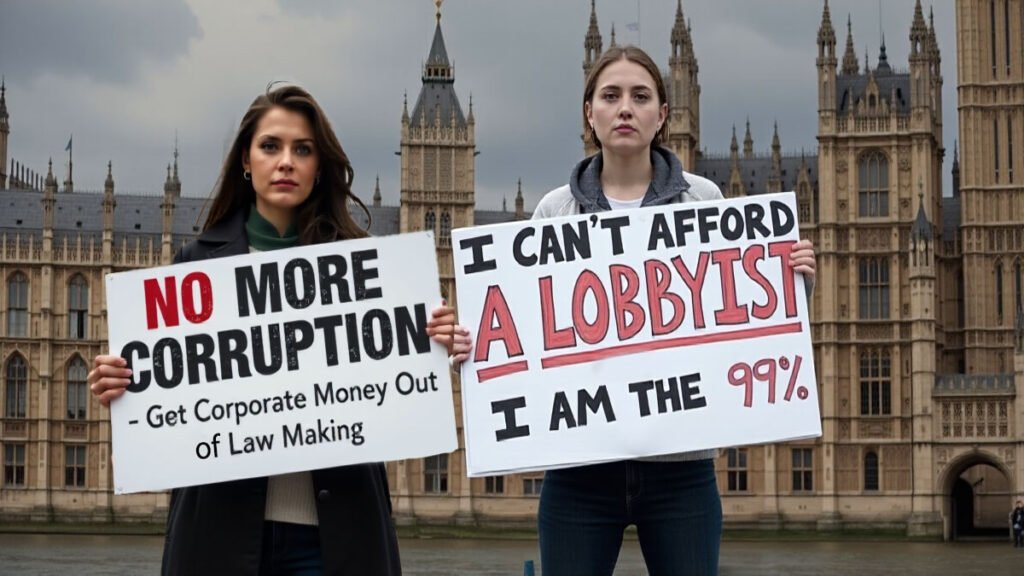
That officer has, since 1685, attended Parliament daily. He is present in the offices of ministers. He monitors the Secretaries of State. He has access to the legislative process at a level of intimacy that no campaign for a higher minimum wage, no trade union seeking to shape employment law, no community organisation fighting a planning decision, has ever been granted. This is not lobbying. It is something closer to a constitutional claim: the assertion that the financial interests of the Square Mile are entitled, as a matter of ancient right, to be present wherever laws are made.
The Corporation’s defenders will say, correctly, that Parliament remains sovereign, that the Remembrancer has no formal power to block legislation, that the relationship is governed by soft power rather than constitutional veto. All of that is true. It is also rather like saying that a man who has dinner every week with the judges who will hear his case has no formal advantage in court.
III(B). THE GHOST IN THE MACHINE: THE KING’S REMEMBRANCER

There is a second Remembrancer. Almost nobody outside the legal establishment knows of his existence, and yet he completes the constitutional picture with a precision that no reformer has ever managed to disturb. The King’s Remembrancer is the oldest continuous judicial office in England and Wales. Created in 1154 by Henry II as the chief official of the Exchequer Court, his original duty was to put the Lord Treasurer and the Barons of Court in remembrance of matters to be called upon for the benefit of the Crown, the primary business being to keep records of taxes, paid and unpaid. The first holder of the office was Richard of Ilchester, a senior servant of the Crown and later Bishop of Winchester. The post now resides with the Senior Master of the King’s Bench Division of the High Court.
He and the City Remembrancer are distinct officers serving distinct masters. The City Remembrancer serves the Corporation, lobbying Parliament from within its walls. The King’s Remembrancer serves the Crown, administering ancient financial and judicial obligations. They are not the same man, do not share an office, and are not, in any formal sense, coordinated. And yet between them they define a constitutional arrangement that has no room in it for the democratic public at all.

Consider what the King’s Remembrancer actually does in relation to the City of London. Each year, he presides over the Quit Rents ceremony at the Royal Courts of Justice, reconstituting the ancient Exchequer Court for the purpose. At this ceremony, the City of London Corporation pays rent to the Crown for two pieces of land, in kind rather than in coin. For a parcel of land near Bridgnorth in Shropshire, leased since at least 1211, the City presents two knives, one blunt and one sharp. The blunt knife is tested by bending a hazel rod over it. The sharp knife splits the same rod clean through.

The King’s Remembrancer examines each, and pronounces: Good service. For a forge near what is now the Royal Courts of Justice, leased since 1235, the City presents six horseshoes and sixty-one nails. The King’s Remembrancer counts them and pronounces: Good number. The horseshoes, themselves centuries old, are then returned to the Corporation to be presented again the following year.

This ceremony has been performed, without interruption, since the thirteenth century. It predates Magna Carta. It predates Parliament. It is the annual re-enactment of a feudal contract in which the City of London acknowledges the Crown’s sovereignty while retaining its own autonomy, and both parties acknowledge the arrangement through ritual rather than democratic deliberation.
No member of the public elected the King’s Remembrancer. No member of the public elected the Lord Mayor who stands opposite him. The ceremony takes place in the Royal Courts of Justice, not in Parliament. Parliament is not party to this transaction.

But the King’s Remembrancer’s role does not end with horseshoes and knives. On Lord Mayor’s Day, each November, the King’s Remembrancer formally presents the newly elected Lord Mayor of the City of London to the Lord Chief Justice, the Master of the Rolls, and the other senior judges of the High Court at the Royal Courts of Justice.
The Lord Mayor swears loyalty to the Crown. The judiciary witnesses the oath. Parliament witnesses nothing. The Lord Mayor’s democratic legitimacy flows not through any popular electoral process but through this ceremony, upward to the Crown, and outward to the judiciary. The King’s Remembrancer is the hinge on which this validation turns.
At Goldsmiths’ Hall, a hall belonging to one of the City’s most ancient Livery Companies, the King’s Remembrancer also oversees the Trial of the Pyx, dating from 1249, in which a jury of twenty-six Goldsmiths, drawn from the Worshipful Company of Goldsmiths, counts, weighs, and assays a sample of freshly minted coins from the Royal Mint. The Crown’s money is tested by the City’s ancient guilds, under the supervision of the Crown’s oldest judicial officer. The circle closes completely.
The City Remembrancer lobbies Parliament from the inside. The King’s Remembrancer validates the Lord Mayor to the judiciary, bypassing Parliament entirely. Between them, they define a constitutional triangle: Crown, City, Parliament. None of its relationships are accountable to the public. It requires no conspiracy. It is a system so old and so interlocked that it operates on institutional memory alone. That is what both Remembrancers are, at their core: institutional memory. Democracy forgets every five years. Remembrancers forget nothing.
The word itself is the key. Both offices are defined by the act of remembering: preserving, across centuries, the claims, the obligations, the arrangements, and the privileges that democratic majorities might otherwise vote to disturb. One remembers for the Crown. One remembers for the Corporation. Neither remembers for the working class. Neither was designed to.
IV. THE GLOBALISTS IN THE COUNTING HOUSE: ALDERMEN AND TRANSNATIONAL NETWORKS
The Court of Aldermen is presented to the public as the upper chamber of a historic local authority. In practice, it is something considerably more interesting. The 25 Aldermen of the City of London are drawn, almost exclusively, from the senior leadership of the global financial industry. They are chairmen, managing partners, and directors of institutions whose business spans continents and whose political connections span governments.
The documented connections between the Corporation’s governing structure and the most powerful transnational policy networks in the world are not speculative. They are a matter of public record. Lord Levene of Portsoken served as Alderman for the Ward of Portsoken while simultaneously serving as a member of the Executive Committee of the Trilateral Commission. The Trilateral Commission, founded in July 1973 by David Rockefeller and Zbigniew Brzezinski, exists to coordinate economic and political policy between North America, Western Europe, and the Asia-Pacific region, that is to say, between the three great poles of global capital. Its membership is not elected. It is self-selecting, drawing from the senior ranks of finance, multinational business, and political life.
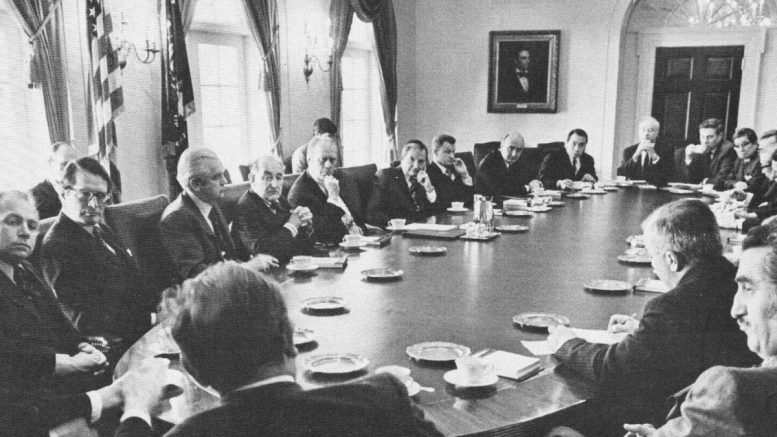
Lord Levene’s dual role is not unique. Dame Vivian Hunt, described regularly as one of the most influential figures in the City of London and a member of the Mayor of London’s Business Advisory Board, has also held membership of the Trilateral Commission. Lord Green of Hurstpierpoint served simultaneously as Group Chairman of HSBC, one of the largest banks headquartered in the Square Mile, and as a member of the Commission. General Lord Guthrie served on the board of N M Rothschild and Sons in London while holding Commission membership.
These are not coincidences. They are the working pattern of a class that has long understood that real power operates through informal networks rather than formal constitutions. The Trilateral Commission does not pass laws. It shapes the intellectual climate in which laws are passed. Its papers inform the assumptions of finance ministers. Its members become the advisers, the central bank governors, the international trade negotiators who determine the rules within which democratic governments must operate. When those members also sit in the governing chambers of the world’s most protected municipal corporation, the circuit of influence becomes very nearly complete.
The question is not whether these individuals are personally corrupt. The question is structural. Power concentrated in unelected bodies, exercised through networks that are invisible to the public, and protected by constitutional arrangements that predate democracy itself: this is the definition of the problem, not the exception to it.
V. THE SPIDER’S WEB: BRITAIN’S HIDDEN FINANCIAL EMPIRE
The City of London Corporation’s domestic power is remarkable enough. But to understand its full significance, you must follow the money offshore, through what the documentary filmmaker Michael Oswald rightly called Britain’s Second Empire.
The story begins in the wreckage of empire. After Suez in 1956, after the dissolution of the sterling zone, after the slow humiliation of decolonisation, British financial elites faced an existential question. The empire that had given the City its global authority was gone. The dollar had replaced the pound as the world’s reserve currency. What remained?
What remained was expertise, networks, and an instinct for regulatory arbitrage that centuries of imperial administration had refined to something approaching genius. In the late 1950s, facing restrictions on overseas lending imposed to protect the pound’s value, the City’s banks hit upon a solution. They would create a market in dollars, physically conducted in London but declared, by a wink and a nod with the Bank of England, to exist in a legal elsewhere. The transactions were between non-residents, in a foreign currency: therefore, the Bank reasoned, they fell outside its regulatory jurisdiction. This was the birth of the Eurodollar market, and it was, as the economist John Christensen has observed, an act of regulatory fiction that transformed the world.
By 1980, the Eurodollar market had reached 500 billion dollars. By 1988, it stood at 4.8 trillion. By 1997, nearly ninety per cent of all international loans were made through it. The British Empire had lost its territories, but its financial infrastructure had found a second life more lucrative than the first.
Simultaneously, accountants and lawyers from the City’s most distinguished firms were arriving in the Cayman Islands, in Jersey, in Bermuda, in the British Virgin Islands, in the remnant archipelago of formal empire that Britain still technically governed. They drafted secrecy laws. They established trust frameworks, the peculiarly British instrument of offshore opacity: a mechanism by which assets can be legally separated from their owner, hidden from taxation, invisible to regulators, and recycled back into global markets as if they had appeared from nowhere. There is no public registry of trusts. There is no reporting obligation. They are, in the economist’s precise formulation, invisible arrangements.
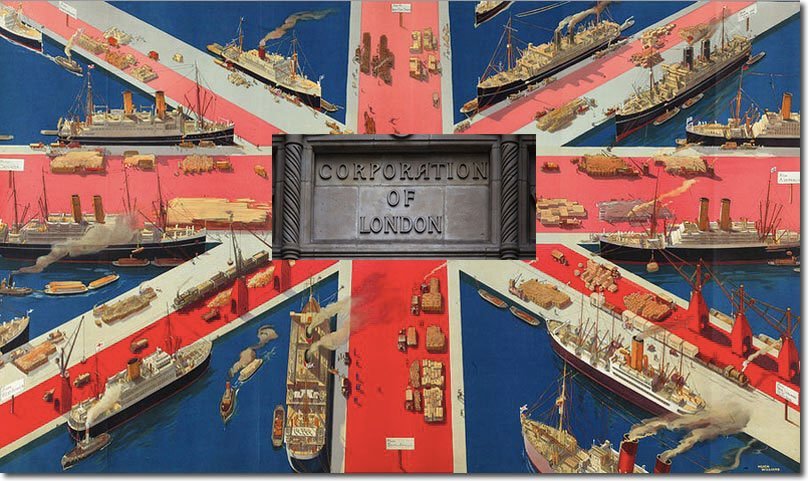
The Bank of England noted in a secret report dated 11 April 1969 that it needed to ensure these offshore developments did not get out of hand. It did not close them down. It watched them grow. By the time the Panama Papers were published in 2016, nine of the world’s ten largest offshore law firms were registered in British overseas jurisdictions.
The City of London likes to maintain a theatrical distance from this offshore infrastructure. Deals are discussed in London and registered in the Caymans. If a scandal breaks, the City can point to the island’s technical autonomy and shrug. The game, as the tax justice campaigner John Christensen described it with characteristic directness, is to get involved in dirty business and then, when the scandal hits, say: that is not us, that is tax haven activity. It is an incredibly convenient relationship.

It is convenient, too, in its domestic effect. The vast inflow of hot money into London, from drug dealing, tax evasion, criminal enterprise, and every shade of grey-area financial activity, has supported the value of sterling. It has made London property among the most expensive on earth. It has driven deindustrialisation, because British banks, unlike their German or Japanese counterparts, have never seen manufacturing as worth financing when financial speculation offers higher returns. The working-class communities that Labour Heartlands was established to serve have paid, and continue to pay, the price of this bargain in closed factories, hollowed high streets, and public services stripped to the bone by governments that are told, calmly but firmly, that the markets will not permit anything better.
VI. TONY BENN’S FIVE QUESTIONS

Tony Benn once said that in the course of his political life he had developed five questions that he put to the powerful. They are, he observed, the most basic questions a citizen can ask, and the answers reveal everything. Let us put them, with appropriate gravity, to the City of London Corporation.
1. “What power have you got?”
The Corporation possesses a combination of public authority and private financial power that is unique in the constitutional architecture of the United Kingdom. It operates as a local authority with its own independent police force, the City of London Police, whose jurisdiction is sovereign within the Square Mile. It controls planning, environmental health, and the maintenance of some of London’s most significant public spaces. Through its private fund, City’s Cash, it finances international lobbying, diplomatic hospitality, and a network of political relationships that extends to the boardrooms of the Trilateral Commission and the corridors of the International Monetary Fund.
Most significantly, it retains the unique power to alter its own constitution through an Act of Common Council, a power possessed by no other body in Britain. Parliament itself requires primary legislation to alter the constitutional framework of any institution. The City of London Corporation can alter its own framework on a vote of its elected members. It has also, since 1690, been constitutionally immune from dissolution. The Crown cannot abolish it. The executive cannot restructure it. Even Parliament would require primary legislation of extraordinary political will to touch it.
2. “Where did you get it from?”
Three sources, each more remarkable than the last. First, prescription: the legal doctrine that its authority is assumed by courts to have existed from time immemorial, confirmed in the charter of 1067 and protected by Magna Carta. Second, a specific Act of Parliament, the 1690 Quo Warranto reversal, that explicitly placed the Corporation’s charter beyond the power of any subsequent Crown action. Third, the steady accumulation, across eight centuries of uninterrupted operation, of property, investment, commercial relationships, and political access that no democratic challenger has ever been permitted to dislodge.
The most accurate short answer, however, is this: it got its power from a deal struck between William the Conqueror and the merchants of London when English democracy did not exist, and it has never been required to renegotiate that deal on democratic terms.
3. “In whose interests do you exercise it?”
Here the Corporation’s own governance structure provides the answer, with the bluntness of a legal document. Its electorate is dominated by corporate appointees. Its policies are directed primarily toward supporting the global financial services industry. Its City’s Cash fund finances lobbying operations in Brussels, Washington, and Westminster on behalf of the Square Mile’s commercial interests. Its Remembrancer monitors parliamentary legislation to ensure that no measure harmful to finance capital passes without the Corporation’s formal scrutiny and representation.
The small residential population of the Square Mile, somewhere between nine and ten thousand people, has a vote. The global banks that occupy the City’s towers have a larger one, administered through a system of corporate appointment that would be instantly recognisable to a fourteenth-century guild master and entirely unrecognisable to any modern conception of democracy.
4. “To whom are you accountable?”
To the Court of Common Council, which is accountable to the ward electorate, which is dominated by corporate appointees. To the Court of Aldermen, who are elected for life by the same electorate. To Common Hall, the assembly of Liverymen who select the Lord Mayor from candidates approved by the Aldermen. For its private wealth, City’s Cash, to no external auditor and no parliamentary committee. For its offshore influence, to no body whatsoever, because the offshore jurisdictions are technically autonomous, technically independent, and technically beyond the reach of formal accountability.
The circuit is closed. The Corporation is accountable, in the final analysis, to itself.
5. “How can we get rid of you?”
This is where the constitutional genius of the arrangement reveals itself most clearly. The 1690 Act of Parliament stated, in terms that have never been repealed, that the charter of the City of London Corporation shall never again be forfeited to the Crown for any cause or misdemeanour whatsoever. Unlike any other local authority in England, the Corporation cannot be dissolved by executive order or ministerial directive. It cannot be restructured by administrative decision. It cannot even be abolished through the ordinary operation of the Local Government Acts.
To be rid of it, Parliament would need to pass primary legislation of specific intent, overriding nine centuries of accumulated constitutional protection, against the active lobbying of an institution with centuries of practice in the art of institutional self-preservation, commanding financial resources that dwarf the lobbying budgets of any countervailing democratic interest, and enjoying the deep personal and professional sympathy of the governing class in both major parties.
In practical terms, the answer to Tony Benn’s fifth question is: you cannot. Not without a political will that no government elected within the existing financial system has shown any sign of mustering.
VII. DEMOCRACY’S PERMANENT EXCEPTION

The standard defence of the City of London Corporation runs something like this. It brings investment to Britain. It generates tax revenues, creates employment, supports the arts and civic infrastructure of the capital. Its constitutional peculiarities are harmless archaisms, the charming furniture of an ancient institution that does its job efficiently and should not be sacrificed on the altar of democratic tidiness.
There is a grain of truth in this. The City does generate economic activity. The Lord Mayor’s Show is, by most accounts, excellent theatre. And it is perfectly true that the Remembrancer does not cast a vote in Parliament, that the Trilateral Commission membership of individual Aldermen does not constitute a formal conspiracy, and that the offshore secrecy jurisdictions technically have their own courts and their own governors and their own laws.
But this is precisely the kind of defence that Orwell, in his essay on the English language, warned us to identify and reject: the defence that works by accumulating accurate details while concealing the dishonest conclusion toward which they are arranged. The question is not whether individual features of the Corporation’s operation are defensible in isolation. The question is what the whole structure, taken together, means for democratic self-government.
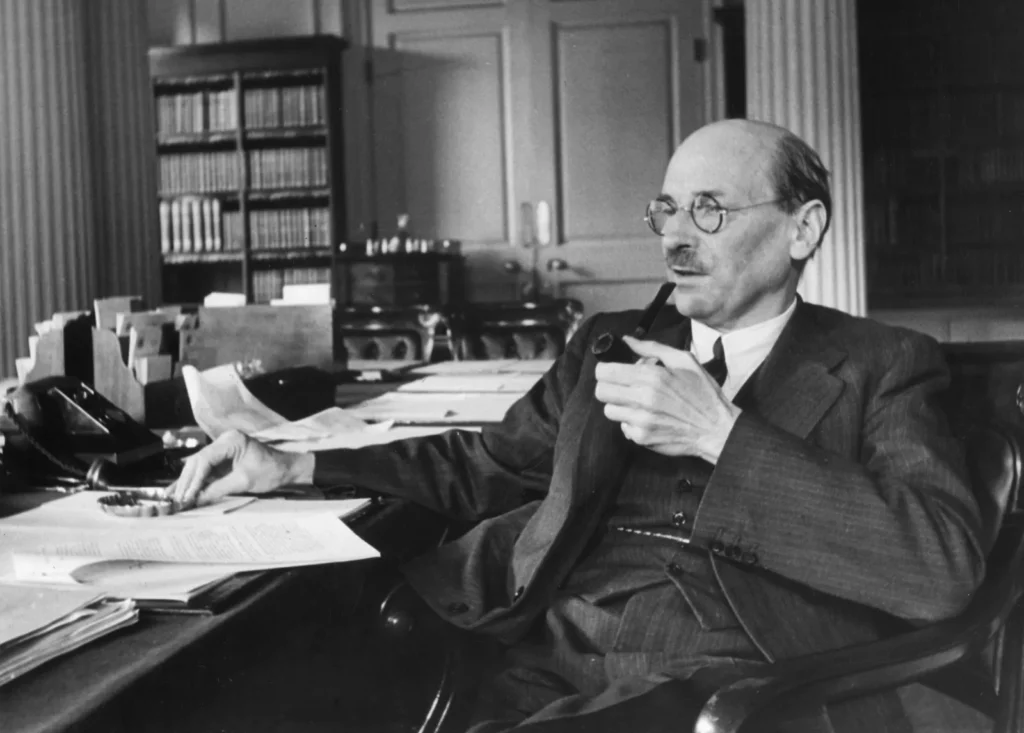
Clement Attlee’s warning, quoted at the opening of this article, was issued in the 1930s, when the City’s power was if anything less globally integrated than it is today. He was right then. The decades since have proved him more right than he could have imagined. The Eurodollar market, the offshore secrecy jurisdictions, the trust structures sheltering fifty trillion dollars of global wealth from any public accountability, the Remembrancer in the parliamentary gallery, the Alderman on the Trilateral Commission executive: these are not separate curiosities. They are components of a single, coherent system.
That system has a name. Nicholas Shaxson, in his indispensable book Treasure Islands, called it the spider’s web. The web has its centre in the Square Mile. Its threads run to Jersey, to the Caymans, to Bermuda, to the British Virgin Islands, to Singapore and Hong Kong and Dubai. Its silk is made of trust law and regulatory arbitrage and the very particular kind of British establishment understanding that does not need to be written down, because everybody who matters already knows how it works.
The web was built to serve the financial class that survived the collapse of formal empire by transforming itself from administrators of territory into administrators of capital. It was built while working-class Britain was being told, decade after decade, that there was no money for adequate wages, no money for decent housing, no money for industrial investment, no money for public services. The money was there. It was simply somewhere else, in the legal fiction of an offshore elsewhere, managed from the Square Mile, protected by a Corporation older than Parliament itself.
When a government that is elected by the people cannot tax the wealth that flows through the Square Mile, cannot regulate the offshore structures that channel that wealth, and cannot even reform the institution that exists to prevent it from trying: you do not have a democracy. You have the appearance of one.
VIII. WHAT IS TO BE DONE
The working class has no City Remembrancer. It has no permanent, accredited presence in the House of Commons charged with monitoring every piece of legislation for effects on its wages, its housing, its health, its future. It has no private fund, built up from eight centuries of rent and investment, to finance its lobbying and its hospitality and its diplomatic relationships. It has no charter confirmed by Magna Carta, no Act of Parliament placing its constitutional rights beyond the power of future governments to remove. What it has is the vote, and the periodic, agonising discovery that the vote alone is insufficient to dislodge power that is not located in Parliament.
That is not an argument for despair. It is an argument for clarity. And clarity begins with naming the thing.
The City of London Corporation is not a charming eccentricity. It is the institutional heart of a system designed to ensure that capital retains its privileges regardless of how democratic majorities vote. Its reform is a democratic necessity, not an ideological preference. What that reform looks like is a legitimate subject for democratic debate. Abolition, radical restructuring, the extension of full standard local government accountability to the Square Mile, the bringing of City’s Cash within the scope of public audit, the removal of the corporate vote, the abolition of the Remembrancer’s parliamentary access: all of these are available options, and none of them requires revolutionary upheaval. They require only a government with the courage to act.

The difficulty is that governments are formed from the same political class that attends the Lord Mayor’s Banquet, accepts the hospitality of the Corporation’s livery halls, and draws on the networks that radiate from the Square Mile outward across the globe. Keir Starmer attended the Lord Mayor’s Banquet within months of taking office. His Chancellor, Rachel Reeves, has spoken of her desire to work in partnership with the City. The Corporation’s Remembrancer will have noted both occasions with professional satisfaction.
Tony Benn used to say that the most radical act in politics is to ask a simple question. He spent his political life asking them. We should honour his method, if we cannot yet honour his conclusions, by asking the plainest question the Corporation’s existence poses.
A corporation that predates democracy, that cannot be abolished, that is governed by the votes of multinational banks, that stations its own lobbyist inside Parliament, and that manages an offshore financial empire that bleeds developing nations and hollows working-class communities: by what warrant does it continue to exercise its authority?
William the Conqueror gave it that warrant in 1067. The people of Britain have never been asked to confirm it. They should be…
The Square Mile has had nine hundred years of privilege without accountability. The question is not whether that arrangement is ancient. The question is whether it is just the question is who does it serve?
As Tony Benn said nearly 35 years ago, every homeless person in London is a victim of market forces. This investigation shows exactly how those market forces are organised, who wields them, and how they have entrenched themselves behind an 900-year-old legal shield. The Spider’s Web can be broken, but first, it must be seen.
Enjoyed this read? I’m committed to keeping this space 100% ad-free so you can enjoy a clean, focused reading experience. Crafting these articles takes a significant amount of research and heart. If you found this helpful, please consider a “small donation” to help keep the lights on and the content flowing. Every bit of support makes a huge difference.

Sources and Further Reading
City of London Corporation constitutional history and officer structure: Corporation of London academic briefs and the London Quo Warranto Judgment Reversed Act 1689 (2 Will. & Mar. c. 8). LINK
The Spider’s Web: Britain’s Second Empire (documentary, dir. Michael Oswald, 2017). Transcript research conducted for Labour Heartlands.
Nicholas Shaxson, Treasure Islands (2011); Tax Justice Network, Financial Secrecy Index.
Clement Attlee, quoted in The Spider’s Web documentary and in multiple published accounts of his speeches on the City’s constitutional position.
Trilateral Commission membership records, parliamentary registers of interests: Lord Levene of Portsoken, Dame Vivian Hunt, Lord Green of Hurstpierpoint, General Lord Guthrie. LINK
Labour Heartlands archive: ‘Autumn Budget: We Have All Become Victims of Market Forces’ (2022); ‘The Spider’s Web: Britain’s Second Empire’ (2020). LINK
Support Independent Journalism Today
Our unwavering dedication is to provide you with unbiased news, diverse perspectives, and insightful opinions. We're on a mission to ensure that those in positions of power are held accountable for their actions, but we can't do it alone. The Heartlands Tribune is primarily funded by me, Paul Knaggs, and by the generous contributions of readers like you. Your donations keep us going and help us uphold the principles of independent journalism. Join us in our quest for truth, transparency, and accountability – donate today and be a part of our mission!
Like everyone else, we're facing challenges, and we need your help to stay online and continue providing crucial journalism. Every contribution, no matter how small, goes a long way in helping us thrive. By becoming one of our donors, you become a vital part of our mission to uncover the truth and uphold the values of democracy.
While we maintain our independence from political affiliations, we stand united against corruption, injustice, and the erosion of free speech, truth, and democracy. We believe in the power of accurate information in a democracy, and we consider facts non-negotiable.
Your support, no matter the amount, can make a significant impact. Together, we can make a difference and continue our journey toward a more informed and just society.
Thank you for supporting Labour Heartlands