Who Was Then the Gentleman? Six Centuries On, Still No Answer
On 15 July 1381, the English state hanged, drew and quartered a priest for preaching that no man is born a lord. Six hundred and forty-five years later, his question has still not been answered. It has only been managed.
The Day They Killed a Question
Why is it that whenever the working class demands a fair return for their sweat, the ruling elite reacts not with economic logic but with the raw, penal violence of the state?
It is a question that has echoed down the centuries, and one that feels painfully intimate today. Walking through the quiet streets of St Albans, where the modern commuter rushes for a train to the City, it is easy to forget that the ground beneath our feet was once soaked in the blood of radicals. Six hundred and forty-five years ago today, on 15 July 1381, a priest named John Ball was led to his death in this town. In the presence of the teenage King Richard II, he was hanged, cut down while still alive, disembowelled and quartered. His four body parts were sent to different corners of the kingdom as a warning to anyone else who dared question the established order.
His crime was not murder or theft. His crime was a question that cut straight to the bone of medieval England’s class system: “When Adam delved and Eve span, who was then the gentleman?”
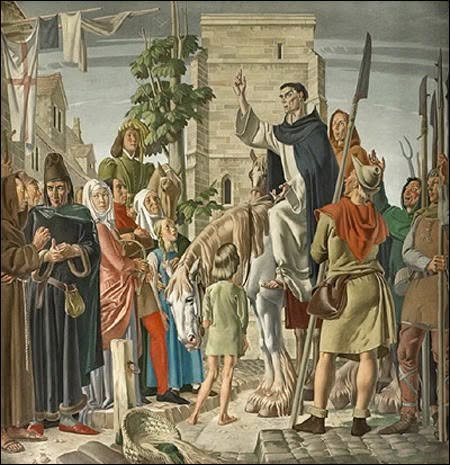
This was not a grievance about wages dressed up as theology. It was theology weaponised against the entire architecture of feudal law. Villeinage, tithe and the manor court all rested on one unspoken premise: that hierarchy was written into creation itself, that some men were born to kneel and others to be knelt to. Ball’s sermon did not ask for better terms within that order. It denied the order had ever existed outside the imagination of the men who benefited from it. If Adam and Eve, the whole of the human race at its origin, worked the earth with their own hands and answered to no lord, then every title, every claim of blood, every manor roll binding a man to land he did not own, was a human invention with no more sanction than the last landowner who wrote it down. “From the beginning,” Ball preached, “all men by nature were created alike, and our bondage or servitude came in by the unjust oppression of naughty men.” That is why the punishment fitted no ordinary theft or riot. Hanging, drawing and quartering was reserved in English law for treason, the gravest offence a subject could commit against the crown. The state did not execute John Ball for stirring up a mob. It executed him for treason against the idea of gentle birth itself, and it needed the full theatre of the scaffold to say so.
The Economics of Suppression: Why Labour Was Criminalised

To understand why that sermon terrified the crown, you have to understand what English workers had just survived, and who stood beside Ball when he preached it.
The Black Death of 1348 killed something like a third to a half of the population. For those left, catastrophe carried a bitter gift: labour was suddenly scarce, and scarce labour commands a price. Ploughmen, reapers and spinners could, for the first time in living memory, name their terms. The response of the landowning class was not to pay. It was to legislate. The Statute of Labourers of 1351 froze wages at pre-plague levels and made it a criminal offence to demand more, or to refuse work at the old rate. When scarcity favoured the lord, that was the natural order. When scarcity favoured the labourer, that was a crime requiring the stocks.
Then came the poll taxes: three in four years, each more brazen than the last. The 1381 levy charged every subject over the age of fifteen a flat fourpence, ploughman and earl alike. In late May, a royal commissioner named John Bampton arrived at Brentwood in Essex to squeeze villages that had already paid once. The men of Fobbing, led by a local called Thomas Baker, threw him out. Word spread within days across Essex and into Kent.
So began the Peasants’ Revolt… The rising found its general in Wat Tyler, chosen to lead the Kentish rebels in early June. He marched them through Maidstone, where they broke open the Archbishop of Canterbury’s gaol and freed Ball, already a marked man after years in and out of prison for preaching this exact sermon. Alongside Tyler and Ball stood Jack Straw, remembered as a co-leader of the rising though historians still argue over how distinct a figure he was, and men and women whose roles chroniclers barely troubled to record: Abel Ker, who led the Kentish men out of their own county, and Johanna Ferrour, a woman named in court records as commanding one of the parties that later stormed London. This was not a faceless mob. It was an organised rising with named leaders and a set of demands any trade unionist would recognise: fair pay, an end to bonded labour, and the sacking of the ministers who had robbed them.
Thirteen Days That Shook the Kingdom

By 12 June the rebels stood at Blackheath, and it was here that Ball delivered the sermon history remembers. The next day they crossed London Bridge, very likely waved through by sympathetic Londoners with grievances of their own against the city’s merchant oligarchy. What followed was not a random rampage. The rebels burned the Savoy Palace, home of the king’s uncle John of Gaunt, whom they blamed above all others for the tax and the war it funded. They broke into the Temple and destroyed the legal records and writs that bound men to their manors. They opened the Marshalsea, Fleet and Newgate prisons. They killed as many as 140 Flemish merchants, a grim reminder that a rising against one injustice does not automatically purify itself of others. And they besieged the Tower of London.
The next day, 14 June, the fourteen-year-old King Richard rode out to Mile End and, faced with a crowd he could not defeat, granted the rebels almost everything: an end to serfdom, free trade, fair rents. While he was making those promises, rebels inside the city dragged Archbishop Simon Sudbury, the Chancellor, and Robert Hales, the Treasurer, the two men most identified with the tax, out of the Tower and beheaded them on Tower Hill.

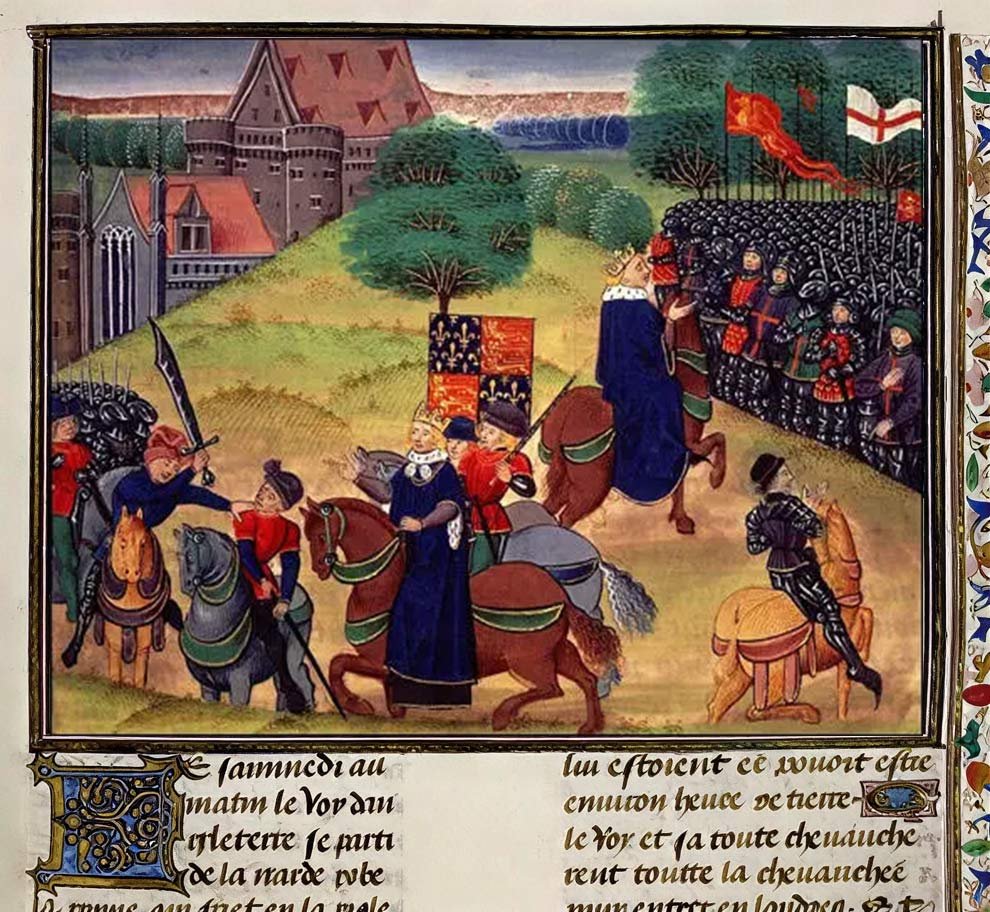
It should have been over. It was not. On 15 June the king met Tyler again, this time at Smithfield, to settle what remained. An argument broke out. William Walworth, the Lord Mayor of London, drew a blade and cut Tyler down in front of the king he had come to petition. Royal soldiers finished the job. Richard, showing a nerve remarkable in a boy of fourteen, rode toward the stunned rebels and declared himself their new captain, buying Walworth just enough time to raise a militia and disperse them. It was the first killing of a named rebel leader by the state in this rising. It would not be the last, and the second would carry the king’s own signature just as surely.
Promises Made, Promises Revoked: The Pattern of Power
Within days the charters were exposed as worthless. On 23 June, Richard formally revoked everything promised at Mile End, on the legal fiction that a promise extracted under duress carries no force in law, a doctrine that has been quietly useful to the powerful ever since. The Chief Justice was sent into Essex to reassert the old order by force. In East Anglia, Bishop Henry Despenser, a warrior prelate more comfortable with a sword than a psalter, crushed the rising rebels at North Walsham in the last days of June. Executions followed across the country. Estimates vary, but by the autumn something in the order of 1,500 rebels had been hanged, a toll that dwarfs anything the rebels themselves inflicted in their weeks of fury.
John Ball ran. For a month he stayed ahead of the men sent to find him. He was finally taken on 13 July, tried for treason the following day, and on 15 July, exactly one month to the day after Wat Tyler bled out at Smithfield, he was hanged, drawn and quartered at St Albans in front of the king whose charters he had helped force from the throne. The state had taken its time. It had not forgotten.
The chronicler Thomas Walsingham puts a phrase in Richard’s mouth after the revolt that deserves to be carved above every Treasury door: “Villeins ye are, and villeins ye shall remain.” Concede under pressure. Wait. Revoke. Punish. It is the same pattern that met the Tolpuddle labourers, transported in 1834 for the crime of swearing an oath to one another. The same pattern that met the miners in 1984. The same instinct that, within our own memory, produced legislation to make effective strikes unlawful in the very services whose workers we clapped from our doorsteps. The tools soften over the centuries, from the gallows to the statute book to the injunction, but the reflex is identical: the labour of the many is a cost to be suppressed, and the demand for its fair price is a disorder to be policed.
Even the poll tax came back. Six hundred years after 1381, a Conservative government reached into the fourteenth century for the same flat charge on rich and poor alike, and got the same answer in Trafalgar Square that Richard’s ministers got at Blackheath.
The case for the crown, fairly stated

Honesty demands the other side be heard. Defenders of the crown do not need to invent atrocities; the rebels supplied plenty of their own. You can point to the Savoy in flames, to Sudbury and Hales dragged from the Tower and beheaded without trial, to the Flemish dead in the street for the crime of being foreign, and mount a serious case that a government facing armed insurrection in its own capital had no real choice but to restore order by whatever means came to hand. Ball, whatever the beauty of his preaching, had helped raise that storm.

from Jean Froissart, Chronicles (c. 1470)
Grant all of it. The crowd’s violence lasted days and its victims can be counted. The statute’s violence lasted centuries and its victims cannot. The Statute of Labourers, the revoked charters, the centuries of villeinage enforced by manor court and gibbet: this was violence too, slow and legal and total, and it fell on people whose only offence was wanting the value of their own hands. A state that answers the second kind of violence with sermons on patience, and the first kind with disembowelling, has told you exactly whose peace it keeps.
The Question That Refuses to Die

Here is the detail the executioners never grasped. Serfdom died anyway, not because a king kept his word, he never did, but because the market the lords had tried to freeze in 1351 proved impossible to hold forever. Within a century, labourers who had watched Tyler bleed at Smithfield and Ball’s quarters carried to the corners of the kingdom were simply not there to be bound; they had walked to better terms elsewhere, manor by manor, because there was no longer enough of them left to refuse.
That leaves an uncomfortable question about who actually won. Gaunt’s palace burned to the ground, yet Gaunt himself remained the most powerful man in England for a decade afterwards. The wage controls first imposed in 1351 stayed on the statute book, reinforced more than once, for generations after Ball’s death. The names of the rank and file who marched, Abel Ker’s men, Johanna Ferrour’s company, the villagers of Fobbing who started it all, survive mostly as entries in the rolls of those hanged for it. The men who benefited from the old order kept their titles, their manors and, for the most part, their lives. The people it fell on paid for that word in a currency the state was always happy to collect: sons, husbands, and the last of their faith in a royal promise.
That is the inheritance of 15 July, and it belongs to every underpaid carer, every striking nurse, every warehouse picker timed to the second by an algorithm their wages could never buy. The gentleman of 1381 has become the shareholder, the non-dom, the consultant on a day rate that would have ransomed a baron. The question has not changed because the answer has not changed.
They cut John Ball into four pieces and sent him to the corners of the kingdom. All they achieved was to make sure his question reached every one of them.
Enjoyed this read? I’m committed to keeping this space 100% ad-free so you can enjoy a clean, focused reading experience. Crafting these articles takes a significant amount of research and heart. If you found this helpful, please consider a “small donation” to help keep the lights on and the content flowing. Every bit of support makes a huge difference.