How Do You Stop a Child Without Checking Every Adult?
Ask yourself one plain question, and refuse to let go of it. How do you stop a fifteen-year-old girl from opening Instagram without first establishing the age of the forty-five-year-old man just about to log in? You cannot. There is no machine that quietly checks the child and waves the adult through unseen. To know that one user is too young, the system must interrogate every user. Which means it must interrogate you.
This morning, in Downing Street, Sir Keir Starmer announced a full ban on under-16s using the major social media platforms: TikTok, Snapchat, X, Facebook, Instagram, YouTube, Reddit. There will be exemptions for YouTube Kids and Google Classroom, a curfew on 16 and 17-year-olds after half past eight at night, and new action to stop strangers contacting children on gaming and livestreaming services. Legislation by the end of the year; the gate itself closing in the spring of 2027. The Prime Minister, who not long ago thought such a ban impractical, now says he will not compromise on:
“the safety and happiness of our children.”
It is a good sentence. It is meant to be. And it performs a precise piece of work: it moves the argument off the only question that matters. Because the policy does not actually turn on whether children should be on Instagram. It turns on what the rest of us must surrender so that the question can be enforced at all.
The child is the shield. The adult is the target.
BritCard by Stealth: How Child Safety Becomes Surveillance

The Cheese in the Mousetrap
Strip away the press-conference warmth and the mechanism is cold and simple. You cannot bar under-16s from a website without checking the age of everyone who visits it. And you cannot check everyone’s age without making them prove, in some fashion, who they are. “Child safety” is the cheese in the mousetrap. The trap is the verification layer that closes behind every adult who reaches for it.
This is not a forecast. It is a description of something already running. Phase 2 of the Online Safety Act came into force on 25 July last year, requiring services likely to be accessed by children to deploy what Ofcom calls “highly effective age assurance.” The permitted methods are exactly what you would fear: facial scans estimated by AI, photo-ID matching, credit-card checks, verification through your mobile carrier, analysis of your banking data. Within days, age checks were running at more than five million a day, most of them on adults trying to reach perfectly legal content. VPN sign-ups surged by well over a thousand per cent as the public reached, by instinct, for the nearest exit.
The new ban does not invent this architecture. It extends it, and points it at the rest of the internet.
It is a recipe for mass surveillance with a child’s face painted on the front.
What “Highly Effective Age Assurance” Actually Buys You.

Look closely at what you are being asked to hand over, and to whom. Not to the state, which at least answers to a ballot box, however feebly. To private verification vendors, many of them overseas, bound by privacy promises written by their own lawyers.
In October last year, Discord, the platform where a great many British children already gather, suffered a breach through the third-party firm handling its age checks. Attackers held access for some fifty-eight hours and walked off with around 70,000 government identity documents, with some analyses putting the true figure far higher. They demanded a ransom; Discord, to its credit, refused. But here is the part that should make any thinking person stop. Discord’s response to a breach caused by collecting identity documents was to expand age verification to every single user on the platform.
That is the logic of this entire enterprise in miniature. The harm done by demanding your papers is met by demanding them more often.
Those who would give up Essential Liberty, to purchase a little temporary Safety, deserve neither Liberty nor Safety.
Benjamin Franklin
A password, once stolen, can be changed. The cryptographic record of your face cannot. Your passport cannot. The data being amassed in these systems, faces, passports, card details, banking histories, is not a list of who watched what. It is the raw material for identity theft, deep-fake fraud, and forms of crime we are only beginning to name. The government assures us that facial estimation can guess your age without saving the image or knowing your name. Perhaps. But the Australian government’s own landmark study of these technologies, commissioned before its own under-16 ban, found that every method carried serious risks, that some retained far too much data, and that there is no reliable way to stop a determined teenager slipping the net with a VPN.
So the system will be invasive, costly, insecure, and trivially circumvented by the very children it claims to protect. That is not a recipe for child safety. It is a recipe for mass surveillance with a child’s face painted on the front.
The Case for the Prosecution, Fairly Put
It would be dishonest, and it would be weak, to pretend the other side has nothing. They have a great deal, and it deserves to be heard before it is answered.
Ninety per cent of parents backed this ban in a consultation that drew well over a hundred thousand replies. Esther Ghey, whose daughter Brianna was murdered by two teenagers steeped in online cruelty, says the measure could save children’s lives, though she rightly insists it cannot stand alone. The NSPCC, no friend of the tech giants, wants robust checks rigorously enforced. The Home Secretary, Shabana Mahmood, says plainly that this is about stopping the coercion and sextortion of children, not policing anyone’s phone. These are not the words of tyrants. They are the words of people who have looked at what the platforms do to the young and decided that something, anything, is better than the shrug we have offered for a decade.
And Australia, the model Britain is copying, took pains to insist that platforms should not verify every adult, on the grounds that they already hold enough data to identify the children among us.
Here, then, is the pivot, and it rests not on suspicion but on the record. When Britain ran precisely this argument through Phase 2 of the Online Safety Act, the promise to check only the children produced five million checks a day on everyone, and a breach that scattered tens of thousands of real identities into criminal hands. The threat of fines worth a tenth of global revenue does not encourage platforms to verify carefully. It encourages them to verify everyone, and to keep the receipts. The intention may well be narrow. The outcome, every time, is universal. We are not required to impute bad faith. We need only read the meter.
The intention may well be narrow. The outcome, every time, is universal.
The Contradiction Starmer Will Not Answer

If a government genuinely wished to keep phones out of children’s hands, there is a measure to hand that is cheaper, faster, and proven: ban the smartphone in the school. New Zealand has done it, and reports calmer classrooms, more reading, less bullying. It requires no facial scan of a single adult. It costs almost nothing. It is targeted, proportionate, and immediate.
The government has refused to do it. When the Conservatives tried to write a statutory school-phone ban into the Children’s Wellbeing and Schools Bill, Labour MPs voted it down, and the Prime Minister pronounced it “completely unnecessary,” insisting most schools already manage the problem themselves. His own department’s survey suggests otherwise, and a group of parents under the banner Generation Alpha is now seeking judicial review precisely because the guidance, in their account, leaves children exposed every school day.
Hold the two decisions side by side, because the contrast is the whole story. A narrow, cheap, effective intervention aimed squarely at children, in the one building the state already controls: refused. A sprawling, expensive, insecure intervention that requires the verification of the entire adult population: embraced. A government serious about children would reach for the first. A government interested in the architecture reaches for the second.
So we are entitled to ask why. And the answer is not hidden. It is sitting in the recent record, in plain sight.
The future is not set. There is no fate but what we make for ourselves. – sarah connor Terminator
The Architecture of Control

In September last year, Sir Keir announced the BritCard: a digital identity he intended to make mandatory for the right to work. “You will not be able to work in the United Kingdom if you do not have digital ID,” he said, and the country recoiled. A petition passed 2.7 million signatures. Polling that had shown comfortable majority support collapsed into net opposition. Big Brother Watch called it a “domestic mass surveillance infrastructure.” Jeremy Corbyn called it “an affront to our civil liberties.” Nigel Farage said much the same from the other shore. It is a rare and instructive thing when the principled left and the populist right read the same blueprint and arrive, independently, at the same word: no.
The government retreated. By January it had dropped the mandate; by March the consultation had been rewritten to sell digital ID as a voluntary convenience for accessing public services, no obligation, no compulsion, nothing to fear. But notice what was never withdrawn. The plumbing. The GOV.UK One Login, the digital wallet, the whole identity scaffold, continued to be built while the public’s attention was allowed to wander.
And now, five months later, here is a policy that cannot function without an age-and-identity layer, arriving to plug into the very scaffold the public thought it had refused.
This is what the lawyers call function creep: data gathered for one stated purpose, quietly repurposed for another. It is not a conspiracy theory. It is the most ordinary thing in government. You will note that even Palantir, Peter Thiel’s surveillance firm and no shrinking violet, declined the British digital-ID work, warning that fusing the nation’s databases into one identity would vastly enlarge the “surface area of risk.” When Thiel’s people think your data architecture is reckless, the hour is later than you suppose.
Different countries, different pretexts, the same infrastructure. Australia reaches for child safety, Britain for child safety and migration, Brussels for a tidy digital wallet, several American states for pornography, Hanoi and Beijing for the open requirement of identity before you may post at all. The justification is always local and always sympathetic. The destination is everywhere the same: a verified identity standing between you and the open internet, and an internet that has quietly stopped being a public square and become a monitored enclosure, where every account, search, post, payment and message is anchored to a name the state can read.
The New Ministry of Truth

Follow the logic past its first stop and the destination comes into view. Surveillance is the means. A managed information state is the end: a settlement in which news, opinion and public argument reach you only through authorised channels, approved platforms, and the established filters that decide what is fit for you to read. We are already most of the way there. A handful of global corporations now shape what hundreds of millions of people see, hear and believe before breakfast. Bolt a verified identity onto that machine and you do not widen the public’s freedom; you fit it with a turnstile. Participation stops being a right and becomes a privilege, granted on good behaviour and revocable at the gate.
Today it is the social media giants. Tomorrow it is the independent news blogs, the awkward little outlets built precisely to challenge governments, publish alternative views, and ask the questions the obedient press will not touch.
The day after that, it is the influencers, writers, campaigners and citizen-journalists who reach the working-class audiences the legacy media abandoned years ago.
Each one can be labelled a “platform likely to be accessed by children”. Each one can be dragged under the same system, wrapped in the same soft language, and justified by the same unanswerable slogan: your safety.
This anxiety is not new, and the men who first set it down were not shy about naming it. In 1975 the Trilateral Commission published The Crisis of Democracy, and diagnosed the trouble with the West not as too little democracy but as too much. An informed, mobilised, argumentative public was the disease. The cure, the report’s American author conceded, was that a functioning democracy requires “some measure of apathy and noninvolvement on the part of some individuals and groups,” together with a press returned to its proper, deferential place. Half a century later, the apathy can be manufactured at the door. You cannot organise what you cannot reach, and you cannot reach what the gatekeeper declines to pass.
George Orwell drew the same machine and gave it its name. “Who controls the past controls the future,” read the slogan on the wall of his Ministry of Truth, “who controls the present controls the past.” A verified, gated internet is no mere filing cabinet for the past. It is a hand laid on the present, deciding in real time who is permitted to speak and who is permitted to be heard.
Benn’s Five Questions
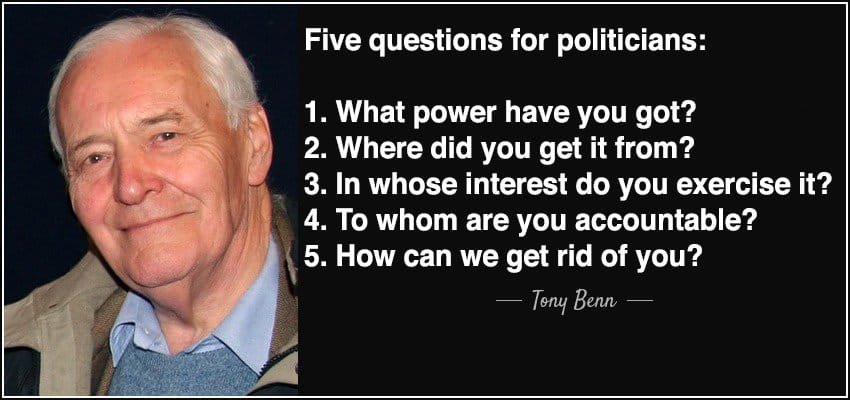
Tony Benn left us a tool for exactly this moment, five questions he said we should put to anyone who holds power over us. What power have you got? Where did you get it from? In whose interests do you use it? To whom are you accountable? And how do we get rid of you?
Put them to the verification system now being built in your name. Its power is to decide whether you may speak, read, and gather online. It took that power under the banner of protecting children, granted by a Parliament the government now seeks new powers to bypass. It serves, in the first instance, the platforms and the vendors who profit from holding your identity, and a state that finds an identifiable citizen so much more convenient than an anonymous one. It answers to almost no one you can name. And you cannot vote it out, because it is not a government. It is a piece of machinery, and machinery does not stand for re-election.
George Orwell understood the shape of this long before the technology caught up with the instinct. “Big Brother is Watching You,” he wrote, and the horror of it was never the watching alone. It was that people came to accept the watching as the price of safety, and then to be grateful for it.
The gate is not yet closed. The legislation has not yet passed. The infrastructure is not yet complete.
But the direction of travel is clear. And if you accept “online safety” laws at face value, you are helping to close the gate behind you.
Once every account, search, post, payment, message and website visit is tied to a verified identity, the internet stops being a public square and becomes a monitored enclosure. And the child who was meant to be protected will grow up into an adult who has never known anything else.
That is not safety. That is surveillance. And it is being sold to you as kindness.
The Ministry of Truth does not arrive shouting censorship. It arrives smiling, with safeguarding legislation. Papers please…
Enjoyed this read? I’m committed to keeping this space 100% ad-free so you can enjoy a clean, focused reading experience. Crafting these articles takes a significant amount of research and heart. If you found this helpful, please consider a “small donation” to help keep the lights on and the content flowing. Every bit of support makes a huge difference.