Why Your Party’s Dual Membership Ban Could Save the Left
Labour Heartlands warned from the beginning that Your Party would be captured if it could not find its own identity. Everything we feared came to pass. And now, in the wreckage of Sunday’s CEC vote and Scotland’s resignations, something unexpected has appeared in the dust: the possibility of the party we always believed this could be.
Labour Heartlands has been covering Your Party since before it had a name. We were there for the Quiet Revolution, when 800,000 people crashed a website to join a movement that did not yet have a manifesto, a structure, or even an agreed leader.
We were there in the beginning, hopeful at seeing the Two Party Stitch-up Shattered for the Elephant in the Room, when we warned that unless Your Party built its own identity it would become someone else’s party entirely. We watched the Stillborn Revolution unfold at Liverpool, when the founding conference descended into precisely the factional warfare we had seen coming from the moment Sultana announced the party ten minutes after Corbyn had expressed his reservations in a meeting chat. We backed “The Many” in February, when others on the left were still insisting that both slates were equivalent, that the real enemy was disunity, that everything would sort itself out if everyone would just be nicer to each other.
We called it, at every stage, with the particular melancholy of people who wanted to be wrong.
We were not wrong. And now, from the rubble of Sunday’s CEC decision and the resignation of Scotland’s entire interim executive on Monday morning, something unexpected has appeared in the dust. Not a death. A threshold.
The Democratic Death Spiral and the Long Walk into Oblivion has Been Halted
THE INFILTRATION WE WARNED ABOUT
When the first Your Party meetings began appearing in community halls across the country, Labour Heartlands told its readers to ask three questions of whoever was running the room: who are you, who do you represent, and what other parties do you belong to?
This was not paranoia. It was pattern recognition. The Socialist Workers Party does not attend new left formations as fellow travellers. It attends them as a property developer attends a planning meeting: with a clear idea of what it intends to build on the land, and the patience to wait while everyone else is still admiring the site.
Unless Your Party was able to form its own identity, it would become someone else’s party. We were not wrong.
What followed was as predictable as it was painful to watch. The SWP and its allied organisations did not arrive waving banners. They arrived with clipboards. They ran the meetings. They shaped the branches. They drafted the motions. And when the founding conference assembled in Liverpool, the agenda that emerged was not the agenda of the 800,000 people who had crashed a website in the summer heat of July to join something they sensed was finally speaking to them.
It was the agenda of the organised few who had been waiting for exactly this kind of unstructured, idealistic new formation to work within.
The result was visible to anyone willing to see it. Zahra Sultana told socially conservative working class, who hold traditional values about family, community, and nation, that there was no place for them.
In the language of platform politics and the careful policing of what a member of the liberal left was permitted to say, think, and believe.
The material left, the left that talks about wages and rents and the price of energy and the closure of the local hospital, was steadily displaced by the performative left, the left that talks primarily about itself.
We watched an 800,000-strong movement shrink to 41,000. We said nothing we had not already said. There was nothing left to say.
THE DECISION THAT CHANGES EVERYTHING
On Sunday, Your Party’s Central Executive Committee voted to ban dual membership for several socialist organisations, including the Socialist Workers Party. On Monday, Scotland’s entire interim executive resigned.
The commentary class has read this as collapse. They are wrong. They are reading the wrong story.
What the CEC did on Sunday was not a death blow. It was a caesarean. The old Your Party, the version captured by liberal-left identity politics and sophisticated entryism before it had drawn its first independent breath, had to be cut away for the living thing inside to survive. The operation was brutal. It came late. It left scars. But it was necessary, and the CEC had the courage to perform it.
The old Your Party had to be cut away for the living thing inside to survive.
Precision matters here, because the commentary around the vote has been characterised by more heat than accuracy. The founding conference voted that members could hold dual membership in other parties where the CEC approved such membership as aligning with Your Party’s values. The CEC’s decision on Sunday was therefore constitutionally correct. They exercised the power the conference itself granted them. The spirit of that founding vote was one of openness; but openness without boundaries is not a political principle. It is an open door, and the SWP knew exactly how to walk through it.
The charge of hypocrisy will come. It deserves an answer. There is a difference between the letter of a democratic decision and its purpose, and there is a higher democratic principle at stake: the right of 800,000 people who joined a party to have that party remain the one they joined, rather than being transformed by incremental capture into something they never signed up for. The CEC protected those 800,000. It is a shame it took nine months and the loss of most of them to get there.
Scotland’s resignations are real, and the management failures they expose are real. A party that cannot coordinate with its own volunteer executives in one of the UK’s most politically fertile territories is not yet ready for government. That problem does not disappear because the ideological crisis has been resolved. Both things are true simultaneously. Sunday’s decision buys Your Party a chance. It is not an absolution.
THE PARTY THE COUNTRY IS WAITING FOR
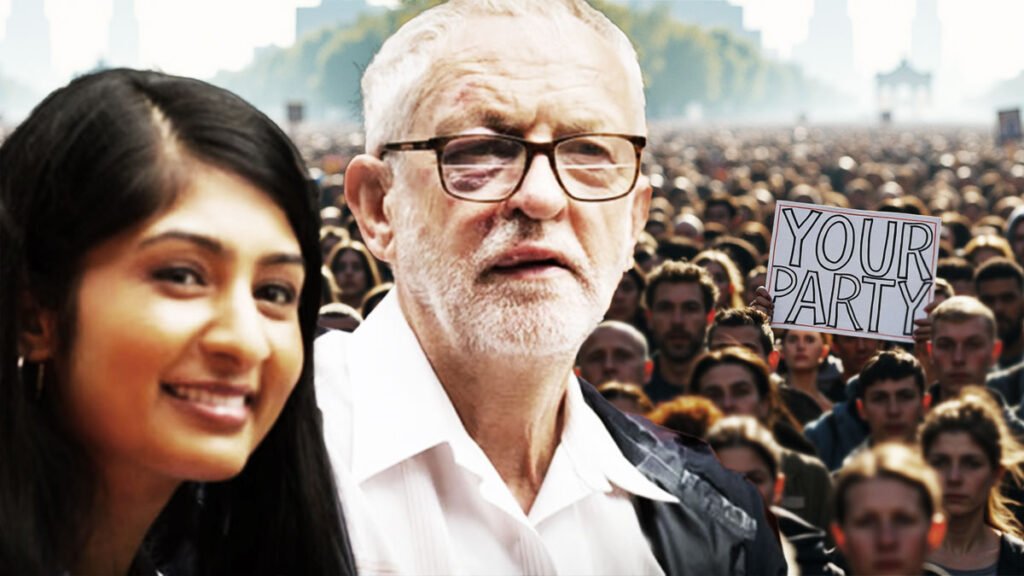
Here is what those 800,000 people actually signed up for, as best we can reconstruct it from their silence and their hope.
They did not sign up for debates about gender recognition at Tuesday night branch meetings. They signed up for a party that would talk to them about the energy bill that had doubled in three years. They did not sign up for the careful policing of ideological purity by organisations with their own competing agendas. They signed up for a party that understood that a former steel town is not failed because its people lacked ambition, but because forty years of political choices stripped it of the industry that gave ambition a destination.
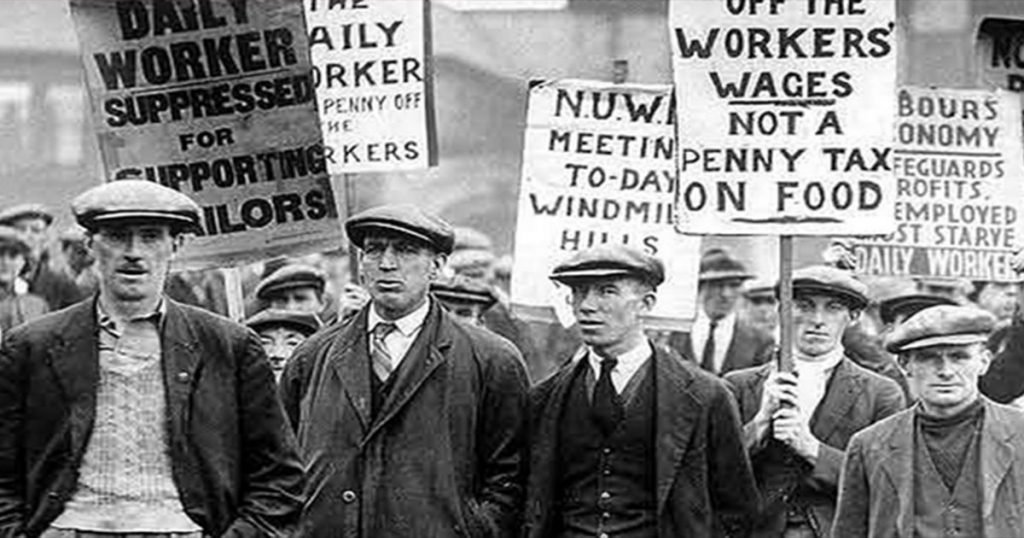
They signed up, in short, for something recognisable to anyone who has read Tony Benn, or stood on a picket line, or watched a factory close and wondered why the government that claimed to represent working class seemed always to be standing on the other side of the gates.
Benn’s Alternative Economic Strategy, developed through the crisis years of the 1970s, was built on a diagnosis that remains unanswerable: the City of London’s dominance of British economic life systematically starves domestic industry of the patient, long-term investment it requires, because finance capital has no interest in productive capacity when speculative returns are easier and quicker. The prescription needs updating for an economy shaped by four further decades of deindustrialisation, financialisation, and technological change. The specific instruments of the 1970s cannot be transplanted wholesale. But the underlying logic is not a museum exhibit. It is a living argument, and its application to the crises of 2026 is not difficult to sketch.
A former steel town is not failed because its people lacked ambition. It is failed because forty years of political choices stripped it of the industry that gave ambition a destination.
Build the things we use in the places we use them. The energy transition is the greatest industrial opportunity Britain has been offered since the post-war reconstruction, and we are squandering it by offshoring the manufacture of every turbine blade, every solar panel, and every battery cell to countries whose labour costs reflect the absence of the rights and standards we have spent a century fighting for. Every component assembled in a British factory is a job, a skills base, a community with a future, and a contribution to the tax base that funds everything else. Every one imported is a subsidy to someone else’s industrial strategy, paid for by workers who are told their communities have no future in the new economy. If we are serious about the planet, we must build the transition here.
Own the strategic industries. Energy, water, rail, the commanding heights of the productive economy: these are not investment opportunities for pension funds registered in jurisdictions that pay no British tax. They are the infrastructure of national life. A country that has privatised its infrastructure has privatised its sovereignty along with it, and sovereignty is not a luxury that working class can afford to be sentimental about.
Work with farmers, not against them. Food sovereignty is not a romantic notion. It is a strategic requirement for any serious state. A country that cannot feed itself is dependent on others for its survival, and that dependence extends into every other domain of national life. Support British agriculture, pay fair prices for what it produces, invest in the stewardship of British land, and break the supermarket duopoly that extracts value from both the farmer and the consumer while contributing nothing to either.
Build a defence industry that serves British security rather than operating as a subscription model for American arms manufacturers. We have the engineering heritage, or what survives of it. We have the national need. The question is whether we have the political will to treat the defence of this country as a public good rather than a procurement contract.
Give people an education and skills system that does not sort children into those who will be served and those who will serve. Germany, which provides cradle-to-career education and vocational training funded as a public good, has produced the most productive workforce in Europe as a direct consequence. Nearly half the German population holds a formal vocational qualification. Germany maintains one of the lowest youth unemployment rates on the continent. Its apprenticeship system, combining structured workplace training with rigorous classroom learning, retains roughly 68 percent of graduates in the firm where they trained. This is not a cultural accident. It is a political choice. Britain could make the same choice. What it has lacked is not the capacity but the will.
Free higher education from the chains of debt that have transformed aspiration into a financial instrument. The student loan system does not invest in human capital. It financialises it. Young people emerge from university owning nothing and owing tens of thousands of pounds for a credential whose value the market determines. That is not a promise of equal opportunity. It is a down payment on lifelong insecurity.
Fund and staff the National Health Service as a public good: not as a quasi-market, not as a performance management system, but as the thing it was built to be, the expression in institutional form of the proposition that no one in this country should suffer or die because they cannot afford not to.
These are not fringe demands. They are majority positions when stripped of the tribal framing the establishment media imposes. They are, in the truest sense of the word, conservative demands: they ask that the institutions and arrangements that made equal life chances genuinely possible in this country be conserved and restored, rather than sold off, outsourced, and managed into profitable decline.
This is the party that 800,000 people wanted. It is the party the country is still waiting for. And for the first time since that July website crash, Your Party has a chance to become it.
SETTING THE CONDITION

That chance is precisely that: a chance. Not a guarantee. Not an absolution for the waste of the past nine months. Not a blank cheque drawn on the hope of people who have already been let down once and will not easily extend their trust a second time.
The CEC must now do something harder than expel the entryists. It must build. It must reach back toward the people who left, not with a press release but with a programme, and not with a programme written for a conference hall but with one that speaks directly to the people standing in the bus shelter at six in the morning, to the people using a food bank for the first time in their lives while working two jobs, to the people who know exactly what they have lost and are waiting for a party that will say it plainly.
It must go to the post-industrial towns and the former mining communities and the coastal cities that Labour abandoned and Reform now courts, and it must speak in the language of class and material interest rather than the language of a university politics seminar.
Labour Heartlands will watch. We will report what we see with the same clarity we have brought to every stage of this story. We will give credit where it is earned. We will say without hesitation when the chance is being wasted.
We have covered Your Party since before it had a name. We have been right about what it was. We intend to be right about what it “can” become.
In the words of the great abolitionist Frederick Douglass, “If there is no struggle, there is no progress.” So let us embrace the struggle, and let us work together to create a world that is just, equitable, and sustainable for all.
Your Party is dead. Long live Your Party.
Enjoyed this read? I’m committed to keeping this space 100% ad-free so you can enjoy a clean, focused reading experience. Crafting these articles takes a significant amount of research and heart. If you found this helpful, please consider a “small donation” to help keep the lights on and the content flowing. Every bit of support makes a huge difference.

Support Independent Journalism Today
Our unwavering dedication is to provide you with unbiased news, diverse perspectives, and insightful opinions. We're on a mission to ensure that those in positions of power are held accountable for their actions, but we can't do it alone. The Heartlands Tribune is primarily funded by me, Paul Knaggs, and by the generous contributions of readers like you. Your donations keep us going and help us uphold the principles of independent journalism. Join us in our quest for truth, transparency, and accountability – donate today and be a part of our mission!
Like everyone else, we're facing challenges, and we need your help to stay online and continue providing crucial journalism. Every contribution, no matter how small, goes a long way in helping us thrive. By becoming one of our donors, you become a vital part of our mission to uncover the truth and uphold the values of democracy.
While we maintain our independence from political affiliations, we stand united against corruption, injustice, and the erosion of free speech, truth, and democracy. We believe in the power of accurate information in a democracy, and we consider facts non-negotiable.
Your support, no matter the amount, can make a significant impact. Together, we can make a difference and continue our journey toward a more informed and just society.
Thank you for supporting Labour Heartlands