One Year Since Supreme Court Ruling: Women Are Still Waiting For The Law To Be Enforced
The Supreme Court ruled. The law is clear. So why have the Government, the unions, and our institutions spent twelve months finding reasons not to obey it?
On the first anniversary of the For Women Scotland Supreme Court ruling, the highest judgment in the land remains unenforced. The government delays. The unions have defected. The institutions carry on as before. This is not a culture war. It is a question of who the law is for.
There is a particular kind of cruelty in winning. You fight for years, through courts and tribunals, through cancellations and threats and the daily indignity of being told that your biological reality is a political opinion. You argue your case before five of the most senior judges in the United Kingdom. You win. Unanimously. And then you discover that winning, in this country, does not mean what you thought it meant.
A year has passed since the Supreme Court delivered its judgment in For Women Scotland v the Scottish Ministers. Five justices, speaking as one, ruled that the terms ‘woman’ and ‘sex’ in the Equality Act 2010 refer to biological sex. Not certificated sex. Not self-declared identity. Biological sex: the material, observable, unchosen fact of what a human being is.
That ruling was never truly in doubt among people who read the plain text of the law. What has been in doubt, and remains in doubt today, is whether those responsible for implementing it have any intention of doing so. The answer, twelve months on, is not encouraging.
THE LONG WAR AGAINST WOMEN’S EXISTENCE

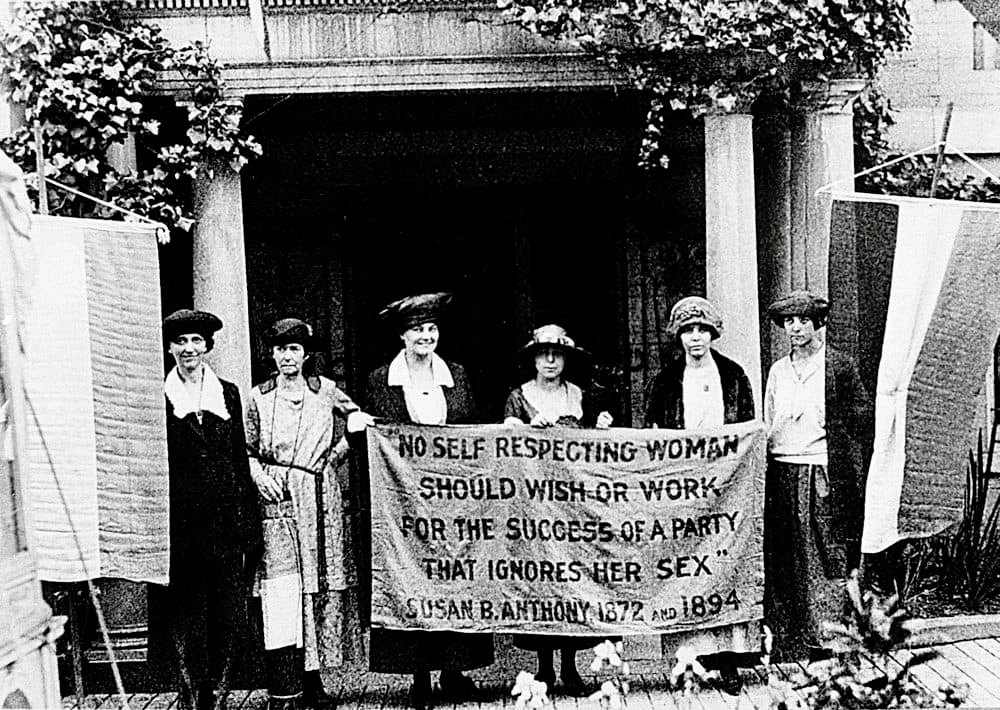
“NO SELF RESPECTING WOMAN SHOULD WISH OR WORK FOR THE SUCCESS OF A PARTY THAT IGNORES HER SEX — SUSAN B. ANTHONY, 1872 and 1894,”
To understand why the resistance to this ruling is so fierce, you have to understand something older than equality law, older than the welfare state, older even than parliamentary democracy. The project of defining women out of existence is not new. It is, in various forms, as old as recorded civilisation.
In the mythology that shaped three of the world’s great religions, Lilith, the first woman in certain Jewish traditions, was expelled from Eden not for disobedience but for insisting on equality: on lying with Adam as his partner rather than his subject. The punishment for that insistence was erasure. She was replaced by a more compliant version of womanhood, and her name became a synonym for danger and transgression. The pattern, once established, has proved remarkably durable.
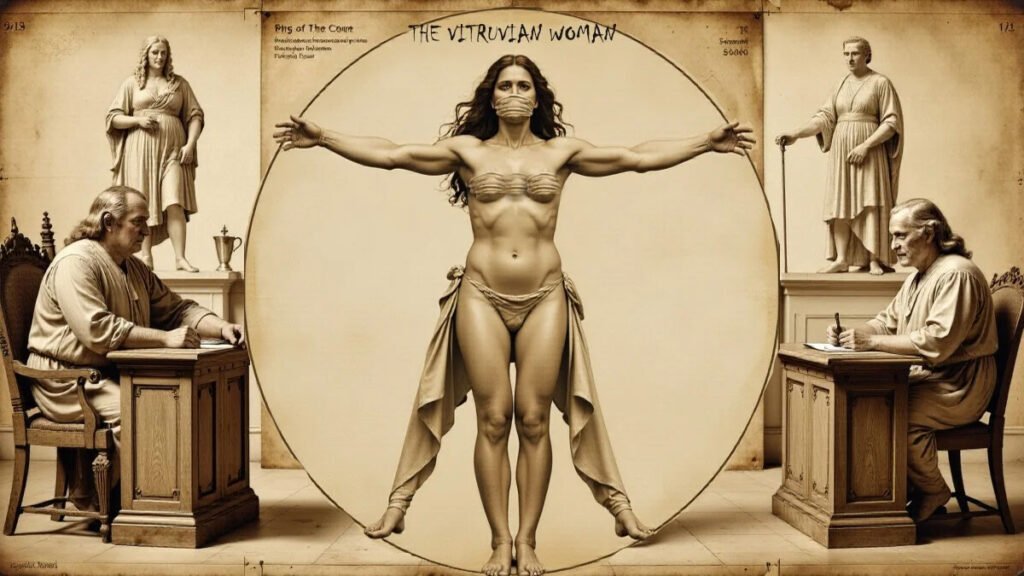
Across medieval Europe, women who possessed knowledge, who healed, who lived independently of male authority, were systematically accused of witchcraft. The witch trials were not primarily about superstition. They were about the suppression of female autonomy, the destruction of female networks, and the reaffirmation that women who stepped outside prescribed limits would be punished for it. An estimated forty to sixty thousand people were executed. The overwhelming majority were women.
The suffragettes were told they were unwomanly. The women who demanded access to education were told they were hysterical. The women who sought control over their own bodies were told they were immoral. In every generation, a new vocabulary of pathology and transgression was deployed against women who asserted that they existed, and that their existence carried rights.
“Woman Adult Human Female”
Now that vocabulary has mutated again. The women who stood before the Supreme Court are not called witches. They are called transphobes, bigots, fascists. They are no-platformed. They are reported to employers. They are hounded online with threats of violence and rape. Their livelihoods are targeted. Their names are placed on blacklists. The technology is modern. The impulse is ancient.
“Women are hounded online, hounded in person, they are no-platformed, they are called bigots and fascists, sometimes for as little as believing that sex is still a site of oppression.”
And what unites every episode in this history is institutional complicity. The witch-finders had the backing of the church and the state. The opponents of suffrage sat in Parliament. The gatekeepers of education who turned women away had the authority of universities behind them. Today, that complicity wears the face of progressive politics. It speaks the language of inclusion and diversity. It has captured the HR departments and the trade unions and the equalities bodies and the NGOs. And it has spent twelve months ensuring that a unanimous Supreme Court ruling gathers dust.
“YOU CANNOT PROTECT WHAT YOU CANNOT DEFINE”
In February 2026, Reem Alsalem, the United Nations Special Rapporteur on violence against women and girls, addressed the Human Rights Council. She expressed concern at the United Kingdom’s failure, nearly one year after the Supreme Court ruling, to translate the judgment into binding guidance or enforce it across public authorities and service providers.
This was, in itself, a remarkable moment. The United Kingdom has long presented itself to the world as a leader in women’s rights. To have a UN official formally expressing concern about this country’s failure to protect those rights, in the same week that government departments and public sector bodies were still operating under guidance that contradicts the law, is a form of international embarrassment that should shame those responsible for it.
But Alsalem had said something even more striking at the Human Rights Council the previous year. She stated that erasing women and women-specific language based on their sex is not only wrong, but demeaning, regressive, and constitutes one of the worst forms of violence that women and girls can experience. She said she had never imagined she would need to write a report simply to establish that women and girls are biological and legal categories defined by sex, and that sex is central to understanding discrimination and violence against them.
She warned that erasing sex-based language weakens protections for motherhood, produces flawed data, undermines services for victims, obscures violence against women, and makes it harder to protect girls. And she closed with a formulation that should be required reading for every minister who has deployed the phrase ‘culture wars’ as a deflection:
“You cannot protect what you cannot define.”
That is not a controversial statement. It is a logical one. It is the argument that For Women Scotland made, in various forms, across seven years of litigation. It is what the Supreme Court affirmed. And it is what the British government, in the person of its Women and Equalities Minister, has spent twelve months declining to act upon.
THE MINISTER WHO WOULD NOT MEET THE WOMEN WHO WON
Bridget Phillipson received the EHRC’s updated Code of Practice in early September 2025. The code, prepared under Baroness Falkner’s leadership, directed businesses and public bodies to ensure that trans women were excluded from female single-sex facilities. It was, in the words of the EHRC itself, both legally accurate and as clear as it was possible to be.
Phillipson did not publish it. She asked for additional information. She asked for an equality impact assessment. She raised concerns about cost to business. She said she needed to proceed ‘thoroughly and carefully’. She changed nothing. Four months after receiving the guidance, in January 2026, she blamed the EHRC for the delay, accusing the watchdog of being slow to provide the information she had requested. The EHRC’s response was crisp: it had provided everything asked of it.
By April 2026, as the first anniversary of the ruling approached, Phillipson had still not published the guidance. The government issued a written ministerial statement saying it had received an updated draft on 13 April and intended to lay it before Parliament in May. Critics noted, with some justification, that May had been the intended publication date for some months, and that the statement arrived days before local elections in the devolved administrations, providing a convenient reason for further postponement.
More telling still: Phillipson’s statement clarified that the existing EHRC code does not apply to workplaces. For the millions of women working in offices, hospitals, schools, and shops across the country, this was not a reassurance. It was an invitation to employers to carry on ignoring the law. There is, as of today, no timeline for an employment-specific code.
For Women Scotland had sought a meeting with Phillipson for weeks before the anniversary. Their request was blocked. Susan Smith, a director of FWS, described this as outrageous, telling the Telegraph that somebody, somewhere did not want to meet them, and that she could not believe they could not get the minister in the same room despite having won the case. Twenty-eight women’s rights organisations wrote jointly to the Prime Minister to demand action.
Baroness Falkner, who spent three years as EHRC chair and faced sustained harassment, including threats against her family, for the simple act of insisting on legal accuracy, was characteristically direct. Phillipson, she said, had erected a hurdle to the application of the law, denying women validation of their rights. The former EHRC chair’s assessment of the delay was equally plain: personal ambition, and a fear of alienating activist MPs in the Labour Party and in the trade unions.
The government’s response to such criticism has been consistent. A Labour source reached for the phrase ‘culture wars’. The accusation that to demand enforcement of the law is to stoke division is not an argument. It is a silencing tactic. It is the contemporary equivalent of telling the suffragettes they were being hysterical.
THE UNIONS’ BETRAYAL

If the government’s failure is a dereliction of duty, the trade union movement’s response to the Supreme Court ruling has been something closer to an act of institutional self-harm.
At the Trades Union Congress in September 2025, delegates voted unanimously for a motion arguing that the EHRC’s interim guidance in response to the ruling was flawed and inconsistent on the inclusion of trans people in public life and workplaces. The motion described the post-ruling period as witnessing a surge of transphobic hate promoted by the far right for political advantage. The unions did not pause to consider whether their female members, many of whom had fought for exactly the legal clarity the ruling provided, might have a different view.
This is not a minor procedural matter. The trade union movement was built to defend workers, and the majority of trade union members are women. The gender pay gap, the pension gap, the disproportionate burden of caring labour, the structural disadvantage that follows women through their working lives: these are not abstractions. They are the lived experience of the women paying their subscriptions. And when those women needed their unions to stand behind a ruling that affirmed their legal rights, the unions voted unanimously in the other direction.
The performing arts union Equity called for solidarity with those affected by the judgment, meaning trans people, without apparent reflection on what it meant for the women who had spent years, in some cases, being hounded out of their professions for gender-critical beliefs. The pattern across the institutional left has been consistent: when the interests of trans rights activism and the rights of biological women have come into conflict, it is women who lose.
This is not a statement about the dignity or humanity of trans people, who retain significant protections under the Equality Act’s gender reassignment provision. It is a statement about institutional priorities. And the priority, in union after union and organisation after organisation, has been ideological conformity over legal compliance and the interests of female members.
THE INSTITUTIONS CARRY ON
The consequences of allowing the Code of Practice to gather dust have not been hypothetical. In the absence of binding guidance, public and private sector institutions have continued to operate under policies that pre-date the ruling or that contradict it. The NHS, the prison service, universities, schools, charities, local government bodies and private sector EDI departments have, in many cases, simply maintained their commitment to trans inclusion regardless of what the Supreme Court said.
The UN Special Rapporteur noted in February 2026 that the earlier 2011 code, now outdated and inconsistent with the ruling, reportedly remained in use. She expressed particular concern that non-compliance extended to government departments. The High Court confirmed in February 2026 that the EHRC’s interim guidance had been legally accurate. That confirmation changed little in practice.
Organisations have used the government’s delay as cover. Awaiting ministerial approval has become a reason to do nothing. The old guidance is still circulating. The policies shaped by years of ideological capture remain in place. Women working in the NHS, in universities, in charities, in local government, find themselves in workplaces whose policies still treat sex as a matter of individual self-declaration, because no one in authority has compelled those workplaces to change.
And meanwhile, the women who raised objections have continued to pay the price. They are disciplined for using protected language. They are excluded from meetings. They are subject to formal complaints for stating biological facts. The ruling has not protected them in practice, because the institutions that employ them have calculated, with considerable accuracy, that they will not be held to account for ignoring it.
THE CLASS THAT IS NEVER MENTIONED

There is a dimension to this that the liberal commentariat consistently avoids, and it is the dimension that Labour Heartlands exists to name. The women most affected by the failure to implement this ruling are not wealthy. They are not well-connected. They are not members of the professional classes who can afford expensive legal advice or who sit on the boards of well-funded advocacy organisations.
They are the nurses who must share changing facilities with male-bodied colleagues. They are the women in prison, the most vulnerable and least powerful women in the country, who have spent years being placed in facilities with male offenders on the basis of self-declaration. They are the domestic violence survivors seeking refuge in genuinely single-sex services. They are the working women in every sector whose HR departments have spent years enforcing a trans-inclusive orthodoxy with all the enthusiasm that it has never applied to closing the pay gap or addressing pension inequality.
Women in the United Kingdom still earn less than men. They still retire with substantially smaller pension pots. They still carry the majority of unpaid caring work. They still face structural disadvantage at every point in their working lives. The unions that represent them have spent this year fighting to water down a Supreme Court ruling that gave them one small, clear, legally confirmed protection, while the pay gap, the pension gap, and the caring gap remain resolutely unaddressed.
The ideological capture of the liberal left on this question is not a minor internal dispute. It is a symptom of what happens when a movement abandons class analysis in favour of identity politics, and when the interests of a small and well-organised group of activists are prioritised over the material interests of half the population. It is, in the end, a betrayal.
There is no progressive politics that throws women under the bus in the name of progress. There is only power, deciding, as it always has, that women can wait.
WHAT COMPLIANCE WOULD ACTUALLY LOOK LIKE
The government’s stated intention to lay the EHRC code before Parliament in May is, if honoured, a necessary first step. But it is only that: a first step. The code’s passage through the forty-day parliamentary scrutiny period, its eventual commencement, the development of a separate employment code with no stated timeline, the withdrawal of all Civil Service guidance that contradicts the ruling: these are not complicated things. They are the ordinary work of a government that has accepted a court ruling and intends to act on it.
What has made them complicated is the calculation that it is easier to manage the anger of women’s rights organisations, who have no institutional power over ministerial careers, than to manage the anger of trans rights activists, who have the organised backing of unions, professional bodies, and a significant faction of the parliamentary Labour Party. That calculation is not about law. It is about politics. And it is, in the fullest sense of the word, a failure of political leadership.
Sir Keir Starmer said in June 2025 that he accepted and welcomed the ruling and that everything else flows from that. Everything else has not flowed from that. It has been obstructed, delayed, qualified, and managed. The women who brought the case have been denied meetings. The guidance has been revised to be more inclusive, a phrase that should be read carefully by anyone who understands what inclusive has meant in this context for the last decade.
Governments are elected to govern. That means implementing the law, including the parts of it that are politically inconvenient. It means standing behind the decisions of the highest court in the land. It means protecting citizens, including female citizens, from institutions that prefer ideology to legality. It does not mean waiting for the political winds to shift while women remain unprotected.
ONE YEAR ON
A year ago, women gathered in Edinburgh to watch the judgment live. They were not radicals seeking to harm anyone. They were mothers and nurses and lawyers and academics and trade unionists who had spent years arguing for a thing so basic it ought never to have required a Supreme Court ruling: that a woman is an adult human female, and that the law which protects women as women should apply to women as women.
They won. And then the real fight began, because winning in law is not the same as winning in practice when every institution with power over daily life has decided to wait for a permission that the government is not yet willing to give.
The trans rights movement has rights and protections under the Equality Act. Those protections have not been removed. What the Supreme Court removed was the right to convert female spaces into mixed spaces by assertion. That is not a small thing for the women whose safety, dignity, and privacy depend on those spaces. It is not a culture war to say so. It is not bigotry to demand that the law be applied.
What it is, is necessary. And the failure to act on it is not a neutral position. Every day that binding guidance is withheld, every day that the 2011 code remains in use, every day that the NHS and the prison service and the university system operate in contradiction to the law, is a day on which women are told, once again, that their rights are conditional. Conditional on political convenience. Conditional on institutional comfort. Conditional on not causing too much trouble.
The women of For Women Scotland caused trouble. They caused it for seven years, through courts and appeals and harassment and cancellation. They won at the highest level. And on the first anniversary of that victory, the minister responsible for implementing it refused to meet them, and the unions their members fund voted to resist the ruling that protected them.
History will record what was decided in these months. It will record whether the United Kingdom chose to enforce the law it had, or to let it dissolve in administrative delay and ideological cowardice. And it will record what women were told, once again, about their place in the hierarchy of those whose rights are taken seriously.
When a government must be dragged by a Supreme Court to acknowledge that women exist, and then spends a year finding reasons not to act on that acknowledgment, it has not lost a culture war. It has simply shown us who it was always willing to sacrifice.
Enjoyed this read? I’m committed to keeping this space 100% ad-free so you can enjoy a clean, focused reading experience. Crafting these articles takes a significant amount of research and heart. If you found this helpful, please consider a “small donation” to help keep the lights on and the content flowing. Every bit of support makes a huge difference.

labourheartlands.com | Independent. Working-class. Unsponsored.
Support Independent Journalism Today
Our unwavering dedication is to provide you with unbiased news, diverse perspectives, and insightful opinions. We're on a mission to ensure that those in positions of power are held accountable for their actions, but we can't do it alone. The Heartlands Tribune is primarily funded by me, Paul Knaggs, and by the generous contributions of readers like you. Your donations keep us going and help us uphold the principles of independent journalism. Join us in our quest for truth, transparency, and accountability – donate today and be a part of our mission!
Like everyone else, we're facing challenges, and we need your help to stay online and continue providing crucial journalism. Every contribution, no matter how small, goes a long way in helping us thrive. By becoming one of our donors, you become a vital part of our mission to uncover the truth and uphold the values of democracy.
While we maintain our independence from political affiliations, we stand united against corruption, injustice, and the erosion of free speech, truth, and democracy. We believe in the power of accurate information in a democracy, and we consider facts non-negotiable.
Your support, no matter the amount, can make a significant impact. Together, we can make a difference and continue our journey toward a more informed and just society.
Thank you for supporting Labour Heartlands