What the 72nd Bilderberg Meeting Reveals About Power Without Accountability
From 9 to 12 April 2026, the world’s most powerful political figures, intelligence chiefs, defence contractors, and corporate oligarchs gathered in Washington D.C. behind closed doors. No minutes were taken. No votes were cast. No mandate was sought. Britain sent its Deputy Prime Minister and its first female MI6 chief. The man who paid for the Deputy PM’s previous Bilderberg trip was sitting in the same room.
Tony Benn gave us the only questions worth asking. We put them to every person in that hotel, Five essential questions that must be answerable by any powerful person or institution. What power have you got? Where did you get it from? In whose interests do you exercise it? To whom are you accountable? And, most devastatingly: how can we get rid of you? He argued that if anyone couldn’t answer that last question then you do not live in a democratic system…
The 72nd Bilderberg Meeting cannot answer it. Not one word of it.
And yet, here we are again, with the blacked-out corridors of Washington’s Salamander Hotel this past week, the people who govern Britain sat alongside the people who profit from governing Britain, and discussed the future of war, intelligence, finance, and technology in a room that the British public was not permitted to observe, let alone interrogate. The official press release from the Bilderberg organisation describes itself, with admirable candour, as a meeting at which no resolutions are proposed, no votes are taken, and no policy statements are issued. That, it seems, is meant to reassure us. In fact it is the indictment.
This publication has tracked the Bilderberg network and its overlap with the Trilateral Commission across several years of reporting, from the Starmer membership scandal to the Mandelson-Epstein connections examined at length in our February 2026 investigation. We do not rehearse that ground here. What this article concerns is what is new, and what is worse, about 2026.
Because this year the British contingent has acquired a dimension that raises the stakes beyond anything that has come before. The head of MI6 is in the room. And the man who sponsored the current Deputy Prime Minister’s first visit to Bilderberg is sitting alongside him. These are not inferences. They are matters of public record.
Tony Benn’s five questions cut through all of it. We apply them now.
1. What power have you got?
The official participant list for the 72nd Bilderberg Meeting, published on the organisation’s own website, is not a leaked document. It is a formal register, confirmed by the Bilderberg Foundation itself, of who attended and in what capacity. The British entries alone constitute a remarkable answer to this first question.
David Lammy: Deputy Prime Minister and Secretary of State for Justice. Blaise Metreweli: Chief of the Secret Intelligence Service. Sir John Sawers: Executive Chair of Newbridge Advisory, former Chief of MI6. Mark Sedwill: former Cabinet Secretary and National Security Adviser, now Chair of Trustees of the International Institute for Strategic Studies. Rishi Sunak: former Prime Minister of the United Kingdom. Zanny Minton Beddoes: Editor-in-Chief of The Economist. Gideon Rachman: Chief Foreign Affairs Commentator at the Financial Times. Camilla Cavendish: Member of the House of Lords. Demis Hassabis: Chief Executive of Google DeepMind.
A serving Deputy Prime Minister. The serving head of British foreign intelligence. A former Cabinet Secretary. A former Prime Minister. The editors of two of the most influential publications in the English language. These are not people attending a dinner party. They hold, or have held, the power to authorise surveillance, shape foreign policy, direct the machinery of justice, and set the terms of public debate. That is what power looks like. And every one of them brought it into that room.
Beyond the British contingent, the 2026 gathering included NATO Secretary General Mark Rutte, European Commission President Ursula von der Leyen, Palantir CEO Alex Karp, Anduril Industries CEO Brian Schimpf, Deutsche Bank CEO Christian Sewing, TotalEnergies Chair Patrick Pouyanné, and former Google chief Eric Schmidt. Canadian Prime Minister Mark Carney attended. Former NATO Secretary General Jens Stoltenberg, now Norwegian Finance Minister, was present. So was Peter Thiel.
This is not idle dinner-party chatter. It is elite coordination space, convened around war, intelligence, finance, and technology, with no record and no public account.
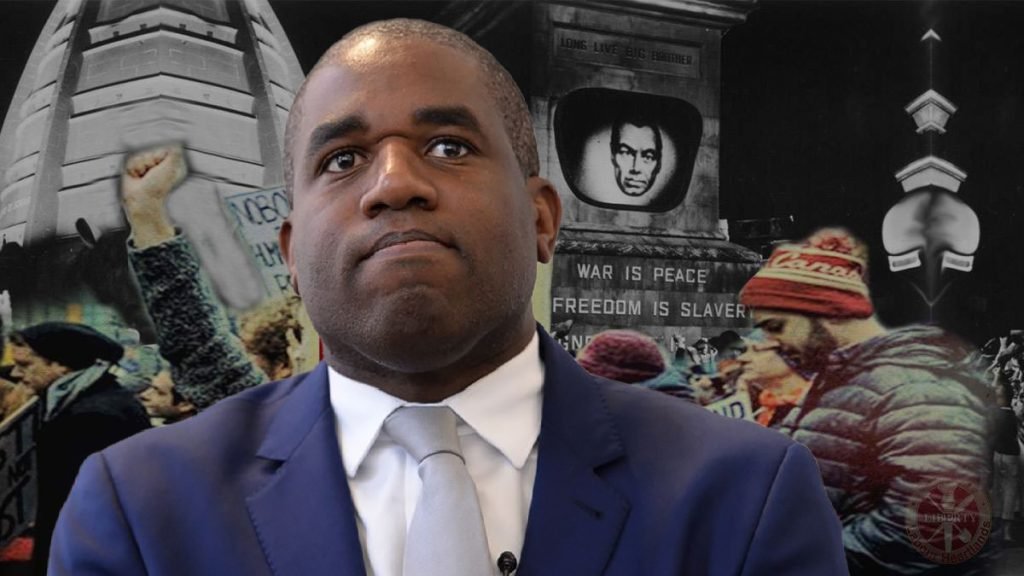
The official agenda for 2026 listed these topics: AI, Arctic Security, China, Digital Finance, Energy Diversification, Future of Warfare, Global Trade, The Middle East, Russia, Trans-Atlantic Defence-Industrial Relationship, Ukraine, The West. These are the load-bearing walls of British national policy, and of Western strategic direction. And they were discussed in private, between people who run states, intelligence services, arms-adjacent companies, and major financial institutions, with no minutes and no mandate.
2. Where did you get it from?
This question has two distinct answers, depending on which people in that hotel room you are asking.
David Lammy’s power derives from the British electorate. He has represented Tottenham since 2000, was appointed Deputy Prime Minister by Keir Starmer in the September 2025 cabinet reshuffle, and exercises his authority by virtue of democratic mandate and royal appointment. Blaise Metreweli’s authority derives from a constitutional appointment process: she was named by Prime Minister Starmer in June 2025 and took office on 1 October 2025, becoming MI6’s first female chief in the service’s 116-year history. She is formally accountable, in constitutional terms, to the Foreign Secretary.
Both of them, in other words, derive their power from the public. From the ballot box, from the constitutional appointment process, and from the taxpayer who funds the institutions they lead. That is the source of their authority. And that authority did not pause at the door of the Salamander Hotel.
Now for the other half of the question: where did the Bilderberg Steering Committee get its power? The answer is instructive. Bilderberg’s own governance page states that the Steering Committee’s members elect one another to four-year terms and designate the chair. The secretariat is funded privately. The current chairman, Henri de Castries, is a former CEO of the insurance group AXA, now President of the Institut Montaigne, a French think tank funded by corporate donors. Nobody elected him. No parliament created the Bilderberg organisation. No electorate can dismiss its Steering Committee.
So we have, in the same room, people who drew their power from democratic consent, and people who drew theirs from private self-selection and financial subscription. The official line is that the first group attends merely as individuals, temporarily free of the conventions of their office. That is not a democratic safeguard. That is a rhetorical device for avoiding the democratic question entirely. David Lammy does not cease to be Deputy Prime Minister of the United Kingdom because he is sitting in a private hotel rather than the despatch box.
In June 2022, when Lammy attended his first Bilderberg meeting as Shadow Foreign Secretary, his trip was paid for by Sir John Sawers, through Sawers’ consultancy Newbridge Advisory. Sawers, a former Chief of MI6, runs the Bilderberg Association in the United Kingdom alongside Zanny Minton Beddoes, the editor of The Economist. She is also on the 2026 participant list.
In other words: the man who sponsored Lammy’s introduction to the Bilderberg network in 2022 is sitting in the same room as Lammy at the 2026 meeting. The person who co-runs the British arm of the Bilderberg organisation is also present. And sitting alongside them is the current serving chief of the very intelligence service that Sawers once led, small world.

This is not a web of conspiracy. It is a web of relationship, patronage, and access, constructed over years, and now operating at the very apex of British state power. Sawers introduced Lammy to the room. Lammy is now the second most powerful elected official in the country. And they are both back in the room together, discussing warfare and intelligence and the transatlantic order, with no minutes and no mandate.
One is entitled to ask, with some precision: whose interests does this arrangement serve?
3. In whose interests do you exercise it?
Tony Benn’s five questions do not need to be applied abstractly to the Bilderberg Group as an institution. They can be applied to the British participants in Washington this week, as concretely as a forensic examination.
What power have you got? David Lammy holds the second-highest office in the British government. He controls the machinery of justice. Blaise Metreweli commands Britain’s overseas intelligence service. She decides, within the constitutional framework, what MI6 knows, what it prioritises, and what it does. These are not theoretical powers. They are powers exercised daily over the lives of millions.
This is where the composition of the room becomes the answer.
The 2026 Bilderberg agenda covered Digital Finance, Global Trade, Energy Diversification, and the Trans-Atlantic Defence-Industrial Relationship. Alongside the British Deputy Prime Minister and the Chief of MI6 sat Alex Karp, CEO of Palantir, the surveillance and data-mining company that holds contracts with British police forces, the NHS, and immigration enforcement. Palantir’s technology is embedded in British public services. Its chief executive was in the same private room as the person who oversees British intelligence and the person who holds the office of Lord Chancellor.
Alongside them sat Brian Schimpf, co-founder and CEO of Anduril Industries, which builds autonomous weapons systems and is aggressively expanding its European footprint under NATO procurement. And Peter Thiel, Anduril’s backer and one of the most powerful techno-libertarian financiers in the Western world. When the Chief of MI6 and the British Deputy Prime Minister discuss the Trans-Atlantic Defence-Industrial Relationship in private, under Chatham House rules, with the chief executives of companies seeking to supply that relationship, the line between policy formation and commercial lobbying ceases to exist as a meaningful category.
This is not a new problem at Bilderberg. It is the permanent condition of the institution. But the 2026 iteration makes it unusually legible. The arms-adjacent companies have grown more prominent, the intelligence representation is now more senior, and the agenda topics are more directly operational than at any previous meeting we have examined. When Satya Nadella of Microsoft and the MI6 chief discuss AI in the same private session, the question of whose interests are shaping British intelligence technology policy is not academic. It is urgent.
The public is expected to trust that when ministers, intelligence chiefs, financiers, corporate chiefs, and editors gather in secretive settings, no durable alignment of interests is being forged. That requires a faith more theological than political.
This is not a partisan issue; it is a systemic one. Look at the 2026 attendance list: Rishi Sunak, only two years out of Number 10, sits alongside the heavyweights of the current Labour government. This isn’t a break from tradition—it’s the tradition. From Thatcher and Blair to Osborne and Balls, the Bilderberg circuit remains the common denominator of the British establishment. Whether wearing blue or red, in power or in opposition, the faces change but the room stays the same. They don’t represent voters; they represent a class.
One now many are calling the Epstein Class…
4. To whom are you accountable?
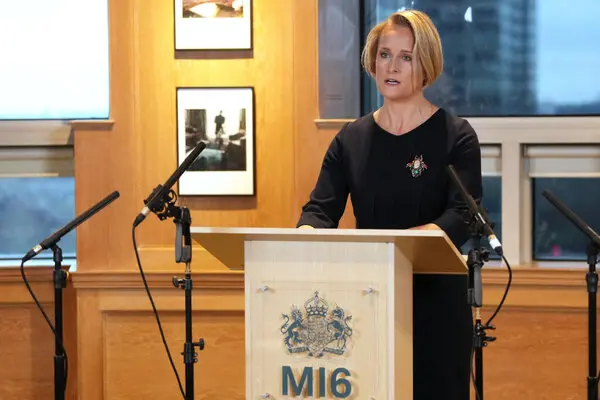
Blaise Metreweli’s presence at the 72nd Bilderberg Meeting demands particular scrutiny, because it raises a question that has not been asked before.
Metreweli became MI6’s first female chief on 1 October 2025, appointed by Prime Minister Keir Starmer following the retirement of Sir Richard Moore. She took office six months ago. In her first public speech, delivered at MI6 headquarters in December 2025, she described a world contested from sea to space, from the battlefield to the boardroom, facing adversaries who deploy assassination, sabotage, cyber-attacks, and information manipulation. She said, with evident gravity, that the frontline is everywhere.
The 2026 Bilderberg agenda covers AI, Arctic Security, Russia, Ukraine, the Middle East, Future of Warfare, and the Trans-Atlantic Defence-Industrial Relationship. Those topics are, in effect, the professional brief of the Chief of MI6, set out on a conference brochure. The overlap between Metreweli’s stated operational domain and the Bilderberg agenda is not coincidental. It is precise.
The most grounded interpretation is not sinister in itself. The Chief of MI6 may well attend private international forums as part of the normal work of intelligence diplomacy. Senior intelligence figures regularly engage with counterparts and allied officials in settings that are not parliamentary. That much is understood.
But Bilderberg is not a meeting of allied intelligence services operating under legal frameworks and treaty obligations. It is a private forum that also invites the CEOs of Palantir and Anduril, the heads of major banks and energy companies, the editors of major newspapers, and an assortment of financiers and think-tank figures. When the Chief of MI6 circulates in that environment, the question that Parliament is entitled to ask is not whether she attended. It is what guardrails govern her attendance, what was discussed in general terms, and whether any conflict of interest arises from mixing the leadership of a secret service with off-record elite networking.
No such question has been asked. No such guardrail has been confirmed. The government has made no statement about Metreweli’s attendance, no Commons declaration, and no Intelligence and Security Committee referral. She attended as an individual. That phrase is doing very heavy lifting indeed.
To describe the Chief of MI6 as attending a private forum in an individual capacity is not a description of reality. It is a rhetorical device for avoiding the democratic question entirely.
When Metreweli returns to Vauxhall Cross, the Intelligence and Security Committee receives no automatic briefing on her attendance at a private forum alongside defence contractors and foreign finance executives.
Here the Sawers connection becomes concretely important. Sir John Sawers is not merely a former MI6 chief attending Bilderberg as a retired mandarin. He paid for Lammy’s trip to the 2022 Bilderberg meeting, through his consultancy Newbridge Advisory. He co-runs the Bilderberg Association in the United Kingdom alongside Zanny Minton Beddoes, also present in 2026. He is therefore simultaneously a Bilderberg organiser and a former payor of the current Deputy Prime Minister’s attendance costs. And he is sitting in the same room as both the Deputy Prime Minister and the current MI6 chief, who is the successor, several positions removed, to the intelligence service Sawers himself once led.
To ask to whom this arrangement is accountable is to surface the answer immediately: to itself. The British state’s intelligence and political leadership is networking with private organisers who have already demonstrated a willingness to sponsor the access of British politicians to elite private forums. No declaration was required. No parliamentary register entry was compelled. No Commons statement was made. The accountability structure that governs Lammy’s official conduct as Deputy Prime Minister does not extend to his conduct in a private meeting paid for, in an earlier iteration, by the chair of the organisation hosting it.
The Bilderberg Steering Committee itself is accountable to nobody outside its own membership. Its deliberations cannot be subject to Freedom of Information requests. Its political effect cannot be audited. Its chair cannot be removed by any democratic process. It is, in the precise sense Benn intended, a structure that exists outside democratic accountability.
THE PATTERN ACROSS THIRTY YEARS
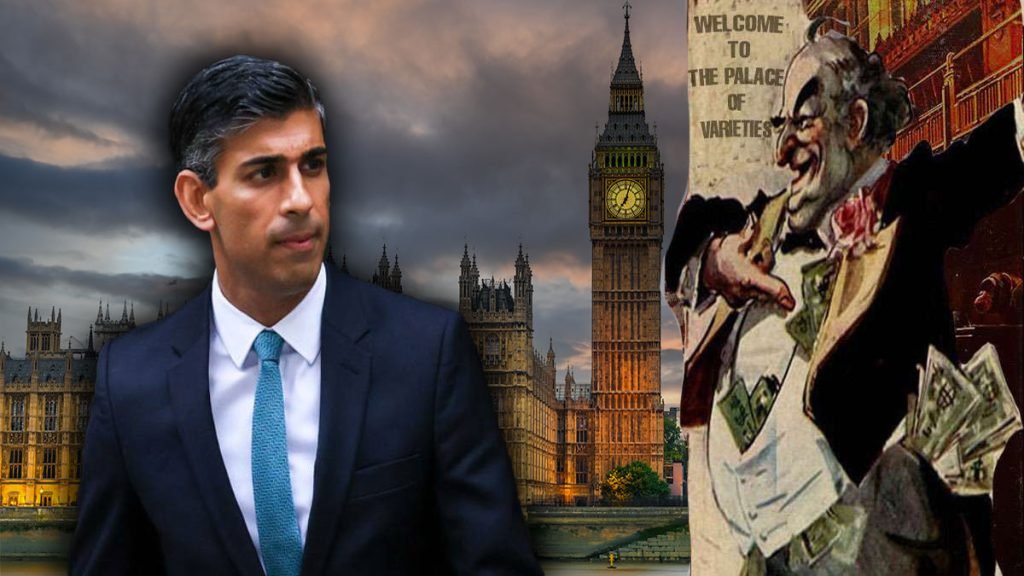
Rishi Sunak may not have walked through the doors of the 2026 Bilderberg meeting, but his inclusion on the official participant list is a detail the establishment would rather leave unexamined. That a former Conservative Prime Minister and the current Labour Deputy Prime Minister were both invited to this closed-door forum is telling. This isn’t mere coincidence; it is a clear demonstration of cross-party continuity, a pattern of power that persists regardless of who is in 10 Downing Street.
In a 2013 House of Commons debate, Kenneth Clarke confirmed on the parliamentary record that he had served on the Bilderberg Steering Committee for approximately ten years, and that the Prime Minister, the Chancellor, Ed Balls, Lord Mandelson, and Baroness Williams had all attended Bilderberg meetings. The list of confirmed British Bilderberg participants over the past three decades reads as a directory of the governing class: Margaret Thatcher, Tony Blair, David Cameron, George Osborne, Ed Balls, Kenneth Clarke, Peter Mandelson, David Lammy. Conservative and Labour. Ministers and shadow ministers. The same rotating cast, in the same private room, under the same Chatham House Rule.
The Trilateral Commission, Bilderberg’s sister organisation, completes the architecture. As this publication has previously reported in detail, Keir Starmer was a member of the Trilateral Commission between 2017 and his departure under the Commission’s own rules when he entered public office. Peter Mandelson’s connections to both organisations, and to Jeffrey Epstein, have been examined at length in our earlier reporting. The point here is not to rehearse those connections but to note that they represent the structural context within which the 2026 meeting should be read.
Bilderberg does not exist in isolation. It is one node in a network of private institutions through which the transatlantic governing class coordinates, socialises, and reproduces its priorities outside democratic scrutiny. The Trilateral Commission, the Bilderberg Group, the Council on Foreign Relations, the Halifax Forum, the various Atlantic Bridge-type arrangements: these are not conspiracies. They are institutions. And institutions have interests, cultures, and effects on the people who inhabit them.
WHEN INTELLIGENCE MEETS THE ARMS BAZAAR
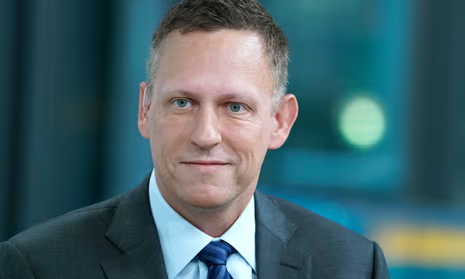
The 2026 participant list contains something that deserves to be named plainly. Alongside the politicians and intelligence chiefs sit the chief executives of Palantir and Anduril Industries, two of the most significant defence technology companies currently operating in the Western world.
Palantir holds contracts with British police forces, the NHS, and immigration enforcement. Its data-mining technology is embedded in British public services. Alex Karp, its CEO, has been forthright about his view that Palantir’s technology is designed to help liberal democracies dominate their adversaries. That is a political position, not merely a commercial one. And Karp is expressing it in the same private room as the Chief of MI6 and the British Deputy Prime Minister.
Anduril Industries, co-founded by Brian Schimpf, builds autonomous weapons systems and is aggressively expanding its European footprint under the umbrella of NATO procurement. Its founder Peter Thiel, also a Bilderberg 2026 attendee, is one of the most prominent techno-libertarian financiers in the Western world. His presence at a forum that includes NATO’s Secretary General and serving British intelligence leadership should not pass without remark.
When the British Deputy Prime Minister and the Chief of MI6 discuss the Trans-Atlantic Defence-Industrial Relationship in private, under Chatham House rules, with the CEOs of the companies seeking to supply that relationship, the line between policy formation and commercial lobbying does not merely blur. It ceases to exist as a meaningful category.
5. How can we get rid of you?
This is the question Benn called the most important. It is the one that separates democratic power from all other kinds. And it is the one that the Bilderberg Group, the Trilateral Commission, and the entire architecture of unaccountable elite coordination cannot answer.
You cannot vote out a Bilderberg Steering Committee. You cannot petition Henri de Castries. You cannot table a motion against the Bilderberg Foundation in any parliament. You cannot FOI its deliberations. You cannot audit its political effect. If it shapes assumptions, normalises positions, or forges informal alliances between people who hold public power and people who hold private capital, there is no mechanism available to the public to challenge, scrutinise, or reverse that process.
The elected officials who attend can, of course, be voted out. Lammy can be removed at the next general election. But the forum itself, and the access and influence it confers, persists regardless of who wins. Conservative Prime Ministers attended. Labour Prime Ministers attended. Shadow secretaries of state attended and then became Foreign Secretaries. The continuity of Bilderberg attendance across the British political class is not a function of any single government’s preferences. It is a structural feature of how the British establishment reproduces itself.
This is what the answer to Benn’s fifth question reveals. You cannot get rid of Bilderberg. But you can, at a minimum, require that the public officials who attend it account for their presence. That they stand at the despatch box and declare what subjects were addressed. That the Intelligence and Security Committee receives a formal briefing when intelligence chiefs attend. That all hospitality received is registered publicly. These are not radical demands. They are the floor of democratic accountability. And they have not been met.
Benn’s fifth question still stands, unanswered, at the door of the Salamander Hotel.
THE STRUCTURE THAT HAS NO MANDATE

This publication has previously documented the Trilateral Commission’s overlap with the Bilderberg network, and the presence within both organisations of figures whose connections to Jeffrey Epstein continue to cast a long shadow across the British establishment. Readers who want the full architecture of that network should consult our investigation from February 2026. What this article has attempted to do is something more immediate: to apply the most powerful democratic test available to a meeting that concluded this week, in the present tense, in the capital of our principal ally, at the moment, attended by the people who currently govern us.
The 72nd Bilderberg Meeting has now concluded. The blacked-out cars have dispersed. The Salamander Hotel has resumed its normal business. The Deputy Prime Minister has returned to his ministerial brief. The Chief of MI6 has returned to Vauxhall Cross. No statement has been made. No questions have been invited. The public, whose taxes pay for Lammy’s salary and Metreweli’s institutional authority, has been told nothing.
This is what unaccountable power looks like in practice. It does not announce itself with fanfare. It does not issue proclamations or threaten the constitution. It simply conducts its business in rooms to which the public is not admitted, under rules that protect its participants from scrutiny, and returns to public life as though nothing has occurred.
Tony Benn’s five questions were not designed for conspiracy theorists. They were designed for democrats. Any citizen who wishes to understand why the policies of successive governments so consistently favour the interests of finance, technology, and defence capital over the interests of working people should consider who is in the room when those interests are discussed, and who is not.
The working people of this country are not in that room. They do not receive invitations from the Bilderberg Steering Committee. They do not attend under Chatham House rules. Their interests are not represented on the agenda. They are, at most, the subject of the discussion, the population whose futures are being managed by people who were never asked for a mandate to manage them.
That is the scandal. Not a single revelation. Not a single smoking document. A structure. A recurring, cross-party, transatlantic structure that places democratic governments in private rooms with unelected power, removes the guardrails of accountability, and returns them to public office without ever having asked the people’s permission.
This is what unaccountable power looks like in practice. It does not announce itself. It does not threaten the constitution. It conducts its business in rooms to which the public is not admitted, under rules designed to prevent scrutiny, and returns to public life as though nothing has occurred. The working people of this country are not in that room. They do not receive invitations from the Steering Committee. Their interests are not on the agenda. They are, at most, the subject of the discussion: the population whose futures are being managed by people who never asked for a mandate to manage them.
Tony Benn stood like Banquo at the feast of the Atlantic governing class and asked the one question it hates most. He has been dead twelve years. The question remains.
Of course, there is always one more question… who they report back to?
Enjoyed this read? I’m committed to keeping this space 100% ad-free so you can enjoy a clean, focused reading experience. Crafting these articles takes a significant amount of research and heart. If you found this helpful, please consider a “small donation” to help keep the lights on and the content flowing. Every bit of support makes a huge difference.

Sources: Official Bilderberg 2026 participant list (bilderbergmeetings.org); Declassified UK; Wikipedia entries for Blaise Metreweli and David Lammy (verified April 2026); GOV.UK official announcement of Metreweli appointment; Hansard (June 2013, Kenneth Clarke); New York magazine (2002, Epstein/Trilateral Commission). For prior Labour Heartlands investigation of the Trilateral Commission and Epstein network connections, see: ‘From Rockefeller to Starmer: Mapping the Trilateral Network in the Epstein Files’ (February 2026).
Support Independent Journalism Today
Our unwavering dedication is to provide you with unbiased news, diverse perspectives, and insightful opinions. We're on a mission to ensure that those in positions of power are held accountable for their actions, but we can't do it alone. The Heartlands Tribune is primarily funded by me, Paul Knaggs, and by the generous contributions of readers like you. Your donations keep us going and help us uphold the principles of independent journalism. Join us in our quest for truth, transparency, and accountability – donate today and be a part of our mission!
Like everyone else, we're facing challenges, and we need your help to stay online and continue providing crucial journalism. Every contribution, no matter how small, goes a long way in helping us thrive. By becoming one of our donors, you become a vital part of our mission to uncover the truth and uphold the values of democracy.
While we maintain our independence from political affiliations, we stand united against corruption, injustice, and the erosion of free speech, truth, and democracy. We believe in the power of accurate information in a democracy, and we consider facts non-negotiable.
Your support, no matter the amount, can make a significant impact. Together, we can make a difference and continue our journey toward a more informed and just society.
Thank you for supporting Labour Heartlands