One backbencher, eighty-one names, and the question that may already have its answer
On a Saturday afternoon in May, with Wales already lost and Scotland unmoved, a former junior minister with no cabinet rank, no shadow frontbench standing, and no obvious machine behind her walked up to a BBC microphone and said the thing no one at the cabinet table had the courage to say.
Catherine West, MP for Hornsey and Friern Barnet, told the nation she would begin a Labour leadership election on Monday morning unless the cabinet, by then, had done the job themselves. She was not bluffing.
West’s words are worth sitting with. Her proposal was not a coup; it was almost polite. She offered Starmer a role in international affairs. She gave the cabinet a Sunday to act. She spoke calmly, as someone who has done her sums and found, to her own apparent surprise, that the sums have to be faced. And then she named the threshold: eighty-one nominations, taken to the party chair, and a leadership election begins.
Whether those eighty-one names materialise is, at this moment, the only question that matters in British politics. Everything else, the resets, the speeches, the Monday reboot in Downing Street, the State Opening on Wednesday, is noise.
The only signal worth reading is whether the Parliamentary Labour Party retains enough survival instinct to read a map.
THE RECKONING IN CARDIFF AND EDINBURGH
Thursday’s elections were not a setback. They were a verdict. The distinction matters, because setbacks can be recovered from and verdicts cannot be appealed by simply announcing a fresh attitude.
In Wales, a country Labour has governed since devolution began in 1999 and dominated for more than a century before that, the party has been reduced to nine seats in a ninety-six-seat Senedd. Nine. Plaid Cymru emerged as the largest party with forty-three seats. Reform UK took thirty-four.

The Welsh First Minister, Eluned Morgan, lost her own seat in Ceredigion Penfro, finishing behind both Plaid and Reform, barely ahead of the Greens. She is the first leader of a government in the United Kingdom ever to lose their seat while still in office. She resigned the same day.
“It ends a century of Labour winning in Wales. The party will need to take a really hard look at itself and understand the depth of the challenge that we face.” – Eluned Morgan, 8 May 2026
In Scotland, the SNP retained its position as the largest party. Labour and Reform finished level, on seventeen seats apiece. The party that was supposed to claw back Scotland for the movement that built it finds itself, instead, sharing a foothold with Nigel Farage’s outfit.
In England, the picture was no different in kind, only in scale. Reform UK took council seats from Labour in numbers not seen before, draining the red wall from below. Labour’s projected vote share in the English locals was twenty per cent: the worst in more than four decades. Not a low tide. A rout.

These are the smiles in Cardiff and Edinburgh. They are the smiles of parties watching the last of a colossus collapse. The grimaces belong to the Labour folk who knew this was coming, who warned it was coming, and who were told, repeatedly, that it could not happen here.
WHAT WEST’S MOVE ACTUALLY MEANS
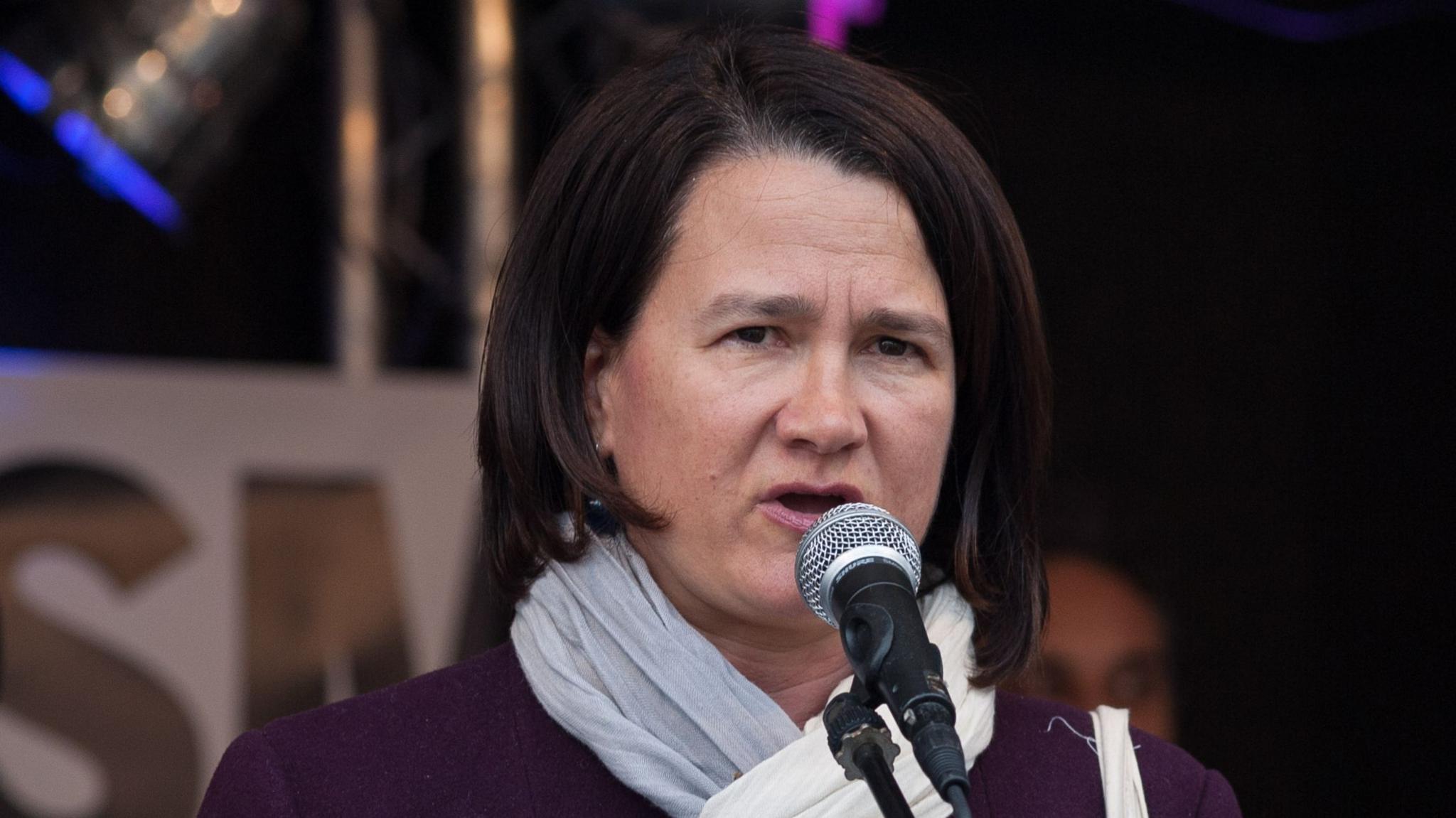
Catherine West is not an obvious leadership candidate. She served as Parliamentary Under-Secretary for the Indo-Pacific until 2025, a role that was important but not one that announces an alternative prime minister. She does not have the profile of Wes Streeting, the shadow-boxing ambition of Angela Rayner, or the strategic weight that would attach to Andy Burnham if he were ever to come south. Her candidacy, on its own terms, may amount to very little.
What it amounts to politically is something else entirely. She is the first sitting Labour MP to say publicly, on the record, in plain English, that she will trigger a formal leadership election if the cabinet does not act. Around thirty Labour MPs had already said Starmer should go or set a timetable. West has now offered a mechanism. She has, in effect, dared the other twenty-nine to stop shaking their heads and start counting.
No. 10 spent this weekend staring at a parliamentary party of more than four hundred. In the coming hours, before Monday’s speech and Wednesday’s State Opening, every face in that caucus is being read for signs of motion. The whips are working. The loyalists are briefing. The operation that has held together through every previous embarrassment is now being asked to hold through the worst electoral performance the party has delivered in living memory.
It may hold. These things often do, longer than logic suggests they should. But the longer it holds, the worse the damage compounds.
West has dared the other twenty-nine to stop shaking their heads and start counting. That is what this moment means.
THE QUESTION THAT REMAINS

Here is where the honest accounting becomes uncomfortable, and where Labour Heartlands has an obligation not to flinch.
A change of leader is not, in itself, salvation. The argument being made in the corridors of Westminster, that all that is needed is a new face with better instincts, presupposes that the Labour Party retains enough of its original substance to be revived. That is not certain. It may not be true.
Keir Starmer did not destroy Labour’s working-class base overnight. The process was long and systematic: the triangulation, the professionalisation, the replacement of class politics with consultancy politics, the contempt for communities that took the wrong view in 2016 and were never quite forgiven for it. Starmer accelerated a process that predated him. The neoliberal capture of the party machinery, the donor class that now sets the parameters of permissible policy, the parliamentary candidates who have never worked a factory floor or staffed a union branch: these did not appear in 2020.
What Starmer added was the final removal of the pretence. Under Blair, working people were invited to believe the party had simply modernised. Under Starmer, the mask has not only slipped, it has been handed to the opponent as a weapon. The people who were told to be patient, to trust the process, to wait for competence to reveal itself, have watched Mandelson appointed to Washington over the vetting objections of his own Foreign Office. They have watched a government that cut the winter fuel allowance from pensioners while finding money for things they were not asked about. They have watched a Prime Minister who treats their votes as a baseline entitlement rather than a relationship to be earned.
The damage done to the party’s credibility in its own communities is not of the kind that a new leader cures in an electoral cycle. The poll projections that have Labour losing three hundred seats at the next general election are not predictions of a rough night. They are warnings of an extinction event.
NIPPING IT IN THE BUD, OR CLOSING THE STABLE DOOR

West is right that acting now is better than acting later. She is right that the cabinet has failed in its basic responsibility to the country by not producing an alternative to a leader the voters have already rejected. She is right that the ritual of Monday speeches and Wednesday pageantry, while the party bleeds support it will never recover, is not a strategy. It is a comfort blanket.
But she should say, and the movement should hear, what even a successful leadership change can and cannot do. It can halt the visible decline. It may reassure enough people to stop the immediate haemorrhage. It might, if the right leader with the right instincts emerges quickly, begin the long, slow work of reconnection with the working-class communities Labour was built to represent.
What it cannot do is undo the ideological damage. The party that chose Starmer twice, first as leader and then again after the election, is a party that still does not fully understand why it chose him, or what his ascent revealed about its own internal culture. A new leader sitting atop the same machine, the same donor networks, the same managerial ideology in a different suit, is not change. It is rebranding.
The working class of this country deserves better than rebranding. It deserves a party that understands, at its foundations, that political power is not an administrative function. It is a relationship. It is built on trust, on shared interest, on the knowledge that when the institution speaks, it speaks for the people in the room, not the people in the boardroom. Labour once knew this. The question is whether it remembers enough of it to act on the knowledge.
WHAT COMES NEXT

West has set a clock. By Monday morning, either the cabinet produces its own solution or she begins collecting nominations. The forty-eight hours between now and that moment will determine whether the Parliamentary Labour Party has any institutional survival instinct remaining, or whether it will spend the next three years walking, with extraordinary dignity, toward the edge of a cliff.
The State Opening of Parliament on Wednesday was supposed to be a moment of authority: the government setting out its programme, its ambition, its claim on the future. Instead, it now risks looking like a state occasion for a party in the process of disintegrating, dressed in ceremonial robes to attend its own hearing.
Starmer will speak on Monday. He will use the language of renewal. He will invoke the future. He will, in all probability, be persuasive enough that some people who know better will persuade themselves to wait another month.
This is how these things end: not with a bang but with a series of managed extensions, each one more expensive in political terms than the last.
West has done a service by naming the mechanism. Whether the eighty-one names materialise will tell us whether Labour’s MPs have finally decided that the service to the country outweighs the service to the leader.
This publication has not always been listened to when it warned of this outcome. The warnings began long before May 2026. They began when the direction of travel was still disputed and could still be changed. They were dismissed, in the way that uncomfortable truths often are, as factional, or embittered, or simply out of step.
The map of Britain, red turned beige turned blue and rust and tartan, is now the answer to that dismissal.
The damage to the Labour brand under Keir Starmer runs deeper than any single leader can repair in a single parliament. Not even the ghost of Keir Hardie himself could hope to revive what Starmer has lost.
What West has fired is not a starting pistol for a revival. It is a flare, in the vain hope of rescue.
Labour Heartlands is an independent left-wing publication committed to the working-class communities that the Traditional Labour Party was built to represent.
Enjoyed this read? I’m committed to keeping this space 100% ad-free so you can enjoy a clean, focused reading experience. Crafting these articles takes a significant amount of research and heart. If you found this helpful, please consider a “small donation” to help keep the lights on and the content flowing. Every bit of support makes a huge difference.

Support Independent Journalism Today
Our unwavering dedication is to provide you with unbiased news, diverse perspectives, and insightful opinions. We're on a mission to ensure that those in positions of power are held accountable for their actions, but we can't do it alone. The Heartlands Tribune is primarily funded by me, Paul Knaggs, and by the generous contributions of readers like you. Your donations keep us going and help us uphold the principles of independent journalism. Join us in our quest for truth, transparency, and accountability – donate today and be a part of our mission!
Like everyone else, we're facing challenges, and we need your help to stay online and continue providing crucial journalism. Every contribution, no matter how small, goes a long way in helping us thrive. By becoming one of our donors, you become a vital part of our mission to uncover the truth and uphold the values of democracy.
While we maintain our independence from political affiliations, we stand united against corruption, injustice, and the erosion of free speech, truth, and democracy. We believe in the power of accurate information in a democracy, and we consider facts non-negotiable.
Your support, no matter the amount, can make a significant impact. Together, we can make a difference and continue our journey toward a more informed and just society.
Thank you for supporting Labour Heartlands