A Coronation or a Cliff Edge?
The King of the North is coming home. Or so the story goes. It is a story constructed almost entirely from conditional clauses, each one balancing on the last like a conjuror’s act that requires everyone in the audience to look away at precisely the right moment.
Andy Burnham will contest the Labour leadership, if the National Executive Committee can be persuaded to grant him permission this time, having blocked him from standing in the Gorton and Denton by-election in January by eight votes to one, with the Prime Minister himself among those who voted against. He will return to Westminster, if he can win the Makerfield seat that Josh Simons vacated yesterday in what has already been noted as the first time in over sixty years that a sitting MP resigned specifically to clear a path for someone outside Parliament. He will unite the party, if the membership, the trade unions and enough of the Parliamentary Labour Party can be brought to believe that the figure presenting himself represents something genuinely different from what went before. That is a great many ifs. And behind each one sits a question the Burnham camp would rather you did not pause to consider.
The NEC: The First Gate Has Not Opened
Begin with the NEC. Burnham has confirmed he will request permission to stand. He has not received it. The same committee that blocked him in January, with the Prime Minister casting one of the eight votes against, must now rule again. Those who argue the political weather has changed since January are correct. But a committee with the Prime Minister’s allies on it does not become a different committee simply because his authority has weakened. The first if remains precisely that.
The Cliff Edge: What the Numbers Actually Say
Then there is the seat itself. Makerfield is being presented in some quarters as a vehicle for Burnham’s return, a formality to be processed before the real business of the leadership contest begins. The polling says something rather different. In the eight Makerfield wards contested at the local elections earlier this month, Reform took approximately 45 percent of the vote to Labour’s 32. The Greens, resurgent under Zack Polanski’s leadership, came in at 19 percent across Greater Manchester and are not standing aside for anyone. Nigel Farage has already confirmed that Reform will, in his own words, throw absolutely everything at the by-election. Most recent MRP polling puts Makerfield down as a firm Reform win.
If Burnham wins, he enters Westminster with a narrative no other leadership candidate can match. If he loses, his career as a national political force is effectively finished. The cliff edge is real, and the fall is a long one.
There is one further fact that the Burnham camp has been notably reluctant to address in its briefings to a sympathetic press. Makerfield voted 64.91 percent in favour of Leave in the 2016 EU referendum. It is not a marginal Leave area. It is one of the heaviest Leave constituencies in Greater Manchester. And Andy Burnham, at the Labour Party conference last autumn, told delegates in his own words: I hope in my lifetime I see this country rejoin. That is not a nuanced position carefully calibrated for a Leave audience. It is a public, on-record commitment to EU membership, delivered into a microphone, in a room full of journalists. Reform will play that clip on a loop from the day the by-election is called to the moment the polls close.
The Kingmaker: A Study in Shadow
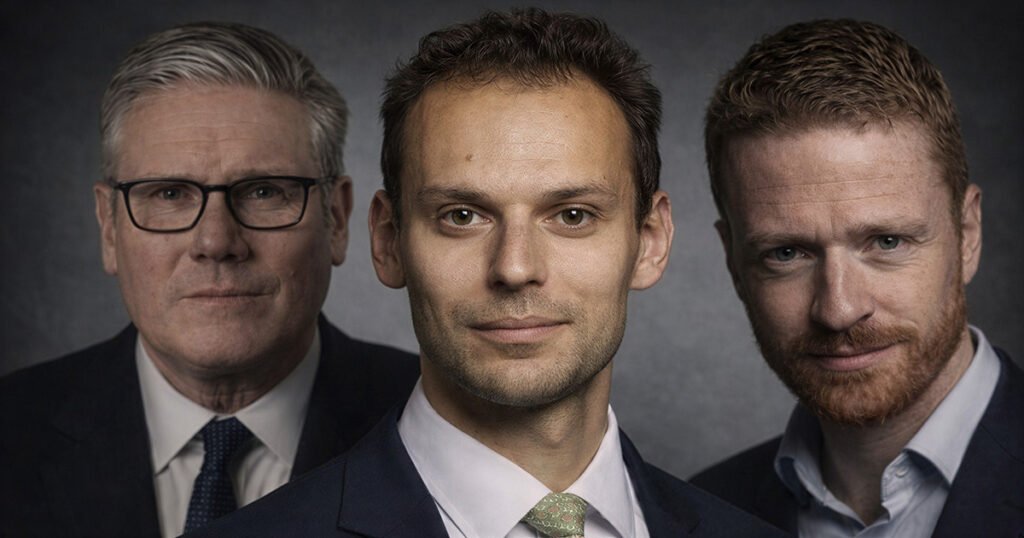
History offers a useful shadow for Josh Simons. Richard Neville, the sixteenth Earl of Warwick, was the great kingmaker of the Wars of the Roses: a man who placed Edward IV on the throne, grew impatient when Edward refused to remain his instrument, and then attempted to unmake the king he had created. The romantic telling casts Warwick as a man of thwarted principle. The accurate telling is less flattering. Warwick was not a democrat. He was an operator whose loyalty was always to his own proximity to power, and who treated the crown as a piece to be moved rather than an office to be served.
Simons is a more contemporary variation on the type, though the darkness around him runs considerably deeper than any medieval parallel can fully illuminate. He entered politics through Jeremy Corbyn’s office, then turned on Corbyn and contributed to the machinery that destroyed him. He built Labour Together, the vehicle that engineered Keir Starmer’s rise and oversaw the systematic removal of the party’s democratic socialist wing. He sat at the centre of the operation that contracted a public affairs firm to compile dossiers on the personal backgrounds of journalists whose only offence was investigating Labour Together’s finances. His career is not the biography of a man who keeps finding new causes. It is the biography of a political operative who has served the apparatus throughout, and whose loyalty has never been to the Labour movement but to the circle of power that captured it.
If Josh Simons is a true believer, one is entitled to ask who exactly he believes in, because the evidence of his career answers that question with a clarity that is not flattering, and the answer is not the democratic process, and it is not the Labour party he helped to hollow out.
The Open Gate: Who Benefits?

Which makes his sudden generosity toward Andy Burnham the most interesting question in British politics this week. The same No. 10 that blocked Burnham from Gorton and Denton in January by eight votes to one, with the Prime Minister casting his own vote against, has now stood aside for Makerfield. Makerfield, where the constituency voted 64.91 percent for Leave in 2016. Makerfield, where Reform are polling at approximately 45 percent to Labour’s 32. Makerfield, chosen as the stage for the return of a candidate who told Labour conference last autumn, in his own words, that he hopes in his lifetime to see this country rejoin the European Union.
Warwick at least had the courage to declare his hand openly. What is happening here is quieter, and in politics, quieter things are usually more dangerous. The gate has been opened. The question worth sitting with is not why Simons opened it. The question is who calculated that opening it served their interests, and whose interests those are. Because the arithmetic of Makerfield, for a pro-rejoin candidate in a 65 percent Leave seat against a Reform machine throwing everything at it, is not the arithmetic of a coronation. It is the arithmetic of a controlled demolition.
The Record: What Burnham Actually Stands For

Set aside for a moment the question of whether Burnham can win the seat. Consider what he is proposing to do if he survives it. His supporters argue that he is the only figure with sufficient political weight to hold off the Reform insurgency and speak credibly to the voters Labour has been haemorrhaging across the post-industrial towns of the North and Midlands. This argument deserves serious engagement, because those voters are real, their anger is legitimate, and Reform’s capture of their loyalty represents a structural crisis for the left.
But Burnham is a man with a record, and that record deserves examination rather than hagiography. He voted for the invasion of Iraq, loyally, as a foot soldier of the Blair project. He later expressed regret. Regret, at the price of hundreds of thousands of lives and the permanent destabilisation of a region, is the minimum acceptable response to that decision, not a credential for leadership. He remains a member of Labour Friends of Israel. At a moment when the British public is watching the destruction of Gaza in real time, when younger voters and communities of colour are expressing not mere unease but outright revulsion, one is entitled to ask whether his foreign policy would differ from Starmer’s in substance or merely in the warmth of its accompanying language. His record suggests the latter.
A leader who channels the frustration of the working class without dismantling the structures that generate it is not a radical. He is a pressure valve with better communication skills.
The case for Burnham rests on the assumption that Labour needs a figure who looks like change without being change: someone who can reassure the party’s institutional funders and the centrist press while projecting enough northern authenticity to recapture the seats lost to Farage. It is a theory of political management, not political transformation. And if there is one lesson from the Starmer years that the party ought to have absorbed by now, it is that management without vision produces precisely the situation Labour currently finds itself in: a majority government with no discernible purpose, declining poll ratings, and a leader whose grip on his own party loosens with every passing week.
The Reckoning
If Andy Burnham clears every obstacle before him, wins Makerfield against a Reform machine throwing everything it has at the seat, secures the NEC’s blessing, gathers his 81 nominations and walks through the door of Westminster only to offer the party Starmerism with a Mancunian accent and a warmer handshake, then Labour will not have found its future. It will have found a more charismatic iteration of its present.
However, Nietzsche wrote that what does not kill you makes you stronger. Remember that, because it applies here with a precision that should concentrate the mind.
If Burnham fails in Makerfield, if the gamble collapses in a Leave heartland against a Reform machine that has already taken the area ward by ward, then Starmer does not fall. He survives. And a Starmer who has watched his most dangerous rival destroy himself on the wrong side of a Brexit-scarred constituency is not a weakened Prime Minister. He is a liberated one. What follows that liberation is not difficult to predict from the evidence of his conduct so far: a Digital ID programme that the public never voted for and Parliament has barely scrutinised; a managed drift toward EU structures that stops just short of the mandate the country was never asked to give; and the continued, methodical removal of the civil liberties and democratic norms that his administration has treated, from the beginning, as inconveniences to be quietly retired.
A Starmer with no challenger left standing is not a Starmer who moderates. He is a Starmer with nothing left to lose. That is the outcome the gate at Makerfield may have been designed to deliver. And it is the outcome the British public, whatever it thinks of Andy Burnham, should be most afraid of.
The working class of this country deserves better than a movement that mistakes a change of voice for a change of direction.
The King of the North may yet sit on the throne. The question, when the dust settles and the votes are counted, is whether anyone left a kingdom worth ruling.
Enjoyed this read? I’m committed to keeping this space 100% ad-free so you can enjoy a clean, focused reading experience. Crafting these articles takes a significant amount of research and heart. If you found this helpful, please consider a “small donation” to help keep the lights on and the content flowing. Every bit of support makes a huge difference.

Support Independent Journalism Today
Our unwavering dedication is to provide you with unbiased news, diverse perspectives, and insightful opinions. We're on a mission to ensure that those in positions of power are held accountable for their actions, but we can't do it alone. The Heartlands Tribune is primarily funded by me, Paul Knaggs, and by the generous contributions of readers like you. Your donations keep us going and help us uphold the principles of independent journalism. Join us in our quest for truth, transparency, and accountability – donate today and be a part of our mission!
Like everyone else, we're facing challenges, and we need your help to stay online and continue providing crucial journalism. Every contribution, no matter how small, goes a long way in helping us thrive. By becoming one of our donors, you become a vital part of our mission to uncover the truth and uphold the values of democracy.
While we maintain our independence from political affiliations, we stand united against corruption, injustice, and the erosion of free speech, truth, and democracy. We believe in the power of accurate information in a democracy, and we consider facts non-negotiable.
Your support, no matter the amount, can make a significant impact. Together, we can make a difference and continue our journey toward a more informed and just society.
Thank you for supporting Labour Heartlands