Britain Goes to the Polls, and the Old World Has No Answer Left
Today, voters across Scotland, Wales, and England cast their ballots in what may be the most structurally significant set of elections since the devolution era began. The results will not merely measure the popularity of parties. They will measure the patience of a people who have been promised change for a decade and handed disappointment each time. This is our assessment, made honestly, before a single vote is counted.
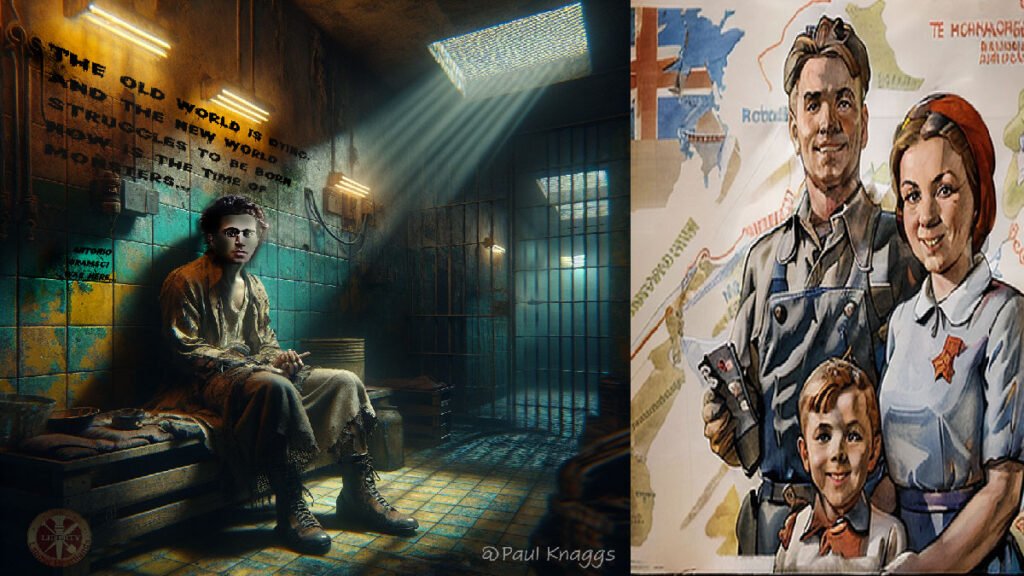
The old world is dying, and the new world struggles to be born:
now is the time of monsters.–Antonio Gramsci, Prison Notebooks
Antonio Gramsci wrote those words in a Fascist prison cell, somewhere between despair and defiance. He was describing a structural moment in history, not a passing inconvenience. He meant that when the dominant order loses its authority but has not yet collapsed, and when the forces that might replace it have not yet found their form, the space between is filled with something dangerous, something distorted, something that feeds on the hunger for change without satisfying it. He was writing about Italy in the 1930s. He might as well have been writing about Britain today.
The political commentator John McTernan, hardly a revolutionary, put it plainly enough in a recent broadcast. Look at the voters, he said. For a decade they have been voting for change: Brexit, then Corbyn, then Johnson, then Starmer, then Farage and Polanski. They are not stupid. They are not fickle. They are hungry, and they have not been fed.
They are not stupid. They are not fickle. They are hungry, and they have not been fed.
That hunger is what walks into the polling station today. It is what shapes the pencil mark on the ballot. And the question that will define British politics for a generation is not which party wins the most council seats, but whether what emerges from this moment is genuinely new, or merely a new label on the same old bottle.
THE RECKONING FOR LABOUR
Let us be direct about Keir Starmer’s position. The evidence, across every credible poll and every reliable projection, points toward a set of losses so severe that the question after tonight will not be whether Labour can recover, but whether it can survive in its present form. YouGov’s final Westminster voting intention, conducted on the 4th and 5th of May, placed Labour on 18 percent, trailing Reform UK by seven points and barely a percentage point ahead of the Conservatives. One projection has the party losing close to two thousand of the roughly two thousand five hundred council seats it is currently defending across England.
Forecasters point to councils such as Sunderland, Barnsley, and Wakefield as virtually certain to fall to Reform. The eastern counties, Essex and Norfolk especially, are projected to shift from Conservative to Reform control, completing a realignment that began with Brexit and has been accelerating ever since. In London, where Labour once enjoyed near-total dominance, the Greens are mounting credible challenges in inner boroughs such as Hackney, while Reform is expected to outperform the Conservatives in swathes of outer London.
Former frontbencher Richard Burgon has said plainly what many in the parliamentary party dare only whisper: if tonight goes as the polls predict, Starmer will be gone. Labour MP Helen Hayes has added that serious questions about the leadership will become unavoidable. Prediction markets have placed the probability of Starmer departing before the year is out at over sixty-five percent. These are not the sounds of a governing party with confidence in its course. They are the sounds of a party waiting to see how bad the damage is before deciding whether to act.
The deeper problem for Labour is not merely the scale of the loss but its geometry. The party is losing simultaneously to its left and to its right. Reform is taking the post-industrial working class. The Greens are taking progressive urban and younger voters. The Liberal Democrats are picking off the professional suburban vote. There is no single counter-move to that kind of dispersal. It represents a coalition that was never really held together by ideological conviction, only by the absence of credible alternatives, and the alternatives have arrived.
Reform is taking the post-industrial working class. The Greens are taking progressive urban and younger voters. The coalition is dispersing in every direction at once.
WALES: A CENTURY ENDS TONIGHT

If there is a single result tonight that ought to stop the entire political class in its tracks, it will come from Wales. For over a century, Welsh politics has functioned on a simple if depressing axiom: Labour governs in Cardiff Bay as surely as rain falls on the Beacons. The final YouGov MRP poll for ITV Cymru Wales placed Plaid Cymru on 33 percent and Reform UK on 29 percent, with Welsh Labour collapsed to 12 percent, its worst performance in any major Welsh election since 1906. Under the new proportional Senedd system, that translates into a chamber where Labour may hold as few as twelve seats.
The structural change here is crucial and too often missed in the commentary. Wales is using a closed-list proportional system for the first time, expanding the Senedd to 96 members. The old constituency-based mechanics that allowed Labour to entrench itself even when its vote was hollowing out have been stripped away. What remains is something closer to an honest arithmetic of Welsh opinion, and that arithmetic is brutal for the party that built the NHS, won the Attlee landslide, and has treated the Welsh valleys as a rotten borough for the best part of thirty years.
Our prediction: Plaid Cymru will emerge as the largest party, almost certainly led by Rhun ap Iorwerth toward some form of coalition or confidence arrangement, most likely with a depleted Welsh Labour as a junior partner. The arrangement would be uncomfortable and fragile, but it would hold a left-to-centre-left majority in the chamber against Reform’s challenge. Reform itself, we predict, will finish as a strong second force with somewhere between 28 and 34 seats, a dramatic entry into Welsh devolved politics but not enough to govern, and, crucially, with every other party on record as unwilling to enable them.
This is not primarily a story about Plaid Cymru’s strength. It is a story about Labour’s failure to remain the vehicle for Welsh working-class aspiration. That failure belongs to the party’s machine in Cardiff Bay and in Westminster equally.
SCOTLAND: MAJORITY DENIED, QUESTIONS MULTIPLIED

In Scotland, the story is different in character but similar in structure. The SNP will almost certainly remain the largest party in Holyrood, but both Survation’s final MRP, placing them at 59 seats, and YouGov’s comparable modelling suggest they will fall short of the 65 required for a majority. That shortfall matters enormously. It transforms the independence question from a clean parliamentary mandate into a piece of political arithmetic requiring negotiation, compromise, and coalition.
The rise of Reform in Scotland is the most arresting subplot of the evening north of the border. A party that held no seats and polled a fraction of one percent in 2021 is now projected to win upwards of 17 seats, competing for second place with Scottish Labour on the regional list. The party’s appeal in Scotland is not purely about immigration or culture war positioning. It is drawing on a deep current of disillusionment with devolution itself among a section of the unionist working class who feel the Scottish Parliament has delivered them nothing except progressive social policies they never asked for and a prolonged argument about independence they have not wanted to have.
Our prediction for Scotland: SNP largest party, short of majority, most likely continuing as a minority administration or in loose arrangement with the Scottish Greens on confidence and supply. Reform will finish a credible third or second on the list vote, representing a genuine parliamentary presence where none existed before. Scottish Labour will continue its long managed decline, unable to escape the shadow of the Westminster government it is nominally part of.
ENGLAND: THE MOSAIC AND THE MESSAGE

Across England, over five thousand council seats in 136 local authorities are up for election. The projections here are more volatile, because Reform is contesting wards at scale for the first time, and first-past-the-post in multi-candidate contests is notoriously resistant to clean modelling. What we can say with reasonable confidence is this: Reform will make historic gains in post-industrial northern towns and in rural county councils across the east. Labour’s defending position, built on the extraordinary circumstances of Partygate in 2022 when it polled 35 percent, simply cannot hold against a party now polling around 20 percent.
The Greens, under Zack Polanski’s leadership, are the progressive wildcard. The party is polling at levels it has never reached before, and the inner London contests, Hackney most prominently, represent a genuine test of whether that polling momentum translates into organised local wins. We expect the Greens to take Hackney and to make significant inroads in Haringey, Lewisham, and parts of Sheffield and Norwich. Whether they can do so at sufficient scale to reshape the narrative of the night remains to be seen.
A note of caution on Reform’s ground operation: translating 27 percent national polling into council seats under first-past-the-post requires disciplined candidate selection, ward-level organisation, and the ability to concentrate votes efficiently. These are things that established parties have built over decades. Reform has built them, if at all, in months. The gap between their polling ceiling and their actual seat yield may be larger than their supporters expect. We still expect them to top the National Equivalent Vote Share when it is calculated from tonight’s results, but the headline seat total may feel anticlimactic by comparison.
Translating 27 percent into council seats requires organisation built over decades. Reform has built it, if at all, in months.
MONSTERS, AND WHAT THEY FEED ON
Gramsci’s monsters emerge in an interregnum. They fill the space that legitimate, confident power has vacated. The question worth asking today, as polls open across Britain, is not simply which monsters are winning but what they are feeding on, and whether any force exists that can offer something better than what the old world provided.
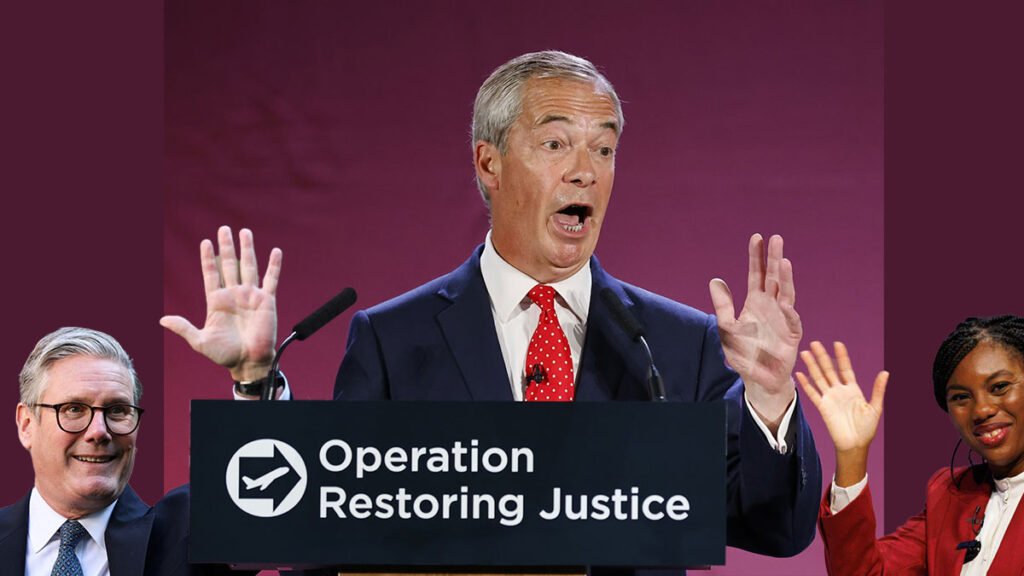
Reform UK is feeding on genuine, material grievance: stagnant wages, deteriorating public services, housing that a generation cannot afford, an NHS that cannot function. It channels that grievance through the politics of spectacle, scapegoat, and personality. Farage has never governed anything at scale, and the councils and Senedd blocs he is about to inherit will require him to do precisely that. The contradiction between populist promise and administrative reality tends to express itself, in time, as disappointment of a particularly bitter kind.
The Greens represent a different possibility. They are drawing, particularly among younger voters, on the same underlying frustration but offering a structural analysis rather than a scapegoat. Their weaknesses are real: limited geographic reach, dependence on the political weather, and a media environment that is not yet sure whether to take them seriously as a governing force or dismiss them as a protest phenomenon. But they are growing, and they are growing in the right direction for a left that has spent thirty years searching for its post-Thatcherite form.

For Labour Heartlands, the honest assessment is this: the working class that built the Labour movement did not abandon it out of spite or confusion. It abandoned it because the party that claimed to represent them made a series of choices, over many years, that prioritised the management of capitalism over the challenge to it. Tonight’s results are the compounding interest on that debt. The question now is whether anyone in what remains of the Labour Party understands that, or whether the response to tonight will be another round of repositioning, rebranding, and managed retreat.
We do not know who wins tonight. Nobody does. British voters have a long and honourable history of making fools of the forecasters. But the structural reality beneath tonight’s numbers is not in doubt: the old world is dying, and it deserves to. The only question that matters is what is born to replace it.
“The old parties are not losing to new ideas. They are losing to old hunger. And hunger, unaddressed long enough, does not ask questions about the menu.”
PREDICTION SUMMARY
Scotland: SNP largest party, short of majority (57-62 seats projected). Reform UK breaks through as a significant list presence. SNP minority government or confidence arrangement with Greens most likely outcome.
Wales: Plaid Cymru largest party on approximately 33 percent. Reform UK second on approximately 29 percent. Welsh Labour historic collapse to around 12 percent. Most likely outcome: Plaid-led administration, requiring coalition or supply arrangement.
England: Reform UK tops NEVS, projected historic gains in northern councils and eastern counties. Labour loses the bulk of its 2022 Partygate-era seat gains. Greens take Hackney, strong urban showings elsewhere. Conservative squeeze from both flanks continues.
National Equivalent Vote Share prediction: Reform 25-27 percent, Labour 18-20 percent, Conservatives 17-19 percent, Greens 13-16 percent, Liberal Democrats 12-14 percent.
All predictions carry the standard caveat: British voters have consistently surprised everyone, and first-past-the-post in multi-candidate contests is structurally resistant to precision forecasting. These are directional assessments grounded in the best available pre-election intelligence.
Enjoyed this read? I’m committed to keeping this space 100% ad-free so you can enjoy a clean, focused reading experience. Crafting these articles takes a significant amount of research and heart. If you found this helpful, please consider a “small donation” to help keep the lights on and the content flowing. Every bit of support makes a huge difference.

Support Independent Journalism Today
Our unwavering dedication is to provide you with unbiased news, diverse perspectives, and insightful opinions. We're on a mission to ensure that those in positions of power are held accountable for their actions, but we can't do it alone. The Heartlands Tribune is primarily funded by me, Paul Knaggs, and by the generous contributions of readers like you. Your donations keep us going and help us uphold the principles of independent journalism. Join us in our quest for truth, transparency, and accountability – donate today and be a part of our mission!
Like everyone else, we're facing challenges, and we need your help to stay online and continue providing crucial journalism. Every contribution, no matter how small, goes a long way in helping us thrive. By becoming one of our donors, you become a vital part of our mission to uncover the truth and uphold the values of democracy.
While we maintain our independence from political affiliations, we stand united against corruption, injustice, and the erosion of free speech, truth, and democracy. We believe in the power of accurate information in a democracy, and we consider facts non-negotiable.
Your support, no matter the amount, can make a significant impact. Together, we can make a difference and continue our journey toward a more informed and just society.
Thank you for supporting Labour Heartlands