Palantir, Starmer, Mandelson and the £570m Scandal
How Peter Mandelson arranged Keir Starmer’s secret visit to a CIA-seeded surveillance firm, how that firm then collected £570 million in public contracts without competitive tender, and how the party that built the NHS is quietly presiding over its surrender to Silicon Valley.
The Labour Party built the National Health Service. It did so against fierce resistance from the medical establishment, from the press, and from a Tory Party that voted against its creation at every turn. That founding act is, by common agreement, the greatest achievement of any British government in the twentieth century. It is the thing Labour points to when it needs to justify its continued existence.
It is worth remembering this as you read what follows.
Because what follows is an account of how the party that built the NHS arranged, in secret and without a single formal minute, a visit by its own Prime Minister to a surveillance technology company seeded by the CIA, founded by a man who believes freedom and democracy are incompatible, and which now holds over half a billion pounds in public contracts covering NHS patient data and military targeting systems.
That visit was arranged by the Prime Minister’s own ambassador to Washington. That ambassador had founded and still held interests in a lobbying firm that listed the same surveillance company as a client. No one in government has explained this. No one in government has been required to.
Aneurin Bevan told the miners of Tredegar that the NHS was the most civilised achievement any country had ever attempted. Keir Starmer told the employees of Palantir that he was a big fan.
Off The Record

In February 2025, Prime Minister Keir Starmer travelled to Washington DC, ostensibly to manage relations with the incoming Trump administration. On his itinerary, a ten-minute drive from the Oval Office, was an unannounced stop at the headquarters of Palantir Technologies. The visit was described subsequently by the Cabinet Office as an ‘informal visit,’ involving a tour of the company’s facilities, a question and answer session with staff, and a meeting with Palantir’s chief executive, Alex Karp.
No official minutes were kept. No transcript exists. The Foreign Office told the Good Law Project that it holds no record of any emails between Palantir and the Ambassador’s office. The meeting did not initially appear in the Prime Minister’s register of visits and was acknowledged only through subsequent disclosures prompted by freedom of information requests and parliamentary questions.
The visit was arranged through the British Embassy in Washington, headed at the time by Lord Peter Mandelson. This is the detail that transforms an unusual meeting into something that demands a public reckoning.
Mandelson founded Global Counsel, a lobbying and advisory firm, in 2016. He is its president and chairman of its International Advisory Board. He has retained a financial stake in the firm. And Global Counsel has listed Palantir Technologies among its clients over a period spanning years, including the period during which Mandelson arranged the Prime Minister’s visit to Palantir’s headquarters.
Jo Maugham of the Good Law Project put the conflict plainly: ‘It is obviously in Palantir’s, and it is likely in Peter Mandelson’s, financial interests that it gets exclusive face time with the British Prime Minister. The failure to keep a minute of the meeting he arranged for the PM shows a kind of contempt for the public interest.’
The lobbying firm’s client arranged to meet the Prime Minister. The Ambassador arranged the meeting. The Ambassador founded the lobbying firm. No one wrote anything down.
Seven months after that unminuted meeting, Palantir’s UK chief executive Louis Mosley was appointed to the Ministry of Defence’s Industrial Joint Council, described by the government as its ‘main strategic mechanism for defence sector engagement.’ Four months after that, the MoD announced a strategic partnership with Palantir, valued at £240 million, awarded without competitive tender. The same month, Palantir won the largest contract it has ever held with the British Ministry of Defence.
The sequence has not been explained. The government insists it followed procurement rules. It declines to explain why the rules permitted a direct award, without competitive bidding, for a contract of this scale with a firm whose chief executive had recently been placed on the department’s own strategic engagement council.
Who’s Palantir
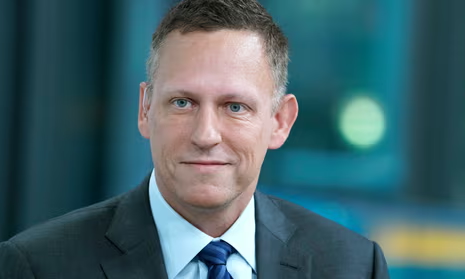
Public accounts of Palantir tend to describe it as a ‘data analytics company.’ This is accurate in the same sense that describing a scalpel as a ‘metal instrument’ is accurate. The description is technically correct and tells you almost nothing important.
Palantir was founded in 2003 with seed funding from In-Q-Tel, the venture capital arm of the Central Intelligence Agency. Its early growth was sustained by contracts with US intelligence agencies and military bodies. Its flagship products, Gotham and Foundry, were designed to aggregate, cross-reference, and analyse vast datasets for the purpose of surveillance, target identification, and population management. Its clients have included the CIA, NSA, ICE, the US Special Operations Command, and, more recently, the Israeli Defence Forces, with whom it signed a deal to provide ‘support for war-related missions’ the day after Israel was accused of genocide at the International Criminal Court.
Under the Trump administration, Palantir has provided the infrastructure for ICE’s mass deportation targeting operations, a programme that has been credibly accused of wrongful detention, the separation of children from their parents, and the forced sterilisation of women in immigration detention. These are not allegations contested by Palantir. They are the conditions of its operation.
Peter Thiel, Palantir’s chairman and founding investor, wrote in 2009 that he ‘no longer thinks that freedom and democracy are compatible.’ He was one of Donald Trump’s largest donors in 2016. Alex Karp, Palantir’s chief executive, has been equally candid about his company’s mission: ‘When the whole world is using Palantir, they can still not like us. They’ll have no choice.’ This is not the voice of a public servant. It is the voice of someone who understands that dependence is more durable than consent.
The Swiss Army investigated Palantir for seven years and rejected it. The conclusion was that routing critical intelligence through US-controlled proprietary software created unacceptable risks of data leakage to American agencies. Britain ignored this precedent entirely.
The NHS: Architecture of Capture

In 2023, the NHS awarded a consortium led by Palantir a contract for the Federated Data Platform, worth up to £330 million over seven years. The FDP was designed to integrate the health records of every person in England, including appointment data, diagnostic results, medication records, and GP notes, into a single operational system. Palantir’s Foundry platform provides the operating architecture.
When the Good Law Project obtained the contract documents under freedom of information law, three-quarters of the 586-page document had been redacted. We do not know what the government committed to. We do not know what Palantir is permitted to do with the data it processes. We do not know the exit terms, if any exist, should a future government wish to move to a different provider.
The last point matters most. Palantir’s Foundry is proprietary. Once NHS operational workflows are built into its architecture, once scheduling, resource allocation, surgical planning, and bed management are governed by its algorithms, the cost of switching providers becomes prohibitive. It is not merely financial. It is the institutional knowledge embedded in custom-built systems, the staff trained in Foundry’s interface, the clinical protocols written around its capabilities. The NHS does not become a customer. It becomes dependent. And dependence, as Karp has helpfully noted, is the point.
The British Medical Association has indicated that doctors may refuse to use the FDP in certain circumstances, citing Palantir’s contracts with ICE and the IDF. Chi Onwurah, chair of the Science and Technology Select Committee, has described the procurement process as requiring urgent parliamentary scrutiny. None of this scrutiny has produced a single additional page of the redacted contract.
The Revolving Door: The Ministry of Defence

In August 2025, Barnaby Kistruck left his post as the Ministry of Defence’s Director of Industrial Strategy, Prosperity and Exports, a role at the heart of the department’s procurement architecture. He had spent nearly two decades in senior national security positions. Nine days after leaving government, he joined Palantir as Senior Counsellor.
Three months later, Palantir was awarded the £240 million MoD contract, the largest it has ever received from British defence. The contract was described as covering ‘data analytics capabilities supporting critical strategic, tactical and live operational decision making across classifications.’ In plain terms: Palantir is now embedded in British military targeting.
Kistruck was Palantir’s fourth hire from the senior public defence sector in a single year. The others included two high-level civil servants, Laurence Lee and Damian Parmenter, and Leo Docherty, the former Conservative armed forces minister who lost his seat at the 2024 election. The pattern is deliberate. Iain Overton of Action on Armed Violence described it accurately: ‘The steady stream of senior defence officials moving into Palantir should concern anyone interested in how the military-industrial complex works. We risk becoming subservient to a single, American-based proprietary technology.’

The Swiss Army investigated Palantir’s suitability for its intelligence systems over seven years and rejected it. The central concern was sovereignty: routing sensitive military intelligence through proprietary US software created risks of data leakage to American agencies that the Swiss military considered unacceptable. Britain, which has outsourced not merely administrative functions but the decision-making architecture of its armed forces to a firm led by a man who bankrolled Donald Trump, has not addressed this concern publicly. It has not addressed it at all.
Former MP Tom Watson, elevated to the Lords as Lord Watson, a peerage being the customary reward in Labour circles for services to internal warfare, and once described by Len McCluskey as a man who lives in “a world of skulduggery,” now sits on Palantir’s public services advisory board while his lobbying firm simultaneously lists the company as a client. The moral landscape is not what it was. The moral landscape is not what it was.
Wes Streeting and Other Privatisation

Palantir’s penetration of the NHS does not stand alone. It is one current in a broader flow of private interest into public health, authorised, accelerated, and staffed from the top.
Research by the campaign group EveryDoctor has established that more than 60 per cent of Health Secretary Wes Streeting’s declared donations since entering Parliament in 2015 have come from companies and individuals with links to the private healthcare sector. The total exceeds £372,000. The government has already budgeted to double its annual spend on private hospitals, from approximately £1.25 billion to £2.5 billion a year. That is public money, transferred to private providers, authorised by a Health Secretary funded substantially by those same private interests. As we have reported in detail previously, the largest single source of those donations, Peter Hearn, whose healthcare recruitment firms have channelled over £260,000 to Streeting, operates through a company with no website, no internet presence, and, according to its own filed accounts, zero employees.
That is the context. Public cash heading for private hands. Now consider who has been appointed to oversee it.
In April 2025, Wes Streeting named Samantha Jones as the new permanent secretary of the Department of Health and Social Care, the most senior civil service role in British health, with responsibility for advising ministers on strategy and approving the department’s major spending decisions. Jones replaces Sir Chris Wormald, who departed to become Cabinet Secretary. She begins her new post at the precise moment that NHS England is being reintegrated into the DHSC, a structural change that will concentrate oversight of the entire NHS, its contracts, its data systems, and its relationships with private providers, into a single department.
Before her appointment, Samantha Jones served as chief executive of Operose Health, a company that runs nearly 60 GP practices across England, the majority in London, and which is now owned by HCRG Group. Operose was previously a subsidiary of Centene Corporation, the US healthcare giant. A 2022 Panorama investigation found that Operose practices offered patients roughly half the average number of GPs per patient compared to standard NHS provision, while using physician associates at approximately six times the NHS average rate. Concerns were raised about the adequacy of supervision those associates received.
Streeting described Jones as bringing ‘a wealth of experience from the frontline of healthcare.’ He did not describe what that experience, specifically at Operose, means for the direction of travel he is setting.
Nobody is claiming a brown envelope changed hands. That is not how this works and has not been for some time. Influence does not arrive with a bang. It walks through the front door wearing a lanyard. A company profits from running NHS services under a model that maximises throughput and minimises GP provision. Its former chief executive is appointed to run the department responsible for overseeing that same system. The lines between public stewardship and private interest do not blur at this point. They disappear.
GP surgeries are the gateway to the NHS. Control them and you shape the flow of patients, treatments, and money across the entire system. Samantha Jones ran the largest private GP chain in England. She now runs the Department of Health.
Jones also previously served as an advisor to Boris Johnson on ‘NHS transformation’ in 2021, a period during which the expansion of physician associates and private care models accelerated significantly, before working as interim permanent secretary and chief operating officer for 10 Downing Street. Her trajectory follows the same revolving pattern visible in the Palantir contracts: public roles providing regulatory knowledge and institutional access, private sector positions monetising that knowledge, and then a return to public authority at a more senior level. The state is not being captured by external force. It is being staffed from within by those who have already served on the other side of the transaction.
The question this poses is not abstract. It is material: are the decisions being made inside the DHSC being made in the interest of patients, or in the interest of a market? Because once those interests diverge, the NHS does not collapse overnight. It is hollowed out, still free at the point of use on the letterhead, still Labour’s proudest achievement in the speeches, but increasingly governed for profit behind the scenes. That is not reform. It is capture. And naming it accurately is the necessary first step to resisting it.
Those in the Shadows: A Gilded Friendly Web
The danger of examining these events individually is that they appear to be coincidences. They are not. They are the expression of a network, and the distinction matters. Coincidences can be dismissed. Networks have interests, memberships, methods, and histories.
This publication has documented in detail the role of the Trilateral Commission, the Bilderberg Group, and the interconnected architecture of think tanks, lobbying firms, and political donations through which the British governing class coordinates its priorities beyond democratic scrutiny. The pattern around Palantir is not separate from that architecture. It is one of its clearest expressions.
When Labour Heartlands reported on the 2026 Bilderberg meeting, held in Washington DC in April, Alex Karp appeared on the official participant list. Subsequent information received by this publication indicates he did not in fact attend. The reason understood to have guided his absence is the mounting toxicity surrounding the Epstein scandal and its intersection with the elite networks in which Palantir’s leadership operates. If accurate, it is a significant signal. A man who has publicly declared his company indispensable, who once said the world would have ‘no choice’ but to use his product, calculated that the political cost of being seen in that room, in that company, at this moment, was too high. The scandal that felled Mandelson is beginning to reshape the boundaries of the permissible. Not through law or accountability — those mechanisms remain largely absent — but through the elementary force of reputational exposure.
Peter Thiel, Palantir’s chairman, co-founder, and a member of the Bilderberg Steering Committee, was also absent from the 2026 meeting. His absence from his own organisation’s governance event is uncharacteristic. The Epstein scandal’s shadow falls unevenly, but it falls broadly, and those who have most to lose from scrutiny of elite network membership are currently weighing that exposure with unusual care.
Wes Streeting attended Bilderberg 2025 alongside Palantir, Peter Thiel and defence industry executives. Keir Starmer was a member of the Trilateral Commission until his own party’s rules required him to leave — a membership, this publication has previously established, he did not disclose to Labour members who elected him leader. Mandelson holds connections to both the Bilderberg network and the Trilateral Commission that predate and survive his ambassadorship. Epstein was a member of the Trilateral Commission. These are not biographical footnotes. They are the structural context in which the Palantir contracts, the unminuted visit, the failed vetting, and the revolving door of defence officials must be read.
Bilderberg is not a conspiracy in the dramatic sense. It is something more pedestrian and more durable: the annual reunion of people who have already decided, in advance, who counts. Palantir’s leadership belonged to that room. The fact that its CEO apparently thought it prudent to avoid it this year is itself a measure of how much the ground has shifted.
What connects these elements is not, to repeat, secret rooms and sealed envelopes. It is something more mundane and more powerful: a shared set of assumptions about who should govern, how decisions should be made, and whose interests count. In that worldview, public ownership is inefficiency waiting to be corrected. Data is an asset class. The NHS is a market to be opened. And a surveillance firm seeded by the CIA is simply a technology partner helping to modernise the state. Former MP Tom Watson, elevated to the Lords as Lord Watson, a peerage being the customary reward in Labour circles for services to internal warfare, and once described by Len McCluskey as a man who lives in “a world of skulduggery,” now sits on Palantir’s public services advisory board while his lobbying firm simultaneously lists the company as a client. The moral landscape is not what it was.
Jeremy Corbyn, speaking in Parliament, called it ‘a gilded friendly web’ and demanded an independent inquiry. He was right about the web. He was right to demand the inquiry. Neither acknowledgement has produced any consequence. That, in itself, is a measure of the network’s strength.
Sunlight is Not a Disinfectant: But it Helps
The demands are not complicated. They do not require legislation. They require only the willingness to treat public accountability as a value rather than an obstacle.
Parliament should require the publication, unredacted, of all contracts between Palantir and UK public bodies, including the NHS Federated Data Platform agreement, the Ministry of Defence strategic partnership, and any police force contracts. The revolving door between senior MoD positions and Palantir’s advisory board should trigger an automatic public interest review. The role of Global Counsel in facilitating Palantir’s access to government should be the subject of a formal Standards Commissioner investigation. And the Prime Minister should explain, in Parliament, with a full account of every person present and every topic discussed, what was said at Palantir’s Washington headquarters in February 2025.
None of this will happen without sustained pressure. The government has refused freedom of information requests from the Good Law Project, Foxglove, and openDemocracy. The Cabinet Office has described the Washington meeting as ‘informal,’ a word chosen precisely because it carries no obligation to record. The Foreign Office claims to hold no emails.
They are hoping you will move on. They are betting that the next scandal will crowd this one out. They have made that bet before and been proved right.
The Labour Party built the NHS so that a person’s survival would not depend on their ability to pay. Palantir built Foundry so that no government’s operational choices would be independent of its architecture. One of these projects has a future in Britain. The other is being quietly retired. You are paying for both.
Enjoyed this read? I’m committed to keeping this space 100% ad-free so you can enjoy a clean, focused reading experience. Crafting these articles takes a significant amount of research and heart. If you found this helpful, please consider a “small donation” to help keep the lights on and the content flowing. Every bit of support makes a huge difference.

Support Independent Journalism Today
Our unwavering dedication is to provide you with unbiased news, diverse perspectives, and insightful opinions. We're on a mission to ensure that those in positions of power are held accountable for their actions, but we can't do it alone. The Heartlands Tribune is primarily funded by me, Paul Knaggs, and by the generous contributions of readers like you. Your donations keep us going and help us uphold the principles of independent journalism. Join us in our quest for truth, transparency, and accountability – donate today and be a part of our mission!
Like everyone else, we're facing challenges, and we need your help to stay online and continue providing crucial journalism. Every contribution, no matter how small, goes a long way in helping us thrive. By becoming one of our donors, you become a vital part of our mission to uncover the truth and uphold the values of democracy.
While we maintain our independence from political affiliations, we stand united against corruption, injustice, and the erosion of free speech, truth, and democracy. We believe in the power of accurate information in a democracy, and we consider facts non-negotiable.
Your support, no matter the amount, can make a significant impact. Together, we can make a difference and continue our journey toward a more informed and just society.
Thank you for supporting Labour Heartlands