THE FLAG AND THE PEOPLE: RECLAIMING ENGLAND FOR THOSE WHO BUILT IT
Saint George’s Day. And right on cue, the same performance begins.
The right wraps itself in the Cross of St George as if they own it. The liberals flinch and reach for their explainers about Roman soldiers from Cappadocia. And the modern left, paralysed between the two, stands on the pavement and says nothing, hoping nobody notices it has forgotten where it came from.
Stand on the Liverpool waterfront and look out past the Liver Birds toward the Mersey. Seven miles of working waterfront, once the artery of a nation. The men who worked it carried a simple code: you did not cross another man’s picket line. When five hundred of them were sacked in 1995, dockers in twenty-seven countries stopped work in solidarity. The American West Coast came to a standstill. That is what English working-class identity looks like at full stretch: rooted in one place, reaching across every ocean. Fiercely local, and therefore genuinely international.
Nobody on that Liverpool quayside needed to be told where they came from, or taught to be embarrassed about it.
That is because working-class people, left or right, have always understood something that the political class has not. Solidarity is not an abstract principle. It is the bloke next to you on the picket line, the neighbour whose door you knock when something goes wrong, the whole end of a football ground rising together when the net ripples. It is seventy thousand people in a stadium who have never met, united by something that needs no explanation. The flag above them is not a political statement.
It is a recognition: we are the same, we come from the same place, we are in this together. Working-class communities have always organised under banners, whether that is a union lodge banner carried through Durham, a football scarf on a freezing terrace, or a Cross of Saint George hanging from a window in a terraced street. The instinct is identical in every case. It is the instinct to belong, to identify, to stand with your own people. The powerful have always feared that instinct, which is precisely why they have spent so long trying to either appropriate it or shame it out of existence.”

George Orwell noticed. In 1941, with bombs falling on English cities, he wrote that England was “the most class-ridden country under the sun” and that the left had made a catastrophic mistake: surrendering patriotism to reaction. He did not see love of country as the enemy of socialism. He saw abandoning it as socialism’s death warrant. “England is not the England of the guidebooks,” he wrote, but it was real, it was distinct, and it belonged above all to the people who actually lived in it, worked in it, and were buried in it.
Clement Attlee understood this. A man who had fought at Gallipoli, who knew what ordinary England had given and what it was owed, built the National Health Service, the welfare state, the modern social contract, as an act of national solidarity. Not despite his patriotism. Because of it. He believed this country, with all its faults, was worth building properly. That is a more serious love of England than anything the flag-waving right has ever managed.

Michael Foot understood it too. Born in Plymouth, soaked in Hazlitt and Swift and Byron, he carried the English radical literary tradition in his bones. He was not embarrassed by England. He was furious at what was being done to it by those who claimed to speak for it while stripping it bare.
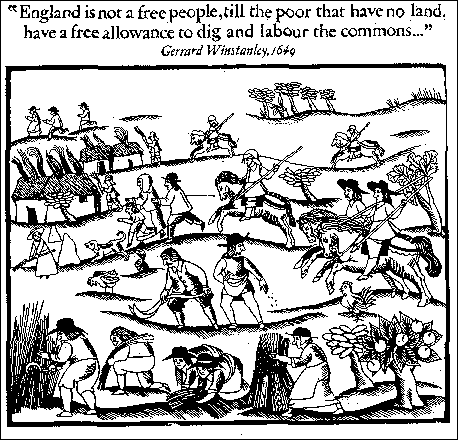
Tony Benn traced his socialism not to Brussels or to any international institution, but directly through the Levellers, the Diggers, the Chartists, the long, stubborn, English line of ordinary people demanding their rights from those who held power over them. He understood that the Cross of St George had been carried by working people long before the right ever got hold of it. The Diggers planted it at St George’s Hill in 1649 and demanded the common land back for the common people. That flag belonged to them. It belongs to us.
So when they tell you he wasn’t English, tell them this: neither were the Norman lords who took the land, the financiers who enclosed it, the hedge funds that bought the utilities, the private equity firms that asset-stripped the industries. Nobody seemed worried about their origins. Origins only matter, apparently, when it is England’s working people being told to keep their heads down and their flags in the drawer.
A nation is not a bloodline. It is habits, loyalties, shared memory. It is the pit village in Yorkshire, the terraced rows in Derbyshire, the dockyards in Liverpool, Bristol, Felixstowe and London, the steel towns and the market squares where people have argued and organised and looked after one another for generations. I know what England is because I grew up in it. It is not a concept to be debated in a seminar room. It is something you feel in your chest when you hear a brass band or smell a working men’s club or stand at a graveside in a churchyard your family has used for two hundred years.

The dragon Saint George faces is not a fairy tale. In every generation it takes a different form. The feudal landlord. The rack-renting mill owner. The privatiser who sells the water, the railways, the post office, the steel, and then waves the flag as the sale completes. The dragon is whatever threatens the community, whatever devours the common good, whatever the powerful use to feed themselves at the expense of the many.
The left has always been the ones trying to slay it. We just forgot to say so.
Fly the flag. Not for kings. Not for Nigel Farage. Not for a government that sells the country’s bones to foreign capital while wrapping itself in red, white, and blue.
Fly it for the people who built this place and keep it going. For the neighbours and the workmates and the families. For the English radical tradition that runs unbroken from the Levellers to the miners to every person who ever stood up and said: this is ours, and we are not moving.
It always was ours. We just need the courage to say it.
Happy Saint George’s Day.
Enjoyed this read? I’m committed to keeping this space 100% ad-free so you can enjoy a clean, focused reading experience. Crafting these articles takes a significant amount of research and heart. If you found this helpful, please consider a “small donation” to help keep the lights on and the content flowing. Every bit of support makes a huge difference.

Support Independent Journalism Today
Our unwavering dedication is to provide you with unbiased news, diverse perspectives, and insightful opinions. We're on a mission to ensure that those in positions of power are held accountable for their actions, but we can't do it alone. The Heartlands Tribune is primarily funded by me, Paul Knaggs, and by the generous contributions of readers like you. Your donations keep us going and help us uphold the principles of independent journalism. Join us in our quest for truth, transparency, and accountability – donate today and be a part of our mission!
Like everyone else, we're facing challenges, and we need your help to stay online and continue providing crucial journalism. Every contribution, no matter how small, goes a long way in helping us thrive. By becoming one of our donors, you become a vital part of our mission to uncover the truth and uphold the values of democracy.
While we maintain our independence from political affiliations, we stand united against corruption, injustice, and the erosion of free speech, truth, and democracy. We believe in the power of accurate information in a democracy, and we consider facts non-negotiable.
Your support, no matter the amount, can make a significant impact. Together, we can make a difference and continue our journey toward a more informed and just society.
Thank you for supporting Labour Heartlands