Britain’s most politically charged criminal trial of the year opens at the Old Bailey on Monday 27 April, as three men face a jury over a series of arson attacks targeting properties connected to Prime Minister Keir Starmer.
The defendants are Roman Lavrynovych, 21, a Ukrainian national from Sydenham, south-east London; Petro Pochynok, 34, also Ukrainian, of Holloway Road, Islington; and Stanislav Carpiuc, 26, a Romanian national of Ukrainian origin, from Chadwell Heath in east London. All three have been held on remand at HMP Belmarsh since their arrests. All three have pleaded not guilty.
Lavrynovych faces three separate counts of arson with intent to endanger life. Pochynok and Carpiuc each face one count of conspiracy to commit arson with intent to endanger life.

The alleged incidents unfolded over five days in north London in May 2025. The first occurred on 8 May, when a car was set alight in a residential street in Kentish Town. Three days later, on 11 May, a fire broke out at the front door of a house converted into flats in Islington. A further fire occurred in the early hours of 12 May at a property in the same Kentish Town street.
The Kentish Town property was the home where Starmer lived before he became Prime Minister and moved into Downing Street. Sir Keir was no longer living at any of the properties at the time of the fires. No injuries were reported in any of the three incidents.

Counter Terrorism Policing London is leading the investigation due to all three fires having connections to a high-profile public figure. That designation reflects the nature of the target, not the charge. No terrorism charges have been brought, and the Metropolitan Police have not attributed the attacks to any foreign state actor.
A fourth man, aged 48, arrested at Stansted Airport in June 2025 on suspicion of conspiracy to commit arson with intent to endanger life, has since been released without charge. A fifth person, a 19-year-old man from Harlow, Essex, was detained in January 2026 and released under investigation while enquiries continue.
The trial will be presided over by a High Court judge. The prosecution must prove its case beyond reasonable doubt. The defendants will have full opportunity to challenge the evidence presented. Nothing in this report should be taken as any indication of guilt or innocence, which is a matter solely for the jury to determine.
The facts are what they are. The jury will decide what they mean.
The question is not whether this trial will be a political disaster for Keir Starmer, but whether it will happen at all before the local elections. Legitimate concerns surround the conditions in which the Old Bailey case opens, or whether it will be quietly pushed down the line and given a new date.

This has been the most turbulent period of the Starmer premiership, and the political ground is shifting fast. Those concerns are compounded by a simple question of timing. Labour is currently projected to lose as many as 1,828 council seats at the May 7 elections in England, with the party projected to lose control in heartland councils including Wigan, Sunderland and Barnsley Poll Check, places that were once as safe as houses. If the trial date were to move for any procedural reason, those concerns would only deepen. Cases of this public weight require stability of process as much as they require legal rigour.
The magnitude of this trial is also inseparable from a question that Westminster cannot currently answer: whether Keir Starmer will even still be Prime Minister when the jury is sworn in. Today’s revelations have sharpened that uncertainty considerably. Starmer faced the Commons on Monday to explain how he was unaware that Lord Mandelson had failed his security vetting before taking up his post as ambassador to Washington, blaming the Foreign Office’s top civil servant, Sir Olly Robbins, for deliberately keeping him in the dark. His statement came amid mounting calls for resignation and accusations that he had misled parliament. Starmer was warned of the reputational risks associated with appointing Mandelson due to his continued relationship with Epstein, and yet the appointment went ahead. Denying that he misled the House while conceding that information “the House should have had” was withheld is a distinction that satisfies no one.

The most significant voice to join the calls for Starmer’s resignation is not one that comes from the opposition benches. Lord Maurice Glasman, the founder of the Blue Labour movement and the intellectual conscience of Labour’s working-class tradition, has said plainly what many in the parliamentary party are thinking but lack the courage to say publicly. “If you can’t own your mistakes, you can’t move. All he needed to say was ‘we made an error.’ But he’s completely stuck in saying he hasn’t done anything wrong, so this can’t go away,” Glasman told the Telegraph. His conclusion was unequivocal: “He cannot conceivably continue as a credible Prime Minister any longer. And that’s all because he cannot say ‘I made a mistake, I’m sorry.'”
What gives Glasman’s verdict its particular weight is not merely his standing within the Labour tradition. He had warned about this appointment before it was made. He had advised Starmer’s former chief of staff Morgan McSweeney against appointing Mandelson, citing his longstanding ties to Jeffrey Epstein.

The warning was delivered. It was ignored. “The abdication of responsibility and the turn to procedure is really not the way ahead,” Glasman said. “Politicians should govern and make decisions in our sovereign democracy.” He also noted that May 7 is going to be another debacle for his party, and that the crisis is paralysing a government that has urgent business before it.
When the man who has spent years arguing that Labour must reconnect with the working-class communities it abandoned reaches this conclusion, the parliamentary arithmetic becomes secondary. The moral argument is already settled.
Starmer has few strong supporters in his party. There is widespread frustration at his lack of direction across all factions. He remains in place because there is no agreement on a successor. That is not a ringing mandate; it is a stay of execution. The more cynical reading of the parliamentary arithmetic is that Labour may simply decide to leave him in place until May 7, let him absorb the electoral catastrophe personally, and then move. Why, after all, should anyone else carry the can for the disaster Starmer has been? The party elders who promoted him, protected him and silenced those who warned about his judgment have no interest in owning the wreckage.
As former MP Andrew Bridgen noted publicly this week, the timing of stories around this trial will be the signal that the establishment has decided to move against Starmer, when that decision is finally made. Better to let the leader take the fall and then present a fresh face to a country that has already moved on.
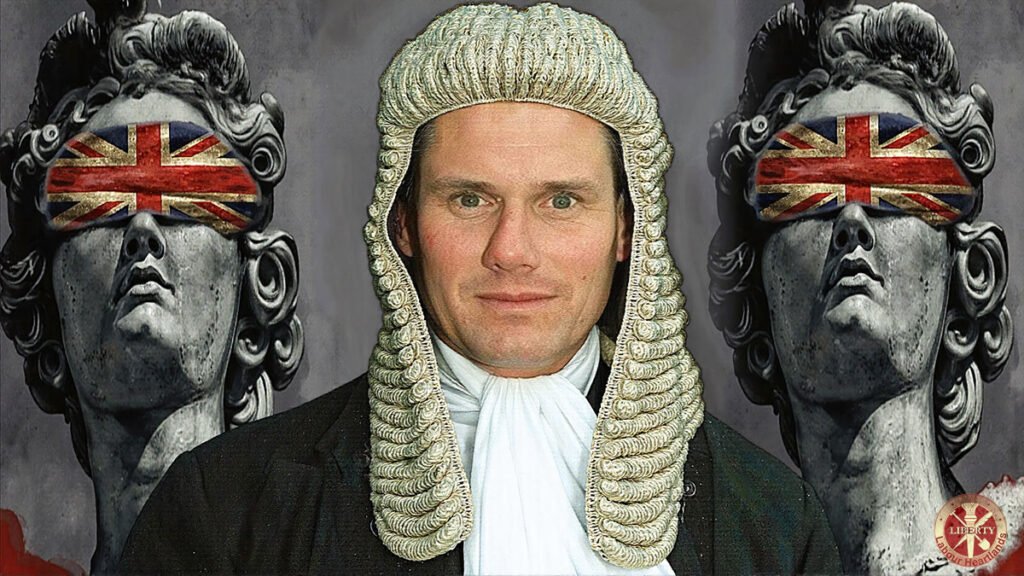
After all, Starmer has served his primary purpose: he has overseen a contraction of British liberties more profound than any Tory government ever dared, and with that work finished, he is no longer a protected asset.
There are, in this, reasons to be grateful for small mercies. This trial still has a jury. That is no longer something any citizen of England and Wales should take for granted. The Courts and Tribunals Bill, currently grinding through parliament, would remove a defendant’s right to elect trial by jury for a wide range of offences, replacing the jury with a single judge sitting alone. The Criminal Bar Association has declared itself “fundamentally opposed” to the proposals, and a survey of criminal barristers found around 90 percent against them. Three thousand two hundred lawyers wrote to the Prime Minister urging the government to abandon the reforms. Their letters, one suspects, went the way of all warnings delivered to this particular Prime Minister. As for the minister responsible, David Lammy was once clear enough on the principle. He told parliament that criminal trials without juries were a bad idea. He is now legislating for them.
When a minister was asked whether the government was pursuing these changes for reasons other than efficiency, she confirmed: yes. Ideology, then. The ideology of a government that trusts neither its citizens nor the courts they built.
But for now, the facts before the Old Bailey are what they are. The jury will decide what they mean. However, spare a thought for how long we will be able to say that with any confidence. At the rate this government is moving, the Star Chamber is not ancient history. It is a policy paper awaiting a second reading.
When a government cannot account for who it vets, who it trusts, or who it protects, but most of all, who it represents, it has already lost the only argument that ever mattered: that it deserves to be in power at all.
Enjoyed this read? I’m committed to keeping this space 100% ad-free so you can enjoy a clean, focused reading experience. Crafting these articles takes a significant amount of research and heart. If you found this helpful, please consider a “small donation” to help keep the lights on and the content flowing. Every bit of support makes a huge difference.

Support Independent Journalism Today
Our unwavering dedication is to provide you with unbiased news, diverse perspectives, and insightful opinions. We're on a mission to ensure that those in positions of power are held accountable for their actions, but we can't do it alone. The Heartlands Tribune is primarily funded by me, Paul Knaggs, and by the generous contributions of readers like you. Your donations keep us going and help us uphold the principles of independent journalism. Join us in our quest for truth, transparency, and accountability – donate today and be a part of our mission!
Like everyone else, we're facing challenges, and we need your help to stay online and continue providing crucial journalism. Every contribution, no matter how small, goes a long way in helping us thrive. By becoming one of our donors, you become a vital part of our mission to uncover the truth and uphold the values of democracy.
While we maintain our independence from political affiliations, we stand united against corruption, injustice, and the erosion of free speech, truth, and democracy. We believe in the power of accurate information in a democracy, and we consider facts non-negotiable.
Your support, no matter the amount, can make a significant impact. Together, we can make a difference and continue our journey toward a more informed and just society.
Thank you for supporting Labour Heartlands