The Farage Scandal Is a Symptom, Not the Disease
Every political party in Westminster has a donor. The only question is what they have been promised.
The parliamentary standards watchdog has launched a formal investigation into Nigel Farage over a £5 million gift from Christopher Harborne, a Thailand-based cryptocurrency billionaire who holds a twelve per cent stake in the stablecoin issuer Tether. Farage received the money shortly before announcing his candidacy for the Clacton seat in the 2024 general election, and has claimed it was a personal gift to cover his security costs, falling outside the rules requiring new MPs to declare benefits received in the twelve months before entering parliament. His party insists everything was declared in accordance with the rules. His opponents insist it was not. The watchdog will now decide.
Good. Investigate it. Every penny of it…
But here is the thing they would rather you not ask. If we are to hold Farage to account for taking £5 million from a crypto billionaire registered in Thailand, what precisely are we to make of Keir Starmer accepting gifts of clothing from a Labour peer while his government stripped the winter fuel payment from pensioners? What are we to make of a party of labour, of the working class, of trade union history and the red flag, receiving the largest single donation in its entire existence from a hedge fund registered in the Cayman Islands, with holdings in arms manufacturers, fossil fuel giants, and American private healthcare firms?
The answer, if you listen carefully to the Westminster machine, is: different. Entirely different. Because it was declared. Because the rules were followed. Because, in the language of the political class, the correct box was ticked.
This is not transparency. It is the theatre of transparency. It is a conjurer’s trick designed to make the audience feel they have seen the secret when they have seen nothing at all.
The question was never whether the piper’s fee was listed in the correct column of the correct form. The question was always who is paying, and what tune they intend to collect.
A DEAD CAT LANDS WHERE IT IS NEEDED MOST

There is one further thing worth saying before we proceed, and it requires a little political honesty that most of the media class will decline to offer. The timing of this story’s escalation is not incidental.
In the seven days prior to the parliamentary standards watchdog announcing its formal investigation into Farage, Keir Starmer’s Labour Party suffered major losses in local and regional elections held across Britain, losing more than 1,100 seats it had previously held, while Reform UK gained more than 1,400. Labour lost control of 38 councils. In Wales, a Labour heartland for generations, Plaid Cymru won the most seats. Within days, 72 Labour MPs had publicly demanded Starmer resign or set a date for his departure. The Prime Minister’s position was, by any reasonable measure, the most precarious of his leadership.
Then Farage and his five million pounds arrived on the front pages. And the conversation changed.
A dead cat thrown onto the table is still a cat, and this one is genuine. But its purpose remains the same regardless of whether the animal once lived. It lands on the table when someone needs the room looking the other way.
Let us be clear: this is not an argument against the investigation. It is an argument against selective attention.
A dead cat thrown onto the table is still a cat, and this one is genuine. Harborne’s money, the crypto millions, the question of declaration: all of it deserves proper scrutiny. But a dead cat is still a dead cat, and its purpose remains the same regardless of whether the animal once lived. It lands on the table when someone needs the room looking the other way.
What was the room not supposed to be looking at? A government in freefall. A Prime Minister who, in the same week, described the catastrophic loss of 1,496 councillors as part of a “ten-year project of renewal.” A Labour Party whose most significant political crisis since taking office is unfolding in full public view, and whose principal media allies have chosen, with impeccable timing, to train their considerable attention on the man across the aisle.
We are not excusing Farage. We are noting who benefits from this moment being the moment. And we are insisting, as we always have, that accountability must not be applied like a spotlight, illuminating one corner of the stage while the rest of the theatre burns in darkness.
THE CAYMAN ISLANDS CALLED. LABOUR ANSWERED.
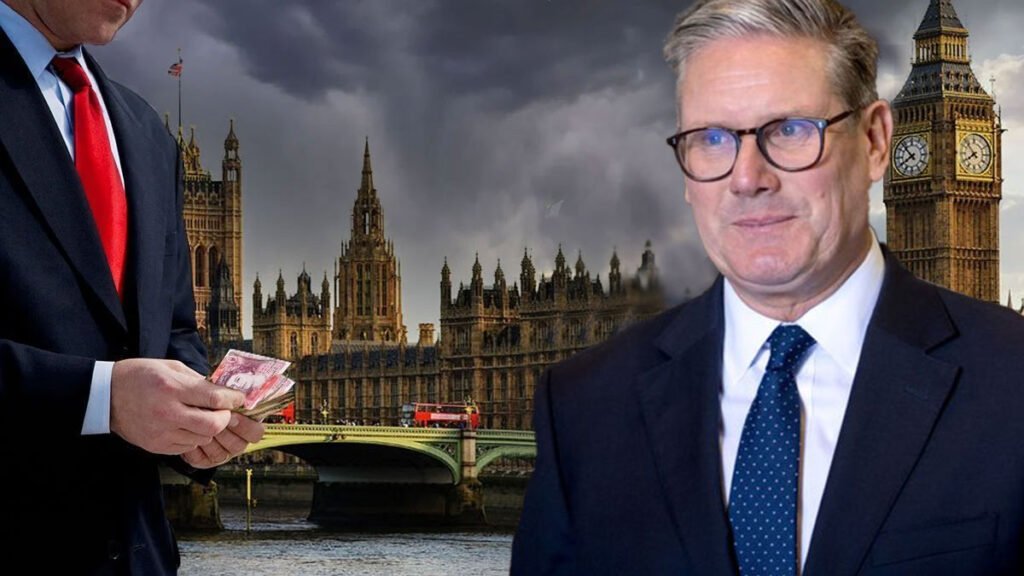
Labour’s largest-ever donation, the sixth-largest in British political history, came from Quadrature Capital, a Cayman Islands-registered hedge fund. Electoral Commission records indicate the party received the £4 million in the narrow window between the announcement of the general election and the start of the pre-poll reporting period, when all donations above £11,180 had to be published weekly rather than quarterly. Despite being donated in May 2024, the gift was not published until more than two months after Labour won the election.
Quadrature’s portfolio at the time included holdings in arms manufacturers Northrop Grumman and Lockheed Martin, American private healthcare companies including UnitedHealth and HCA Healthcare, asset managers including Blackstone and KKR, and technology firms including Palantir. The firm called it a values-based donation. It said it was not political. It said it was about climate. And Labour’s new climate envoy, as journalist Michael Crick subsequently revealed, sat on the advisory board of the Quadrature Charitable Foundation.
The donation was timed to avoid the pre-poll reporting period, delaying its public disclosure by months. Not illegal. Merely convenient.
We have covered both these scandals in depth at Labour Heartlands: the wardrobe, the hedge fund, the timing, the silence. What we have not said loudly enough, until now, is this: the scandals are not aberrations from a broken system. They are the system operating exactly as designed.
TWO MOMENTS IN A DEMOCRACY
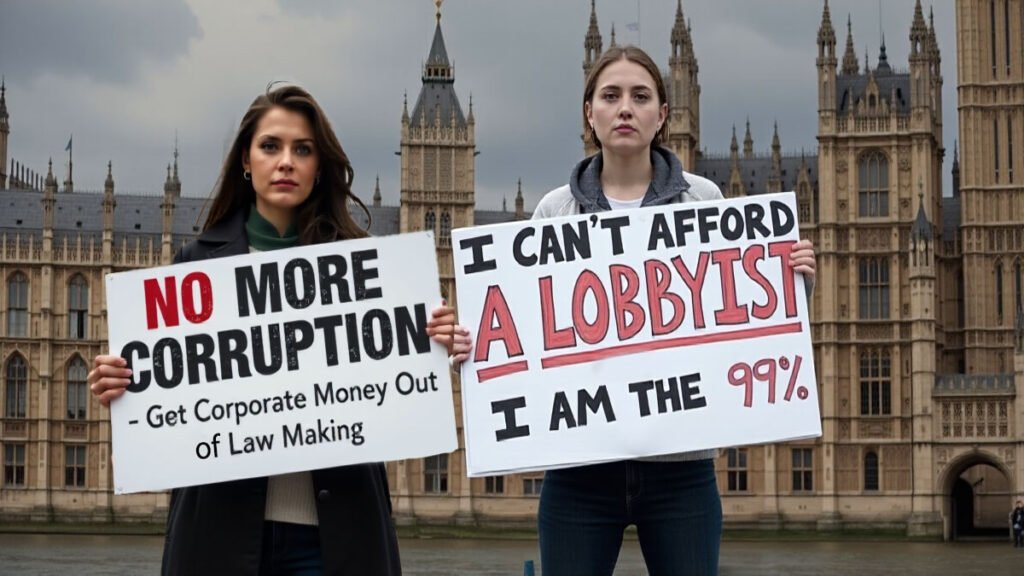
There are two moments in British democracy. The first is the moment you vote, which happens once every few years, in a polling booth, in a few seconds, on a piece of paper. The second is every other moment: the access, the dinners, the donations, the phone calls, the appointments, the revolving door. The first moment belongs to you. The second belongs to them.
The donor class does not wait for elections. It does not need to. It is already there, in the anteroom, in the correspondence, in the terms and conditions attached to every significant cheque. When a hedge fund whose portfolio includes arms dealers and fossil fuel extractors transfers four million pounds to the governing party of the United Kingdom, it is not making a gesture of civic generosity. It is making an investment. And investments, as any financier will tell you, are expected to return a yield.
The appropriate response to learning this is not to congratulate the party for having ticked the correct box on the Electoral Commission’s forms. The appropriate response is to ask why this is legal at all.
OTHER COUNTRIES ASKED THE QUESTION. THEY ANSWERED IT.

In Germany, state funding of political parties is tied to demonstrated electoral support, providing resources without the corrupting dependency on private wealth. In Canada, corporate and union donations to federal parties were banned outright in 2006. The argument in both cases was not ideological abstraction. It was practical: democracy cannot function when the parties that compete for public power are financially dependent on private interests.
In Britain, we have not had this conversation seriously. We have had instead the ritual of declaration and disclosure, the periodic scandal, the investigation, the resignation or the reprieve, and then the resumption of exactly the same arrangements under a different name.
In the 2024 American federal elections, approximately 300 billionaire families accounted for nineteen per cent of all reported federal campaign contributions, totalling around three billion dollars.
Look, if you want to understand where this road ends, look west. In the 2024 American federal elections, approximately three hundred billionaire families accounted for nineteen per cent of all reported federal campaign contributions, totalling around three billion dollars. The party with the largest war chest does not always win, but it almost always shapes the battlefield, determines the terms, and sets the limits of what is considered possible.
This is not a warning about a future we might stumble into. It is a description of where the logic of private political funding, left unchecked, inevitably arrives. Britain is not America. But it is following a recognisable trajectory. The bells and whistles of political advertising, the targeted campaigns, the media saturation, the professional operation that costs tens of millions: all of it requires money. And money, in the absence of democratic alternatives, comes with strings. Long, expensive, invisible strings.
THE COUNTERARGUMENT. AND THE ANSWER TO IT.

The counterargument, usually offered by those most invested in the status quo, is that public funding of political parties is an imposition on the public purse. Why, they ask, should working class people subsidise political parties they despise?
It is a fair question. It deserves a straight answer.
Because the alternative is that working class people subsidise the donor class instead, not through taxation, but through the policies, the wage structures, the planning decisions, the trade agreements, and the regulatory frameworks that donors purchase with their contributions. The cost of donor-funded democracy is not invisible. It appears in NHS waiting lists when private health firms have invested in the governing party. It appears in energy bills when fossil fuel interests have the ear of ministers. It appears in every moment where the interests of those who can afford to pay for political access diverge from the interests of those who cannot.
A modest, proportional public subsidy for registered parties, structured to reflect their democratic footprint rather than their fundraising capacity, would cost a fraction of what the existing system extracts from the people it nominally serves.
INVESTIGATE EVERYTHING. THEN REMOVE THE CONDITION THAT MAKES IT NECESSARY.
Nigel Farage should be investigated. So should every donation, from every donor, to every party, regardless of which side of the political ledger it sits on.
But investigation, disclosure, and the tick of the compliance box are not the solution. They are the managed appearance of accountability in a system that has no genuine interest in being held accountable. The piper will play whatever tune he is paid to play. He has always done so. He will continue to do so until we remove the financial relationship between private wealth and public power entirely.
The Levellers understood this, three and a half centuries ago, arguing on the rain-soaked common ground of England that sovereignty rests not in property or title but in the people themselves. The great democratic tradition of this island people has always known that power purchased is power that does not belong to those who thought they cast it.
We are told we live in a democracy. Perhaps one day we will.
Until then, we have nothing to lose but our donors’ chains.
Enjoyed this read? I’m committed to keeping this space 100% ad-free so you can enjoy a clean, focused reading experience. Crafting these articles takes a significant amount of research and heart. If you found this helpful, please consider a “small donation” to help keep the lights on and the content flowing. Every bit of support makes a huge difference.

Support Independent Journalism Today
Our unwavering dedication is to provide you with unbiased news, diverse perspectives, and insightful opinions. We're on a mission to ensure that those in positions of power are held accountable for their actions, but we can't do it alone. The Heartlands Tribune is primarily funded by me, Paul Knaggs, and by the generous contributions of readers like you. Your donations keep us going and help us uphold the principles of independent journalism. Join us in our quest for truth, transparency, and accountability – donate today and be a part of our mission!
Like everyone else, we're facing challenges, and we need your help to stay online and continue providing crucial journalism. Every contribution, no matter how small, goes a long way in helping us thrive. By becoming one of our donors, you become a vital part of our mission to uncover the truth and uphold the values of democracy.
While we maintain our independence from political affiliations, we stand united against corruption, injustice, and the erosion of free speech, truth, and democracy. We believe in the power of accurate information in a democracy, and we consider facts non-negotiable.
Your support, no matter the amount, can make a significant impact. Together, we can make a difference and continue our journey toward a more informed and just society.
Thank you for supporting Labour Heartlands