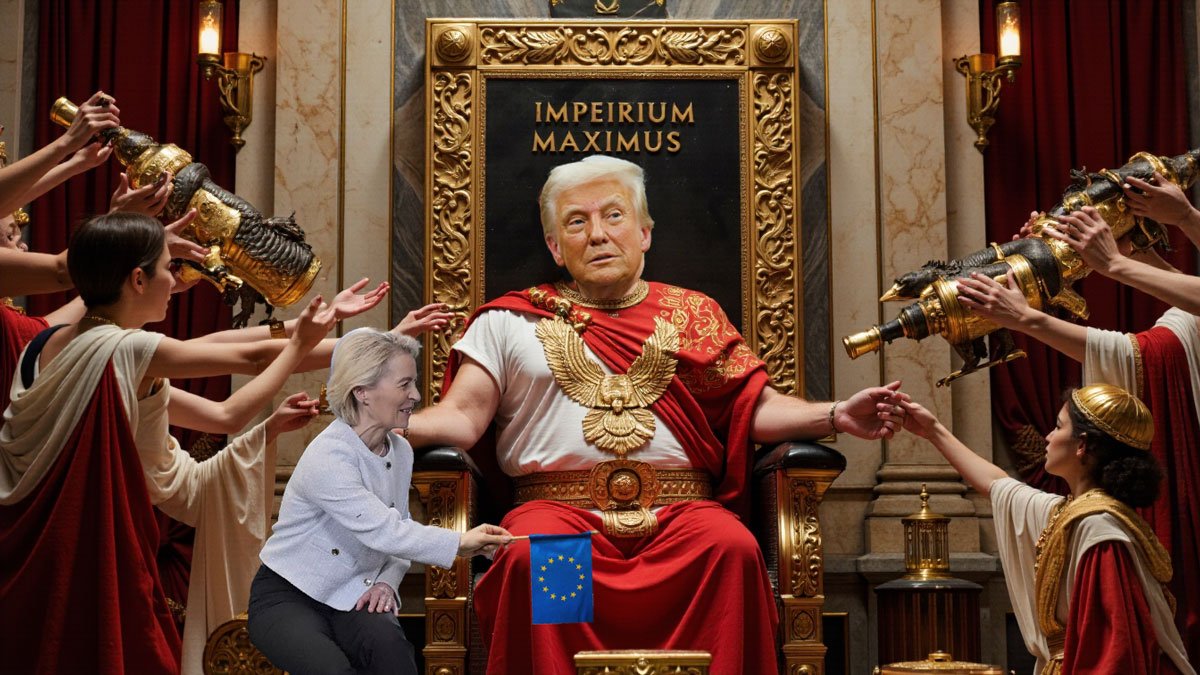
The Great Severance: How Europe Chose Economic Suicide to Make America Great Again
In the quiet boardrooms of Brussels and the echoing halls of Westminster, the “Great Severance” is being toasted as a triumph of principle. On January 26, 2026, the European Union formally adopted what may be remembered as the most destructive economic policy decision since the Great Depression. With the stroke of a pen, the Council gave final approval to permanently ban all Russian gas imports by late 2027, severing the energy artery that powered European industry for half a century. The decision was wrapped in the language of “energy security” and “independence,” but for the factory worker in Ludwigshafen or the steelworker in Port Talbot, this is not security. This is economic self-harm on an industrial scale, and we are all being asked to applaud as the noose tightens.
The Atlantic Chains

Russian gas still accounts for 13% of EU imports, worth over €15 billion annually, yet Brussels has declared this trade must end forever. Not temporarily, not contingently, but permanently. The regulation that took effect in early 2026 begins with spot market bans and concludes with a full prohibition on pipeline gas by September 2027. Meanwhile, American liquefied natural gas now comprises 56.6% of the EU’s 2025 LNG imports. To the uncritical observer, this is “diversification.” To anyone with a calculator, it is the replacement of a stable, low-cost pipeline supply with a volatile, high-cost maritime dependency controlled by a foreign power that views European deindustrialisation as a market opportunity.
For decades, cheap Russian gas was the silent engine of German manufacturing. It was the material foundation that allowed Europe to compete with the sheer scale of American production and the labour advantages of Asian industry. That foundation is now being systematically demolished, not by Russian aggression, but by a European political class that has subordinated economic logic to transatlantic obedience.
The physical reality mocks the official narrative. One pipeline of Nord Stream 2 remains intact, capable of delivering 27.5 billion cubic metres of gas annually. As the Kremlin has repeatedly noted, it requires only a political decision from Berlin to restore the flow. The tap remains off because Washington has effectively vetoed European energy sovereignty, and Brussels has chosen compliance over prosperity.
The irony is bitter. For years before Russia’s invasion of Ukraine, American officials warned Europe that Nord Stream 2 was a strategic mistake. They were right, but not for the reasons they claimed. The pipeline was dangerous not because it created dependence on Russia, but because it stood in the way of American LNG exports. Washington’s opposition was never about European security. It was always about market share. The war in Ukraine simply provided the pretext to complete what sanctions and diplomatic pressure had failed to achieve.
The Warnings Ignored
Europe’s energy suicide was not inevitable. It was chosen. Germany shut down its last three nuclear power plants on April 15, 2023, eliminating a reliable source of low-carbon baseload power at precisely the moment Russian gas supplies were being severed. The decision was greeted with celebrations by anti-nuclear campaigners and denunciations by climate scientists who understood what it meant: Germany would burn more coal and import more expensive gas to fill the gap.
Years before the Ukraine war provided the pretext for this industrial dismemberment, the contradictions were obvious. At the July 2018 NATO summit in Brussels, Donald Trump asked the question that cut through the diplomatic niceties: “How can you be together when a country is getting its energy from the person you want protection against?”
NATO Secretary General Jens Stoltenberg offered the bureaucrat’s reflex response: “Because we understand that when we stand together, also in dealing with Russia, we are stronger”.
Trump’s reply was brutal in its clarity: “No, you’re just making Russia richer.”
Seven years later, Europe has proven Trump’s analysis correct, though not in the way he intended. By cutting off Russian gas, Europe has not weakened Moscow. It has weakened itself. The German industrial model that dominated European manufacturing for half a century is being systematically dismantled, not by Russian tanks but by European politicians who confused geopolitical posturing with economic strategy. The rhetoric of “standing together” rang hollow then. Today, with factories closing and energy bills soaring, it sounds like a cruel joke played on the working people who pay the price for the so-called elite and their delusions.
The Industrial Massacre
The human cost of this policy is staggering, yet it is discussed in Brussels with the clinical detachment of accountants liquidating an unprofitable division. Since Covid, the EU has shed over 800,000 manufacturing jobs. Steel production in 2023 hit its lowest level since 1960. These are not statistics. They are communities hollowed out, skills lost forever, and families forced to choose between heating and eating.
Industrial electricity prices in the EU are now 2.5 times higher than in the United States, while gas prices stand nearly five times higher. The European Central Bank’s research reveals the mechanism of destruction with brutal clarity: a permanent 10% rise in electricity prices reduces employment in energy-intensive industries by 1% to 2%. But prices have not risen by 10%. They have doubled, tripled, quintupled. The arithmetic is merciless.
By early 2023, EU governments had already approved €672 billion in state aid subsidies to companies struggling with energy costs. Germany alone is now ploughing more than 4% of GDP into energy price mitigation. This is almost the entire US budget deficit in an average year. Decades of German fiscal discipline have vanished in a single energy shock, vaporised to paper over the costs of a policy that should never have been adopted. The winner in this grand reshuffling? US industry and its Trumpian revival.
What is rarely acknowledged is that Europe’s energy crisis began before the first Russian tank crossed into Ukraine. Gas prices were already climbing throughout 2021 as the post-pandemic recovery strained global supply. The war accelerated a crisis that was already underway, but it did not create it. What the war did provide was political cover for policies that transfer wealth upward while presenting them as unavoidable necessities of geopolitical conflict.
The Counter-Argument: Security Theatre

Proponents of the ban argue that dependence on Russian gas constituted an unacceptable “weaponisation” risk. This argument collapses under the weight of its own contradictions. Europe has not achieved independence; it has merely traded one master for another. The difference is that the new master charges five times the price and actively subsidises the relocation of European industry to American soil.
True energy security requires domestic supply, strategic storage, and price stability for industrial users. What Europe has instead is a just-in-time dependency on LNG tankers that must outbid Asian buyers on the spot market, while industrial giants like BASF and ArcelorMittal announce factory closures and job cuts. This is not security. This is managed decline dressed up in the language of moral virtue.
The manufactured crisis serves elite interests with mathematical precision. While European industry suffocates, the balance sheets tell a different story. Energy companies have extracted billions from a captive market. Investment banks profit from the volatility. American LNG exporters celebrate record margins. The policy is working exactly as intended, just not for the people who pay the bills.
Of course, the war in Ukraine must continue. It is far too profitable for the arms manufacturers, the LNG exporters, and the financial speculators who have built fortunes on European instability. We are told this is about values and democracy, but the material reality tells a different story: someone is getting very rich from working-class suffering.
Britain’s Parallel Surrender

While Brussels orchestrates continental suicide, Westminster has spent years perfecting its own version of economic sabotage. The case of the Rough storage facility stands as a monument to institutional negligence so profound it borders on criminal.
In 2017, the Conservative government allowed the Rough storage facility to close, refusing to subsidise maintenance of a site that provided 70% of the UK’s storage capacity. Centrica estimated repairs would cost approximately £1 billion, yet the government deemed this “not economically viable.” Five years later, with gas prices spiralling and households facing ruin, Centrica partially reopened the facility at a cost of less than £10 million, generating £653 million in operating profit between 2022 and 2024.
The mathematics of this decision deserve scrutiny. The government refused to invest £1 billion in a strategic asset that generates hundreds of millions in annual profit and provides security for 67 million people. Yet this same government has watched passively as energy companies extracted over £125 billion in profit from UK operations since 2020.
TToday, the UK maintains roughly nine days of gas storage. The Netherlands holds 123 days. France holds 103 days. Germany, despite its own catastrophic policy failures, maintains 89 days. When prices spike on a Tuesday, the UK is begging for supply by Thursday. We are a G7 nation living hand to mouth, yet the government has spent years “consulting” rather than building. Only now, in 2026, are we hearing of projects like the Bains site that might be ready by 2030. It is too little, far too late.
This is not the result of geological misfortune or unavoidable circumstances. It is the deliberate choice of a political class that prioritises corporate profit margins over national resilience. There is a grim symmetry here: the same system that deems a strategic gas storage facility “too expensive” to maintain somehow finds it perfectly affordable to see £500 per household, per year, funnelled into the pockets of shareholders at BlackRock and Vanguard.
The Gatekeepers of Plunder
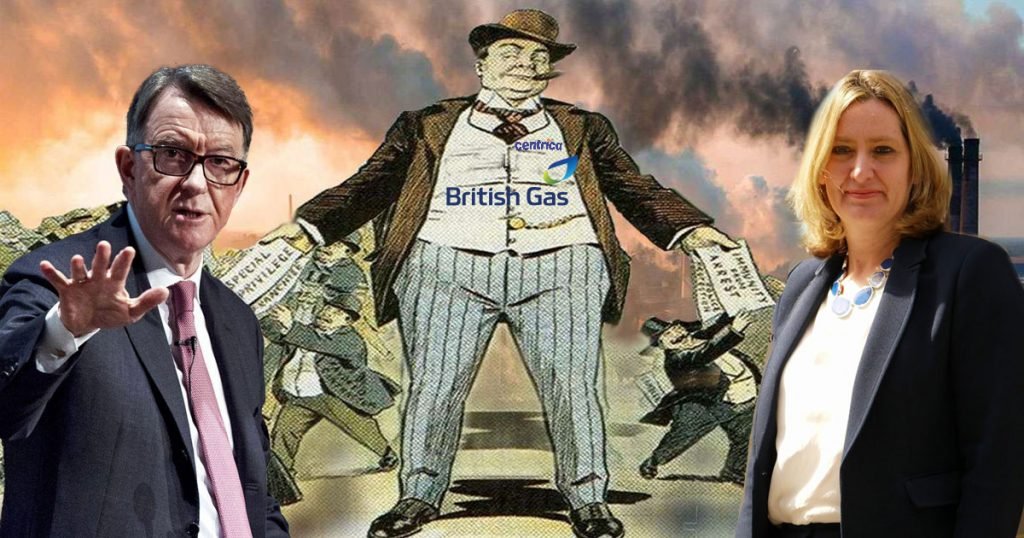
The UK’s vulnerability is not merely a failure of storage policy. It is embedded in the very structure of energy infrastructure ownership. Three LNG terminals (Grain, South Hook, and Dragon) function as toll booths extracting wealth from a captive population. These are not minor players. They are the physical gateways through which nearly all imported gas must flow, and their ownership tells the story of Britain’s submission to international capital.
Grain LNG, the largest terminal in Europe, was sold by National Grid in late 2025 for £1.5 billion. It is now owned by Centrica and Energy Capital Partners, a US-based investment firm. Centrica thus owns both the import gateway and the retail delivery system, a vertically integrated machine for extracting wealth. When wholesale prices rise, the terminal profits. When those costs are passed to British Gas customers, the retail arm maintains its margins. It is a perfect circle of extraction.
neighbourSouth Hook LNG tells an even starker story. It is owned by QatarEnergy (67.5%), ExxonMobil (24.15%), and TotalEnergies (8.35%). Every time the UK outbids a European neighbour for a Qatari tanker, the profits flow directly to the Qatari state and American oil giants. QatarEnergy and ExxonMobil are currently funding their next generation of US-based export plants using the premium prices paid by British consumers, according to S&P Global.
Dragon LNG completes the trifecta: a 50/50 split between Shell and VTTI. Shell, which recently reported nearly £22 billion in global profit, uses Dragon to ensure that its vast global supply of gas always has a high-priced destination. The UK is not buying gas on a competitive market. It is paying tribute to foreign states and corporate leviathans for the privilege of using its own geography.
In the sterile jargon of the City, this arrangement is called “portfolio streamlining.” In reality, it is the auctioning of the British public’s vulnerability to the highest bidder.
The New World Order of Profit
This is not a conspiracy theory. It is arithmetic. The system is working exactly as designed. Governments that once represented popular will have become implementation mechanisms for corporate strategy. The manufactured crisis around energy has served multiple elite objectives: transfer wealth from working populations to energy companies, justify permanent austerity in public services, and force industrial production to relocate to jurisdictions with lower costs (conveniently, the United States).
The EU’s permanent ban on Russian gas is not about security or values. It is about control. It locks Europe into a high-cost, high-volatility energy system that benefits American exporters, financial speculators, and the shrinking class of people wealthy enough to profit from economic instability. The working class of Europe, from Gdansk to Glasgow, are being asked to shoulder the costs of this grand strategy while being told it is for their own good.
While the industrial heartlands hollow out, the balance sheets of the energy giants and their financiers tell a different story. The government is not an idle bystander; it is the silent partner in this plunder. By refusing to implement a meaningful, permanent windfall tax or a state-owned energy generator like France’s EDF, they have effectively prioritised the profit margins of the few over the industrial survival of the many.
There is a final, darker symmetry worth noting. The windfall profits from these energy giants are often recycled into the same financial ecosystems that fund the arms industry. The UK government is content to watch energy company profit margins rise because those same companies, and their institutional investors like BlackRock, form the backbone of the “defence” sector. We are paying for our own insecurity twice: once at the gas meter, and again through a tax system that subsidises the very corporate interests profiting from global instability.
Reclaiming Sovereignty
The “cost-of-living crisis” is a misnomer. It is a crisis of distribution and sovereignty. We are paying a “sovereignty tax” to US private equity and Middle Eastern states for the privilege of using our own geography. This madness can be reversed, but only if we acknowledge what is actually happening.
This is not an energy crisis. It is a crisis of priorities. Energy is abundant. The technological capacity to store, generate, and distribute it exists. What is missing is the political will to prioritise human welfare over corporate profit.
The solution begins with three non-negotiable demands:
Strategic Nationalisation: Energy infrastructure must return to public ownership. Follow the French model. Energy is a public utility, not a private casino. The UK’s LNG terminals should be treated as strategic national assets with capped transition fees. The Rough storage facility should be fully restored and expanded under state control.
Mandatory Storage Investment: Use a permanent levy on energy company profits to fund immediate, large-scale gas and green hydrogen storage. Sixty days of strategic reserves should be the minimum standard. Any company profiting from gas imports should be legally required to fund and maintain national storage capacity.
Industrial Energy Caps: Protect manufacturing hubs from global price volatility through subsidised rates for heavy industry. If we can spend hundreds of billions propping up banks and bailing out failed corporations, we can spend a fraction of that sum ensuring factories remain operational and jobs remain in communities.
The EU’s decision to permanently ban Russian gas will be studied by future historians as a case study in self-inflicted economic catastrophe. The question is whether we will reverse course before the damage becomes irreversible, or whether we will continue applauding as the industrial base that sustained European prosperity for a century is auctioned off to the highest bidder.
The government isn’t failing to solve the energy crisis. They are succeeding in managing the greatest transfer of wealth from the working class to international capital in a generation, and they expect us to thank them for the privilege of paying the bill.

Support Independent Journalism Today
Our unwavering dedication is to provide you with unbiased news, diverse perspectives, and insightful opinions. We're on a mission to ensure that those in positions of power are held accountable for their actions, but we can't do it alone. Labour Heartlands is primarily funded by me, Paul Knaggs, and by the generous contributions of readers like you. Your donations keep us going and help us uphold the principles of independent journalism. Join us in our quest for truth, transparency, and accountability – donate today and be a part of our mission!
Like everyone else, we're facing challenges, and we need your help to stay online and continue providing crucial journalism. Every contribution, no matter how small, goes a long way in helping us thrive. By becoming one of our donors, you become a vital part of our mission to uncover the truth and uphold the values of democracy.
While we maintain our independence from political affiliations, we stand united against corruption, injustice, and the erosion of free speech, truth, and democracy. We believe in the power of accurate information in a democracy, and we consider facts non-negotiable.
Your support, no matter the amount, can make a significant impact. Together, we can make a difference and continue our journey toward a more informed and just society.
Thank you for supporting Labour Heartlands