The Entry Fee for a War Without End
“WAR is a racket. It always has been. It is possibly the oldest, easily the most profitable, surely the most vicious. It is the only one international in scope. It is the only one in which the profits are reckoned in dollars and the losses in lives.” — General Smedley Butler, War Is a Racket (1935)
A Stage Managed in Yerevan
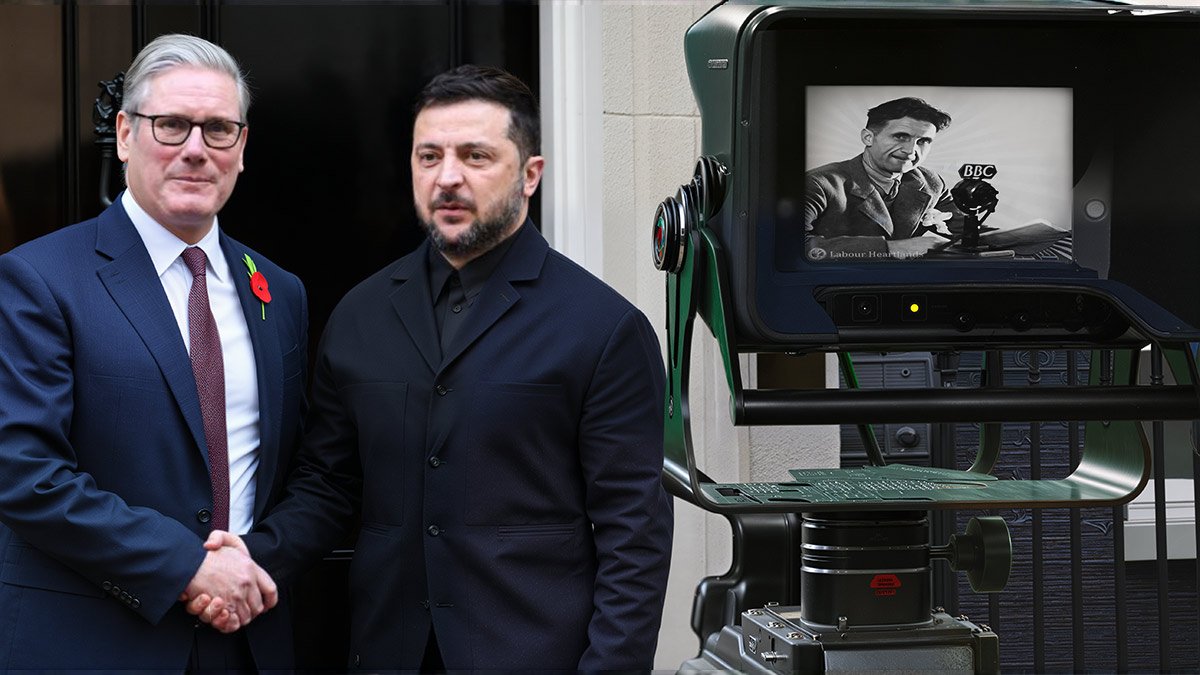
There is a particular kind of political theatre that the British governing class has perfected over a century. It involves distance, both literal and emotional. The further from home a Prime Minister travels to make a commitment, the less likely it is that anyone at home will notice the bill. On Monday, 4 May 2026, three days before British voters went to the polls in local elections, Keir Starmer flew to Yerevan, the capital of Armenia, to attend the European Political Community summit. There, framed by flags and the carefully arranged faces of European leaders, he announced that the United Kingdom would enter negotiations to join the European Union’s €90 billion loan scheme for Ukraine.
He sold it, as is the custom, as a win-win-win. It would, he told reporters, be good for Ukraine, good for British industry, and good for UK-EU relations. Brussels welcomed the “clear political signal” from the other side of the Channel, though a Commission spokesperson was rather more candid about the small print: London, he said, “must also commit to providing a fair and proportionate financial contribution to the costs arising from borrowing” and that contribution would be “proportionate to the value of contracts awarded to entities established in the UK.” In other words, the more British defence firms profit from the scheme, the more British taxpayers contribute to its borrowing costs. The profitability and the liability arrive together.
How large might that liability be? The precedent is instructive. Talks over Britain’s participation in the EU’s separate €150 billion SAFE rearmament fund collapsed because the two sides could not bridge a significant gap over London’s financial contribution. According to Euractiv, the UK wanted to contribute no more than €100 million to that scheme. The EU estimated the figure should be closer to €2 billion. Those talks failed. The contribution to this €90 billion Ukraine loan will, the Commission says, be determined after contracts are awarded. The British public has not been told what the range of possible exposure is. The negotiations have begun anyway.
The more British defence firms profit from the scheme, the more British taxpayers contribute to its borrowing costs. The profitability and the liability arrive together.
What Starmer did not say, in any of his press remarks from Yerevan, was how much this would cost the families of the people who sent him to Parliament. What he did say, with a candour that deserves to be remembered, was that the commitment would play out with the electorate. Not with people. With the electorate. The distinction is not trivial. People have energy bills, rent arrears, and are waiting in corridors for operations that used to be routine. The electorate is an abstraction to be managed. In Yerevan, three days before local elections, Starmer chose the abstraction.
No Vote. No Debate. No Mandate.
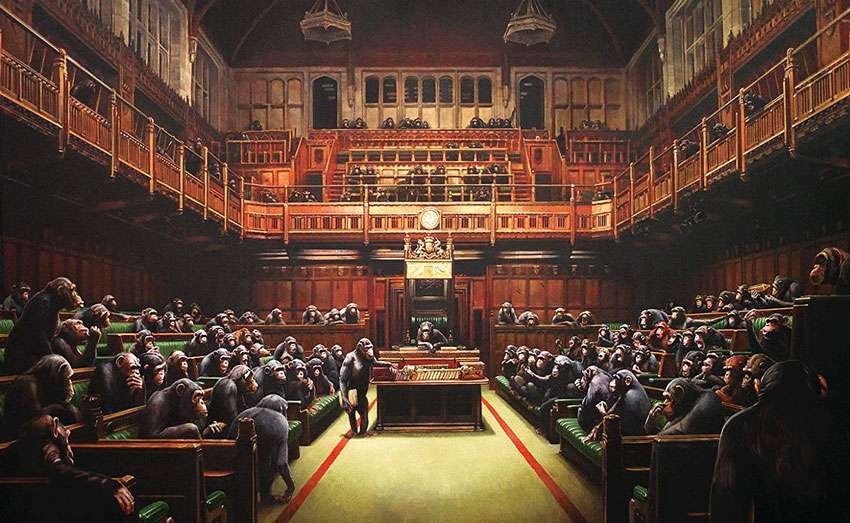
The government has already committed the United Kingdom to £21.8 billion in total support for Ukraine since the invasion began: £13 billion in military assistance, £5.3 billion in non-military aid, and £3.5 billion in export finance guarantees. Starmer has pledged to sustain £3 billion per year in military aid until 2030 to 2031, a commitment framed as lasting “for as long as it takes”, a formulation that contains no endpoint and implies no exit.
Not one of these commitments has been put to a parliamentary vote in any meaningful form. Not one has been subjected to public debate with full disclosure of financial projections and risk ranges. Not one appeared in a manifesto. They are executive decisions, taken by a government that came to power in July 2024 on the most threadbare of mandates, and exercised with the confidence of a class that has always understood accountability, like poverty, to be a condition that happens to other people.
The European Political Community summit is not a body to which Britain is formally accountable. Its communiques carry no democratic weight. No British parliamentarian voted on the parameters of the Ukraine loan negotiation. The House of Commons was not sitting. The Prime Minister flew to Yerevan, made commitments whose financial scale is not yet publicly quantified, and flew home. The local elections were three days later. The financial accounting will come considerably after that.
Not one of these commitments has been put to a parliamentary vote in any meaningful form. They are executive decisions exercised with the confidence of a class that has always understood accountability to be a condition that happens to other people.
The Corruption the Cameras Did Not Show
There is something else that did not make it into the summit press releases. In the weeks immediately surrounding Starmer’s announcement, Ukraine was in the grip of the largest corruption scandal since the beginning of Zelensky’s presidency. Operation Midas, conducted by Ukraine’s National Anti-Corruption Bureau, had spent fifteen months building a case against what investigators described as a high-level criminal organisation embedded in the state-owned nuclear utility Energoatom. The group, investigators alleged, systematically extracted kickbacks of between ten and fifteen percent of contract values, with suppliers who refused to pay having their payments blocked or being excluded from future work entirely.
The alleged ringleader was Timur Mindich: businessman, co-owner of the Kvartal 95 production company through which Zelensky built his entertainment career, and, by all accounts, a personal friend of the president. Mindich fled to Israel the night before investigators raided his associates. Zelensky subsequently imposed sanctions on him, which is to say the president sanctioned his own friend after the investigators moved first. The investigation has implicated, at various levels, the former Deputy Prime Minister, the former Energy Minister, and figures connected to both the presidential chief of staff and the defence ministry.
By February 2026, the Organisation for Crime and Corruption Reporting Project confirmed that the former Energy Minister, German Galushchenko, had been charged with money laundering and organised crime. Investigators alleged he had used shell companies registered in the Marshall Islands, routed through a trust in St. Kitts and Nevis, to funnel money to his family in Switzerland, including funds used for his children’s education there. Over seven million dollars was transferred into family accounts. The scale was not rumour. It was indictment.
Ukraine’s own anti-corruption institutions, it is worth emphasising, are the source of all of this. NABU is Western-backed and institutionally independent. The Economist covered the scandal. The New York Times covered the scandal. This is not Russian propaganda. It is Ukraine’s own anti-corruption infrastructure operating as it was designed to operate, and the findings are uncomfortable for everyone who has treated the financial commitments to Ukraine as self-evidently uncomplicated.
Iuliia Mendel, who served as Zelensky’s own press secretary until 2021, was direct. “Corruption is one of the key reasons we are losing this war,” she said. “It severely damages Ukraine’s image on the international stage. Corruption will destroy Ukraine.” This is the former voice of the Ukrainian presidency, speaking from direct knowledge of a system she once served. Chatham House, not an institution disposed toward anti-Western sentiment, identified the scandal as a direct risk to European partners’ capacity to sustain financial support.
None of this means the money sent to Ukraine has been wasted, nor that the war effort is irredeemably corrupt, nor that support should be unconditional on accountability. Ukraine’s anti-corruption institutions are, demonstrably, functioning. But it does mean the question of where the money goes when it arrives is not a rhetorical question. It is the governing question. And in Yerevan, it was not asked.
The question of where the money goes when it arrives is not a rhetorical question. It is the governing question. And in Yerevan, it was not asked.
The Racket
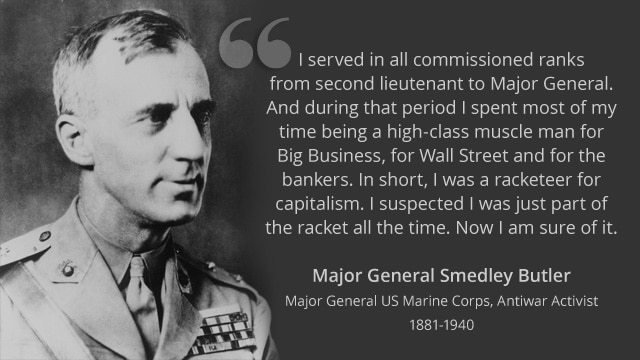
Smedley Butler understood something about war that the political class has spent a century trying to make us forget. Butler was not a peacenik. He was a United States Marine general, twice awarded the Medal of Honour, who had spent his career fighting across the Philippines, Central America, China, and France, before arriving at the conclusion that he had spent those years, as he put it, as a high-class muscle man for Big Business, Wall Street, and the bankers. The wars were real. The suffering was real. The profits, for those who financed and equipped the wars without fighting in them, were also very real. What was not real was the story told to the people who paid for it.
Butler wrote those words in 1935. The mechanism he described has not changed, only the branding. Where once the story was imperial duty and civilisational advance, it is now rules-based order and democratic solidarity. Where once the contracts went to the munitions manufacturers of Pittsburgh and Sheffield, they now go to BAE Systems, Thales, and Rheinmetall. BAE Systems reported profits of more than three billion pounds for 2024, a fourteen percent increase in revenue, with an order backlog reaching £66.2 billion. The company’s major shareholders include BlackRock, Capital Group, and Invesco. That is not a conspiracy theory. It is a financial disclosure.
Starmer told the Yerevan summit that the loan scheme would create opportunities for British defence firms to compete for contracts. This is the sentence that deserves to be read twice, and slowly. The solidarity and the commercial interest are not in contradiction. The UK has delivered over 85,000 military drones to Ukraine in six months, invested £600 million to accelerate domestic drone production, and enabled a £1.6 billion deal for Thales to supply 5,000 lightweight multirole missiles manufactured in Belfast. These things are presented as acts of solidarity. They are also, simultaneously, export orders. Both things are true. But only one of them is told to the public.
The Class Politics of Permanent War
There is a question that the professional commentariat in Britain never asks, though it sits at the centre of everything: who pays, and who profits? The answer divides cleanly along class lines. Those who profit from the Ukraine commitments are the shareholders of defence and finance companies, the executives of arms manufacturers, the lawyers drafting bilateral treaties, and the consultants advising governments on procurement strategy. None of them will be asked to contribute more through taxation. The windfall profits accruing to the defence sector are not subject to a windfall tax.
Those who pay are the people who depend on public services compressed to accommodate the new arithmetic. To fund the defence increases already announced before the Armenia commitment, the government slashed Britain’s foreign aid budget from 0.5 percent of gross national income to 0.3 percent, a forty percent cut that the International Development Minister Anneliese Dodds resigned to protest. Aid to Sudan, where civil war has produced the world’s largest displacement crisis, has been cut. These decisions attract a fraction of the coverage accorded to the flag-waving of European political summits. The people affected by them are not the electorate that Starmer worries about playing out with. They are simply people.
The timing of the Yerevan announcement was not accidental. A Prime Minister facing significant losses in local elections chose to make open-ended financial commitments not in Parliament, not through a published financial prospectus, not with a Commons debate, but at a summit abroad before an audience of European leaders whose approval he evidently craved. The grander the stage, the smaller the scrutiny. The more flags in the background, the fewer questions at home. It is a very old trick. Butler would have recognised it instantly.
WAR IS PEACE: THE LOGIC NO ONE IS ALLOWED TO QUESTION

Let us state plainly what the professional political class will not. This war did not begin on 24 February 2022. It began in 2014, at the Maidan, when a government was toppled with the active encouragement of Washington, and when the civil war in the Donbas that followed claimed fourteen thousand lives before a single Russian soldier crossed the border in force. The pretext for the current phase of the conflict is not as clean as it has been presented. That is not to excuse the invasion. It is to insist that a conflict rooted in a decade of NATO expansion, proxy manoeuvring, and broken diplomatic commitments cannot be solved by yet more weapons and yet more borrowed money. Context is not justification, but it is essential, and it has been systematically withheld from the British public.
This was, in its most candid formulation, Biden’s proxy war. The United States poured over $175 billion into it, supplied the intelligence, and set the strategic terms. Then Trump walked away. Not because he developed a principled objection to proxy conflict, but because the political calculus changed in Washington. Britain, which had no decisive role in designing this strategy and no seat at the table when its terms were set, is now being asked by Starmer to deepen its financial commitment to a war whose principal architect has abandoned it. The inheritor of someone else’s forever war is the worst possible position from which to be signing open-ended financial commitments abroad while the economy deteriorates at home.
This was Biden’s proxy war. Trump walked away. Britain, which had no decisive role in designing this strategy, is now being asked to deepen its financial commitment to a conflict whose principal architect has departed.
And it is a forever war. That is the thing they will not say out loud. There is no peace initiative on the table from any Western government. There are no serious ceasefire talks. There is no articulation of what victory looks like, or what it costs, or when it ends. There is only the indefinite continuation of the conflict, funded by an ever-expanding coalition of states whose publics have never been asked whether this is what they want their money spent on. Orwell gave us the phrase in 1949: War is Peace. He meant it as a warning. The political class has adopted it as a policy.
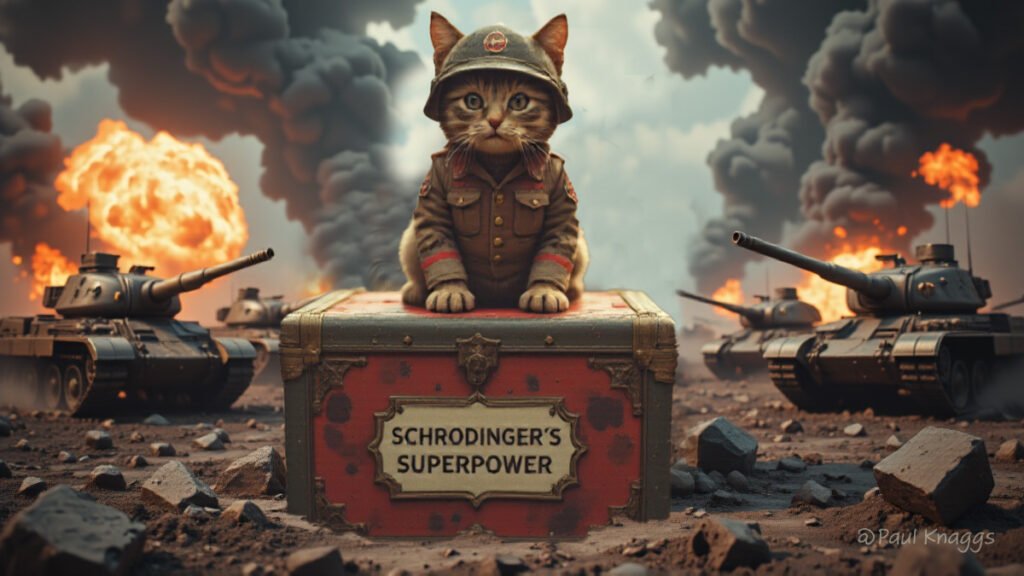
There is a logical contradiction at the heart of the Western position that nobody in the mainstream press will name. The case for NATO’s expansion, its spending increases, and its collective posture is built on the proposition that Russia is an existential military threat to European civilisation, a power so dangerous that the entire continent must double its defence budgets and accelerate its rearmament. But the parallel case being made for arming Ukraine is that Ukraine can beat Russia. That, with sufficient Western support, a nation of forty million can defeat a nuclear power in a conventional land war. These two propositions cannot both be true. Either Russia is an existential threat to Europe, in which case the pretence that Ukraine can defeat it is a cruel fiction used to justify perpetual spending, or Ukraine genuinely can repel Russia through Western-supplied arms, in which case the entire premise of NATO’s threat inflation is fraudulent. They want both arguments simultaneously. They cannot have them.
Ask the question they will not ask. Where are the doves? Where are the serious politicians in the mainstream of British public life calling for negotiations, for a ceasefire, for a diplomatic settlement that stops the killing? They have been systematically marginalised, smeared, and driven from the stage. The Overton window on this conflict has been engineered as carefully as any propaganda operation in living memory. To question the wisdom of the strategy is to be labelled an appeaser. To ask where the money goes is to be accused of doing Putin’s work. To demand peace is to be told you do not understand the stakes. This is not democratic deliberation. It is manufactured consent, and Butler named its purpose a century ago.
The real question that Starmer’s Yerevan commitment demands is not whether the financial contribution is £2 billion or €100 million. It is whether the British working class should continue to fund a strategic approach that has no exit, no mandate, no peace framework, and no honest accounting of its costs, while being told that asking any of these questions is morally suspect. The doves have not disappeared because they were wrong. They have been silenced because they were inconvenient. Silence, in this context, is the most expensive thing of all.
“Until Ukraine wins” is not a plan, it is a blank cheque. No terms, no timeline, no truth. Just a war machine fed by other people’s sons and our money. It is a racket with a flag draped over it.
Enjoyed this read? I’m committed to keeping this space 100% ad-free so you can enjoy a clean, focused reading experience. Crafting these articles takes a significant amount of research and heart. If you found this helpful, please consider a “small donation” to help keep the lights on and the content flowing. Every bit of support makes a huge difference.

Support Independent Journalism Today
Our unwavering dedication is to provide you with unbiased news, diverse perspectives, and insightful opinions. We're on a mission to ensure that those in positions of power are held accountable for their actions, but we can't do it alone. The Heartlands Tribune is primarily funded by me, Paul Knaggs, and by the generous contributions of readers like you. Your donations keep us going and help us uphold the principles of independent journalism. Join us in our quest for truth, transparency, and accountability – donate today and be a part of our mission!
Like everyone else, we're facing challenges, and we need your help to stay online and continue providing crucial journalism. Every contribution, no matter how small, goes a long way in helping us thrive. By becoming one of our donors, you become a vital part of our mission to uncover the truth and uphold the values of democracy.
While we maintain our independence from political affiliations, we stand united against corruption, injustice, and the erosion of free speech, truth, and democracy. We believe in the power of accurate information in a democracy, and we consider facts non-negotiable.
Your support, no matter the amount, can make a significant impact. Together, we can make a difference and continue our journey toward a more informed and just society.
Thank you for supporting Labour Heartlands