How Starmer’s Praetorian Guard Turned Spies on the Press, and Why It Matters More Than They Want You to Know
Who controls the past controls the future: who controls the present controls the past.
George Orwell, Nineteen Eighty-Four
What does a political movement do when it has run out of arguments? When the facts are against it, when the documents are damning, when the money trail leads exactly where its enemies said it would? It does what every cornered power has done since the invention of the state: it turns on the people asking the questions.
The story of Labour Together, Morgan McSweeney, and “Operation Cannon” is not merely another Westminster scandal to be consumed over morning coffee and forgotten by lunch. It is a case study in the corruption of democratic principles by men who speak the language of democracy while gutting its substance. It is a story about what happens when a political faction treats investigative journalism not as a pillar of free society but as a threat to be neutralised through surveillance, smear, and manufactured conspiracy.
And it arrives at a moment of exquisite irony. McSweeney, the architect of Starmer’s rise, resigned on 8 February 2026 as Downing Street Chief of Staff, brought down not by the journalists he tried to silence but by the very patron whose friendship he cultivated: Peter Mandelson, now under criminal investigation by the Metropolitan Police for misconduct in public office over his relationship with Jeffrey Epstein. The spider has been caught in his own web. But the web itself remains intact, and it is the web we must examine.
The Fraudulent Pitch

To understand Operation Cannon, you must first understand the alleged fraud that preceded it. Between 2017 and 2020, Labour Together, the organisation McSweeney founded in 2017 during Jeremy Corbyn’s leadership, ran an undisclosed project funded by £730,000 in donations that were not reported to the Electoral Commission within the legal timeframe. The Commission eventually fined the organisation £14,250 for over twenty breaches of electoral law, a penalty it described as being “towards the high end of the scale.”
The purpose of this dark money operation was precise and ruthless: to dismantle the left-wing leadership of the Labour Party and replace it with a candidate engineered to win. McSweeney conducted extensive polling of Labour’s membership to determine what they wanted to hear. He then crafted Keir Starmer’s leadership pitch accordingly: Starmer would be presented as a radical eco-socialist, an inheritor of the Corbyn tradition, a unifier who would end factionalism. Every word of it was calculated. Every promise was expendable.
As investigative journalist Paul Holden has documented in his book The Fraud, this was a leadership campaign built on market research rather than conviction. The membership was polled not to be represented but to be manipulated. They were told what McSweeney’s data said they needed to hear in order to vote for a leader who would subsequently abandon every commitment that secured their support. The board of Labour Together during this period included Trevor Chinn, a businessman who funded anti-Corbyn MPs, and Martin Taylor, a hedge fund manager. This was not a grassroots movement. It was an astroturf operation with a hedge fund floor.
When the Sunday Times published a front-page story in November 2023 exposing these undeclared donations, the Labour Together operation faced a choice that defines the character of any political movement: would it address the substance of the reporting, or would it attack the reporters? The answer tells you everything you need to know about the people who now govern Britain.
Starmer sits comfortably in the centre of the web, yet remains just one strategic layer of plausible deniability away from the tinted hands of his own enforcers.
Operation Cannon: The Anatomy of a Smear
In November 2023, with a general election approaching and their man Starmer a near-certainty for prime minister, Labour Together hired APCO Worldwide, a Washington DC-based corporate intelligence firm whose previous clients include big tobacco companies and Israeli defence firm Elbit Systems. The contract, addressed to Josh Simons, then director of Labour Together, was explicit: APCO would “investigate the sourcing, funding and origins of a Sunday Times article about Labour Together, as well as upcoming works by authors Paul Holden and Matt Taibbi.” The fee was at least £30,000.
The contract went further. APCO’s “approach should provide a body of evidence that could be packaged up for us in the media in order to create narratives that would proactively undermine any future attacks on Labour Together.” Read that sentence again. Not to establish truth. Not to correct inaccuracies. To “create narratives” that would “undermine” journalism. This is the language of counter-intelligence, not democratic politics.
The resulting 58-page report, codenamed “Operation Cannon,” is a document that should make every citizen of this country uneasy. It designated Sunday Times journalists Gabriel Pogrund and Harry Yorke, the Guardian’s Henry Dyer, Paul Holden, and journalists from other outlets as “significant persons of interest” and discussed potential “leverage” over reporters. APCO’s briefings speculated, without providing a shred of evidence, that the stories about Labour Together’s funding originated from a Russian or Chinese hack of the Electoral Commission.
But here is where the operation descends from the merely cynical into something genuinely sinister. The report contained almost ten pages of deeply personal and false claims about Gabriel Pogrund. It referenced his Jewish beliefs and made fabricated claims about his personal and professional relationships. It suggested that his previous reporting, including stories about the royal family, “could be seen as destabilising to the UK and also in the interests of Russia’s strategic foreign policy objectives.”
There is a bitter irony here that will not be lost on those of us who experienced the other end of the Sunday Times’s journalism during the Corbyn years.
Pogrund himself was part of the machinery that weaponised antisemitism accusations to destroy left-wing candidates and activists. In 2019, while standing as a Labour councillor in Chesterfield, I received a WhatsApp message from the Sunday Times. Pogrund and his colleague Richard Kerbaj were preparing another “exclusive” on antisemitism in Labour. Remarks I had made about religious interference in politics, directed at all faiths equally, were stripped of context and repackaged as anti-Jewish hatred. I was suspended mid-campaign on the basis of their reporting. I was never found guilty of any wrongdoing. But the punishment was the process, and that was always the intention. The timing, weeks before local elections, was not accidental. It never was.

This was the pattern across the country: week after week, the Sunday Times and others churned out stories designed to hammer the same message home, that Labour was institutionally antisemitic and Corbyn personally tainted. Individual cases were weaponised to tar an entire movement. Careers were destroyed, candidacies torpedoed, and a democratic socialist project systematically undermined, all through the pages of newspapers that are now, quite rightly, outraged at being targeted themselves.
So let us be precise about the irony. It is not that Pogrund and Yorke deserved what Labour Together did to them. They did not. No journalist deserves to have their faith, their family, and their personal relationships catalogued in a smear dossier by a foreign intelligence firm. What Operation Cannon did was wrong, full stop. But the irony is that the same factional apparatus that once used the Sunday Times as a willing instrument to destroy left-wing activists on the basis of distorted allegations has now turned its techniques on the very journalists it once weaponised. The machine does not distinguish between its former allies and its current enemies. It consumes everyone who becomes inconvenient.
A political organisation that spent years weaponising accusations of antisemitism to destroy the Labour left hired a foreign intelligence firm that then targeted a Jewish journalist’s faith as material for a smear dossier. The same people who insisted that Jeremy Corbyn’s Labour was an existential threat to British Jews commissioned a report that treated a Jewish reporter’s identity as a data point to be exploited. Orwell would have recognised this technique instantly. In Nineteen Eighty-Four, the Party’s slogans were built on precisely this kind of inversion: War is Peace. Freedom is Slavery. And, it seems, fighting antisemitism means investigating the Jewish backgrounds of inconvenient journalists.
The Russian Ghost in the Machine
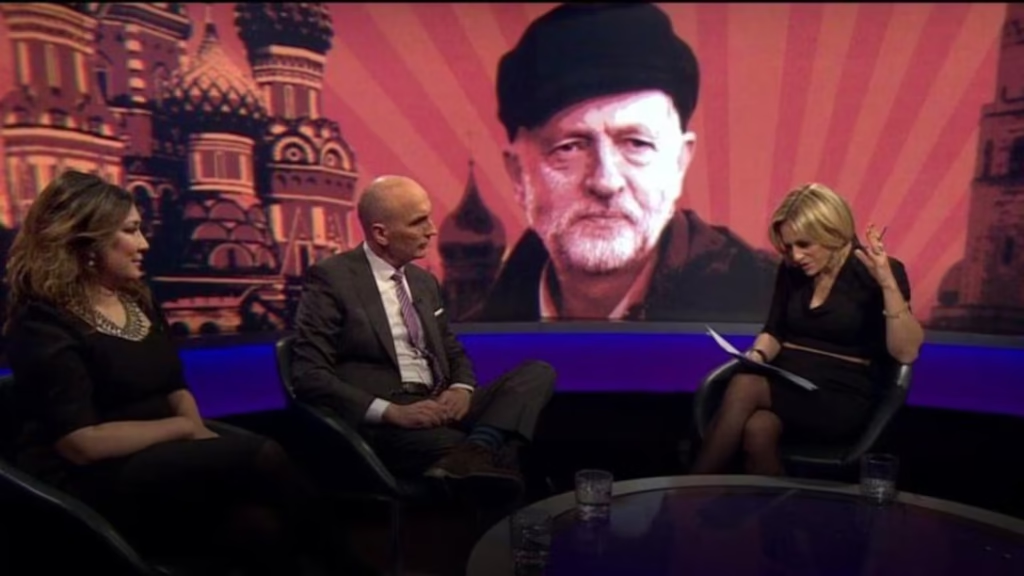
The most insidious element of Operation Cannon was the manufacture of a Russian conspiracy theory. Having failed to find any errors in the Sunday Times reporting (because there were none), Labour Together and APCO constructed a narrative that the journalists’ sources must have been Russian intelligence. A December 2023 APCO memo, marked “strictly private and confidential,” stated that “the likeliest culprit is the Russian state, or proxies of the Russian state.”
This fabricated narrative was then laundered through official channels. Labour Together, with Simons’s direct knowledge, reported to the National Cyber Security Centre that it had been the victim of a hack, presenting APCO’s report as evidence. The NCSC declined to launch a full investigation. But the mere fact of having made the referral gave Labour Together material to brief to other journalists, effectively poisoning Fleet Street against the original reporting.
On 8 February 2024, Pippa Crerar, then deputy political editor of the Guardian, contacted Paul Holden with an extraordinary claim: the Guardian was 24 hours away from publishing a story alleging he was under investigation by UK security services for receiving information stolen by Russia. The story was, in Holden’s words, “nonsense.” He had never received a single document from Russia. When he threatened to sue for defamation, the story vanished.
But consider what this smear would have achieved had it succeeded. Holden is not some obscure blogger. He is a veteran anti-corruption investigative journalist who has spent fifteen years investigating grand corruption in South Africa. His work with the National Prosecuting Authority and multiple international law enforcement agencies led to the recovery of nearly one billion dollars in stolen assets from the corrupt Gupta family. He has been sued by a Russian oligarch. He is on the right side of this fight by any measure.
Had the Russian spy smear landed, it would have been a gift not just to Labour Together but to every criminal actor Holden has pursued across continents. As Holden himself has observed, those criminals would have seized on such an allegation to undermine ongoing prosecutions and investigations. A political faction’s desire to avoid embarrassment over undeclared donations would have fatally compromised international anti-corruption efforts and let some of South Africa’s worst criminals off the hook. That is the collateral damage of Operation Cannon.
The Apparatus: From CCDH to APCO to the Online Safety Act

Operation Cannon did not emerge from nowhere. It is the latest manifestation of an apparatus that Morgan McSweeney has been building for the better part of a decade: a network of organisations that use the language of accountability and counter-disinformation to silence dissent and control political narratives.
In 2018, McSweeney co-founded the Centre for Countering Digital Hate (CCDH), a British-American nonprofit that campaigns to deplatform individuals and organisations it labels as spreaders of “hate and disinformation.” The CCDH’s early targets were revealing. It focused not on genuine far-right extremists but on left-wing pro-Corbyn media outlets, particularly The Canary. It also amplified antisemitism accusations against Corbyn himself. As Holden’s book documents, CCDH was “incubated using resources from Labour Together.” McSweeney used his factional think tank to launch what amounted to a censorship operation targeting the media outlets that supported his political opponents.
This is the pattern: create organisations that sound like they serve the public interest (who could oppose countering digital hate?) and then deploy them as weapons against political enemies. When that proves insufficient, hire corporate intelligence firms to investigate journalists. When their reports prove thin, launder their speculation through security services. When that fails, brief other journalists against the original reporters. Each layer of the operation provides deniability for the last.
And the pattern is accelerating. On the very day this article is published, Starmer has announced plans to seek sweeping new powers to regulate the internet, including social media restrictions, controls on AI chatbots, and the ability to bypass parliamentary scrutiny in implementing future curbs. Framed as child protection (and who could oppose that?), the proposals would grant ministers authority to act “within months rather than waiting years for new primary legislation every time technology evolves.” Note the language: reduced parliamentary scrutiny, ministerial discretion, speed over deliberation. These are not the instincts of a government that trusts democratic debate. These are the instincts of a government that has already demonstrated, through the CCDH, through APCO, through Operation Cannon, that its preferred response to uncomfortable speech is to control it. Orwell warned that “freedom of speech and of the Press are usually attacked by arguments which are not worth bothering about.” Child safety is always the Trojan Horse. The walls it breaches belong to everyone.
It is also essential to understand who the real targets of Operation Cannon were. The Sunday Times and the Guardian are now, quite properly, outraged at having their journalists investigated. But the primary targets of APCO’s dossier were not the staff reporters of Fleet Street broadsheets. They were Paul Holden and Andrew Feinstein, the South African investigative journalists who run Shadow World Investigations, a small independent outlet dedicated to exposing corruption, the arms trade, and elite malfeasance. Feinstein, the son of a Viennese Holocaust survivor, is a former ANC member of parliament who resigned in protest against corruption under Jacob Zuma. He later stood against Starmer himself in Holborn and St Pancras in the 2024 general election, winning over seven thousand votes. The APCO dossier played up Feinstein’s support for Corbyn and his appearances on Russia Today, while treating his investigative work as evidence of political campaigning rather than journalism.
This distinction matters. The Sunday Times and the Guardian will fight for their own. But where were these newspapers when Julian Assange was dragged from the Ecuadorian embassy and subjected to years of detention for the crime of publishing information the powerful did not want published? The Guardian, which profited handsomely from Assange’s leaked material, was notably relaxed about his persecution. The Sunday Times did not lead any campaigns for his freedom. When the target was an independent publisher operating outside the established media ecosystem, Fleet Street was content to let him rot. Now that the surveillance state has turned its attention to their own correspondents, they discover a passion for press freedom that was curiously absent when Assange needed it most.
The lesson is clear: established media will defend itself, but it will not defend the independent outlets that are doing the most dangerous work. Holden and Feinstein were targeted precisely because they operate outside the protection of major media groups. They do not have legal departments on retainer. They do not have proprietors who lunch with cabinet ministers. They are vulnerable in exactly the ways that make them dangerous to power, and it is the independent media, the small outlets, the citizen journalists, the Substacks and the podcasters, who will bear the brunt of whatever online censorship regime Starmer’s government constructs next.
Simons, who commissioned the APCO contract, now sits as a Labour MP and Cabinet Office minister. He has claimed that APCO was hired merely to investigate a suspected hack, and that the targeting of journalists was not his intention. This defence is difficult to reconcile with the contract itself, which explicitly names the journalists and their work as targets. Simons says he was “surprised and shocked” that the report went beyond the brief. One struggles to understand how a man who commissioned an investigation into journalists could be surprised when the firm investigated journalists.
The Mandelson Convergence: Where All Roads Meet

The timing of these revelations is not coincidental. McSweeney resigned as Chief of Staff on 8 February 2026 because his personal loyalty to Peter Mandelson proved to be his undoing. He was, by all accounts, a “keen advocate” for Mandelson’s appointment as Ambassador to the United States, championing the nomination despite warnings from security services, despite a Cabinet Office due diligence report flagging the Epstein connection, and despite Maurice Glasman’s explicit warning about photographic evidence circulating in Washington.
Mandelson was dismissed from the ambassadorship in September 2025 after emails between him and Epstein were made public. He resigned from the Labour Party on 1 February 2026 and from the House of Lords shortly after. On 3 February, the Metropolitan Police launched a criminal investigation into misconduct in public office, and police subsequently raided two of his properties. The documents show that while serving as Business Secretary, Mandelson gave Epstein advance notice of a 500 billion euro EU bailout, shared internal economic briefings, and appeared to lobby against banking restrictions on Epstein’s behalf.
McSweeney learned his politics from Mandelson. This is not speculation; it is the documented history of his career. He worked closely with Mandelson from 2001 onwards. The McSweeney-Mandelson relationship is the thread that connects Labour Together’s dark money to Starmer’s leadership, and Starmer’s leadership to the Epstein scandal. The architect of Starmer’s rise was the protege of a man now under criminal investigation for sharing state secrets with a convicted sex offender. The man who hired intelligence firms to spy on journalists was the devoted apprentice of a politician who shared market-sensitive government information with a paedophile’s financial network.
When Josh Simons appears on television talking about how “trust in elected politicians is so completely broken,” one searches for a category beyond irony. The people who engineered a leadership campaign on false promises, who failed to declare three quarters of a million pounds in donations, who hired foreign intelligence firms to spy on British journalists, who manufactured a Russian conspiracy to discredit the free press, and who championed the appointment of Jeffrey Epstein’s friend as Britain’s most important diplomat: these are the people lamenting the collapse of public trust.
The Structural Question

The defenders of these tactics will argue that every political party plays hardball, that opposition research is a normal feature of democratic politics, and that Labour Together was merely protecting itself from unfair attacks. This argument collapses under the slightest scrutiny.
There is a world of difference between opposition research and hiring a foreign intelligence firm to compile dossiers on journalists’ personal lives, religious backgrounds, and family connections. There is a canyon between defending your record and manufacturing a fake Russian conspiracy to discredit the press. There is an abyss between political spin and attempting to frame an internationally respected anti-corruption journalist as a Kremlin agent.
Normal democratic politics does not involve codenamed operations. Normal democratic politics does not require the identification of journalists’ faith backgrounds as potential “leverage.” Normal democratic politics does not involve briefing fabricated security concerns to GCHQ in an attempt to trigger investigations into reporters. If these are the methods Labour Together employed while in opposition, what will they deploy with the full machinery of the state behind them? That is not a rhetorical question. It is the most urgent political question in Britain today.
Orwell understood this with a clarity that has only sharpened with time. “What is needed,” he wrote, “is the right to print what one believes to be true, without having to fear bullying or blackmail from any side.” Operation Cannon is bullying and blackmail dressed in the language of national security. It is the deliberate corruption of public discourse by people who cannot win the argument on its merits.
The Electoral Commission must publish in full its investigation into Labour Together’s funding. The Public Relations and Communications Association’s investigation into APCO must be conducted with genuine independence and its findings made public. The Cabinet Office must explain how a minister who commissioned intelligence operations against British journalists can remain in a position of public trust. And Parliament must examine whether the use of dark money groups to fund private investigations into the media requires new legislative safeguards.
The Windows Must Be Opened

The Labour Party was founded to give voice to those who had none: the workers, the dispossessed, the people whose interests were systematically ignored by the machinery of wealth and privilege. It was not founded to operate like a corporate security department, deploying private intelligence against anyone who threatens the brand.
George Orwell saw this coming. He warned that “the freedom of the Press in Britain was always something of a fake, because in the last resort, money controls opinion.” Labour Together is the proof of that warning made flesh. Dark money funded a fraudulent leadership campaign. When journalists exposed the dark money, more money was spent on silencing the journalists. The circle is vicious and complete.
One of the things that the investigation into Labour Together has demonstrated beyond doubt is that there is one thing the Labour right wing absolutely cannot tolerate: independent media holding them to account. Their response to scrutiny is not transparency but counter-intelligence. Their response to investigation is not explanation but surveillance. Their response to truth is not correction but conspiracy. Jon Cruddas, who helped found Labour Together in 2015 as a vehicle for pluralism within the party, has described what it became as “dark shit.” He has never heard of anything like it. Neither have we.
Sunlight, as Justice Brandeis observed, is the best disinfectant. It is time we opened the windows on Labour Together and let the air back into our democracy. Because if the people who govern us believe they have the right to spy on the press, manufacture conspiracies against journalists, and weaponise the security state against democratic accountability, then we do not live in the democracy they claim to defend. We live in the one Orwell warned us about.
But when all is said and done, we are left not with answers but with questions, and that should trouble us most of all.
Morgan McSweeney did not act alone. He was not a rogue operative pursuing a private vendetta. He was the chief strategist of a political project that involved hundreds of thousands of pounds in undeclared donations, a network of think tanks and censorship outfits, corporate intelligence operations against the press, and the deliberate cultivation of a man now under criminal investigation for sharing state secrets with a convicted sex offender. McSweeney has resigned. Mandelson has resigned. But the project has not resigned. Keir Starmer remains Prime Minister. The tools of censorship and control that McSweeney’s apparatus constructed, from the CCDH to the Online Safety Act to the sweeping new internet powers announced this very week, are not being dismantled. They are being legislated. The infrastructure of narrative control is not retreating; it is being hardened into law.
This darkness runs deep, and this plot is still in the making. Josh Simons still sits in the Cabinet Office. The donors who funded Labour Together’s dark money operation still have access to the levers of power. The APCO dossiers may have been exposed, but the instinct that produced them, the belief that scrutiny is subversion and that journalism is an enemy to be neutralised, remains embedded in the culture of this government. We have seen the spider’s web. We have identified some of the spiders. But the web is intact, and there are players still in the shadows whose names we do not yet know.
Who else received the APCO briefings? Which cabinet ministers saw the smear material before it was circulated? Who authorised the approach to GCHQ? And who, ultimately, decided that the response to true reporting about illegal donations should be the surveillance of journalists rather than the admission of wrongdoing?
Until those questions are answered, the party of the workers remains the party of the wiretappers. They called it Operation Cannon. They should have called it what it was: Operation Cover-Up. And the cover-up, as it always does, continues.
Enjoyed this read? I’m committed to keeping this space 100% ad-free so you can enjoy a clean, focused reading experience. Crafting these articles takes a significant amount of research and heart. If you found this helpful, please consider a “small donation” to help keep the lights on and the content flowing. Every bit of support makes a huge difference!

Support Independent Journalism Today
Our unwavering dedication is to provide you with unbiased news, diverse perspectives, and insightful opinions. We're on a mission to ensure that those in positions of power are held accountable for their actions, but we can't do it alone. Labour Heartlands is primarily funded by me, Paul Knaggs, and by the generous contributions of readers like you. Your donations keep us going and help us uphold the principles of independent journalism. Join us in our quest for truth, transparency, and accountability – donate today and be a part of our mission!
Like everyone else, we're facing challenges, and we need your help to stay online and continue providing crucial journalism. Every contribution, no matter how small, goes a long way in helping us thrive. By becoming one of our donors, you become a vital part of our mission to uncover the truth and uphold the values of democracy.
While we maintain our independence from political affiliations, we stand united against corruption, injustice, and the erosion of free speech, truth, and democracy. We believe in the power of accurate information in a democracy, and we consider facts non-negotiable.
Your support, no matter the amount, can make a significant impact. Together, we can make a difference and continue our journey toward a more informed and just society.
Thank you for supporting Labour Heartlands