The departure of Josh Simons is being packaged as a noble sacrifice. It is nothing of the sort. It is a controlled detonation designed to bury the story that matters: how the think tank that bought a Labour leadership is now running the country, and how it responded to scrutiny not with openness, but with espionage.
In the smoke-filled corridors of Westminster, they tell you that a resignation is an act of honour. It is the last refuge of the gentleman politician: fall on your sword, clear your desk, and allow the institution to exhale. The machine resets. The story dies. The people responsible for the original sin walk quietly to their next appointment.
Josh Simons has now performed this ritual. He has resigned as Cabinet Office minister, been cleared of breaching the Ministerial Code by the Prime Minister’s ethics adviser Sir Laurie Magnus, and issued a letter to Keir Starmer so carefully worded that it reads less like a resignation and more like a legal settlement. There is tributes to the journalists targeted. There is regret about the “perceived gap” between his public statements and the reality of what he commissioned. There is, notably, no apology.
Read that again. The man who authorised a £36,000 corporate intelligence operation against journalists investigating his think tank’s finances, who signed off on a 58-page dossier that examined Gabriel Pogrund’s Jewish faith and fabricated links to the Kremlin, who then passed that poisoned intelligence to the National Cyber Security Centre in an attempt to trigger a state security investigation into working reporters, has resigned without a word of apology to the people he targeted.
This is not an oversight. It is the Starmerite method in its purest, most distilled form: the management of scandal through procedural compliance, with no concession of actual wrongdoing. The ethics adviser says no code was breached. The minister says he is devastated. The machine moves on. And we, the public, are invited to accept that the system worked.
It did not work. It performed.

We have been here before. Labour Heartlands was among the first outlets to document the original scandal when Labour Together was fined £14,250 by the Electoral Commission for failing to declare more than £800,000 in donations across a five-year period. The fine was modest. The implications were not. A think tank with strong personal and financial links to the party leadership, funded substantially by a Mayfair hedge fund manager and a major business donor, had systematically evaded the transparency obligations that exist to protect our democracy. The response from within the Labour movement was silence. The response from the mainstream press was tepid. The story was filed and forgotten.
It should not have been forgotten. Because what followed was not contrition. It was escalation.
When reporters from the Sunday Times began pulling on the thread of Labour Together’s undeclared donations in November 2023, the organisation’s response was to reach for the phone and hire APCO Worldwide, a Washington-based corporate intelligence and lobbying firm. APCO was not engaged to improve governance or audit internal processes. It was engaged to investigate the “sourcing, funding and origins” of the journalism itself. To examine the reporters’ backgrounds and motivations. To find leverage.
The resulting document, all 58 pages of it, was a grotesque exercise in corporate character assassination. Written by Tom Harper, a former Sunday Times employee now working for APCO, it named Pogrund and Yorke as “persons of significant interest.” It devoted nearly ten pages to Pogrund alone, noting his Jewish faith as a relevant biographical detail, suggesting a suspicious mismatch between his religion and his alleged political sympathies, and claiming that his journalism “could be seen as destabilising to the UK and also in the interests of Russia’s strategic foreign policy objectives.” It was not analysis. It was a fabricated dossier designed to discredit a journalist by painting him as a foreign asset, to be weaponised across Westminster and briefed to the security services.
Pogrund was not the only target. Paul Holden, the South African investigative journalist whose meticulous work first uncovered Labour Together’s undeclared donations, was also named, with the report making the extraordinary claim that he and Andrew Feinstein, the former Mandela government minister and South African Jewish anti-arms trade campaigner, were both connected to an ANC intelligence unit. John McEvoy of Declassified UK was in the dossier.
So was Kit Klarenberg of The Grayzone, and American journalist Matt Taibbi of Racket News. The independent journalist Peter Geoghegan, whose Democracy for Sale publication first broke the Operation Cannon story, was also targeted. The APCO operation was not a narrow reprisal against two Sunday Times reporters. It was a systematic attempt to build a dossier of leverage against a broad network of investigative journalists and political challengers, unified by the single fact that they had each, in their different ways, held Labour Together to account.
But here is the irony that ought to stop every observer cold, and which the mainstream press coverage has largely chosen to avoid examining.
Gabriel Pogrund was not merely a victim of Labour Together’s dossier operations. He was, years earlier, one of their primary beneficiaries.
In 2018, Morgan McSweeney and his colleague Imran Ahmed spent months trawling Corbyn-supporting Facebook groups with hundreds of thousands of members, cherry-picking posts to build what was, in effect, an intelligence dossier on the Corbyn left. McSweeney ensured the most inflammatory examples reached the Sunday Times. On the 1st of April 2018, the paper’s front page splash was headlined “Exposed: Jeremy Corbyn’s Hate Factory.” Pogrund was one of the four journalists bylined on that story. His by-line appeared again and again on the coverage that hammered the antisemitism narrative against ordinary Labour members and activists across the Corbyn years. Coverage fed to him, at least in part, by the same Labour Together network whose dossier against him would be compiled half a decade later.
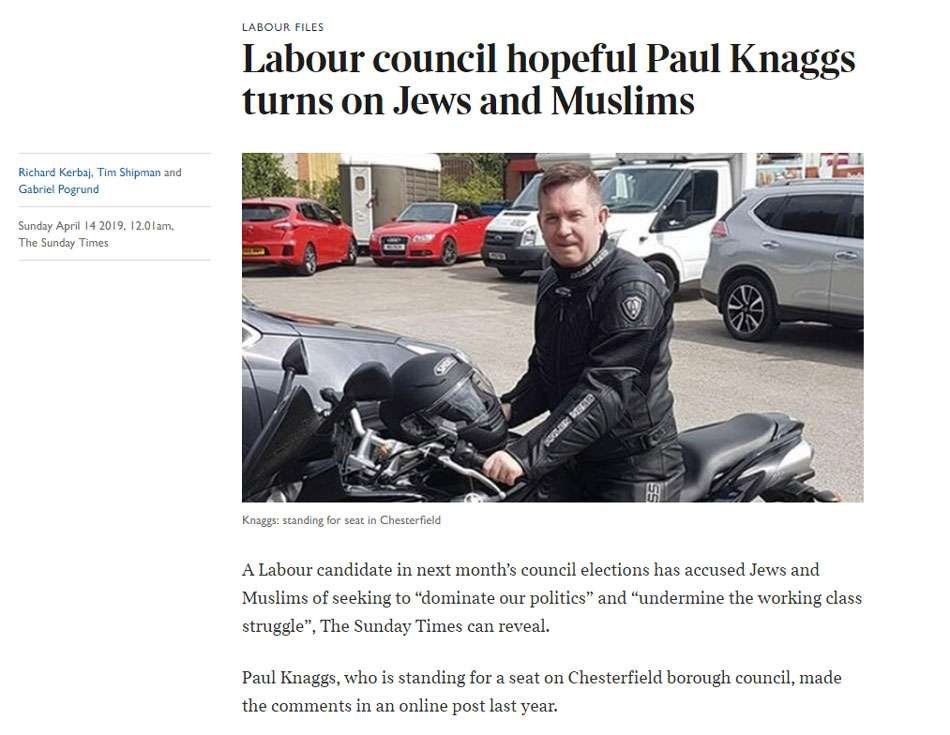
I know this territory personally, because I was one of those ordinary members. In 2019, standing as a Labour councillor candidate in Chesterfield, I received a WhatsApp message from the Sunday Times. It was from Richard Kerbaj and his colleague Gabriel Pogrund, working on yet another antisemitism “exclusive.” The message went through my publicly made comments, decontextualised and distorted, and invited me to confirm details that bore little relationship to what I had actually said or meant. I was not a public figure of any significance. I was a working-class man standing for a local council seat.
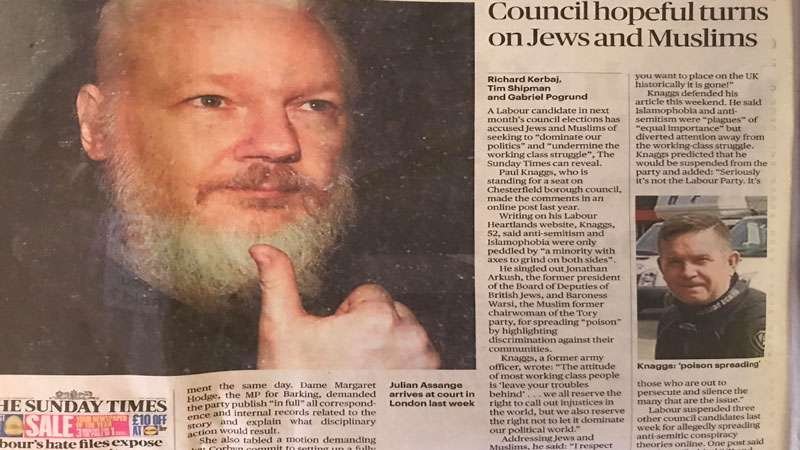
I was not contacted in the spirit of journalism. I was contacted to be processed into a narrative. And I was not alone. Audrey White, a Labour activist suspended over antisemitism allegations in 2020, was among those caught in similar operations. Jo Bird, a Jewish Labour councillor in Wirral whose family had fled European fascism, found herself suspended, then re-suspended, then ultimately expelled, her Jewish identity no protection and indeed no consideration to a factional machine that had decided which Jews counted and which did not.
This is not written to minimise what was done to Pogrund. Having his Jewish faith weaponised by APCO, having fabricated Kremlin connections whispered across Westminster, is a serious and corrosive wrong. His description of the experience, borrowing from the rabbinic image of the gossip scattered like goose feathers that can never be recalled, is genuinely poignant. But Pogrund’s revulsion carries more weight if it is accompanied by a reckoning with the fact that the same dossier techniques, the same fabricated connections, the same character assassination by briefing, were the stock-in-trade of the very network that made his earlier career and whose coverage he amplified, against people who had done nothing wrong except stand in the way of a faction’s ambitions.
The machine does not distinguish. It processes. It used antisemitism allegations as a crowbar against the Corbyn left, and when that same machine turned on its own former journalist allies, it used his Jewish faith as a crowbar against him. The instrument was always the same. Only the target changed.
Labour Together gave this operation a name. We have previously reported that it was known internally as Operation Cannon. The targets were designated “significant persons of interest.” The language was that of state intelligence and corporate counter-espionage. The purpose was the intimidation and delegitimisation of journalists asking where the money came from.
One does not accidentally commission Operation Cannon. One does not accidentally email GCHQ to suggest that Sunday Times reporters are Kremlin conduits. These are deliberate acts, clothed after the fact in the bureaucratic language of “hasty appointments” and terms that were “wider than he had understood.”
Simons’ resignation letter does something even more revealing than its absence of apology. It praises Pogrund, Harry Yorke, and Henry Dyer by name as journalists whose work “sustains our democracy.” It is a gracious tribute, entirely at odds with the 58-page document he commissioned to destroy their credibility.
But here is what the letter does not do. It does not mention Paul Holden, the South African investigative journalist and author of “The Fraud,” whose meticulous work first uncovered Labour Together’s undeclared donations and shared the findings with Pogrund. Holden, whose research formed the factual foundation for everything that followed, is instead noted in Simons’ letter only as the author of a book that “diminishes the antisemitism that infected Labour under its previous leadership.”
Read that carefully. In his resignation letter, with the world watching, Simons used the space afforded to him not to acknowledge the man who broke the story, but to attack the integrity of his book. It is a final, barely disguised smear, wrapped in the language of contrition. The man who claims he never sought to smear journalists used his resignation statement to smear a journalist.
One senior Labour insider, quoted anonymously in the New Statesman, dismissed Simons with the remark “Ayatollah I didn’t break the ministerial code!” It is a sharp line. But it mistakes the farce for the crime. The ministerial code is not the point. The ministerial code is a procedural document. What is at stake here is something rather more fundamental: the right of a free press to investigate political organisations without becoming the subject of corporate intelligence operations briefed to spy agencies.

Sir Laurie Magnus, a man tasked with assessing whether ministerial standards were breached, has concluded that they were not. In the narrow, legalistic sense of Westminster’s internal rules, perhaps he is correct. But we should be honest about what this finding actually means.
The ethics adviser was asked to assess Simons’ conduct as a minister, not his conduct as director of Labour Together. He was asked to evaluate whether Simons had been honest in his public statements about the affair, not whether those public statements were themselves satisfactory. The entire framing of the inquiry was designed to answer the smallest possible question in the most exculpatory way possible. It is the institutional equivalent of asking whether the arsonist properly completed the fire risk assessment form.
Because the questions that actually matter are not procedural. They are structural. And they lead, with uncomfortable directness, to people still in or adjacent to power.

But how did the APCO come to be hired at all? It was not an obvious or neutral choice. In October 2023, one month before Labour Together engaged APCO, the think tank appointed a new wave of advisers to its board. Among them, as Politico noted at the time, was Kate Forrester, described as an “APCO public affairs bod.” Forrester was simultaneously advising Labour Together and running APCO’s London office. She is married to Paul Ovenden, who was Keir Starmer’s head of communications at the time the contract was signed. Forrester has since confirmed that she “was aware of the work happening” and that she may have “been copied in on some emails.” She maintains her involvement was “peripheral.” One is entitled to find that characterisation strained.
Then there is Morgan McSweeney. It was McSweeney who built Labour Together into the machine it became, who presided over the period of the undeclared donations that first drew the journalists’ attention, and who was by November 2023 Starmer’s closest aide and chief of staff. Sources close to McSweeney admitted to reporters that he was aware Labour Together had hired APCO. He did not dispute it. He simply did not make the formal decision himself: that fell to his successor at the think tank’s helm, Josh Simons, who signed the contract. McSweeney was the builder of the house. Simons lit the match inside it. The distinction matters only in the narrowest legalistic sense.

And there is a further detail, reported but little remarked upon. Lord Mandelson, himself recently forced to resign as ambassador to Washington partly because of questions Labour Heartlands and others have raised about his connections to Jeffrey Epstein’s network, was one of those senior Labour figures who reportedly repeated claims from the APCO dossier in Labour circles. The dossier, it should be remembered, fabricated Kremlin links to journalists. Mandelson spread those claims. This is the company in which Operation Cannon circulated.
Labour Together’s current chief executive, Alison Phillips, has said the scope of APCO’s work was “indefensible.” She is correct. But indefensibility without accountability is just public relations management dressed in the language of reform. APCO Worldwide has taken no meaningful responsibility for a document it produced and was paid handsomely to deliver. The organisation that commissioned it has changed leadership and issued statements about “improved governance arrangements.” And the architects of the original operation, who now occupy or recently vacated senior positions across the Cabinet Office, Number 10, and the Washington embassy, continue without a moment of genuine public reckoning.

This matters beyond the immediate scandal because of where it points. As we documented in our recent investigation into Starmer’s internet regulation agenda, the instinct that produced Operation Cannon is the same instinct now reaching for legislative power over digital communications. Labour Together built the CCDH, the organisation that targeted independent left-wing media outlets for deplatforming.
The same network ran Operation Cannon against the Sunday Times. The same political project now holds the legislative pen on the Online Safety Act and its extensions into AI content regulation.
When a political organisation’s first response to investigative journalism is to commission a corporate intelligence dossier, report journalists to spy agencies, and attempt to fabricate links between reporters and foreign adversaries, we are not dealing with an error of judgment. We are dealing with a culture. And cultures do not resign when a minister does.
Morgan McSweeney, who served as Labour Together’s managing director before becoming Starmer’s chief of staff, is not in the dock. The think tank’s major donors, a Mayfair hedge fund manager who contributed nearly £807,000 and a businessman who gave £245,500, have faced no scrutiny beyond the Electoral Commission’s modest fine. The organisation that was described as a “party within a party” and a “blueprint for Starmerism” has offered lessons-learned statements and new governance arrangements. The £730,000 in undeclared donations remains unexplained in any meaningful democratic sense.
The resignation of Josh Simons is, at best, the amputation of a finger to save a fist. The machine that built him, funded him, elevated him, and ultimately discarded him when he became inconvenient is entirely intact.

There are those who will say we are being unfair. That Simons was cleared. That he acted in good faith in a confusing situation. That APCO exceeded its brief. That this was a mistake, not a conspiracy.
Let us take that argument seriously for a moment. If Simons genuinely did not understand what he was commissioning when he hired a Washington corporate intelligence firm to investigate the “sourcing, funding and origins” of journalism, that is itself a devastating indictment of his fitness for the role he held. The director of a major political think tank, a man who would go on to serve in the Cabinet Office, does not sign off on a £36,000 contract with a surveillance-adjacent PR operation without some understanding of what he is buying. And if he truly was so far out of his depth that he emailed GCHQ with unverified intelligence about journalists without knowing what he was doing, we should be equally alarmed.
Good faith is not a defence when the consequences are the targeting of the free press by state security structures. Good faith is not a shield against the chilling effect of knowing that reporters who ask about political funding may find themselves the subject of corporate espionage operations briefed to spy agencies.
The test of any government’s commitment to press freedom is not what it says in resignation letters. It is what it does when its own networks have been caught operating against the press. By that test, this government has failed. Starmer accepted the resignation “with sadness.” He did not demand answers about the broader operation. He did not commit to a full, independent investigation into Labour Together’s activities. He wrote a letter of warm farewell to a man who authorised a dossier that examined a journalist’s Jewish faith.
If this government truly believes, as both Simons and Starmer wrote to each other this week, that the work of investigative journalists “sustains our democracy,” then it must prove it with something more substantial than an ethics adviser’s narrow clearance and a tactical resignation.
It must open Labour Together’s books fully, not to the Electoral Commission’s limited remit, but to a genuinely independent public inquiry with powers of disclosure. It must explain the full chain of decision-making that produced Operation Cannon, who approved it at every stage, and what other operations of similar character were conducted. It must account for the full network of influence, funding, and political coordination that enabled a think tank to effectively purchase a party leadership and then staff the resulting government.
It must, in short, answer the question that the resignation was designed to prevent anyone from asking: not who signed the form, but who built the machine.
Until it does, the stench of Operation Cannon will linger long after Josh Simons has cleared his desk, found a new cause to champion, and assured us all that he remains committed to the vigorous scrutiny of power.
Just not, apparently, scrutiny of the power that made him.
“When the ethics adviser clears a minister for spying on the press, you know the ethics have already left the building.”
Enjoyed this read? I’m committed to keeping this space 100% ad-free so you can enjoy a clean, focused reading experience. Crafting these articles takes a significant amount of research and heart. If you found this helpful, please consider a “small donation” to help keep the lights on and the content flowing. Every bit of support makes a huge difference!

Support Independent Journalism Today
Our unwavering dedication is to provide you with unbiased news, diverse perspectives, and insightful opinions. We're on a mission to ensure that those in positions of power are held accountable for their actions, but we can't do it alone. Labour Heartlands is primarily funded by me, Paul Knaggs, and by the generous contributions of readers like you. Your donations keep us going and help us uphold the principles of independent journalism. Join us in our quest for truth, transparency, and accountability – donate today and be a part of our mission!
Like everyone else, we're facing challenges, and we need your help to stay online and continue providing crucial journalism. Every contribution, no matter how small, goes a long way in helping us thrive. By becoming one of our donors, you become a vital part of our mission to uncover the truth and uphold the values of democracy.
While we maintain our independence from political affiliations, we stand united against corruption, injustice, and the erosion of free speech, truth, and democracy. We believe in the power of accurate information in a democracy, and we consider facts non-negotiable.
Your support, no matter the amount, can make a significant impact. Together, we can make a difference and continue our journey toward a more informed and just society.
Thank you for supporting Labour Heartlands