Net Zero doesn’t end our need for gas. It just ends our control over it.
Britain sits on its own energy resources while paying some of the highest energy prices in the developed world. That is not an accident. It is a policy.
There is a sleight of hand at the heart of Britain’s Net Zero policy, and it is hiding in plain sight.
When the government refuses new North Sea licences, it does not stop Britain using gas. It stops Britain producing gas. That distinction is everything, and politicians know it. The difference is made up by importing liquefied natural gas, shipped halfway around the world from Qatar and the United States, loaded onto tankers at enormous energy cost, and delivered to British households at a premium price with a heavier carbon footprint than what we could have produced at home.
Sky News Economics and Data Editor Ed Conway has laid this out with characteristic clarity in the analysis embedded above. Under the government’s baseline assumptions, liquefied natural gas will account for 46 per cent of Britain’s total gas supply by 2035. The United Kingdom’s own North Sea provides just 18 per cent. That is not a transition to clean energy.
That is a transfer of dependency from our own seabed to foreign markets, foreign tankers, and foreign profit margins.
The alternative is not hypothetical. If North Sea production is sustained at a higher rate, the numbers shift dramatically. Domestic supply could account for 57 per cent of what Britain needs. LNG dependency drops from 46 per cent to just 6 per cent.
Energy security improves. Prices fall. And here is the part that upends the standard political narrative: carbon emissions from the supply of gas fall as well.
We still use the gas. We just don’t get the jobs, the tax, or the security.
THE CARBON ARITHMETIC THEY IGNORE

This is not a claim invented by the oil industry looking for favourable headlines. Analysis from Wood Mackenzie, one of the world’s leading energy research firms, concludes that every additional trillion cubic feet of North Sea gas produced could save fifteen million tonnes of CO2 equivalent in supply chain emissions when it displaces US LNG imports.
The emissions intensity of UK gas supply is projected to triple by 2035 under the LNG-dependent scenario, rising from 3.7 to 11.3 grams of CO2 equivalent per megajoule. Domestic North Sea gas does not have to be liquefied, loaded onto a supertanker, shipped five thousand miles, and then regasified before it reaches a British home.
There are those who will argue, with some justification, that when total combustion emissions are included, the difference between North Sea gas and imported LNG narrows considerably. Carbon Brief has pointed out that the end-to-end emissions gap is closer to fifteen per cent rather than the headline figures the industry sometimes promotes. That is a legitimate factual correction, and it deserves acknowledgement. But it is also an answer to the wrong question.
The relevant policy question is not whether burning gas is damaging regardless of its origin. Of course it is. The question is this: given that Britain will continue consuming gas during any realistic transition period, where should that gas come from, at what price, under whose control, and to whose profit? On every one of those questions, domestic production serves the national interest. Imported LNG serves someone else’s.
We’re not giving up gas under Net Zero. We’re giving up British Gas.
THE THING POLITICIANS NEVER TELL YOU

There is no legal or economic barrier to public ownership of Britain’s energy infrastructure. None. The generation, grid, and supply of energy could be brought into public hands tomorrow if the political will existed. Energy would then be run as a national necessity rather than a profit extraction machine.
Shareholder dividends, financial engineering, and the speculation that inflates costs at every stage of the supply chain would be removed from a basic human need. Prices, for households and for businesses, would fall. Not because energy would suddenly be free, but because the overhead cost of private enrichment would be gone.
The People’s Power
A blueprint for public energy ownership: Decoupling from the global market, utilising North Sea assets, and building a Norwegian-style wealth fund to permanently lower costs for British homes and businesses.
The Cost Crisis & The Solution
British energy prices are dictated by volatile global markets. By bringing extraction and distribution into public ownership, we insulate our economy from shocks and use North Sea revenue to directly lower bills.
Average Annual Household Bill
Current Market
£1,928
Public Model
£1,150
⚡ 40% reduction — removing private wholesale/retail margins and applying North Sea revenue subsidies directly to consumer bills.
Bill Composition Breakdown
How public ownership structurally changes what you pay.
*Negative bar represents direct subsidy from North Sea revenues.
The British Sovereign Wealth Model
Inspired by Norway, profits from nationalised North Sea extraction won’t just offset immediate bills — they will build a massive Sovereign Wealth Fund. Long-term relief for households AND British businesses, acting as an economic buffer for generations.
Extraction
Wealth Fund
Projected Wealth Fund Growth
Cumulative surplus value reinvested for the public good (£ Billions).
📈 Fund milestones
Projected value based on North Sea revenue allocation (5% annual return)
A Self-Sufficient Energy Mix
North Sea assets provide the financial bridge, but energy independence relies on expanding nuclear, renewables, and massive hydroelectric investments — from traditional dams to cutting-edge wave generation.
Targeted Generation Portfolio
Transition away from open-market fossil fuels.
⚛️ Nuclear provides baseload stability, while subsidised domestic gas acts as a transition fuel. Massive expansion focuses on renewables, removing reliance on imported LNG.
The Hydroelectric Investment Focus
Capital allocation for new water-based energy generation (£ Billions).
🌊 Beyond Scottish pumped hydro dams, significant R&D and deployment will be directed toward coastal wave generation and tidal streams, capitalising on the UK’s natural island geography.
The analysis of the United Kingdom’s energy market through the lens of public ownership, resource rent capture, and the Norwegian model reveals a clear disparity between the current liberalised system and a state-managed alternative. The historical evidence suggests that the United Kingdom “squandered” a windfall of at least £400 billion by failing to adopt the Norwegian model of state equity and long-term wealth sequestration.
While the cost of full nationalisation is substantial, ranging from £90 billion to nearly £200 billion, the potential for annual savings of £45 billion and the ability to decouple domestic prices from global volatility offer a compelling economic counter-argument. The successful transition to such a model would require a coordinated investment in the “dispatchable” low-carbon portfolio, leveraging the 8 GW pipeline of pumped hydro storage, the “Golden Age” of modular nuclear technology, and the United Kingdom’s global leadership in tidal stream energy.
Ultimately, the argument for state ownership is an argument for energy as a public good rather than a commoditised financial asset. By treating the remaining North Sea resources as a tool for domestic subsidy and industrial stabilisation, and by sequestering the resulting value in a national wealth fund, the United Kingdom could move from a state of “import dependency” and “price taking” to a position of sovereign energy security. Such a shift would not only relieve the cost burden on British businesses and domestic properties but also provide the fiscal and strategic foundation for a resilient, net-zero future.
The only thing preventing this is the revolving door between government, corporate boardrooms, and the lobbying class that services both.
The first step to energy freedom is to stop outsourcing what we already own. We’re not saving the planet. We’re just outsourcing conscience.
WHO PROFITS FROM THE CRISIS
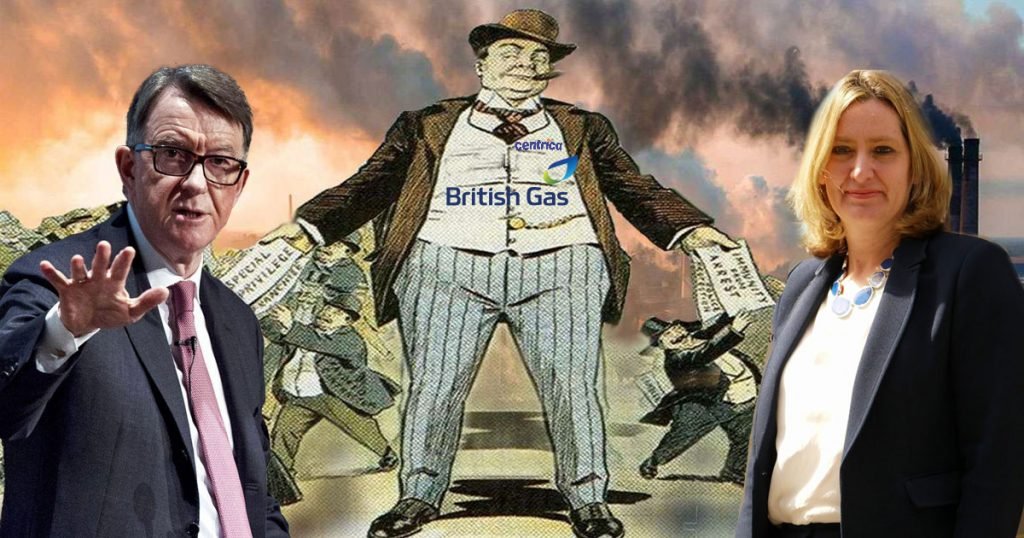
Since the Ukraine war, and again through the current Iran conflict, the question of who benefits from high energy prices has grown impossible to ignore. The answer is not the working people of Europe, whose bills have risen sharply. The primary beneficiaries have been the United States, whose LNG exports surged to fill the gap left by Russian pipeline gas, and the financial sector, which has profited from the sustained high interest rate environment that energy-driven inflation helped create.
Behind the energy majors, the arms companies, and the big financial institutions that now dominate global capital, the same names recur with regularity: BlackRock, Vanguard, and the giant asset managers that sit at the centre of the modern financial system, collecting returns from every angle of the crisis they help sustain.
Ministers, civil servants and MPs enjoy lucrative second careers selling policy influence. Fossil fuel companies, banks and monopolies funnel vast sums into lobbying and jobs for the political class. In return, they gain billions from privatisation, subsidies, tax breaks and regulatory favours.
Banks, energy companies, consultants and monopolies spend millions on lobbying, political donations, speaking fees and advisory roles. In return they benefit from privatisation, subsidies, tax breaks and favourable regulation.
Since the 2024 election, around 236 MPs have declared outside earnings or second jobs, with some spending the equivalent of a full working day each week on private work. Others hold additional paid roles such as councillors or consultants. Public service increasingly looks less like a full-time duty and more like a stepping stone into lucrative private sector careers.
At the same time, research shows nearly a third of former ministers and senior officials take private sector jobs linked to their previous government responsibilities, raising serious concerns about conflicts of interest and policy capture. Vested interests do not need to win elections when they can hire the people who write the laws.
Britain pays some of the highest energy bills in the developed world. It does so while sitting above its own resources. It imports gas at higher cost and greater supply chain emissions than it could produce at home. It is blocked from taking those resources into public ownership by a political class that serves the system maintaining that arrangement.
So when ministers insist this is about climate, or markets, or security, remember what the data makes clear. We do not stop using gas when we stop drilling. We simply stop producing our own. We become more dependent, more exposed, and more expensive to run. We transfer sovereignty over a national necessity to the same global market that has spent three years demonstrating exactly how little it cares about working people’s energy bills.
The question was never whether Britain could afford to produce its own energy. The question is who profits when it cannot.
Enjoyed this read? I’m committed to keeping this space 100% ad-free so you can enjoy a clean, focused reading experience. Crafting these articles takes a significant amount of research and heart. If you found this helpful, please consider a “small donation” to help keep the lights on and the content flowing. Every bit of support makes a huge difference.

Support Independent Journalism Today
Our unwavering dedication is to provide you with unbiased news, diverse perspectives, and insightful opinions. We're on a mission to ensure that those in positions of power are held accountable for their actions, but we can't do it alone. Labour Heartlands is primarily funded by me, Paul Knaggs, and by the generous contributions of readers like you. Your donations keep us going and help us uphold the principles of independent journalism. Join us in our quest for truth, transparency, and accountability – donate today and be a part of our mission!
Like everyone else, we're facing challenges, and we need your help to stay online and continue providing crucial journalism. Every contribution, no matter how small, goes a long way in helping us thrive. By becoming one of our donors, you become a vital part of our mission to uncover the truth and uphold the values of democracy.
While we maintain our independence from political affiliations, we stand united against corruption, injustice, and the erosion of free speech, truth, and democracy. We believe in the power of accurate information in a democracy, and we consider facts non-negotiable.
Your support, no matter the amount, can make a significant impact. Together, we can make a difference and continue our journey toward a more informed and just society.
Thank you for supporting Labour Heartlands