Does the people’s right to be judged by their peers have an expiry date? In the windowless corridors of Whitehall, it seems the answer is yes, provided the backlog is long enough, and the political will is short enough.
Today, Christopher Moran, a criminal barrister of nineteen years’ standing and a lifelong Labour loyalist, wrote a letter to the Prime Minister. It was not a letter of complaint, not a polite protest, not a note to be filed away and forgotten. It was a resignation. And it was, in its quiet, measured fury, one of the most damning indictments of this government that has yet been written.
Moran is not a man of the right. He is not a culture warrior or a reactionary defending privilege. He is a legal aid barrister, a man who chose public duty over private gain, who prosecuted and defended in the courts of this country for two decades out of a commitment to justice. He voted for Starmer as Labour leader. He believed, as so many of us did, that a former Director of Public Prosecutions understood the sacred nature of what he had been entrusted with.
He has changed his mind. Shame on you, he wrote. Those three words should ring through every Labour constituency office in the country.
“Power without principle is barren.” The extent to which Labour has ditched its own arguments as soon as it came to power is simply staggering. For Party members like me it is heartbreaking.
The catalyst is the Courts and Tribunals Bill, introduced to Parliament on the 25th of February 2026 by the then Lord Chancellor David Lammy.
Its second reading is scheduled for tomorrow, the 10th of March. It is a bill described by its authors as pragmatic reform. It is, in truth, constitutional vandalism dressed in the language of efficiency.
Solicitors in England and Wales plan to mobilise to lobby MPs ahead of a debate on proposals to curb jury trials.
Britain’s justice secretary David Lammy last year announced plans to reduce the number of criminal cases that would be heard with juries, in an effort to reduce backlogs in the system.
According to the England-and-Wales Law Society Gazette, criminal-law practitioners will march to parliament tomorrow morning (10 March) to lobby MPs before the second reading of the Courts and Tribunals Bill in the House of Commons.
The solicitors will then move to a permitted location to protest.
The action is being led by the London Criminal Courts’ Solicitors Association.
THE ARCHITECTURE OF BETRAYAL
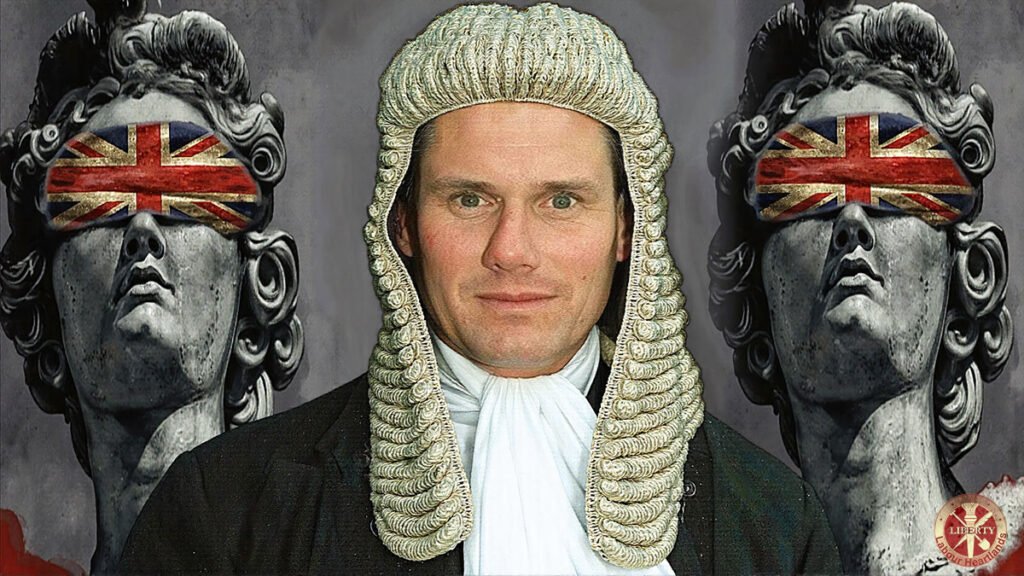
The government’s argument is seductively simple. The courts are in crisis. The Crown Court backlog stands at over 80,000 cases. Nearly 20,000 defendants have been waiting more than a year for their day in court, among them around 2,000 victims of rape waiting for justice. Trials are now being listed as far ahead as 2029. Something must be done.
Nobody disputes the crisis. What is in dispute is the remedy. And here the government has chosen not surgery but amputation.
The bill removes, for the first time in modern British legal history, a defendant’s right to elect trial by jury for either-way offences. It creates a new Bench Division, where cases likely to attract a sentence of three years or less will be heard by a judge alone, without twelve citizens deliberating on the facts. Complex fraud and bribery cases may also be directed to judge-only proceedings. At a stroke, this removes jury trial from a swathe of cases that include theft, burglary, assault, and lower-level fraud: the everyday crimes that most ordinary people, if they ever interact with the criminal justice system at all, are most likely to face.
The government claims this will save twenty per cent of Crown Court time for the affected cases. Independent analysis tells a different story. The Criminal Bar Association estimates the reforms will save approximately 200 sitting days per year across the entire system. The Institute for Government has been equally withering, concluding that the impact on trial delays would be negligible, and that the measure draws resources and focus away from far more direct and effective remedies. We are trading eight centuries of democratic participation for a rounding error in the Ministry of Justice’s spreadsheets.
And this was nowhere in the Labour manifesto. Moran makes this point precisely and correctly. If the government truly believed the jury system was the bottleneck, they had the chance to say so at the election. They did not. Because they knew.
THE LAMMY PARADOX

There is an irony here so thick it borders on the farcical. The man piloting this bill through Parliament is David Lammy, a Lord Chancellor who once argued, with considerable force, that juries act as a filter for prejudice, that they deliver equitable results regardless of the ethnic background of defendant or jury, and that the jury system, though centuries old, remains fit for purpose.
He was right then. The question is not what changed in the evidence. The question is what changed in David Lammy’s circumstances.
“You can blackmail, bribe, or threaten a single judge. You cannot do the same to twelve good people selected at random from the life of a community; you can not prejudge an entire jury.”
Writing in the New Statesman as Justice Secretary, he tells us he must be a realist as well as a romantic. It is a formulation that tells you everything about where power has taken him. The romance, apparently, was the principle. The realism is its abandonment.
Lammy argues that only around three per cent of criminal cases ever reach a jury today, and that more than ninety per cent of all cases are already heard in magistrates’ courts without one. He presents this as reassurance. It is, in fact, the prosecution’s own confession.
The erosion of the right to jury trial is already well advanced. This bill does not introduce a new danger; it accelerates an existing one.

To understand what is truly at stake, we must look beyond the sterile language of administrative reform and recognise the profound historical struggle that has brought us to this moment. Trial by jury isn’t merely an administrative feature of the justice system; it is a bedrock principle of our democracy that stretches back to Magna Carta in 1215, when it was established that “no free man should be imprisoned or stripped of his rights… except by the lawful judgment of his equals.” in other words the right to trial by jury…
John Lilburne, that indomitable Leveller who became the quintessential martyr of judicial resistance. Tried repeatedly for seditious libel, Lilburne consistently challenged the very legitimacy of courts that denied those fundamental rights as he once stated:
“I know nothing that makes a man a Magistrate over me but law, and while he walks by the rules of that Law which make him a Magistrate, I shall own him as a Magistrate, but when he tramples it under his feet, and walks by the law of his own will, I for my part in such a condition cannot own him for a Magistrate.”
These were not privileges handed down by the ruling class but hard-won victories by ordinary people, a fundamental assertion of citizen’s rights against institutional tyranny.
Ironically, a distant relation of John Lilburne, Thomas Jefferson, the 3rd U.S. President and Founding Father, also understood the profound connection between democracy and justice that trial by jury represents. Jefferson eloquently captured this in a letter to Thomas Paine, stating, “I consider trial by jury as the only anchor ever yet imagined by man, by which a government can be held to the principles of its constitution.”
There are some things our “colonial cousins” got it right—and Britain would do well to remember them.
THE HUMAN COST OF EFFICIENCY

It is worth pausing on what a jury actually is. It is not an administrative mechanism. It is not a legacy feature to be deprecated in the name of modernisation. It is the only institution in the entire structure of the British state where the citizen is not a subject of the law but a participant in its administration.
Twelve people, drawn from ordinary life, accountable to no one but their own consciences, deliberating on the facts before them. They can acquit where a judge would convict. They can refuse to enforce laws they consider unjust. They represent the one genuinely unpredictable, genuinely democratic element in a system that increasingly treats the human being before it as a unit of caseload to be processed.
The government points to magistrates as a lay element in the new Bench Division. But magistrates, however well-intentioned, become part of the state apparatus the moment they accept their commissions. They are trained, guided, and supervised by the very system they are meant to check. A jury remains genuinely independent.
Moreover, magistrates are not a representative cross-section of the public they judge. In 2023 and 2024, only thirteen per cent of magistrate appointments came from ethnic minorities, against eighteen per cent of the general population. Eighty-one per cent of magistrates are over fifty, compared with forty-three per cent of the general population. The bench that will replace the jury box is older, whiter, and more institutionally shaped than the community it serves.
And there is a truth that cannot be prettified with the language of reform: a single judge can be pressured, influenced, and predicted in ways that a jury never can. The legal establishment has always understood this. That is precisely why authoritarian systems throughout history have moved, as their first order of business, to eliminate the jury.
WHAT THE NUMBERS DON’T SAY

The government’s own figures tell a story it does not intend. There are 80,000 cases in the Crown Court backlog. The backlog has more than doubled since 2019. Cases were being listed for 2029 before this bill was ever drafted. The crisis is real, acute, and damaging to real human beings, victims and defendants alike.
But the crisis is not a product of too many jury trials. It is a product of deliberate, systematic underfunding. A decade of austerity gutted the court estate, drove barristers and solicitors from legal aid work, and closed courts across the country. The Criminal Bar went on strike in 2022 because the pay for legal aid work had become unsustainable. The government inherited a system stripped to the bone.
The solution to underfunding is not the removal of rights. The solution is funding. The bill contains some investment; the government has announced uncapped Crown Court sitting days and additional capital spending on the court estate. These measures deserve credit. But they do not require the abolition of jury trial to function. They are being bundled with the constitutional change as cover.
This is a pattern. Create a crisis through underfunding, then use that crisis to justify restructuring. It is disaster capitalism applied to constitutional law.
GHOSTS IN THE MACHINE

We have been here before. The Star Chamber, abolished by Parliament in 1641 after it became the instrument through which monarchs silenced political opponents and punished critics without jury oversight, has never fully left us. Its ghost haunts every proposal to strip the citizen of the right to be judged by equals.
We have the more recent example of the Diplock courts in Northern Ireland, where jury trials were suspended for terrorist offences in 1973 as a temporary emergency measure. They were not fully abolished until 2007. The temporariness of emergency exceptions has a way of becoming permanent.
The government insists jury trials will be protected for the most serious offences: murder, rape, aggravated burglary, people trafficking. But the category of what is sufficiently serious has a way of contracting over time. Today’s exception is tomorrow’s standard. The criterion of three years or less will not remain fixed; it will be adjusted, extended, and normalised through secondary legislation. That is what the bill provides for. The Lord Chancellor is given powers to make further regulations by statutory instrument, beyond the scrutiny of full Parliamentary debate.
Perhaps most troubling is the provision that would allow judge-only trials for fraud cases of exceptional complexity, on the basis that the subject matter is outside the understanding of the general public. This logic does not limit itself. Who decides what is outside the understanding of the general public? Judges? Civil servants? The same class of experts who assured us that financial derivatives were perfectly safe, that mass surveillance was limited and proportionate, and that algorithmic systems were neutral and fair?
The citizens who are apparently too stupid to understand a fraud trial are trusted to elect governments, to serve on juries in murder trials, and to make life-and-death decisions as parents, doctors, and workers every day of their lives. The condescension here is not incidental. It is structural.
FORTY LABOUR MPS AND A BARRISTER’S CONSCIENCE

The opposition inside the Labour Party to this bill is real and growing. By December 2025, nearly forty Labour backbenchers had written to the Prime Minister to say they would not support proposals to limit jury trials. Karl Turner, a solicitor and MP for Kingston upon Hull, has been leading cross-party work with the Law Society and the Bar Council to develop a compromise position involving pilot schemes. The Justice Select Committee has launched pre-legislative scrutiny and its call for evidence closes tomorrow, the same day as the bill’s second reading.
The Bar Council, the Law Society, the Criminal Bar Association, the Criminal Law Solicitors Association, and a cohort of former judges have all raised serious objections. This is not a campaign of vested interests defending their guild. These are practitioners who see, every day, what the justice system does to real people, and who understand with professional clarity what is being lost.
And now Christopher Moran has walked away. A legal aid barrister who chose public service over private profit, who voted for this Prime Minister, who believed in the Labour Party as the greatest political vehicle for positive change in this country. He has added his voice to that of Oscar Wilde’s Lady Bracknell, whom Moran himself quoted in his resignation letter, about knowing the price of everything and the value of nothing.
The government knows the price of its reforms. It has put it in the impact assessment. It cannot tell us the value of what it is discarding, because it no longer believes in the concept.
THE CHOICE BEFORE PARLIAMENT

Tomorrow, Parliament debates a bill that will strip the right to jury trial from defendants facing sentences of up to three years. It will do so on behalf of a government that did not mention this in its manifesto, that dismissed the crisis it now cites as justification when it was building in opposition, and that is led by a Lord Chancellor who spent years arguing the exact opposite of what he is now proposing.
The backlog is real. The suffering it causes to victims is real. The need for investment and reform is real. None of this requires the abolition of the citizen’s right to be judged by equals.
A Labour government should know this above all others. The working class has always been more vulnerable to the power of the state than those with money and connections. A single judge, however learned, however well-intentioned, is a product of the professional class that has always administered the law. A jury of peers is the one moment where the defendant stands before people who may share his postcode, his circumstances, his understanding of the pressures that put him in that dock.
Remove that, and you have not reformed the justice system. You have removed its most democratic element, and replaced it with the efficient processing of human beings through a machine that no longer contains any part of themselves.
Eighty years ago, a Labour government built the NHS, created legal aid, and established the post-war settlement on the principle that the state should serve the people, not process them. Today, a Labour government is being asked to understand the difference between a backlog and a birthright.
Christopher Moran understood it. He spent nineteen years in the courts demonstrating that he understood it, and yesterday he wrote it down for the Prime Minister in plain English.
The question now is whether anyone in this government is still capable of reading it.
“The backlog is a failure of funding, not a failure of the British people’s right to judge one another. Fix the system. Do not abolish the principle.”
Enjoyed this read? I’m committed to keeping this space 100% ad-free so you can enjoy a clean, focused reading experience. Crafting these articles takes a significant amount of research and heart. If you found this helpful, please consider a “small donation” to help keep the lights on and the content flowing. Every bit of support makes a huge difference.

labourheartlands.com | @Labourheartland
Support Independent Journalism Today
Our unwavering dedication is to provide you with unbiased news, diverse perspectives, and insightful opinions. We're on a mission to ensure that those in positions of power are held accountable for their actions, but we can't do it alone. Labour Heartlands is primarily funded by me, Paul Knaggs, and by the generous contributions of readers like you. Your donations keep us going and help us uphold the principles of independent journalism. Join us in our quest for truth, transparency, and accountability – donate today and be a part of our mission!
Like everyone else, we're facing challenges, and we need your help to stay online and continue providing crucial journalism. Every contribution, no matter how small, goes a long way in helping us thrive. By becoming one of our donors, you become a vital part of our mission to uncover the truth and uphold the values of democracy.
While we maintain our independence from political affiliations, we stand united against corruption, injustice, and the erosion of free speech, truth, and democracy. We believe in the power of accurate information in a democracy, and we consider facts non-negotiable.
Your support, no matter the amount, can make a significant impact. Together, we can make a difference and continue our journey toward a more informed and just society.
Thank you for supporting Labour Heartlands