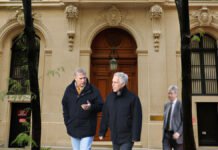
An investigation into the elite networks linking convicted sex offenders, surveillance capitalists, and the Labour government
It’s a big club, and you ain’t in it. George Carlin’s line cuts deeper every year. But here’s the democratic demand he didn’t make explicit: we may not be in the club, but we have the right to know who is.
British law requires MPs and police officers to declare membership in Freemasonry. The rationale is straightforward: secretive networks create opportunities for patronage, preferment, and conflicts of interest that undermine public trust. If we demand transparency about local lodge memberships, surely we should demand the same for global elite coordination forums.
Yet membership in the Trilateral Commission, an invitation-only organisation explicitly designed to shape policy beyond democratic accountability, requires no such declaration. Peter Mandelson belongs to it. So did Jeffrey Epstein. Keir Starmer served as a member while simultaneously claiming to represent socialist principles as Jeremy Corbyn’s shadow Brexit secretary. And the networks connecting these men extend directly to Peter Thiel, whose surveillance company Palantir now controls access to NHS patient data, police intelligence systems, and nuclear weapons infrastructure.
At the centre of the Mandelson scandal sits not one compromised individual but an architecture of elite capture. Overlapping memberships. Off-the-record meetings. Business partnerships that continue even after criminal convictions. And revolving doors that ensure the same names circulate through government, corporate boardrooms, and policy forums designed to insulate elite consensus from democratic volatility.
This is not conspiracy theory. This is institutional architecture operating in plain sight.
At its centre sits a network of overlapping elite institutions that connects Epstein, Mandelson, and Palantir founder Peter Thiel through a web of business interests, intelligence connections, and membership in one of the world’s most powerful private organisations: the Trilateral Commission and the Trilateral Web.
The parliamentary transcript from 4 February reveals MPs demanding answers about how Mandelson passed vetting despite his documented ties to Epstein. What they did not discuss is how both men belonged to the same exclusive policy group, or how Mandelson’s lobbying firm helped embed Thiel’s surveillance company into Britain’s most sensitive systems while Thiel was simultaneously in business partnership with Epstein. These are not coincidences. They are the architecture of elite capture.
The Epstein Files: A Trilateral Connection
The latest Department of Justice document release confirms what researchers have long suspected. Jeffrey Epstein was not simply a financier with powerful friends. He was a member of the Trilateral Commission, the invitation-only policy forum founded in 1973 by David Rockefeller to coordinate elite interests across North America, Europe and Japan.
This interconnected network, referred to as the Trilateral Web, underscores the influence and reach of these elite individuals.
How does a college dropout from Brooklyn with no formal financial qualifications gain entry to one of the world’s most exclusive policy organisations? According to the Commission’s own documentation, membership is determined by “economic weight and political influence.” Standard networks of capital do not explain Epstein’s admission. Something else was operating.
In audio recordings now public, Epstein recounted his relationship with David Rockefeller directly. “He formed something called the Trilateral Commission,” Epstein told Steve Bannon. “The Trilateral Commission is some spooky stuff. People said it was something the people that the Illuminati and there’s some mystery about it, people that ran the world.”
Epstein then explained Rockefeller’s rationale. “David said most countries, the politicians get elected for four years or eight years. Someone’s there for four years and then they’re not there anymore. The most important people to have stability and consistency would be businessmen. So he formed this Trilateral Commission of businessmen and politicians from three major continents.”
What Epstein understood, and what the Commission represents, is elite consensus formation beyond democratic accountability. Politicians serve fixed terms and face voters. Capital moves freely across borders and answers to no electorate.
Mandelson’s Double Connection

Peter Mandelson appears on Trilateral Commission membership lists for the European Group. He also appears in Epstein’s contact book no fewer than ten times, with entries for his direct line, home, and country home.
The DOJ files released on 30 January 2026 reveal that Epstein wired £10,000 to Mandelson’s husband, Reinaldo Avila da Silva, in September 2009, several months after Epstein’s release from his first prison term for soliciting prostitution from a minor. This was not a historical friendship that pre-dated Epstein’s conviction. This was active contact after Epstein’s crimes were publicly known and legally established.
Virginia Giuffre, one of Epstein’s primary accusers, testified in 2011 that she was “introduced to Mr Mandelson at a dinner party” at Epstein’s New York residence. BBC reporting confirmed that Mandelson lobbied Tony Blair for a meeting with Epstein at Downing Street in May 2002. A civil servant’s memo from that period described Epstein as “a friend of Bill Clinton and Peter Mandelson.”
Two Trilateral Commission members. One convicted of crimes against children. The other facilitating his access to the highest levels of British government. And now, both men are at the centre of a scandal about how surveillance technology entered Britain’s most sensitive infrastructure.
The Thiel-Epstein Business Partnership

Documents seen by Labour Heartlands reveal the depth and duration of Peter Theil’s personal business relationship with Jeffrey Epstein. This was not casual acquaintance. It was active partnership that continued years after Epstein’s 2008 conviction.
In 2014, Epstein became a co-owner of Peter Thiel’s Valar Ventures, investing $40 million in a business partnership that would continue until Epstein’s 2019 arrest. Ehud Barak, former Israeli prime minister, described Valar as ‘co-owned’ by Thiel and Epstein as they bought into the Israeli surveillance technology firm Carbyne.
The timing is significant. In 2018, Palantir Technologies hired Mandelson’s lobbying firm, Global Counsel, to facilitate the company’s penetration of UK Government contracts. At the same time, Epstein remained an active Valar partner receiving confidential investment opportunities from Thiel’s fund.
Palantir, founded by Thiel in 2003 with seed funding from the CIA’s venture arm In-Q-Tel, now holds more than £670 million in UK Government contracts spanning nuclear weapons systems, NHS patient records, Ministry of Defence operations, and police intelligence databases.
If Mandelson’s links to Epstein disqualify him from holding power, why does the company controlled by Epstein’s business partner and co-owner retain access to Britain’s most sensitive national security infrastructure?
Trilateral Networks and British Politics

Keir Starmer was a member of the Trilateral Commission. According to membership records, Starmer joined between March 2017 and October 2018 while serving as Jeremy Corbyn’s shadow Brexit secretary. He maintained membership until sometime between April 2021 and June 2022, covering his early period as Labour leader.
During his time as a member, Starmer served alongside two former heads of the CIA: John Deutch and David Petraeus. Jami Miscik, CIA deputy director for intelligence from 2002-5, also sat alongside him. John Negroponte, director of US national intelligence under George W Bush, and two former chairmen of the US National Intelligence Council also served with Starmer.
Declassified UK reported that Starmer never declared this membership to parliament, despite other MPs doing so. When asked about his Trilateral membership, Starmer did not respond.
While official Trilateral Commission membership lists do not list Peter Thiel as a current member, his secretive “Dialog” group is heavily populated with Trilateral Commission members, including Eric Schmidt, Larry Summers, Anne-Marie Slaughter, Robert Rubin, and Richard Haass. Thiel also sits on the Bilderberg Steering Committee, the elite networking forum where David Rockefeller and Zbigniew Brzezinski received blessing to establish the Trilateral Commission in 1972.
These overlapping networks operate beyond public scrutiny. Membership is by invitation only. Meetings are strictly off the record. And the same names circulate through multiple organisations, creating an interlocking directorate of elite power.
The Palantir Pipeline
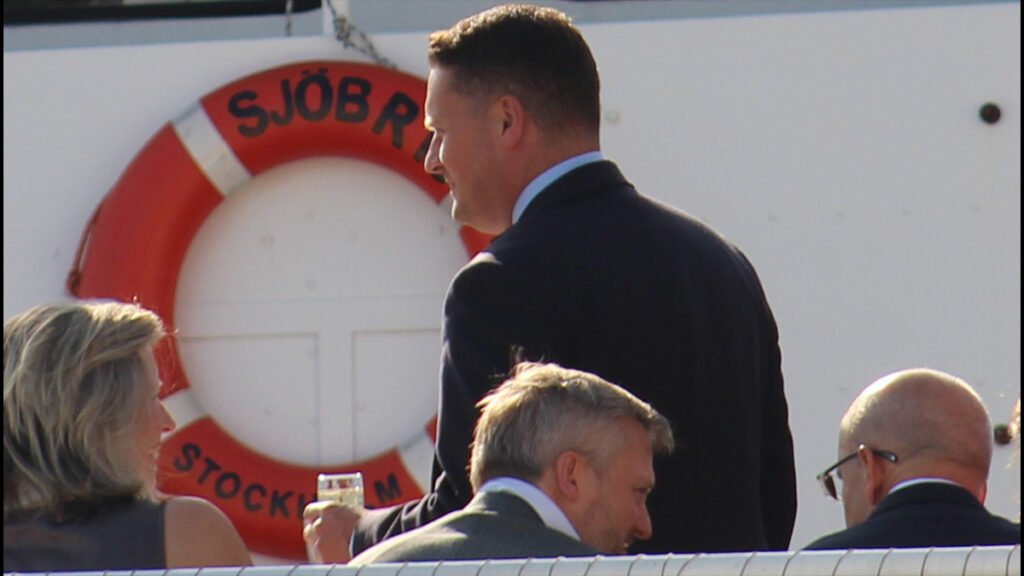
The revolving door between the NHS, Global Counsel, and Palantir demonstrates how institutional capture operates in practice.
Matthew Swindells, deputy chief executive of NHS England, joined Global Counsel in 2019. Indra Joshi, former NHSX director of AI, and Harjeet Dhaliwal, deputy director of data services at NHS England, both joined Palantir in 2022.
Meanwhile, Palantir hired Global Counsel for lobbying as it sought to cement UK Government contracts. Co-founded by Peter Mandelson, the firm counted Palantir among its clients during the period when the company was securing its massive NHS contract.
In February 2025, as Mandelson served as UK Ambassador to the United States, he personally arranged Keir Starmer’s visit to Palantir’s Washington headquarters. No official record was kept. No minutes. No transcript. Just access, facilitated by a man whose firm represented the company and who held significant financial interest in Global Counsel’s success.
The Good Law Project later confirmed that Mandelson’s Global Counsel firm represented Palantir at the time of Starmer’s visit. Despite this apparent conflict of interest, no official records of the meeting were recorded by the Government.
Speaking after the meeting, Palantir’s UK boss Louis Mosley told the House Magazine: “You could see in [Starmer’s] eyes that he gets it. The ambition is there, the will is there.”
The Epstein-Thiel Middle East Connection
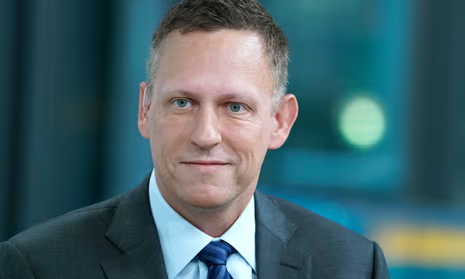
Emails released in the latest Epstein files reveal coordinated discussions between Epstein and Thiel about destabilising the Middle East. Messages reference Iraq, Iran, Libya, Syria, Palestine, Lebanon and Egypt, suggesting attempts to advance Western interests in the region.
In audio recordings from the DOJ release, Ehud Barak describes how, as he was leaving official government service in Israel, he turned to Jeffrey Epstein for guidance. Epstein told him he needed to look at a Peter Thiel company called Palantir.
The latest files show Epstein helped Barak establish business initiatives in Ivory Coast between 2012 and 2014. Epstein coordinated Barak’s meetings during the UN General Assembly, connected him with Ivory Coast President Alassane Ouattara’s chief of staff and officials, and helped arrange connections with the president’s family. Barak, meanwhile, commissioned former Israeli intelligence officers to produce technical plans for nationwide phone and internet monitoring.
This private initiative later became the basis of a 2014 defence and internal security agreement between Israel and Ivory Coast. Surveillance technology, elite networks, and geopolitical strategy converging through Epstein’s connections.
Parliamentary Questions, Inadequate Answers
The 4 February parliamentary debate revealed the extent of governmental failure. Shadow ministers challenged the Prime Minister’s judgment in appointing Mandelson despite knowing about his Epstein connections. They demanded release of the vetting documents that supposedly cleared him.
MPs highlighted that the Prime Minister was aware that Mandelson had an ongoing friendship with Epstein that continued beyond the conviction. It was not only in the public domain. In January 2024, a Financial Times journalist told the Prime Minister about it directly. The Cabinet Office propriety and ethics team included it in their briefing note to Downing Street.
The New Statesman reported that the propriety team’s report contained warnings about potential conflicts of interest surrounding Global Counsel, the lobbying firm which Mandelson established and in which he retained about 28% stake. The firm had Russian and Chinese clients, which reportedly raised serious concerns with the ethics team.
One MP captured the absurdity: “What is the level of relationship that is acceptable with a pedophile? Is it coffee in the morning or dinner at night? What is that level? There should be none with a convicted pedophile.”
Yet the debate never touched on the Trilateral connections, the Palantir contracts, or the business partnership between Thiel and Epstein. The questions were about one man’s judgment. The systemic capture remained invisible.
Russia, Crypto, and Convergent Interests
The Epstein files reveal another dimension. Correspondence shows Epstein maintained close contacts with Russian officials, including Sergey Belyakov, who graduated from the FSB spy academy and served as senior advisor to oligarch Oleg Deripaska before becoming Russia’s Deputy Minister of Economic Development.
In 2013, Epstein pitched to Belyakov what he described as “a new form of money, on a worldwide basis” using blockchain technology. He urged Russia to “reinvent the financial system of the 21st century.”
Peter Thiel was a keen admirer of cryptocurrency and its ability to provide an alternative to government-controlled money. He once declared, “Bitcoin is what PayPal should have been.”
As Epstein and Thiel’s finances aligned through Valar Ventures, so did their politics. Both men were unusually important early backers of Donald Trump’s first presidency. Emails capture the tone of their relationship. Epstein wrote to Thiel, “I liked your Trump exaggerations, not lies,” before suggesting Thiel “visit me [in the] Caribbean.”
Thiel broke with much of Silicon Valley to endorse Trump and pour millions into pro-Trump PACs. Epstein’s correspondence shows close tracking of Trump-Clinton polling, campaign personnel, and appointments linked to Bitcoin and fintech.
Surveillance Capitalism Meets Democratic Failure
Palantir is not a neutral technology provider. It is a surveillance firm with deep ties to security agencies, foreign governments, and a political ideology hostile to transparency and civil liberties.
Peter Thiel, the company’s chairman and co-founder, has publicly stated he “no longer think[s] that freedom and democracy are compatible.” Speaking at the Oxford Union, he suggested the UK public’s attachment to the NHS was a case of “Stockholm syndrome,” adding: “Highways create traffic jams, welfare creates poverty, schools make people dumb and the NHS makes people sick.”
This is the man whose company now has access to NHS patient data, police intelligence systems, and nuclear weapons infrastructure. And he gained that access with help from a lobbying firm founded by a man who had been compromised by a convicted sex offender who was also a Trilateral Commission member and Thiel’s business partner.
CEO Alex Karp has been equally blunt about Palantir’s ambitions. “When the whole world is using Palantir,” he declared, “they can still not like us. They’ll have no choice.”
This is not the voice of a public servant. This is the voice of a company that sees democracy as an obstacle to be managed, not a value to be upheld.
The Pattern of Elite Capture
What emerges from these connections is not conspiracy but institutional architecture. The Trilateral Commission creates spaces where elite consensus forms beyond democratic accountability. Epstein used his membership to cultivate relationships with powerful figures across business, politics, and intelligence. Mandelson leveraged both his Trilateral connections and his Epstein access to position Global Counsel as a broker between corporate power and government contracts.
Thiel, operating through his Dialog group packed with Trilateral members and his position on the Bilderberg Steering Committee, maintains similar networks. His business partnership with Epstein continued for five years after Epstein’s conviction, ending only with Epstein’s 2019 arrest.
The revolving door spins. NHS officials join Palantir. Palantir hires Mandelson’s firm. Mandelson arranges prime ministerial meetings. No records are kept. No accountability exists. And the surveillance infrastructure embeds deeper into the British state.
The Unanswered Questions
The parliamentary debate of 4 February asked why Mandelson passed vetting despite his Epstein connections. The real question is why the vetting process examined only individual relationships rather than the institutional networks that create systemic risk.
Did the propriety and ethics team investigate Mandelson’s Trilateral Commission membership alongside Epstein? Did they examine how Mandelson’s Global Counsel profited from lobbying for a company whose founder was simultaneously in business partnership with Epstein? Did they consider whether Palantir itself represents a security risk given Thiel’s documented relationship with a convicted sex offender who maintained extensive Russian intelligence connections?
These questions were never asked because the networks themselves remain invisible to conventional scrutiny. The Trilateral Commission does not register as a lobby group. Its meetings are off the record. Its membership is public but its activities are not. The same applies to Bilderberg, to elite policy forums, to the revolving doors between government, consultancy, and corporate power.
And while MPs debate whether one peer should have been appointed ambassador, the surveillance infrastructure that peer helped establish continues to expand. Palantir’s NHS contract runs until February 2027. Its access to defence systems, police databases, and nuclear weapons data remains intact. The technology embeds deeper while the scandal focuses on personalities.
Democratic Accountability or Elite Management?
The Trilateral Commission’s 1975 publication, “The Crisis of Democracy,” argued that democratic societies faced a crisis precisely because too many people were participating in politics. The solution, the Commission proposed, was to reduce expectations of democratic responsiveness and strengthen governance by elite consensus.
It should be noted that Noam Chomsky, a lifelong critic of elite institutions including the Trilateral Commission, has himself been implicated in the latest Epstein file releases. This is not mentioned to discredit Chomsky’s analysis of elite power structures. Rather, it demonstrates how thoroughly these networks penetrate even among those who publicly oppose them. The architecture of elite capture does not spare its critics. If anything, Chomsky’s connections to Epstein underscore the argument he makes about institutional power: these networks operate with such reach that proximity to them becomes nearly unavoidable for anyone moving through elite academic, political, or intellectual circles. The question is not whether one encounters these networks, but whether one serves them.
This is not historical curiosity. This is the operating logic visible in the Mandelson scandal. Democratic accountability is for the managed classes. Elite networks operate beyond such constraints.
Keir Starmer’s Trilateral membership during his time as shadow Brexit secretary represents the same pattern. He joined an organisation explicitly committed to elite management of democratic processes while simultaneously claiming to represent a socialist political movement under Jeremy Corbyn. The contradiction was never resolved because it was never acknowledged.
Mandelson’s Trilateral membership alongside Epstein demonstrates how these networks operate. Both men moved through the same elite spaces. Both cultivated relationships across business, politics, and intelligence. Both operated beyond conventional democratic oversight. One happened to be a convicted sex offender. The other happened to lobby for a surveillance company whose founder was that offender’s business partner.
These are not separate scandals. They are the same scandal. The institutional architecture that enabled Epstein to operate for decades is the same architecture that embeds Palantir into the British state. Elite networks, off-the-record meetings, revolving doors, and the systematic exclusion of democratic oversight.
What Must Happen Now
The British government’s swift action to sever Mandelson’s appointment acknowledges that his relationship with Epstein posed a continuing national security threat. That logic must now extend to Palantir. A company controlled by a man who was co-owner of an investment fund with Epstein, who maintained active business partnership with him until his 2019 arrest, and who operates within the same elite networks that enabled Epstein’s decades of impunity.
Parliament must demand full disclosure of:
- Starmer should resign
- All communications between Mandelson and Palantir while Global Counsel represented the company
- The complete vetting reports that supposedly cleared Mandelson for ambassadorial appointment
- The nature and extent of Thiel’s business partnership with Epstein through Valar Ventures
- How Palantir gained access to NHS data, defence systems, and police databases while its founder maintained financial ties to a convicted sex offender
- Whether the propriety and ethics team examined Trilateral Commission connections as part of security vetting
- What due diligence was conducted on Palantir’s leadership before awarding contracts worth £670 million
The contracts with Palantir must be suspended pending independent security review. Not simply reviewed. Suspended. The precautionary principle applies when national security infrastructure is controlled by companies whose leadership maintained active business partnerships with convicted criminals.
The revolving door between government, consultancy firms, and surveillance companies must be closed. Mandatory cooling-off periods of at least five years for senior officials before joining firms they regulated or awarded contracts to. Criminal penalties for officials who fail to declare conflicts of interest.
And the Trilateral Commission, Bilderberg, and similar elite policy forums must be subject to the same transparency requirements as any organisation seeking to influence government policy. Mandatory disclosure of membership by public officials. Public records of meetings. Registration as lobby groups if they claim to shape policy.
The Truth We Must Face
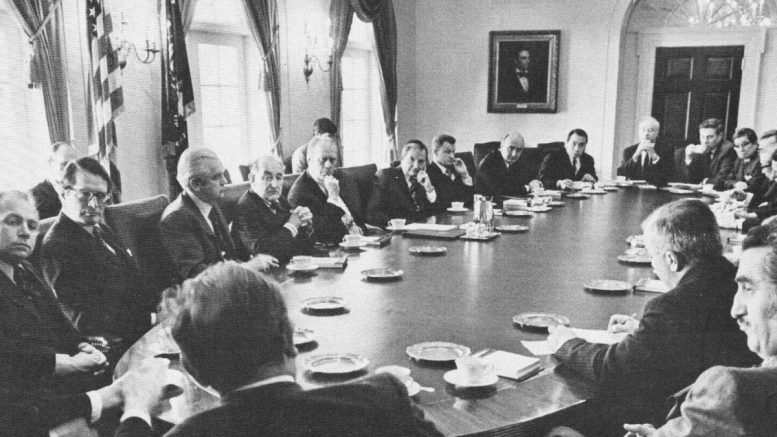
Democracy fails not through dramatic coups, there is no storming the Bastille; it comes through quiet capture. Through networks that operate beyond scrutiny. Through revolving doors that ensure the same names circulate through government, corporate boardrooms, and elite policy forums. Through the institutional architecture that treats democratic accountability as a problem to be managed rather than a principle to be upheld.
The Mandelson scandal exposes this architecture because Epstein’s crimes were so egregious that even elite consensus could not protect him. But Epstein was not an aberration. He was a product of these networks. His ability to operate for decades despite multiple investigations, despite victims coming forward, despite evidence accumulating, demonstrates how elite protection functions.
The same networks that protected Epstein now embed Palantir into the British state. The same revolving doors that facilitated his access now facilitate corporate capture of public infrastructure. The same elite consensus that treated his crimes as private failings rather than systemic symptoms now treats the Mandelson scandal as a question of individual judgment rather than institutional corruption.
This is what institutional capture looks like. Not dramatic takeovers but quiet coordination. Not conspiracy but convergence of interest. Not darkness but daylight, if anyone cares to look.
Peter Mandelson’s connections to Epstein removed him from power. Peter Thiel’s identical connections leave his company embedded in the most sensitive systems of the British state. The scandal is not that one peer was compromised. The scandal is that the architecture of compromise remains intact.
When convicted sex offenders belong to the same elite networks as prime ministers and surveillance capitalists, we are not governed by democracy. We are managed by a class that has exempted itself from the accountability it demands of others.
Enjoyed this read? I’m committed to keeping this space 100% ad-free so you can enjoy a clean, focused reading experience. Crafting these articles takes a significant amount of research and heart. If you found this helpful, please consider a “small donation” to help keep the lights on and the content flowing. Every bit of support makes a huge difference!

Support Independent Journalism Today
Our unwavering dedication is to provide you with unbiased news, diverse perspectives, and insightful opinions. We're on a mission to ensure that those in positions of power are held accountable for their actions, but we can't do it alone. Labour Heartlands is primarily funded by me, Paul Knaggs, and by the generous contributions of readers like you. Your donations keep us going and help us uphold the principles of independent journalism. Join us in our quest for truth, transparency, and accountability – donate today and be a part of our mission!
Like everyone else, we're facing challenges, and we need your help to stay online and continue providing crucial journalism. Every contribution, no matter how small, goes a long way in helping us thrive. By becoming one of our donors, you become a vital part of our mission to uncover the truth and uphold the values of democracy.
While we maintain our independence from political affiliations, we stand united against corruption, injustice, and the erosion of free speech, truth, and democracy. We believe in the power of accurate information in a democracy, and we consider facts non-negotiable.
Your support, no matter the amount, can make a significant impact. Together, we can make a difference and continue our journey toward a more informed and just society.
Thank you for supporting Labour Heartlands