Your Party Factional War: Corbyn Wins
Jeremy Corbyn has his mandate. He has his committee majority. He is, in all but name, the leader of the left’s great new hope. But in politics, as in life, winning the argument inside the room counts for nothing if your co-founder is already checking the exits.
There is a particular cruelty that the British left reserves for itself. It is not visited upon it by its enemies, though they are plentiful and well-resourced. It is self-administered, with a thoroughness and dedication that would be admirable in any other context. Today, on the very morning that Jeremy Corbyn secures his grip on Your Party’s Central Executive Committee, one is permitted to feel not triumph but a cautious, mournful recognition: we have been here before.
The numbers, at first glance, look decisive enough. Corbyn’s ‘The Many’ slate has won 14 of the 24 seats on the CEC, double the seven secured by Zarah Sultana’s ‘Grassroots Left.’ In the all-important Public Office Holders section, Corbyn himself topped the poll with 6,740 votes against Sultana’s 5,124. It is a margin of over 1,600. It is not a whisker. It is a statement.
And yet. And yet.
What lies behind those figures. Your Party was launched last July amid a wave of popular excitement that saw 800,000 people express interest in what Corbyn and Sultana were building. Eight hundred thousand. Eight months later, the party has 40,985 verified members. Of those, 25,347 voted in this election, a turnout of 61.8 per cent. The arithmetic of attrition is sobering. From 800,000 expressions of hope to fewer than 26,000 casting a ballot in the election that was supposed to decide the party’s soul. That is not a mass movement. That is a rump.
| Faction | CEC Seats Won | Key Figures |
| The Many (Corbyn) | 14 | Jeremy Corbyn, Laura Smith, Louise Regan |
| Grassroots Left (Sultana) | 7 | Zarah Sultana, Grace Lewis |
| Independents | 3 | (Various regional reps) |
The reasons for this collapse from aspiration to reality are not obscure. They were written in public, on social media, in legal letters, and in the poisoned briefings that flew between the two camps throughout the autumn. The fumbled membership launch in September. The chaotic founding conference in November, at which SWP members were expelled and Sultana boycotted the proceedings in protest. The bitter row over hundreds of thousands of pounds held by MoU Operations Ltd. The accusation, from Sultana’s camp, that Corbyn’s operation ran a ‘sexist boys’ club.’ The counter-accusation, from Corbyn’s Peace and Justice Project, that a Sultana victory would turn Your Party into ‘an angry fringe party that conducts purity tests at the door.’
These were not policy disagreements dressed up as personality clashes. Beneath the personal bitterness lay a genuine and profound difference of vision. Corbyn wanted a single leader; conference rejected that by the narrowest of margins, 51.6 per cent against 48.4. Having lost that vote, he then entered a collective leadership election and won it comprehensively. The irony writes itself. The man who wanted a single leader now effectively is one, courtesy of the very structure his opponent championed.
The Structure and Its Discontents

Sultana’s vision, articulated by her supporters as one of ‘maximum member democracy,’ was not, as Corbyn’s camp suggested, mere cover for sectarian entrenchment. There is a serious argument, familiar to anyone who has studied the history of the Labour left, that without robust internal democracy a party led by a charismatic figure will simply reproduce the top-down culture that drove so many members out of Labour in the first place.
Claudia Webbe put it starkly: this election was about whether the party would build ‘a political home for millions or a debating chamber for the few.’
The Many’s response was equally serious in its way. Corbyn’s slate member Cassi Bellingham warned that many proto-branches were being ‘dominated by Trotskyist groups and sects,’ and that a Sultana victory risked locking the party into ‘an insular and sectarian path.’ This was not merely factional abuse. It reflected a real tension between those who wanted Your Party to be a vehicle for radical but mainstream working-class politics and those who saw it as a platform for the organised far-left.
In the end, Corbyn’s framing prevailed. End the navel-gazing. Campaign on the big issues. It is the right instinct. The cost-of-living crisis, Palestine, the NHS, the housing emergency: these are the issues that move people on doorsteps. Nobody who wants to defeat Reform UK will do so by arguing about branch structure at three in the morning.
And yet one is bound to note a certain tension between the stated ambition and the visible reality. Your Party has four MPs: Corbyn, Sultana, Ayoub Khan and Shockat Adam. It is worth noting that Khan and Adam, both nominally on The Many slate, failed to secure seats on the CEC. The new ruling body is heavily weighted toward Corbyn loyalists. Building branches in time for May will require the active goodwill of precisely those Sultana supporters who now find themselves in a structural minority.
The Green Shadow
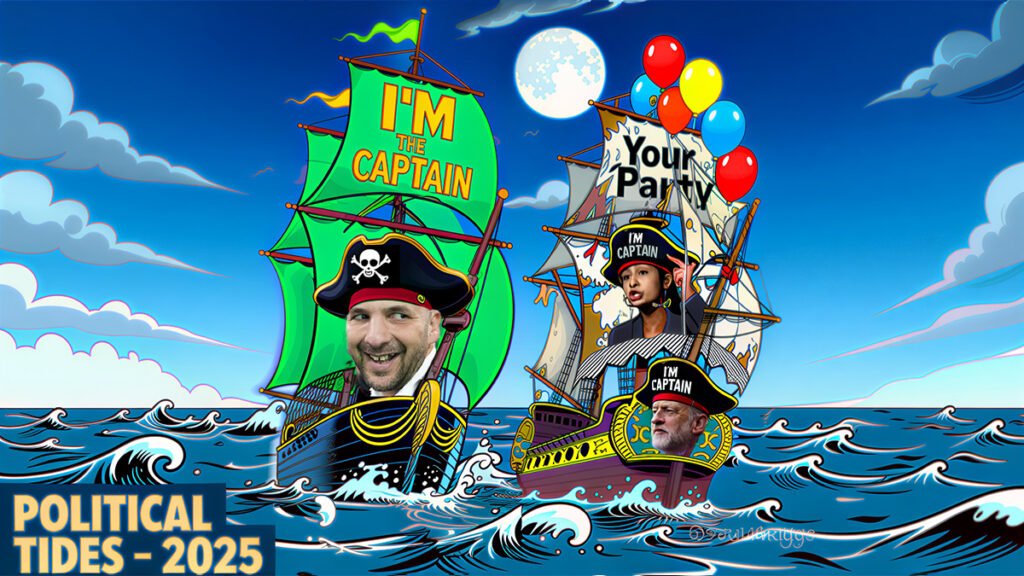
We come now to the matter the party’s new leadership would prefer not to discuss. Zarah Sultana is, as of this writing, still a member of Your Party. She is still one of its four MPs. She is also, by her own admission to the i newspaper, open to an electoral alliance with Zack Polanski’s Green Party.
That admission alone should give the new CEC pause. Because Polanski has not been shy. ‘I like Zarah, come join the Green Party,’ he said publicly. His party has surged from 68,000 members at the time of his election as leader last September to over 170,000 today. Your Party, in the same period, has retained fewer than 41,000 verified members. The Greens are not merely a competitor; they are, at this moment, the more successful vehicle for the left-of-Labour impulse that Sultana and Corbyn together ignited last summer.
The pattern of defection is already established. Greens in Hackney are seeing an influx of members who went from Labour to Your Party and have now moved again, driven out by the public feuding between the co-founders. Former Welsh Labour MP Beth Winter has already left the party. The flow is in one direction.
For Sultana, the calculation is not simply political. It is personal. She warned previously against building ‘Labour 2.0,’ a top-down hierarchy dressed in socialist clothing. She has now watched a CEC election produce exactly the structural outcome she feared. Corbyn, having lost the vote for a single leader, has achieved the functional equivalent through a CEC majority. Whether that is the party Sultana wishes to remain part of is a question only she can answer. But the logic of her position, her values, her previous statements, and the political opportunities available to her all point in the same direction. My prediction, offered here without pleasure but with some confidence, is that she will cross to the Greens before the year is out.
Hobson’s choice

None of this need be fatal. Politics is not logic. Sultana may surprise us. Corbyn retains genuine affection among the working-class communities that Labour has spent a generation abandoning. His instinct on Palestine, on the cost of living, on peace and redistribution, is sound and broadly popular beyond the party’s current membership.
But Corbyn must understand that he has won a battle whose importance depends entirely on what follows. The May local elections are the first real test. Building branches, selecting candidates, and presenting a coherent platform in fewer than three months will expose every weakness the founding chaos has created. The party currently has no established branch network. Its membership data systems have been the subject of legal dispute. It is, in institutional terms, starting from almost nothing.
Corbyn’s post-result statement spoke of ‘a precious opportunity to unite our movement.’ That is the right language. The question is whether it describes a genuine intention or a victor’s courtesy. A mass socialist party cannot be built by 14 people voting down the other ten. It requires the active commitment of everyone in that room, including the seven who voted against.
History is not encouraging. The SDP, launched in 1981 with genuine popular support, destroyed itself through precisely the combination of personal ambition and structural incoherence that has already marked Your Party’s first eight months. Its legacy was to keep the Conservatives in power for a further decade by splitting the centre-left vote. If Your Party fractures, the beneficiary will not be some imagined socialist future. It will be Farage, and behind Farage, something worse.
Corbyn knows this. He named Farage specifically in his victory statement, and he was right to do so. The ‘fear, divisiveness and racism of Reform’ represents a genuine and present threat to the communities Your Party claims to serve. The only answer to that threat is a left that is unified, credible, and present in the places where Reform is winning. None of those things are currently true of Your Party. That is the measure of the work ahead.
“Jeremy Corbyn has won the party. The question is whether, in winning it this way, he has already begun to lose it.”
Enjoyed this read? I’m committed to keeping this space 100% ad-free so you can enjoy a clean, focused reading experience. Crafting these articles takes a significant amount of research and heart. If you found this helpful, please consider a “small donation” to help keep the lights on and the content flowing. Every bit of support makes a huge difference!

Support Independent Journalism Today
Our unwavering dedication is to provide you with unbiased news, diverse perspectives, and insightful opinions. We're on a mission to ensure that those in positions of power are held accountable for their actions, but we can't do it alone. Labour Heartlands is primarily funded by me, Paul Knaggs, and by the generous contributions of readers like you. Your donations keep us going and help us uphold the principles of independent journalism. Join us in our quest for truth, transparency, and accountability – donate today and be a part of our mission!
Like everyone else, we're facing challenges, and we need your help to stay online and continue providing crucial journalism. Every contribution, no matter how small, goes a long way in helping us thrive. By becoming one of our donors, you become a vital part of our mission to uncover the truth and uphold the values of democracy.
While we maintain our independence from political affiliations, we stand united against corruption, injustice, and the erosion of free speech, truth, and democracy. We believe in the power of accurate information in a democracy, and we consider facts non-negotiable.
Your support, no matter the amount, can make a significant impact. Together, we can make a difference and continue our journey toward a more informed and just society.
Thank you for supporting Labour Heartlands