Labour Is Extinguishing the Light of English Liberty
🎧 AI Audio Trial: The Last Jury: When Labour Tore Up Magna Carta (MP3)
When a government announces it will strip away an 800-year-old constitutional protection in the name of efficiency, you know something has gone terribly wrong. Not with the system it claims to fix, but with the government itself.
David Lammy, Justice Secretary and Deputy Prime Minister, stood before Parliament this week to announce what he doubtless considers a triumph of pragmatic modernisation. Jury trials, that ancient bulwark against tyranny, will now be abolished for any offence carrying a likely sentence of less than three years. Murder, rape, and robbery might still merit the judgment of twelve citizens. Everything else? A judge sitting alone will do nicely, thank you.
The government frames this as necessity. There are, they tell us with appropriate gravity, some 78,000 cases awaiting trial in Crown Courts. By 2028, this backlog may reach 100,000. Victims face years waiting for justice. Some trials scheduled today will not be heard until 2029 or 2030. The system is broken, they insist. Something must be done. This is something. Therefore, we must do this.
It is the logic of the man who, finding his house too small, decides to burn down half of it.
A Convenient Crisis
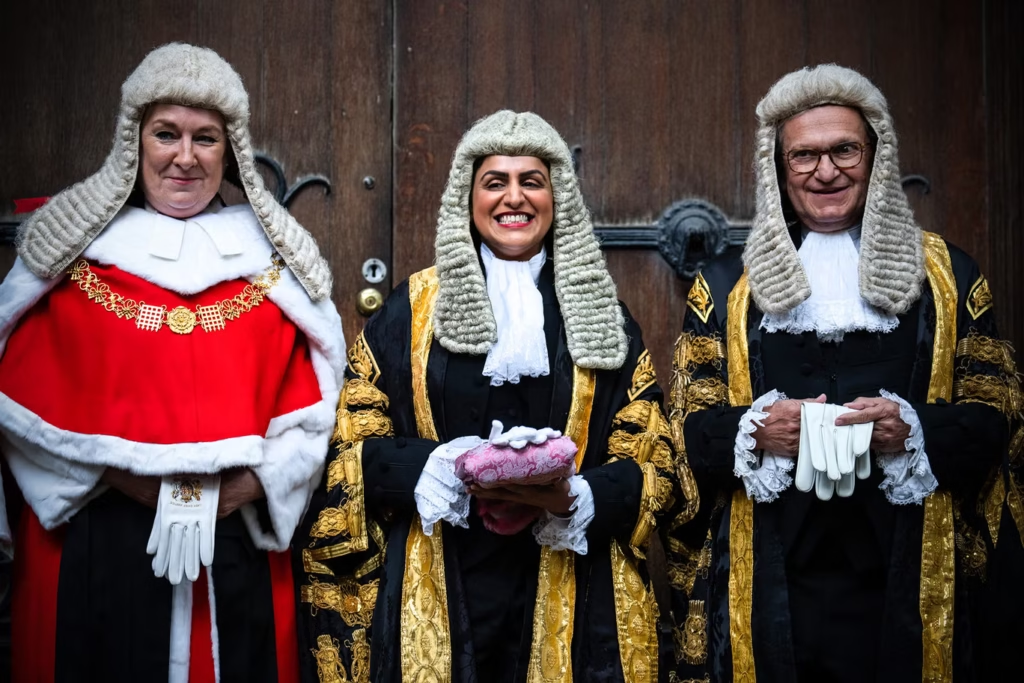
Let us be clear about what created this backlog. It was not juries. Court staff have declined by 30% since 2010. Courtrooms sit empty because there are no judges to sit in them. Harrow Crown Court has been shut for over two years with all eight courtrooms out of action. Prison transport companies, outsourced to for-profit corporations, deliver defendants late or not at all, causing trials to collapse. Criminal practitioners are leaving the profession in droves because the pay is derisory and the demands impossible.
These are problems with obvious solutions: fund the courts, maintain the buildings, pay legal professionals properly, bring prison transport back under public control. But such solutions require money, and this government, like its predecessor, has decided that austerity is a price worth paying. Just not by those who impose it.
So instead, we get constitutional vandalism dressed up as reform. We get the slow dismantling of protections that took centuries to build, sacrificed on the altar of a manufactured crisis. And we are told to be grateful for the innovation.
Lord Devlin, a Law Lord who spent fifteen years trying cases with juries, concluded his 1956 lectures by observing that “The first object of any tyrant in Whitehall would be to make parliament utterly subservient to his will; and the next to overthrow or diminish the right to trial by jury, for no tyrant could afford to leave a subject’s freedom in the hands of 12 of his countrymen.” Corker Binning He called trial by jury “the lamp that shows that freedom lives.”
Lammy is not a tyrant, of course. He is something perhaps more dangerous: a technocrat armed with spreadsheets and convinced that ancient liberties are merely inefficiencies to be optimised away.
The Weight of History
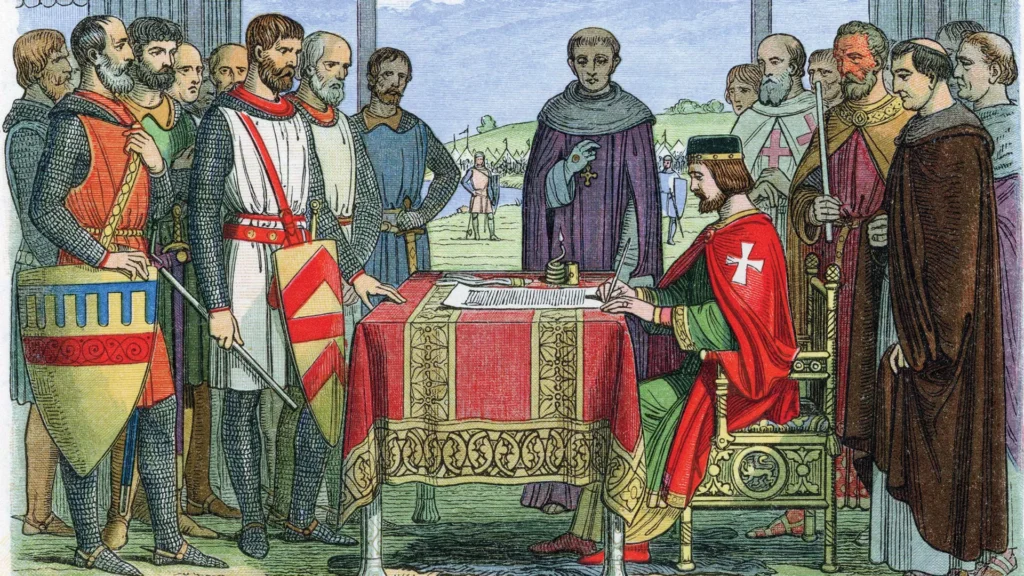
The right to be tried by one’s peers appears in Magna Carta, that document sealed at Runnymede in 1215, which promised no freeman would be imprisoned except by “the lawful judgement of his peers and the law of the land.” This was not romantic flourish. It was a hard-won restraint on arbitrary power, extracted from a tyrannical king by barons who understood that unchecked authority tends inevitably toward abuse.
That principle was tested in 1688 when seven bishops, led by Archbishop Sancroft, refused to read King James II’s Declaration of Indulgence in their churches. They were arrested and tried for seditious libel. The Crown prosecutors were incompetent, the case against the bishops weak, but what mattered was the jury. Three judges refused to comment on whether James was entitled to use his dispensing power and focused on the issue of libel. The jury were allegedly ready to return a verdict of not guilty immediately after the trial but were delayed until the next morning by two members employed in James’ household.

When the acquittal was announced, wild celebrations broke out throughout London, including among English Army regiments based in Hounslow. The king’s own soldiers cheered the defeat of royal prosecution. Within months, James had fled to France and the Glorious Revolution had secured parliamentary supremacy over royal prerogative. A jury had nullified what it considered an unjust law. Historians see the case as marking the emancipation of the judiciary from executive control.
This is what juries do. They stand between the state and the citizen. They refuse to enforce laws the community considers unjust. They protect individuals from prosecutorial overreach and judicial prejudice. They are, as Lord Denning called them, “the bulwark of our liberties.” As Lord Judge, the former Chief Justice, put it: “a safeguard against oppression and dictatorship.”

The English radical tradition understood this instinctively. From the Levellers and John Lilburne in the seventeenth century through to Tony Benn in our own time, the cry of the “freeborn Englishman” has meant something specific: that power must be accountable, that authority must be justified, that the people themselves must have a hand in the administration of justice. Benn stood in that tradition, tracing it back through Robert Owen and the Chartists to John Ball and the 1381 Peasants’ Revolt. The right to be judged by one’s peers was never merely procedural. It was the recognition that justice belongs to the community, not to the state.
Dark Precedents

The last modern European country to systematically dismantle trial by jury was not some minor dictatorship. It was Germany. In January 1924, Justice Minister Erich Emminger abolished juries in the Schwurgericht, replacing them with a mixed system of three professional judges and six lay judges. This was done under the democratic Weimar Republic, presented as an emergency, money-saving measure in a period of acute financial stringency.
Sound familiar?
Although a special meeting of the German Bar demanded the revocation of the decrees, and the Social Democrats called the reform a flagrant usurpation, the decrees did not cause much commotion. After all, it was just a cost-saving measure. Just a practical reform. Nothing to worry about.
When the Nazis came to power in 1933, they found the groundwork already laid. Hitler determined to increase the political reliability of the courts. In 1933 he established special courts throughout Germany to try politically sensitive cases. The People’s Court, established in 1934, became “an instrument of state-sanctioned terror, which served one single purpose, which was the destruction of political opponents. Behind a juridical facade, state-sanctioned murder was committed”, as the West German Bundestag declared in 1985.
The Nazi legal doctrine was brutally simple: the Führer’s will was the supreme source of law. Judges were enjoined to let “healthy folk sentiment” (gesundes Volksempfinden) guide them in their decisions. The judiciary’s role was to interpret and execute the leader’s will, not to provide an independent check on power.
I am not suggesting David Lammy is a Nazi. That would be absurd. But I am suggesting that the mechanisms of authoritarian control often begin with reasonable-sounding arguments about efficiency and necessity. The protection is removed not in a single dramatic coup but through a series of incremental steps, each justified by immediate pressures, each eroding the bulwarks that stand between citizen and state.
The Manufactured Urgency
Lammy’s proposals go far beyond even the recommendations of Sir Brian Leveson’s review, which suggested trial by judge alone only where defendants requested it or in particularly lengthy and complex trials. According to leaks, the Ministry of Justice originally planned to restrict jury trials to only “public interest” cases with sentences over five years. Lammy has given us a watered-down version, and we are apparently supposed to be grateful.
The Bar Council, which represents trial lawyers, said replacing juries with a magistrate or judge sitting alone was not the answer. Barbara Mills, the Bar Council chair, noted: “We have continuously opposed proposals to curtail jury trials because there is no evidence that their removal would reduce the backlog, nor has it been set out how an alternative system would be resourced.”
Consider the mathematics. Jury trials account for around 2% of all criminal cases. The Crown Court backlog stands at 78,000 cases. But the Magistrates’ Court backlog reached 361,027 cases in June 2025, more than four times larger. The government will also increase magistrates’ sentencing powers from 12 to 18 months imprisonment, meaning more people will face longer sentences from volunteer lay judges with no legal training, sitting without juries.
If the goal were truly to clear backlogs and deliver swift justice, one might expect proposals to fund courts adequately, recruit and retain legal professionals, and repair crumbling infrastructure. Instead, we get the removal of constitutional protections and the expansion of summary justice.
The Southport Shadow

There is another context we must acknowledge, uncomfortable though it may be. After the Southport riots last summer, hundreds of people were convicted with remarkable speed. Starmer ordered his show trials immediately after the Southport-related riot, and the machinery of justice suddenly found itself capable of moving with dispatch when the political will existed.
Over 12,000 arrests have been made over social media posts or comments. Protests now require licensing. Freedom of speech faces restrictions previously unthinkable. We have created, slowly and with bipartisan support, a culture of surveillance and control that would have horrified the freeborn Englishmen who extracted Magna Carta from King John.
The removal of jury trials for “lesser” offences takes on a different cast in this context. When the state prosecutes someone for an inflammatory social media post, do we really want a judge sitting alone to determine guilt? When climate activists or trade unionists face charges under ever-expanding public order legislation, should their fate rest with a single member of the judiciary rather than twelve citizens?
There have been cases, for example in protest-related trials, where juries have interpreted the law in ways that reflect broader community standards. Such instances remind us that the legitimacy of criminal justice depends on public consent. Juries can act as a democratic check on official power, nullifying prosecutions that the community considers unjust or disproportionate.
Class and Justice
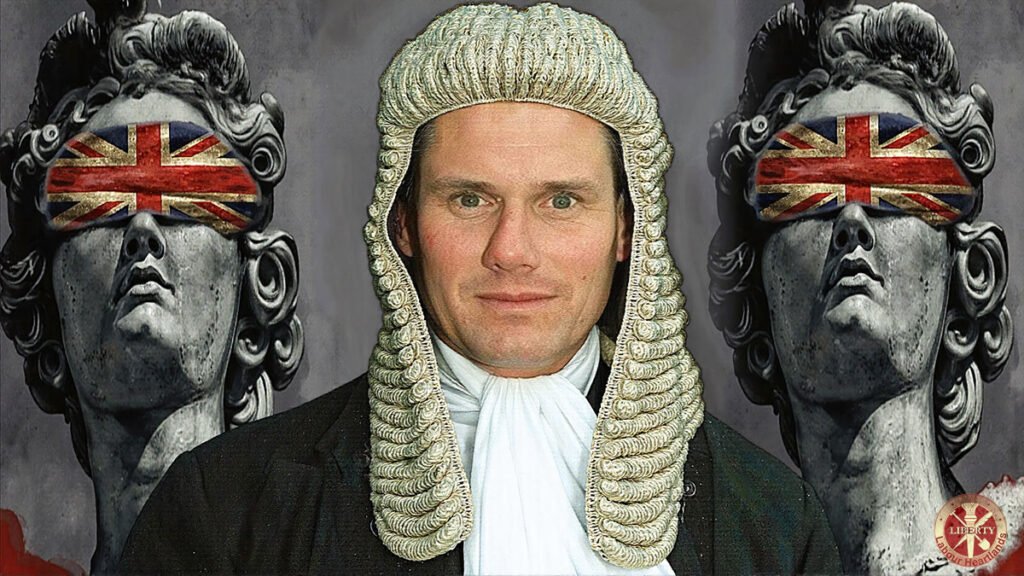
There is a class dimension to this that Labour, of all parties, should understand. Professional judges, however learned and principled, come from a narrow social background. They attended the same schools, the same universities, move in the same circles. They are, by definition, part of the establishment. Their view of the world, their assumptions about what constitutes reasonable behaviour, their understanding of the pressures faced by ordinary people are inevitably shaped by their position in society.
A jury of twelve brings something judges cannot: the collective life experience of the community. “Whatever the intellectual capacity of a judge, they do not have the practical life experience, collectively, of 12 jurors,” as Jim Allister MP, himself a King’s Counsel with nearly 50 years at the bar, observed in the Commons debate. “It is that [collective life experience] which brings superior credibility to a jury verdict.”
This is not sentimentality. It is a recognition that justice must be rooted in the community it serves. When twelve ordinary people, drawn from all walks of life, unanimously agree that someone is guilty, that verdict carries a moral weight that no judge sitting alone can match. And when they refuse to convict, when they exercise what the state calls “perversity” but ordinary people recognize as common sense, they perform the essential democratic function of tempering the law’s harshness with human understanding.
The working class has always understood this. It is the affluent who can afford expensive barristers and who know how to navigate the legal system. For everyone else, the jury is often the only guarantee that justice will not be reduced to an exercise in state power.
The Authoritarian Creep

Let us name what we are witnessing. This Labour government, elected with promises of change and renewal, has instead continued the authoritarian trajectory of its Conservative predecessor. The surveillance state expands. Speech is criminalised. Protest is restricted. And now, trial by jury is to be abolished for the majority of criminal offences.
These are not the actions of a government confident in its mandate or secure in its principles. They are the actions of a government that fears its own people and seeks to insulate itself from accountability.
The tragedy is that it was avoidable. The crisis in our courts is real, but it is a crisis of funding, not of fundamental design. Juries work. Research has found that juries do generally make fair decisions. They bring legitimacy to verdicts. They provide public participation in the administration of justice. They are, in short, one of the things we got right.
But rather than defend what works and fix what is broken, this government has chosen the path of least resistance. It is easier to abolish juries than to fight the Treasury for proper funding. It is simpler to expand summary justice than to rebuild a court system hollowed out by fourteen years of austerity. It is more convenient to sacrifice constitutional protections than to make the case for the investment justice requires.
Of course, none of this is inevitable. The proposals will require parliamentary approval. MPs who claim to value British traditions and constitutional protections will have to decide whether their words mean anything. This was not in Labour’s manifesto. The public considers trial by jury to be a fundamental right, placing it second only behind universal healthcare.
There is still time to step back from this precipice. We could fund our courts properly. We could pay legal professionals adequately. We could bring prison transport back under public control. We could maintain our courtrooms and recruit enough judges to hear cases promptly. We could, in short, preserve trial by jury while addressing the genuine problems in our justice system.
But that would require political courage, and that appears to be in shorter supply than courtroom space.
David Lammy may believe he is being realistic, pragmatic, solutions-oriented. He may tell himself that in a world of limited resources and pressing demands, something has to give. But some things should not give. Some principles are not negotiable. Some protections, once lost, cannot be recovered.
Lord Devlin warned us. The Seven Bishops showed us. The English radicals taught us. Trial by jury is the lamp that shows that freedom lives. When we extinguish that lamp to save on electricity costs, we should not be surprised to find ourselves stumbling in darkness.
Once juries are gone, once the people no longer stand between the state and the accused, once judges alone decide who is guilty and who goes free, the light will have gone out of more than just our courtrooms. It will have gone out of our democracy itself.

Support Independent Journalism Today
Our unwavering dedication is to provide you with unbiased news, diverse perspectives, and insightful opinions. We're on a mission to ensure that those in positions of power are held accountable for their actions, but we can't do it alone. Labour Heartlands is primarily funded by me, Paul Knaggs, and by the generous contributions of readers like you. Your donations keep us going and help us uphold the principles of independent journalism. Join us in our quest for truth, transparency, and accountability – donate today and be a part of our mission!
Like everyone else, we're facing challenges, and we need your help to stay online and continue providing crucial journalism. Every contribution, no matter how small, goes a long way in helping us thrive. By becoming one of our donors, you become a vital part of our mission to uncover the truth and uphold the values of democracy.
While we maintain our independence from political affiliations, we stand united against corruption, injustice, and the erosion of free speech, truth, and democracy. We believe in the power of accurate information in a democracy, and we consider facts non-negotiable.
Your support, no matter the amount, can make a significant impact. Together, we can make a difference and continue our journey toward a more informed and just society.
Thank you for supporting Labour Heartlands