🎧 AI Audio Trial: The Great Game (MP3)
“You have a great game to play, and it will be a terrifying one.” -Arthur Conolly, 1842.
Arthur Conolly knew what he was talking about. The British intelligence officer who coined the phrase ‘The Great Game’ had played it himself, at close quarters, in the places where the stakes were not abstractions. He had spent years in Central Asia running the kind of missions that empires have always run: gathering intelligence, manipulating local powers, securing the routes along which profit travelled. The Great Game, as he named it, was a tournament of shadows, stretching across Afghanistan, Persia and Tibet, in which the British and Russian Empires competed for supremacy through espionage, diplomacy, and, when necessary, blood.
Arthur Conolly was captured in Bukhara in 1842. He was beheaded shortly after. You can rest assured, the empire mourned his death.
You can also rest assured, men who design such games very rarely die in them.

Today, the Great Game is still being played. The empires may have changed. The methods updated. The language laundered through press conferences and parliamentary statements, and the measured vocabulary of international relations. But the profits flow in the same direction they always have. And the victims remain, with a consistency that history ought to find embarrassing.
The game is as predictable as it is ruthless.
The bombs fall. Then the share prices rise. This is not coincidence. It is the system operating exactly as designed; A macabre dance of death and profit, in which the powerful collect their windfalls and the powerless are told to tighten their belts.
This is the great game…
The men who design these games rarely die in them. The profits flow in the same direction they always have. The victims remain, with a consistency that history ought to find embarrassing, exactly the same.
The Dead We Do Not Count
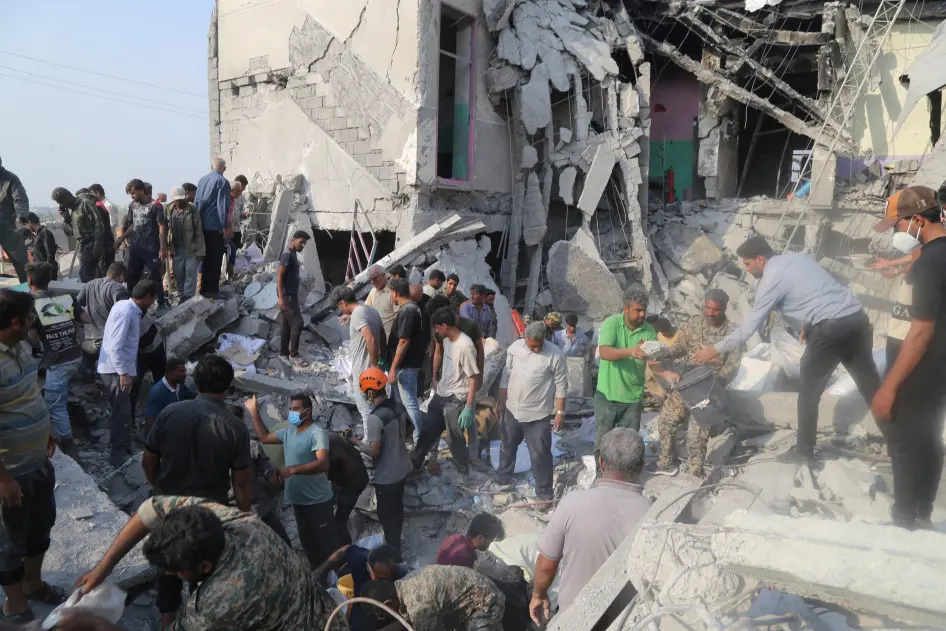
There is a primary school in Tehran. Or rather, there was. An Amnesty International investigation has now confirmed that a US strike on that school killed at least 170 people, the majority of them girls. Their names are not known in the West. Their ages are not on record in our newspapers. They were simply present when the bombs arrived, which is to say they were simply Iranian, which is to say they did not matter enough to make the calculation.
Let us be clear about something before we go any further. The regime those bombs were aimed at was a theocratic dictatorship. It hanged dissidents from cranes. It imprisoned and brutalised women for the crime of refusing to cover their heads. It used its own people as political currency, deploying their suffering as leverage in a game played by men who were insulated from its consequences. The people of Iran deserved to be free of it. They have been saying so on the streets, at extraordinary personal risk, for years. Over 1,444 of them have been killed since the strikes began. Eighteen thousand more have been injured. In Lebanon, at least 886 more are dead.
But this was not their liberation. The people of Iran did not ask to be bombed into freedom. They were not consulted. They did not consent to the method. They were simply, once again, the raw material of other people’s decisions: first the regime’s, now the bombers’. The schoolgirls of Tehran were crushed beneath rubble that once housed their lives, killed by the ambitions and calculations of men in Washington and Tel Aviv who will never see the inside of a school that has been hit by a five-thousand-pound bunker buster. Nor, for that matter, will the men in London who chose to facilitate a continuation of this war.
We state this without equivocation and without apology. Opposing the regime and opposing its destruction by aerial bombardment are not contradictory positions. They are the only coherent position available to anyone who takes human life seriously, Iranian or otherwise.
And Then the Share Prices Rose

While the dust was still in the air over Tehran, something remarkable happened. Something that tells you everything you need to know about how this world actually works. BAE Systems shares surged six per cent on the London Stock Exchange. On Wall Street, Lockheed Martin, Northrop Grumman and RTX posted combined shareholder gains of between $25 billion and $30 billion. In a single trading session. In a single day of death, the armaments oligarchy pocketed more than the entire annual social care budget of Wales.
This is not coincidence. It is the system operating exactly as designed. The people of Iran paid with their lives. The people of Lebanon paid with their neighbourhoods. The people of Britain are now being handed a different kind of bill: 142.62 pence per litre at the pump, household energy bills heading toward £2,500, food prices poised to spike fifteen per cent by autumn. A macabre dance of death and profit, in which the powerful collect their windfalls and the powerless are told to tighten their belts.
Our leaders speak of strategic necessity and defending the rules-based order. Yet the only order being defended here is one where risk is socialised and profit is privatised. Where the working class shoulders the cost and the investor class collects the dividend. The Iran war is not a crisis visited upon the powerful. For them, it is a revenue stream. For the rest of us, it is the quarterly utility bill; the grimmer weekly shop; the mortgage statement arriving with the chill precision of a court summons.
In a single day of death, the armaments oligarchy pocketed more than the entire annual social care budget of Wales. For the powerful, this war is not a crisis. It is a revenue stream.
The Pump, the Bill, the Calculation
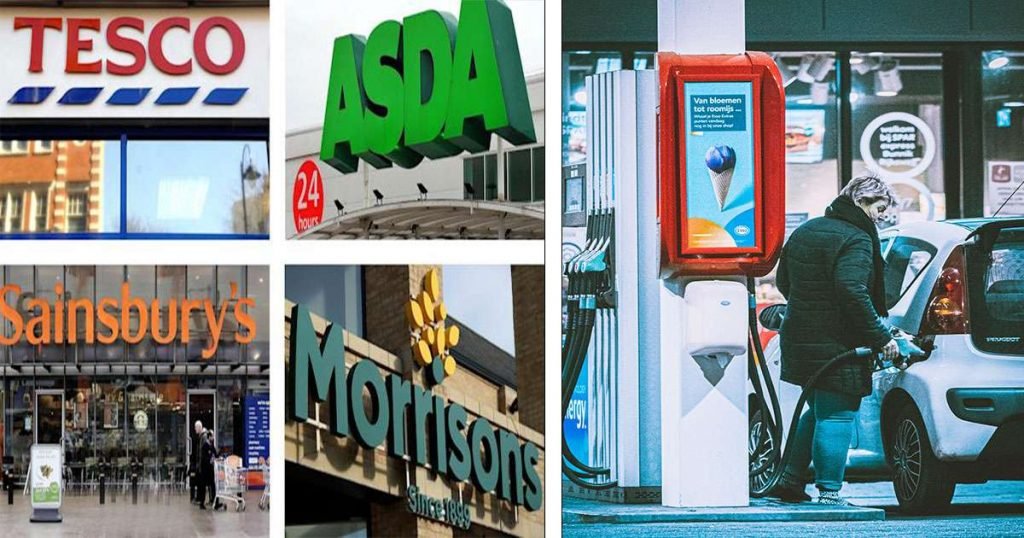
The International Energy Agency has described the Strait of Hormuz closure as the largest supply disruption in its five-decade history. Global oil supply has fallen by eight million barrels per day. Qatar, the world’s second-largest exporter of liquefied natural gas, has declared force majeure. UK gas prices have risen 78 per cent in thirty days. Brent crude has settled above $100 per barrel for the first time since August 2022.
The consequences for ordinary households are not abstract. Petrol has already hit an eighteen-month high of 142.62p per litre, with the RAC warning that 150p is not out of the question if elevated prices persist. The Resolution Foundation has calculated that soaring oil and gas prices could add roughly a full percentage point to inflation and £500 to typical annual energy bills. Cornwall Insight, the energy analysts, now forecast the Ofgem price cap will jump to £1,801 from July. Stifel, the financial firm, warns it could reach £2,500 per year if the conflict drags on.
The Bank of England held interest rates at 3.75 per cent this week, warning of a new shock to the economy. Governor Andrew Bailey stated plainly that war in the Middle East has pushed up global energy prices. The National Institute of Economic and Social Research has modelled what a prolonged conflict means for Britain: inflation rising 0.7 percentage points above baseline in 2026; interest rates climbing a further 0.8 percentage points; GDP contracting by 0.2 per cent this year and deepening further in 2027. These are bloodless numbers. They will not feel bloodless to the couple in Rotherham remortgaging in September.
These are bloodless numbers. They will not feel bloodless to the couple in Rotherham re-mortgaging in September.
The Second Wave: What They Are Not Telling You About Food
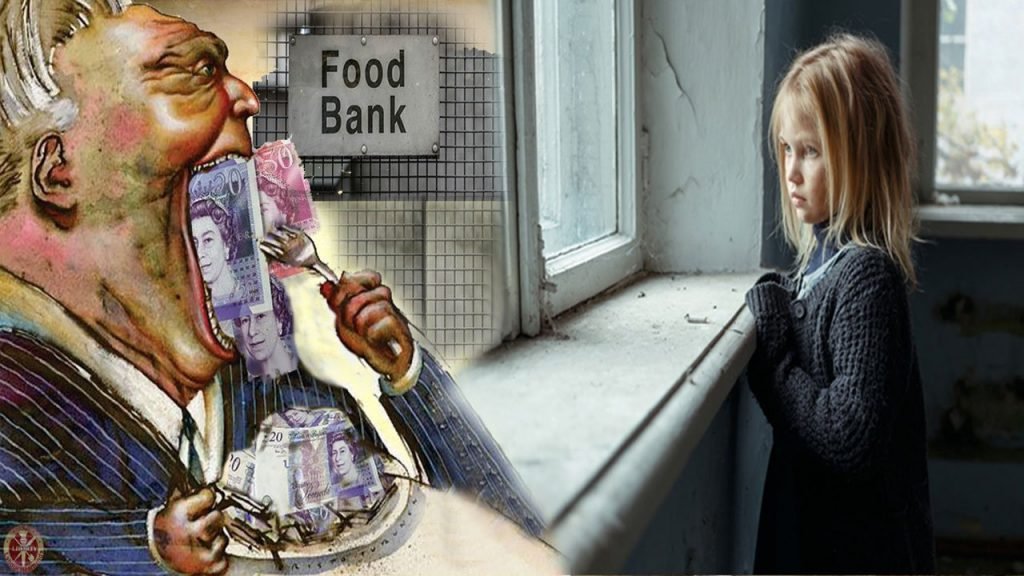
Fuel prices are the visible wound. The fertiliser crisis is the infection beneath. The Strait of Hormuz carries not only oil. Approximately one-third of all globally traded fertiliser transits that narrow waterway. Qatar’s closure of its LNG export facilities has shuttered fertiliser plants from India to Bangladesh. The Gulf region produces nearly half the world’s urea and thirty per cent of its ammonia, both indispensable to growing the crops that fill our supermarkets. The benchmark price of urea has already jumped to £450 per tonne from £337 in a single week.
Tom Bradshaw, president of the National Farmers’ Union, has warned that food prices will peak in the autumn. The NFU is already tracking rapid escalation in input costs: red diesel for tractors, gas to heat glasshouses, transport costs on every lorry that moves a pallet of food from farm to shelf. Industry analysts say the impact on supermarket prices could represent the most significant pressure since the Russian invasion of Ukraine. Within the next six weeks, everyday produce including tomatoes, peppers and cucumbers could rise by around fifteen per cent. Dairy products are expected to follow. Bread could become costlier still if fertiliser prices remain elevated, with some growers now questioning whether planting crops is economically viable at all.
Keir Starmer announced £53 million in support for households unable to afford heating oil. Fifty-three million pounds. BAE Systems posted underlying earnings of £3.32 billion for 2025 alone, a twelve per cent increase on the previous year, on record sales of £30.66 billion, against an order backlog of £83.6 billion. The government’s response to the crisis its allies helped to create amounts to roughly 1.6 per cent of the profits recorded by a single arms manufacturer in a single financial year. Starmer told a Downing Street press conference that he would not allow companies to make huge profits from the hardship of working people. The figures suggest he already has.
The Anatomy of Profiteering: Who Gains When Others Burn

The defenders of orthodoxy will tell you that market forces are neutral. That the government cannot control global commodity prices. That Britain is simply a cork bobbing on the geopolitical tide. This is not an argument. It is an alibi. And like most alibis, it is carefully constructed to obscure who benefits from the crime.
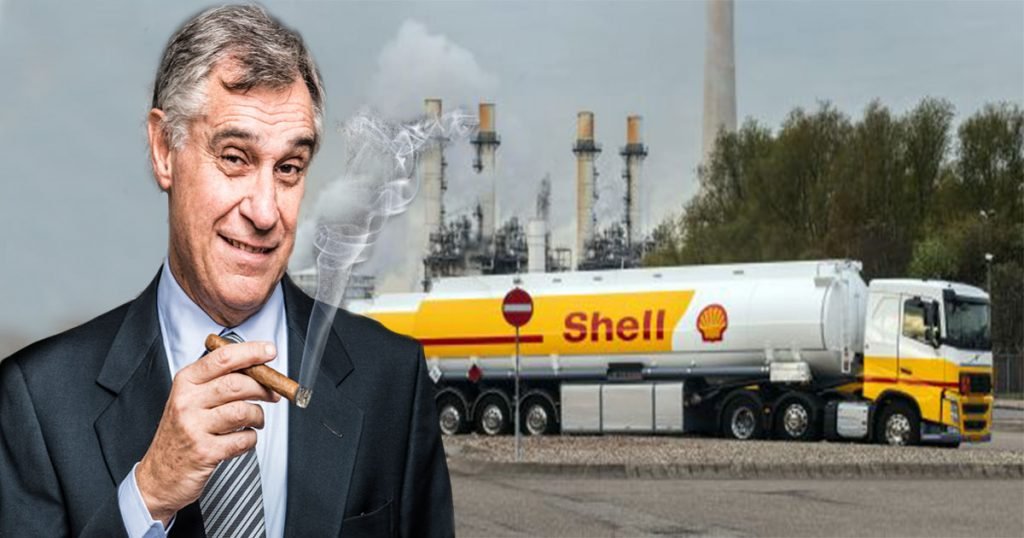
Begin with the arms manufacturers. BAE Systems shares are up 57 per cent in the past twelve months and 23 per cent in 2026 alone, and that was before the conflict began. With the conflict under way, the company surged a further six per cent in a day, as its chief executive hailed what he called a new era of defence spending. The biggest US contractors agreed to quadruple production of advanced weaponry following a White House meeting attended by the chief executives of RTX, Lockheed Martin, Boeing, Northrop Grumman, BAE Systems, and others, all of them sitting on billions of dollars of backlogs. The company’s order book now stands at a record £83.6 billion. War is not a tragedy for these men. It is a production schedule.
Then there is the energy sector. American oil producers alone will generate an estimated additional $5 billion in cash flow in March, driven by the roughly 47 per cent rise in crude prices. US liquefied natural gas exporters are set to earn nearly $1 billion more per week on higher global prices, their profits inflated by the very disruption that leaves British pensioners choosing between heating and eating.
There are also structural beneficiaries the newspapers rarely name. Shipping reroutes around the Cape of Good Hope add roughly ten to fourteen days and approximately $1 million in fuel per vessel. That cost falls on importers and ultimately consumers. But the revenue flows directly to tanker operators, fuel suppliers and port operators along the alternative routes. War-risk insurance premiums for Hormuz transits have risen as much as twelvefold. The specialist marine underwriters are counting their blessings.
And the Treasury. Fuel duty is fixed, but VAT is a percentage of the final price. Every penny added to the pump price increases the state’s cut automatically. The government that announces emergency support packages with one hand quietly collects extra revenue with the other. The fiscal headroom may erode, but the structural dividend from taxing a captive, fuel-dependent working class is not to be sniffed at.
The government that announces emergency support packages with one hand quietly collects extra revenue with the other. This is not cynicism. It is arithmetic.
The Counter-Argument and Why It Fails
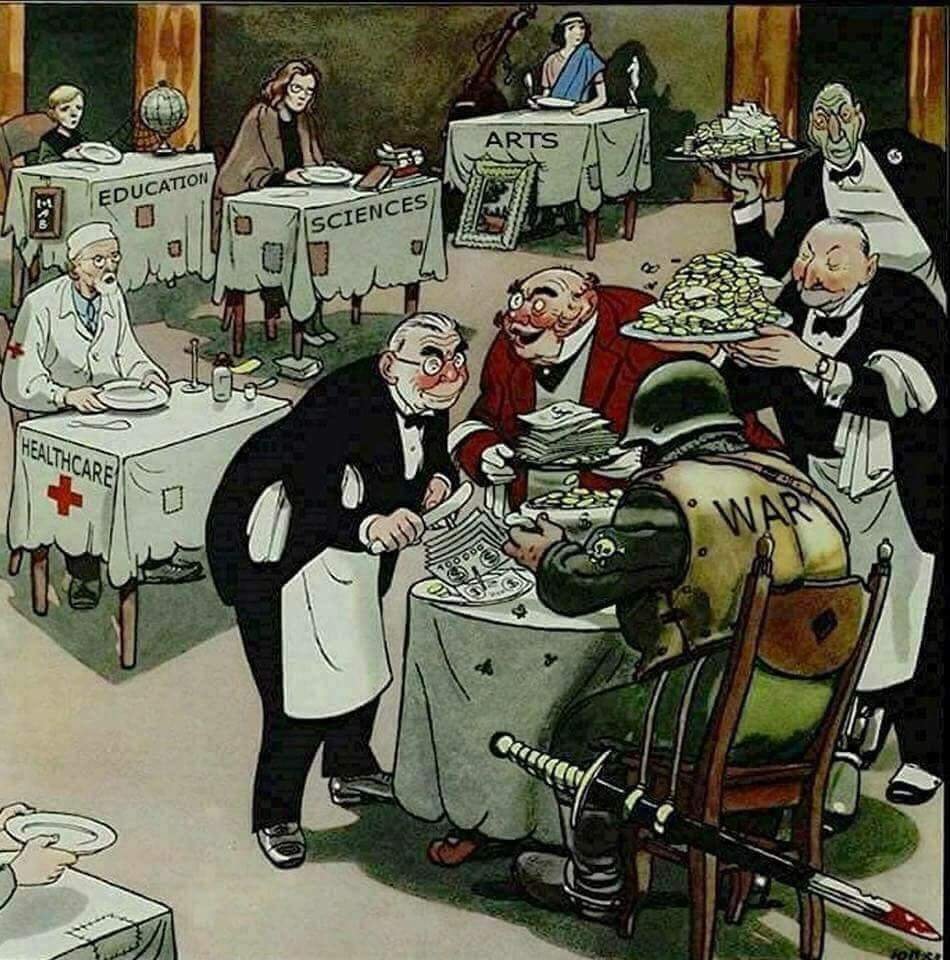
The defenders of this arrangement will argue that the government is powerless before global commodity markets. That the UK is a trading nation bound by the logic of international prices. That the arms industry creates jobs and sovereign capability. That the windfall tax on energy companies claws back excess profits. That Starmer’s £53 million package proves the government cares.
Each claim contains a fragment of fact and a core of fraud. Yes, the UK cannot unilaterally set the global oil price. But the vulnerability of the British working class to that price is not a natural phenomenon. It is a policy choice, accumulated over decades. Our energy transition was handed to the private sector rather than structured as a public good. Our strategic reserves were allowed to dwindle. Our social safety net has been shredded to the point where a fifteen per cent rise in the price of cucumbers is a genuine crisis for millions of families. These were choices. They were made by people in suits, for the benefit of people in suits.
Yes, BAE Systems employs British workers and those workers deserve secure and well-paid jobs. But the question is not whether defence manufacturing exists. It is whether an industry whose profits are structurally underwritten by permanent war should be permitted to shape British foreign policy, and whether British workers should subsidise its shareholders through higher fuel bills every time those policies produce another conflict and another set of schoolchildren who do not appear in our casualty columns.
As for the windfall tax: even with it in place, the sheer scale of global price volatility allows for margins that make a mockery of the cost-of-living crisis. The tax is designed to claw back excess profit at the margins. The excess is structural. Trimming the edges of a bonfire does not put the bonfire out.
The Structure of Managed Misery
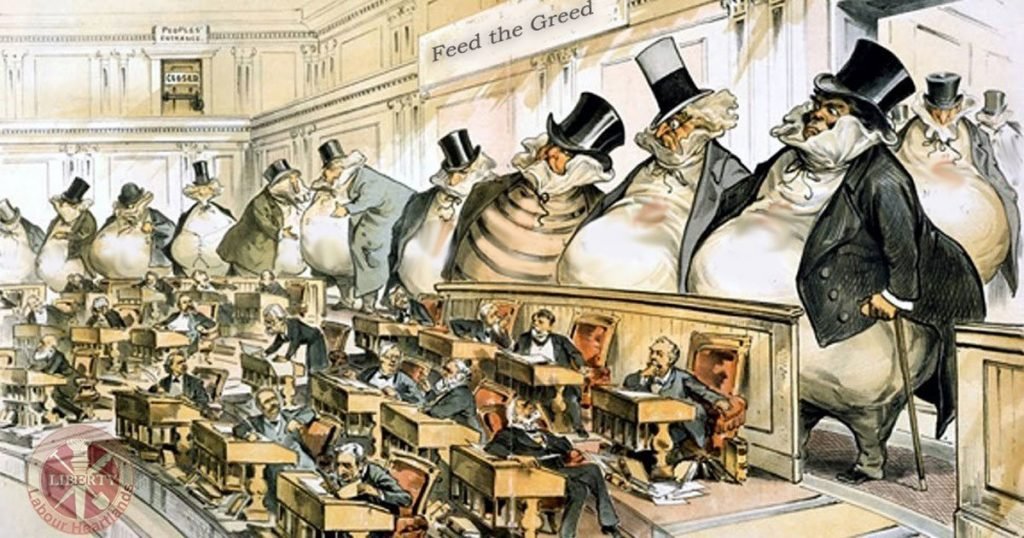
There is nothing accidental about how this unfolds. The architecture of crisis distribution in Britain is as reliable as the seasons. Risk is pushed downward. The oligarchy insures itself through derivatives, offshore holdings and diversified portfolios. Costs are pushed downward. Every supplier passes every penny of increased fuel cost along the chain until it arrives at the checkout till. The bill settles at the bottom. The working class is expected to fund the geopolitical ambitions of an elite that will never once have to choose between heating and eating.
And in every emergency, the same institutions emerge stronger than before. BAE Systems enters this conflict with an order backlog of £83.6 billion and a share price that has tripled since the Russian tanks rolled into Ukraine four years ago. The energy majors enter it flush with two years of post-Ukraine windfall profits already banked. The banks that manage the derivatives through which all these positions are insured collect their fees regardless of the direction of travel. The only variable is how much the working class loses.
This is what they mean when they talk about the rules-based international order. The rules are simple. The powerful make the decisions. The powerless absorb the consequences. The powerful make the profits. The powerless pay the bills. The rubble in Tehran and the receipt at the Rotherham petrol station are two expressions of the same arithmetic. The schoolgirls and the care worker filling her tank share the same position in the hierarchy, which is to say they share the position of those who do not matter when the calculations are made.
The rubble in Tehran and the receipt at the Rotherham petrol station are two expressions of the same arithmetic. The schoolgirls and the care worker share the same position: those who do not matter when the calculations are made.
The Same Game, The Same Victims, Every Time
Geopolitics is discussed in the abstract tones of a chess match, conducted with aircraft carriers and drone strikes and the bloodless vocabulary of strategic assets and deterrence architecture. But for the people of this world, it is not abstract. In Tehran, it is a school that no longer exists. In south Lebanon, it is a neighbourhood reduced to powder. In Britain, it is the anxiety of the monthly mortgage statement; the grim arithmetic at the petrol pump; the dwindling weight of the weekly shop, the tomatoes that cost fifteen per cent more than last month, the heating oil that has doubled in price.
We are told this is the price of security. We must ask: whose security are we buying? The Strait of Hormuz closes, and BAE Systems shareholders gain billions. It reopens, and they keep them. The oil price spikes, and the energy executives collect their windfalls. It falls back, and they keep those too. The working class absorbs the shock on the way up, and bears the accumulated damage on the way down. There is no rebalancing mechanism. There is no reset. There is only the next crisis, and the same distribution of its costs.
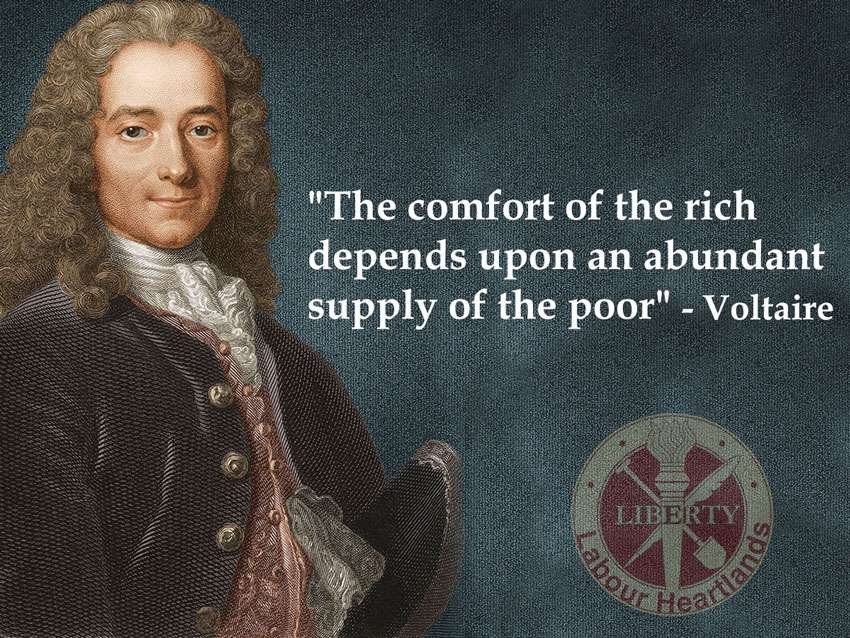
The Prime Minister tells us he will not allow companies to make huge profits from the hardship of working people. He has offered £53 million to prove it. BAE Systems made £2.1 billion in net profit last year. The maths is not complicated. The political will required to confront it apparently is.
Until we build a politics that names this plainly, that insulates the working class from the next geopolitical shock through public energy ownership, strategic food security and a social safety net that actually holds, the game will continue. The players will change. The board will be reset. The bombers will find another school. The bill will arrive at the same address. It always does.
Everyone talks about geopolitics in the abstract tones of strategy and necessity. The working class know it by another name: the price of petrol, the price of bread, and the monthly mortgage bill. The same exploitation, differently packaged. Recorded in high profits and empty bellies. Written in the rubble of other people’s children.
The Great Game is played in marble halls. The bill is always settled in copper at the supermarket till. And in Britain, as ever, it is the working class who fund the ambitions of those who will never know the price of bread, or the weight of a school reduced to rubble.
Enjoyed this read? I’m committed to keeping this space 100% ad-free so you can enjoy a clean, focused reading experience. Crafting these articles takes a significant amount of research and heart. If you found this helpful, please consider a “small donation” to help keep the lights on and the content flowing. Every bit of support makes a huge difference!

labourheartlands.com | Independent left journalism from the heartlands
Sources: Amnesty International, NIESR, New Economics Foundation, Resolution Foundation, RAC Fuel Watch, Cornwall Insight, NFU, IEA, Chatham House, Al Jazeera, CNBC, The Grocer, European Business Magazine, Morningstar, BAE Systems full-year results 2025.
Support Independent Journalism Today
Our unwavering dedication is to provide you with unbiased news, diverse perspectives, and insightful opinions. We're on a mission to ensure that those in positions of power are held accountable for their actions, but we can't do it alone. Labour Heartlands is primarily funded by me, Paul Knaggs, and by the generous contributions of readers like you. Your donations keep us going and help us uphold the principles of independent journalism. Join us in our quest for truth, transparency, and accountability – donate today and be a part of our mission!
Like everyone else, we're facing challenges, and we need your help to stay online and continue providing crucial journalism. Every contribution, no matter how small, goes a long way in helping us thrive. By becoming one of our donors, you become a vital part of our mission to uncover the truth and uphold the values of democracy.
While we maintain our independence from political affiliations, we stand united against corruption, injustice, and the erosion of free speech, truth, and democracy. We believe in the power of accurate information in a democracy, and we consider facts non-negotiable.
Your support, no matter the amount, can make a significant impact. Together, we can make a difference and continue our journey toward a more informed and just society.
Thank you for supporting Labour Heartlands