Is a country still a sovereign nation if it cannot guarantee its people the basic warmth required to survive a northern winter? Or has the United Kingdom become something else entirely: a captive market, presided over by a government that acts less like a protector of the public interest and more like a debt collector for the global petrochemical elite?
While the rhetoric in Westminster focuses on “global headwinds,” the ledger tells a different story. Since the dawn of the energy crisis, energy firms have extracted over £125 billion in profit from their UK operations alone. Globally, that figure rises to a staggering half a trillion pounds since 2020. This was not a catastrophe of nature; it was a triumph of design.
Covid. Ukraine. Now Iran. The crisis changes its name every few years. The extraction never changes at all. Each new emergency arrives with its own ready-made explanation, its own sympathetic headline, its own political cover. And behind every one of them, the same companies post another record quarter while the same households choose between heating and eating.
“Energy firms continue to post multi-billion pound profits while millions of households struggle to afford to heat their homes.” — End Fuel Poverty Coalition
The Fiction of the Free Market

The tragedy is that this exploitation is perfectly legal. It is the result of a “marginal pricing” system, under which the cost of all electricity is pegged to the price of the most expensive unit in the grid: almost always gas. Even when our wind turbines and nuclear plants produce energy cheaply, you are charged as if every kilowatt had been sourced from the most volatile corner of the global commodity market.
This is not a market. It is a mechanism for the upward transfer of wealth.
While households were forced into the cruel binary of “heating or eating”, shareholders were toasted with dividends. Today, typical energy bills under the current price cap remain 40 per cent higher than in winter 2021/22. The average annual energy bill has soared from £1,042 in 2020 to £1,755 today. Expressed differently, that represents £878 per household, per year, in pure profit extracted from necessity.
We are told the “market” dictates these prices, yet when those same companies face losses, they are the first to seek state intervention. We have socialised the risks and hyper-privatised the rewards.
THE HUMAN COST OF CORPORATE GREED
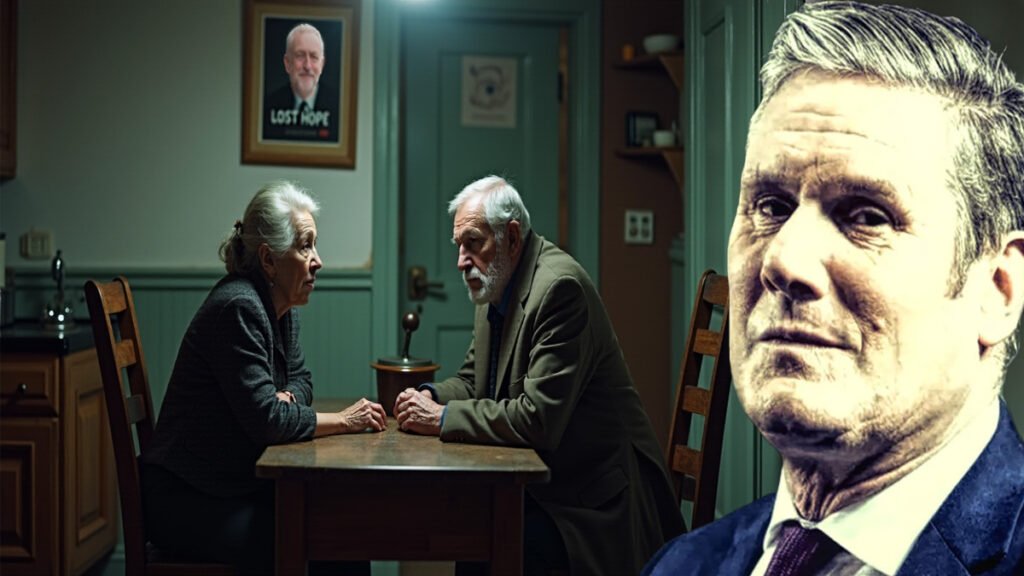
The consequences are not abstract. 6 million UK households are now in fuel poverty, with total energy debt standing at £6 billion. Nine in ten households have cut back their energy use, and Great Britain households now owe around £3.5 billion to energy companies. providing the service they can no longer afford. By 2024, the number of households required to spend more than 10 per cent of their income on domestic energy had reached 36.3 per cent, equating to nearly nine million people.
British Gas saw its profits jump to £751 million in 2023, up tenfold from 2022. Across the sector, the big firms are awash with cash while their customers drown in debt.
The government’s response to this divergence, between record corporate profit and record household debt, has been to call it a market outcome. In a sense, it is right.
The Silent Partner: The Treasury
The government’s role in this is not merely one of incompetence, but of complicity. Weak governments allow their people to be exploited. Cynical ones profit from it.
Through fuel duty and a 5 per cent VAT rate on domestic energy, the Treasury has watched its own coffers swell alongside the energy giants. Fuel duty revenue is forecast to reach £31.7 billion in 2025/26. VAT on domestic fuel and power alone, levied at the reduced rate of 5 per cent, contributes billions more to the Exchequer. The government, in other words, takes a cut of every overpriced unit of energy it forces its citizens to buy.
“The government is choosing the offshore bank account over the pensioner’s radiator.”
THE WINDFALL TAX THAT WASN’T
Critics will argue that windfall taxes have been implemented to “claw back” these gains. This is a half-truth at best.
The Energy Profits Levy currently stands at a headline rate of 78 per cent, one of the highest in the world. But the various levies are riddled with investment allowances and loopholes. Labour promised to “end the loopholes in the levy that funnel billions back to the oil and gas giants”, yet the 29 per cent investment allowance on oil and gas operations was removed in a way that critics say has stifled investment rather than genuinely clawing back excess profits.
The result is a circular economy of exploitation: the taxpayer funds the very industry that is impoverishing them, while the Treasury takes its cut at every stage.
Great British Energy Myth

We were promised a revolution. Labour’s 2024 manifesto pledged to “Set up Great British Energy” to cut bills and boost security. Yet, as former Jamie Driscoll recently noted, the reality is a masterclass in smoke and mirrors. When asked by the SNP’s Stephen Flynn when bills would actually come down, the CEO of GB Energy, Juergen Maier, admitted that lowering bills is simply “not the scope” of the company.
Read that again. The chief executive of Great British Energy, a body created specifically to transform the nation’s relationship with energy, has told Parliament that reducing the bills driving millions into poverty is outside his remit.
Currently, GB Energy’s output, from solar panels on schools and similar projects, accounts for a negligible fraction of our national energy requirement. By Driscoll’s calculation, at the current rate of state-owned generation, it would take another 3,730 years to reach net zero. This is not a national energy company. It is a branding exercise designed to mask continued private dominance.
INFRASTRUCTURE OR EXTRACTIVE ASSET?
The government continues to rely on the “Contract for Difference” (CfD) system, which Driscoll rightly identifies as “corporate welfare.” In January, the government set a “strike price” for offshore wind at £91.20 per MWh. However, the International Renewable Energy Association notes the actual cost of production is just £46.40.
This 97 percent price premium is guaranteed for 15 years, regardless of how low wholesale prices drop.
This wealth does not stay in our communities; it flows directly to shareholders in Qatar, Abu Dhabi, and Blackrock. We are told this “derisks” investment, yet no teacher or nurse is guaranteed 197 percent of their living costs for fifteen years.
A System Designed for Extraction
The UK electricity system, privatised in 1990, was built on the myth of competition. In reality, it created an oligopoly. In the North East, Northern Powergrid paid out £300 million in dividends from a £536 million turnover in 2024. Over half of every pound paid by local residents left the region as profit rather than being reinvested in the grid.
When energy retailers fail, the taxpayer, via OFGEM, foots the bill. This is the “old story” of privatising profits while nationalising losses. We are subsidising the decline of our own infrastructure while billionaire owners milk every kilowatt-hour for dividend growth.
True reform requires more than symbolic gestures. It requires a total decoupling of energy prices from global speculation and a massive shift toward public investment. As a sovereign nation, Britain can borrow to build; we do not need to “lever in” private finance that demands a century of tribute in return.
Until we stop treating a basic human necessity as a speculative commodity, poverty will continue to rise while our national wealth evaporates into offshore accounts.
It is not Net Zero that is raising your bills; it is the billionaires, and the state is their willing accomplice.
Infrastructure or Extractive Asset?

We must return to a fundamental truth that our political class has spent forty years trying to erase: energy is not a luxury product. It is national infrastructure. It is the literal current that keeps a modern civilisation functioning. To treat it as a speculative commodity is a dereliction of duty.
A country that allows its core infrastructure to become a profit extraction machine should not be surprised when its social fabric begins to tear. When the state refuses to decouple energy prices from global speculation, it is making a deliberate political choice. It is choosing private accumulation over public need, the offshore bank account over the pensioner’s radiator.
True structural reform requires more than a symbolic tax. It requires the return of energy to public hands, where the primary motive is provision, not extraction. Until we break the pricing system that treats a basic human need as a windfall opportunity, we are not a nation of citizens. We are a nation of victims.
The market did not fail; it did exactly what it was designed to do.
Enjoyed this read? I’m committed to keeping this space 100% ad-free so you can enjoy a clean, focused reading experience. Crafting these articles takes a significant amount of research and heart. If you found this helpful, please consider a “small donation” to help keep the lights on and the content flowing. Every bit of support makes a huge difference.

Support Independent Journalism Today
Our unwavering dedication is to provide you with unbiased news, diverse perspectives, and insightful opinions. We're on a mission to ensure that those in positions of power are held accountable for their actions, but we can't do it alone. Labour Heartlands is primarily funded by me, Paul Knaggs, and by the generous contributions of readers like you. Your donations keep us going and help us uphold the principles of independent journalism. Join us in our quest for truth, transparency, and accountability – donate today and be a part of our mission!
Like everyone else, we're facing challenges, and we need your help to stay online and continue providing crucial journalism. Every contribution, no matter how small, goes a long way in helping us thrive. By becoming one of our donors, you become a vital part of our mission to uncover the truth and uphold the values of democracy.
While we maintain our independence from political affiliations, we stand united against corruption, injustice, and the erosion of free speech, truth, and democracy. We believe in the power of accurate information in a democracy, and we consider facts non-negotiable.
Your support, no matter the amount, can make a significant impact. Together, we can make a difference and continue our journey toward a more informed and just society.
Thank you for supporting Labour Heartlands