The Ministry of Truth: Starmer’s Plan to Regulate the Internet: From AI to Age Limits
There is a rule in politics so reliable it ought to be carved above the door of every parliament: when a government says it is doing something for the children, check your civil liberties at the door.
Today, Keir Starmer announced sweeping new powers to regulate the internet. AI chatbots will be brought under the Online Safety Act. A consultation beginning in March will consider banning under-16s from social media. VPN use by young people may be restricted. And, most significantly of all, ministers will seek legal authority to implement future online restrictions “within months rather than waiting years for new primary legislation every time technology evolves.” In plain English: reduced parliamentary scrutiny over what the British people can see, say, and read online.
The Technology Secretary delivering this announcement is Liz Kendall. If that name rings a bell in the context of Labour Together, it should. Her 2015 leadership campaign was run by Morgan McSweeney, the man who went on to build the entire apparatus of narrative control that now structures this government’s relationship with information. McSweeney, who resigned as Chief of Staff eight days ago over the Mandelson-Epstein scandal, co-founded the Centre for Countering Digital Hate in 2018 using Labour Together resources. The CCDH’s first targets were not far-right extremists. They were left-wing media outlets that supported Jeremy Corbyn. McSweeney built a censorship machine and dressed it in humanitarian language.
With or without McSweeney today, that machine is being upgraded to government specification.
The Pattern

The trajectory. In 2018, McSweeney launches the CCDH to deplatform independent media that challenges his faction’s grip on the Labour narrative. In 2023, Labour Together hires APCO Worldwide, a Washington corporate intelligence firm, to compile dossiers on journalists investigating its undeclared donations. They codename the operation “Operation Cannon.” They designate reporters as “significant persons of interest.” They discuss “leverage.” They manufacture a fake Russian conspiracy to discredit the press and brief it to GCHQ in an attempt to trigger security investigations into working journalists.
And in 2026, the same political project seeks statutory powers to regulate the internet with reduced parliamentary oversight.
This is not a sequence of unrelated events. It is the maturation of a single instinct: the belief that inconvenient information is a threat to be managed, not a democratic function to be protected. The tools have changed. The instinct has not.
The Trojan Horse

Starmer says he is doing this for children. “As a dad of two teenagers, I know the challenges and the worries that parents face making sure their kids are safe online,” he told reporters. “Technology is moving really fast, and the law has got to keep up.”
Nobody in their right mind opposes protecting children from genuine online harm. Nobody defends the distribution of illegal images or the algorithmic exploitation of minors. These are arguments not worth having because everyone agrees on the conclusion. And that is precisely what makes child safety the perfect vehicle for broader censorship: to oppose the mechanism is to appear to oppose the cause.
But the mechanism matters. When Starmer says he wants powers to “act fast” without “waiting years for new primary legislation,” he is asking for the ability to impose restrictions on the digital lives of every person in the country without the full parliamentary scrutiny that new laws normally require.
The measures will be introduced as amendments to the Crime and Policing Bill, not as standalone legislation subject to proper debate. The consultation that begins in March will consider not merely social media age limits but restrictions on AI chatbots, limits on VPN use, and curbs on features like infinite scrolling and auto-play.
You would think a Prime Minister this concerned about teenagers would have supported the ban on mobile phones in school…but he didn’t.
Each of these proposals sounds reasonable in isolation. Taken together, they constitute a framework for ministerial control over the architecture of online communication, implemented at speed, with reduced democratic oversight, by a government that has already demonstrated its willingness to use intelligence firms against journalists and censorship outfits against independent media.
The Independent Press in the Crosshairs

Who benefits from such a framework? Not the BBC, the Sunday Times, or the Guardian. Their content will not be caught by age-gating restrictions or algorithmic controls. They have compliance departments and legal teams and institutional relationships with regulators.
The outlets that will feel the weight of this regime are the ones that already found themselves in Labour Together’s crosshairs: the independent journalists, the citizen media operations, the Substacks and podcasts and small investigative outfits that operate without the protection of media conglomerates. Paul Holden and Andrew Feinstein’s Shadow World Investigations. The Canary, which McSweeney’s CCDH targeted for deplatforming. Declassified UK. Double Down News. Publications like this one.
When Starmer says “no platform gets a free pass,” we should hear what he means. He does not mean the platforms that serve his interests. He means the platforms that challenge them. The Online Safety Act, as we have documented, was always designed with a scope broad enough to encompass independent media under the guise of content regulation. Today’s announcement extends that scope further, into AI (where independent analysis often circulates beyond the control of traditional editorial gatekeeping) and into VPN use (which allows citizens to circumvent geographic content restrictions).
Imgur, a widely used image-hosting site, has already blocked access to all UK users rather than comply with age-verification rules. Major pornography sites have done the same. These are the early casualties of a regime that treats access restrictions as the default response to content concerns. The pattern will expand. It always does.
The Kendall Connection
It is worth dwelling on the fact that Liz Kendall is the minister delivering today’s announcement. This is the same Liz Kendall who, when questioned about Labour Together’s activities, responded with a masterpiece of bureaucratic evasion, assuring us they are “investigating.” The same Kendall whose political career was shaped by McSweeney’s strategic vision from its earliest days. The same Kendall who now oversees the very technology portfolio that will determine how far the state can reach into the digital lives of British citizens.
In the old Labour Party, such a concentration of factional influence over a sensitive policy area would have raised alarms. In Starmer’s Labour, it is simply how things work. The same network that built the CCDH, that ran Operation Cannon, that cultivated Mandelson’s patronage, now holds the legislative pen on internet regulation. The personnel are the policy.
What Orwell Actually Meant
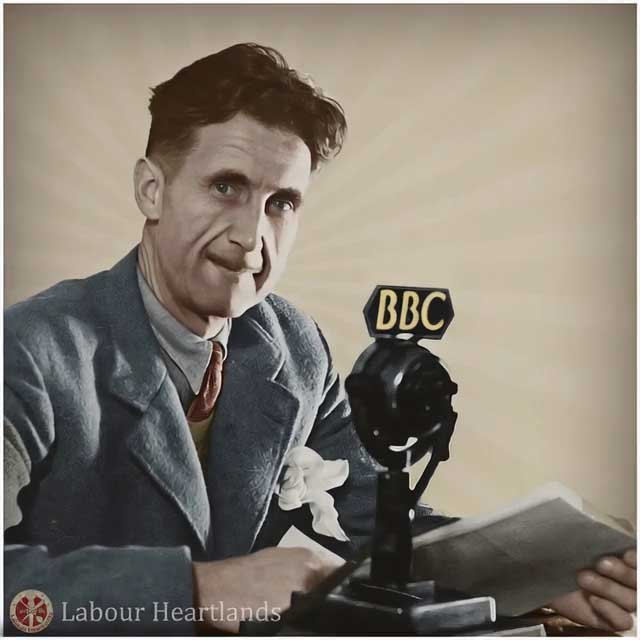
Orwell is routinely quoted in debates about online safety, usually by people who have not read him carefully. When he wrote that “freedom of speech and of the Press are usually attacked by arguments which are not worth bothering about,” he was not describing arguments that are obviously wrong. He was describing arguments that are obviously right but irrelevant to the real purpose of the restriction.
Of course children should be protected online. Of course illegal images should be removed. Of course platforms bear responsibility for the content they host. These propositions are not worth bothering about because nobody disputes them. What is worth bothering about is the architecture being constructed around these uncontroversial propositions: the reduced parliamentary scrutiny, the ministerial discretion, the fast-track powers, the extension of content regulation into AI systems where independent analysis and dissenting opinion circulate beyond the reach of traditional editorial control.
Orwell also wrote, and this is the quotation that matters most today: “If liberty means anything at all, it means the right to tell people what they do not want to hear.” The people who run Britain’s government do not want to hear about undeclared donations, about intelligence operations against journalists, about the Mandelson-Epstein connection, about the censorship infrastructure built by their chief strategist. They have demonstrated, repeatedly and with increasing sophistication, that their response to hearing such things is to attack the people saying them.
The Prime Minister asks, ‘How will parents police this alone?’ It is a leading question. He is not seeking to empower parents; he is positioning the State as the ultimate arbiter of what is healthy and what is harmful.

We are told this is for safety, yet there are numerous privacy-preserving alternatives. Age verification could be handled locally on devices or through decentralised, private checks. The government has ignored these because safety was never the primary objective. The objective is control.
We are being nudged into a credentialed society where the State monitors what you search, what you post, and when you do it. Digital ID, censorship and control… They are building a digital gulag under the guise of a playground monitor. If we accept the premise that the government must ‘verify’ us to protect us, we have already surrendered the keys to our private lives.
This is not mission creep; it is the mission.
The gate is being built, the tokens are being minted, and the lock is about to turn.
Today, they are asking Parliament to give them the legal tools to do so more efficiently. We should not let them.
When a government that has already deployed private intelligence against the press asks for fast-track powers to regulate what you read online, the question is not whether you trust them. The question is why they think you should.
Enjoyed this read? I’m committed to keeping this space 100% ad-free so you can enjoy a clean, focused reading experience. Crafting these articles takes a significant amount of research and heart. If you found this helpful, please consider a “small donation” to help keep the lights on and the content flowing. Every bit of support makes a huge difference!

Support Independent Journalism Today
Our unwavering dedication is to provide you with unbiased news, diverse perspectives, and insightful opinions. We're on a mission to ensure that those in positions of power are held accountable for their actions, but we can't do it alone. Labour Heartlands is primarily funded by me, Paul Knaggs, and by the generous contributions of readers like you. Your donations keep us going and help us uphold the principles of independent journalism. Join us in our quest for truth, transparency, and accountability – donate today and be a part of our mission!
Like everyone else, we're facing challenges, and we need your help to stay online and continue providing crucial journalism. Every contribution, no matter how small, goes a long way in helping us thrive. By becoming one of our donors, you become a vital part of our mission to uncover the truth and uphold the values of democracy.
While we maintain our independence from political affiliations, we stand united against corruption, injustice, and the erosion of free speech, truth, and democracy. We believe in the power of accurate information in a democracy, and we consider facts non-negotiable.
Your support, no matter the amount, can make a significant impact. Together, we can make a difference and continue our journey toward a more informed and just society.
Thank you for supporting Labour Heartlands