Let’s Not Kid Ourselves: From Iraq to Caracas: The Same War Script, the Same Resource Prize
There are moments in history when the mask slips so completely that even the official story reads like satire. Saturday morning in Caracas was one of them.
According to Donald Trump, the United States has conducted a “large-scale” military strike on Venezuela, captured President Nicolás Maduro and his wife Cilia Flores, and flown them out of the country to face trial in America. If true, this represents one of the most brazen violations of international law since the invasion of Iraq. If untrue, it still marks one of the most reckless escalations of military rhetoric in living memory.
Either way, what we are witnessing is not an aberration. It is simply empire conducting business as usual, only this time without the courtesy of a convincing disguise.
The Language of Liberation
Already, the propaganda machinery has begun its work. The same script, dusted off and slightly updated, now plays across Western media and through the mouths of compliant politicians.
US Deputy Secretary of State Christopher Landau declared Venezuela was experiencing a “new dawn.” “The tyrant is gone,” he proclaimed. “He will now, finally, face justice for his crimes.” Argentine President Javier Milei celebrated on social media with the words “liberty advances.” Florida Senator Rick Scott announced “a new day is here for Venezuela and Latin America.”
This is the language of liberation. Of freedom. Of justice delivered at the end of a missile.
It is also, let us be clear, the language of conquest dressed in humanitarian drag.
The most revealing endorsement comes from María Corina Machado, the Venezuelan opposition leader awarded the Nobel Peace Prize this year. She has called Trump “a champion of freedom in this hemisphere” and expressed her gratitude for his administration’s actions. In a recent interview, she spoke openly of “Venezuela’s liberation mission” and promised that after Maduro’s removal, she would “privatise the oil industry with transparency and public oversight.”
There it is, stated with remarkable candour. Liberation, in this context, means privatization. Freedom means opening Venezuela’s resources to foreign investors. Democracy means a government friendly to American corporate interests.
Machado’s economic team has described Venezuela as presenting a “trillion-dollar opportunity,” a free-market paradise waiting to be unlocked. The Atlantic Council, never one to miss a strategic opening, has published glowing accounts of the post-Maduro Venezuela: liberalised, investor-friendly, and eager to become “America’s energy hub.”
One might admire the honesty, if the cost were not measured in human lives.
What Actually Happened
The timeline is extraordinary even by the standards of modern American interventionism.
Early Saturday morning, residents of Caracas reported explosions tearing through the Venezuelan capital. Video verified by CNN showed helicopters roaring overhead, plumes of smoke rising above government and residential districts. One witness told the BBC her heart was pounding and her legs were shaking. Strikes also hit the states of Miranda, Aragua, and La Guaira. Venezuela’s largest military complex, Fuerte Tiuna, was engulfed in flames.
Hours later, Trump announced via Truth Social that US forces had “successfully carried out a large scale strike against Venezuela” and captured Maduro during the operation. US Secretary of State Marco Rubio told Republican senators that Maduro would “stand trial in the United States on criminal charges.” Attorney General Pam Bondi promised Maduro would “face the full wrath of American justice on American soil.”
CBS News reported that the Army’s elite Delta Force, the 160th Special Operations Aviation Regiment (the “Night Stalkers”), carried out the capture after the CIA identified Maduro’s location. Trump had apparently given the green light several days earlier. Troops were ready to strike on Christmas Day but were delayed due to airstrikes against ISIS in Nigeria.
Venezuelan Vice-President Delcy Rodríguez said the government does not know where Maduro or Flores are and demanded “immediate proof of life.” She stated that the attack had killed officials, military personnel, and civilians across the country. Defence Minister Vladimir Padrino López, conspicuously making no mention of Maduro’s alleged capture, vowed resistance to what he called “the worst aggression” Venezuela has ever suffered. Venezuela declared a state of emergency and requested an urgent meeting of the UN Security Council.
At no point has the United States provided independent confirmation of Maduro’s capture beyond Trump’s social media announcement. At no point has Venezuela confirmed his whereabouts. What we have instead is a claim, an explosion, and the familiar choreography of power asserting itself while law looks politely elsewhere.
The Predictable International Response

The world divided along entirely predictable lines.
Russia demanded urgent clarification, calling the alleged seizure an unacceptable violation of sovereignty and international law. Iran condemned what it described as a “clear violation of the basic principles of the United Nations Charter.” Cuba’s President Miguel Díaz-Canel accused Washington of “state terrorism,” invoking the revolutionary slogan: “Homeland or Death, We Shall Overcome.”
Brazilian President Luiz Inácio Lula da Silva declared the US had crossed “an unacceptable line,” warning that “attacking countries, in flagrant violation of international law, is the first step toward a world of violence, chaos, and instability, where the law of the strongest prevails over multilateralism.” Colombian President Gustavo Petro condemned “the aggression against the sovereignty of Venezuela and of Latin America” and deployed military forces to the Venezuelan border.
Even Palestinian resistance groups issued statements of solidarity with Venezuela. The Popular Front for the Liberation of Palestine drew explicit parallels between US actions in Venezuela and Israeli aggression in Palestine, describing both as manifestations of the same colonial mindset.
Starmer’s Stuttering Response to Venezuela Proves International Law Only Applies to Britain’s Enemies
Across Europe, the tone was more cautious but equally revealing. EU foreign policy chief Kaja Kallas said she had spoken with US officials while noting that “under all circumstances, the principles of international law and the UN Charter must be respected.” Sir Keir Starmer carefully stated that Britain was “not involved in any way” while adding that he “always say[s] and believe[s] we should all uphold international law.”
Starmer said: “I always say and believe we should uphold international law.
“But I think at this stage [in a] fast moving situation, let’s establish the facts and take it from there.
“I want to establish the facts first. I want to speak to President Trump.
“I want to speak to allies. As I say I can be absolutely clear we were not involved in that.”
This careful language matters. When the strongest state on earth moves, international law tends to shuffle politely out of the way. Article 2(4) of the UN Charter explicitly prohibits “the threat or use of force against the territorial integrity or political independence of any state.” There are only two exceptions: self-defence under Article 51, or action authorised by the Security Council under Chapter VII.
Professor Marc Weller, director of the international law program at Chatham House, was blunt in his assessment: “International law prohibits the use of force as a means of national policy. Force is only available in response to an armed attack or possibly to rescue a population under imminent threat of extermination. Clearly, none of these requirements are fulfilled by the armed operation against Venezuela.”
Yet here we are. And the interesting question is not whether this violates international law (it plainly does), but why anyone expected otherwise.
Regime Change By Any Other Name
Back in Washington, the political theatre played out with weary familiarity.
Senate Republicans largely rallied behind Trump’s actions. Senator Tom Cotton declared that Maduro “wasn’t just an illegitimate dictator; he also ran a vast drug-trafficking operation.” Senator Rick Scott promised “a new day” for Venezuela. Florida Representative María Elvira Salazar, chair of the House Foreign Affairs Subcommittee on the Western Hemisphere, insisted that “what the President is doing does not require congressional approval” because it constitutes “law enforcement or counter-narcotics operations against indicted terrorists.”
This framing is crucial. By designating Venezuela’s Cartel de Los Soles as a foreign terrorist organisation and Maduro as its head, the Trump administration claims the authority to conduct military operations without congressional approval. It is the same logic that has justified decades of extrajudicial killings, drone strikes, and covert operations: if we call it law enforcement rather than war, the constitutional requirements for congressional authorisation magically evaporate.
Some Democrats pushed back. Senator Ruben Gallego called it “the second unjustified war in my lifetime” and declared it “illegal.” Senator Andy Kim warned that the operation “sends a horrible and disturbing signal to other powerful leaders across the globe that targeting a head of state is an acceptable policy for the U.S.” Representative Darren Soto demanded “extensive hearings on the attack.”
But these objections came after House Democrats had already failed to pass resolutions that would have limited Trump’s authority to conduct military operations in Venezuela. The measures were voted down. Congressional oversight, it seems, remains a pleasant fiction we invoke when convenient and ignore when power demands it.
Notably, even some MAGA-aligned conservatives expressed unease. Senator Rand Paul declared himself “opposed” to what he believes is regime change in Venezuela. Senator Roger Marshall warned, “I think we just have to be very careful when we’re dealing with regime change. It seems to backfire a lot.”
They are, of course, correct. But their concerns will be drowned out by the chorus of liberation rhetoric and the promise of a trillion-dollar opportunity waiting to be seized.
The Machinery of Justification

The Trump administration has spent months constructing the rhetorical scaffolding for precisely this moment.
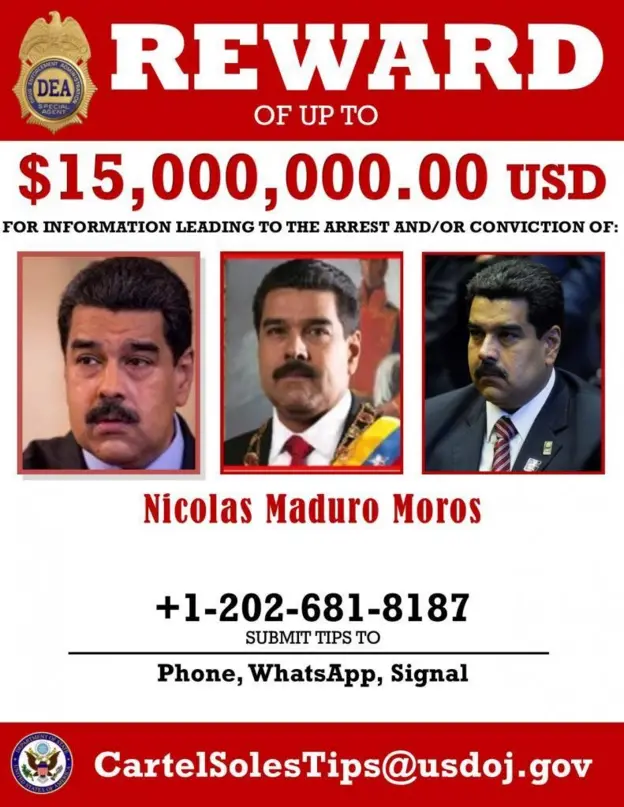
In November, Trump designated Venezuela’s Cartel de Los Soles as a foreign terrorist organisation, placing it on the same list as al-Qaeda and the Houthi rebels. The bounty on Maduro’s head was raised from $25 million to $50 million. Maduro has faced federal charges of narco-terrorism in the United States since 2020, accused of partnering with Colombian rebel groups to “flood the United States with cocaine.”
Marco Rubio has repeatedly insisted that Maduro is “NOT the President of Venezuela” but rather “the head of the Cartel de Los Soles, a narco-terror organisation which has taken possession of a country.” Senator Mike Lee, after speaking with Rubio, said the operation was “deployed to protect and defend those executing the arrest warrant” and likely falls within the president’s “inherent authority under Article II of the Constitution.”
This is a remarkable claim. The idea that a US president possesses inherent constitutional authority to bomb a sovereign nation and abduct its head of state stretches Article II to the point of absurdity. But it follows a familiar pattern: designate the target as something other than a legitimate government, invoke the language of law enforcement rather than war, and present military aggression as the simple execution of an arrest warrant.
One almost admires the efficiency of it. Bombing becomes policing. Invasion becomes arrest. Sovereignty becomes an administrative detail.
The Long Shadow of Latin American Intervention
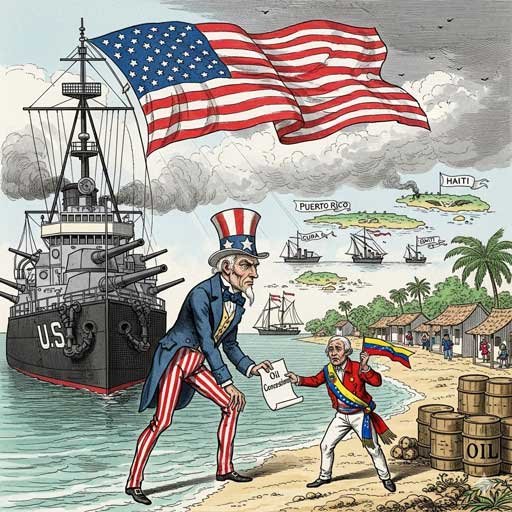
For anyone familiar with the history of US involvement in Latin America, none of this should come as a surprise. The Caribbean and Central America have long served as Washington’s laboratory for testing the limits of international tolerance.
In 1954, the CIA orchestrated the overthrow of Guatemala’s democratically elected president Jacobo Arbenz after he attempted land redistribution that threatened the United Fruit Company. In 1973, another CIA-backed operation helped install Augusto Pinochet in Chile, ending Salvador Allende’s democratic socialist government and ushering in 17 years of brutal dictatorship.
Throughout the 1980s, the Reagan administration funded the Contras in Nicaragua, mining harbours and supporting rebels against the Sandinista government. In 1989, the US invaded Panama with 27,000 troops to remove Manuel Noriega, a former CIA asset turned liability. Conservative estimates suggest at least 2,000 to 3,000 Panamanians died in the assault.
According to historians, direct US military interventions in Latin America and the Caribbean have killed more than 65,000 people, not counting the tens of thousands more who died under US-backed dictatorships throughout the 20th century.
The pattern is consistent. A government inconvenient to American interests emerges. The rhetoric of drugs, communism, or terrorism (depending on the era) provides the justification. Military or covert action follows. The international community issues statements of concern. And years later, declassified documents reveal what everyone already knew: that economic and strategic interests, not humanitarian concerns, drove the intervention from the start.
Venezuela fits this template perfectly. Only this time, there is one additional factor that makes the whole operation feel uncomfortably familiar.
The Unspoken Constant

At all times, one fact hums quietly in the background. Venezuela possesses the largest proven oil reserves on Earth.
At approximately 303 billion barrels, Venezuela’s reserves exceed even those of Saudi Arabia (297.7 billion barrels). The majority sit in the Orinoco Belt, a vast region spanning 55,000 square kilometres of extra-heavy crude. While this oil is expensive and technically challenging to extract, it represents a resource prize of staggering magnitude, valued by Machado’s own team at $1.7 trillion.
Venezuela was a founding member of OPEC in 1960. For decades, it was one of the largest suppliers of oil to the United States, sending about 1.4 million barrels per day at its peak. Production has collapsed in recent years due to mismanagement, underinvestment, and sanctions, falling to around 860,000 barrels per day. But the reserves remain, dormant and vast.
History suggests that when humanitarian language, criminal indictments, and sudden military urgency converge over a resource-rich country, the result is rarely accidental. The pattern repeats with numbing predictability: Iraq and its oil, Libya and its oil, Syria and its pipeline routes.
Now Venezuela and its oil.

María Corina Machado has been remarkably transparent about what comes next. In her plans for post-Maduro Venezuela, she promises to “privatise the oil industry with transparency and public oversight” and transform the country into “America’s energy hub and a reliable partner in regional security.”
Her economic advisors describe Venezuela as presenting a “trillion-dollar opportunity,” a free-market paradise where foreign investors can finally access resources that have been locked away under socialist mismanagement.
The Atlantic Council, always eager to provide intellectual cover for imperial adventures, has published breathless accounts of the economic transformation awaiting Venezuela once Maduro is removed. They speak of unleashing market forces, attracting investment, and integrating Venezuela into the global economy.
Translation: American and European corporations will be given access to Venezuela’s oil on terms favourable to those corporations.
Trump’s pressure campaign against Venezuela began months ago. More than 30 boats allegedly carrying drugs were struck and destroyed in the Caribbean and Pacific, killing over 70 people. Two oil tankers were seized. In December, the CIA conducted a drone strike on a Venezuelan port facility. Last month, Trump announced a blockade of sanctioned oil tankers moving in and out of Venezuelan waters, boasting that the country was “completely surrounded by the largest Armada ever assembled in the History of South America.”
Troops, we are told, will not remain long. Marco Rubio assured senators that he “anticipates no further action in Venezuela now that Maduro is in U.S. custody.” The operation, they insist, was surgical, precise, and limited in scope.
But geologists may yet arrive with suspicious enthusiasm. Technical advisors will be needed to help stabilize Venezuela’s oil infrastructure. Security consultants will be required to ensure the safety of foreign personnel. Economic experts will assist with the privatisation process.
Expect solemn speeches explaining that stabilisation requires external support. Expect reassurances that Venezuela’s oil wealth will now be managed responsibly, for the benefit of the Venezuelan people, naturally.
One can almost hear Keir Starmer clearing his throat to inform us that the United States has an absolute right to defend itself, somewhere in the Caribbean.
What Happens Next

Venezuela’s constitution provides several possible paths forward, none of them neat.
Under Article 233, an “absolute absence” of the president triggers constitutional succession. Vice-President Delcy Rodríguez would assume power and call elections within 30 days. But opposition figures argue the legitimate president is Edmundo González Urrutia, currently in exile in Spain and backed by María Corina Machado. They claim large sections of the security forces would support a transition.
Defence Minister Padrino López has already vowed total resistance, calling for unity against foreign aggression. He made no mention of Maduro’s reported capture, referring only to “Maduro’s orders.” This ambiguity is itself revealing. It suggests either profound confusion within the Venezuelan government or a deliberate attempt to maintain continuity in the face of chaos.
All of these paths carry the risk of internal conflict. And internal conflict, as Iraq and Libya demonstrated, tends to prolong foreign involvement rather than shorten it.
The grim reality is that Venezuela now faces the prospect of prolonged instability, potential civil war, and the likelihood of its oil wealth being carved up by foreign corporations eager to profit from the chaos.
This is what liberation looks like when delivered at the end of a missile.
The Orwell Problem
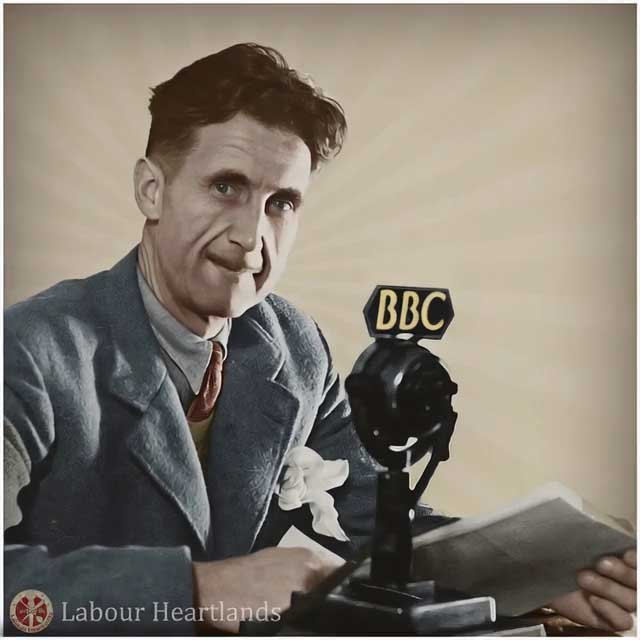
George Orwell’s line from 1984 hangs over this moment like a verdict already passed:
War is peace. Freedom is slavery. Ignorance is strength.
Today, we might add: Bombing is law enforcement. Invasion is liberation. Sovereignty is negotiable. Resource extraction is democracy.
International law, it turns out, means whatever the strongest power says it means at any given moment. The UN Charter’s prohibition on the use of force stands as clear and unambiguous as any legal principle in the modern world. Yet here we are, watching it bend in real time.
The tragedy is not that this represents something new. The tragedy is that it represents something very old, dressed up in the language of justice and human rights. American exceptionalism has always operated on the premise that rules apply to others but not to us. The Monroe Doctrine, first articulated in 1823, established Latin America as Washington’s sphere of influence. The Roosevelt Corollary of 1904 declared the United States to be “the policeman of the Caribbean.”
That language has changed. The underlying assumptions have not.
What we are witnessing is not the breakdown of international order. It is the revelation of what that order has always been: a system of rules that apply selectively, enforced by those with the power to ignore them when convenient.
The Class Question Nobody Asks
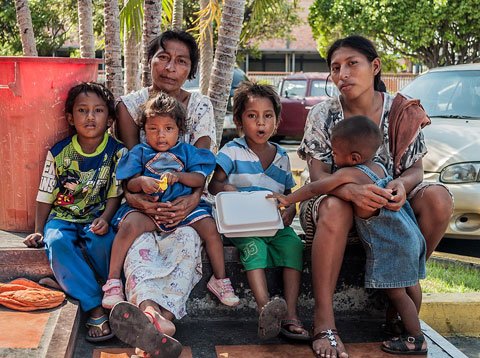
The question that ought to be asked, but rarely is, concerns who benefits from this operation.
It is not the Venezuelan people, who face the prospect of prolonged instability, potential civil conflict, and the likelihood of their country’s oil wealth being carved up by foreign corporations. It is not the American working class, whose taxes fund these military adventures while healthcare, education, and infrastructure crumble at home.
The beneficiaries, as always, are those who profit from instability and control of resources. Defence contractors who manufacture the missiles and helicopters. Oil companies salivating at the prospect of access to the world’s largest reserves. Financial interests who see in Venezuela’s collapse an opportunity for privatisation and debt restructuring.
Venezuelan opposition leader María Corina Machado may genuinely believe she is fighting for freedom and democracy. But her promises to privatize Venezuela’s oil industry and transform the country into a free-market paradise tell us exactly who will benefit from this “liberation.”
The grim reality is that intervention in Latin America has never been about democracy or human rights. It has been about ensuring that governments friendly to American corporate interests remain in power and that those who are not remain weak, divided, or removed.
This is not conspiracy theory. It is documented history. The declassified documents exist. The pattern is clear. And yet the same script plays out again and again, with only minor variations in the cast and setting.
Where Law Becomes Theatre

Whether Maduro is alive, captured, or already being paraded through a US courtroom, certain truths have already crystallised.
International law remains remarkably flexible when oil, power, and credibility are at stake. The “rules-based order” that Western leaders invoke so solemnly turns out to be a set of guidelines that apply to adversaries but not to allies. Sovereignty is sacred when it protects Western interests and disposable when it obstructs them.
The United States can bomb a sovereign nation, allegedly abduct its head of state, and face no meaningful consequences beyond performative statements of concern from European allies and condemnation from countries that lack the power to enforce their objections.
This is not a legal order. It is a hierarchy of force dressed up in the language of law.
And the most dispiriting aspect of all this is how utterly predictable it has become. The lies are familiar. The justifications are recycled. The pattern repeats with the grim regularity of a machine built for precisely this purpose.
George Orwell understood that the corruption of language enables the corruption of thought. When bombing becomes liberation, when invasion becomes democracy promotion, when aggression becomes law enforcement, we lose not just the ability to describe reality accurately but the capacity to think clearly about power and its exercise.
The Venezuela operation is many things. It is a violation of international law. It is a continuation of centuries of American intervention in Latin America. It is a resource grab dressed up as humanitarian intervention. But above all, it is a reminder that power, when unconstrained by genuine accountability, will always find ways to justify its own actions.
The rules-based order is dead. It has been dead for a long time. What remains is simply the right of the might, however they choose to phrase it.
And oil, as always, remains the unspoken language in which empires conduct their most honest conversations.
When law becomes theatre and bombs become liberation, we should at least have the decency to call the performance what it is: not justice, but conquest dressed in the rhetoric of freedom, regime change masquerading as democracy, and empire doing what it has always done while the world watches and pretends to be surprised.

Support Independent Journalism Today
Our unwavering dedication is to provide you with unbiased news, diverse perspectives, and insightful opinions. We're on a mission to ensure that those in positions of power are held accountable for their actions, but we can't do it alone. Labour Heartlands is primarily funded by me, Paul Knaggs, and by the generous contributions of readers like you. Your donations keep us going and help us uphold the principles of independent journalism. Join us in our quest for truth, transparency, and accountability – donate today and be a part of our mission!
Like everyone else, we're facing challenges, and we need your help to stay online and continue providing crucial journalism. Every contribution, no matter how small, goes a long way in helping us thrive. By becoming one of our donors, you become a vital part of our mission to uncover the truth and uphold the values of democracy.
While we maintain our independence from political affiliations, we stand united against corruption, injustice, and the erosion of free speech, truth, and democracy. We believe in the power of accurate information in a democracy, and we consider facts non-negotiable.
Your support, no matter the amount, can make a significant impact. Together, we can make a difference and continue our journey toward a more informed and just society.
Thank you for supporting Labour Heartlands