Profiteering Energy Giants and the Green Transition: Are Crushing Working People
Ireland’s Working-Class Revolt Against the Diesel State
What is happening in Ireland this week is not an Irish story. It is a global one, and Ireland just happens to be the country where working people decided they had absorbed enough of it.
Across the developed world, the same mechanism has been running for years. Energy prices spike. Governments gesture at relief. Oil and gas companies record the largest profits in human history. The cost of living rises. Wages do not. The people who move goods, grow food, drive buses and pour concrete find themselves working harder for less, in a system apparently designed to ensure that every crisis at the top becomes a cost at the bottom.
The world’s largest oil companies raked in roughly two hundred billion dollars in global profits in 2022 alone, a year in which working families across Europe and Ireland were heating one room and skipping meals. The suffering was real. The profits were also real, and they were enormous, and they were not accidental. Every spike in global commodity prices is a transfer of wealth. That is its purpose.
The chaos is not a bug in the system. It is the product.
France had its gilets jaunes. The Netherlands had its farmers blocking motorways. Germany watched its industrial workers face energy bills that threatened to close factories that had stood for a century. And Britain? Britain had a cost of living crisis so severe that food banks became a normal feature of the landscape, and a public so effectively sorted into cultural tribes that it could not agree on whether the people suffering were the right kind of people to deserve sympathy.
Ireland is different. Not because the Irish are inherently more rebellious and have the balls to be defiant in the face of authority, though history offers evidence for that argument. Different because, right now, a protest that started with a WhatsApp group on a Sunday night, with every person burning diesel adding another person burning diesel, has grown in four days into a movement that has blockaded the country’s only oil refinery, locked up half its fuel supply, and forced the government to deploy the army. The Irish, it turns out, are not taking this lying down.
THE GRASSROOTS THAT WOULDN’T BE MANAGED
What is remarkable about this protest is that it started with a WhatsApp group on Sunday night, and every person who was burning diesel started adding another person who was burning diesel, and it grew organically from there. No union bureaucracy. No party apparatus. No professional agitators running a media operation from a glass office in Dublin 2. Just working people, finding each other in the dark, because the cost of their working lives had finally exceeded what flesh and patience can bear.
They came together via social media after talks between the government and individual organisations, including the Irish Road Haulage Association and the Irish Farmers’ Association, resulted in the announcement of support dismissed by many as derisory. That is the key detail. The established bodies sat at the table. They talked. They were offered what amounted to aspirin for a haemorrhage. And the people those bodies are supposed to represent looked at the offer, looked at their fuel bills, and decided the table itself was part of the problem.
🎯 What the Protesters Want
Protesters have put forward several key demands aimed at providing immediate and long-term relief.
- Immediate Relief: They are calling for the government to temporarily suspend the carbon tax and cut excise duty or VAT on fuel to bring down prices immediately. Others want a direct cap on the price of various fuels, including agricultural diesel and kerosene.
- Long-Term Strategy: A more controversial demand is for the government to revisit its ban on fossil fuel exploration off the west coast of Ireland, which protesters believe could provide a domestic supply and reduce prices.
- Political Engagement: Crucially, protesters want senior government figures to meet with them directly to hear their concerns, a request the government has so far refused, preferring to engage with established representative bodies like the Irish Farmers’ Association (IFA)
Independent TD Mattie McGrath met people he described as “angry and exhausted, who feel abandoned and ignored.” That phrase deserves to be read slowly. Not angry and radical. Not angry and extreme. Angry and exhausted. That is what prolonged economic pressure does to a person. It does not produce revolutionaries. It produces people who are simply too tired to pretend any more that the system is working for them.
Angry and exhausted. That is what prolonged economic pressure does to a person. It does not produce revolutionaries. It produces people who are too tired to pretend any more that the system is working for them.
By day four, the Whitegate oil refinery in east Cork had trucks and tractors blocking both entrances, the only refinery in Ireland where diesel and petrol are made from oil. With protests also at the terminals in Foynes in Limerick and in Galway, that amounted to around half of Ireland’s fuel supplies locked up, unable to get out to service stations. This is not a fringe spectacle. This is a working-class movement that has, in four days, brought a nation’s logistics to the edge of genuine rupture.
DIVIDE AND CONQUER: THE LEFT’S MISSING ARMY
Here is where the honest left needs to sit with some discomfort.
When truckers and farmers take to the roads, a certain reflex activates in progressive circles. Diesel. Flags. Men in high-visibility vests. The instinct is to look for the far-right fingerprints, to find the YouTube channel or the Facebook group that proves this is not really about fuel at all, and then to dismiss the whole thing as something other than what it plainly is.
God forbid, apparently, that we stand in solidarity with a haulier.
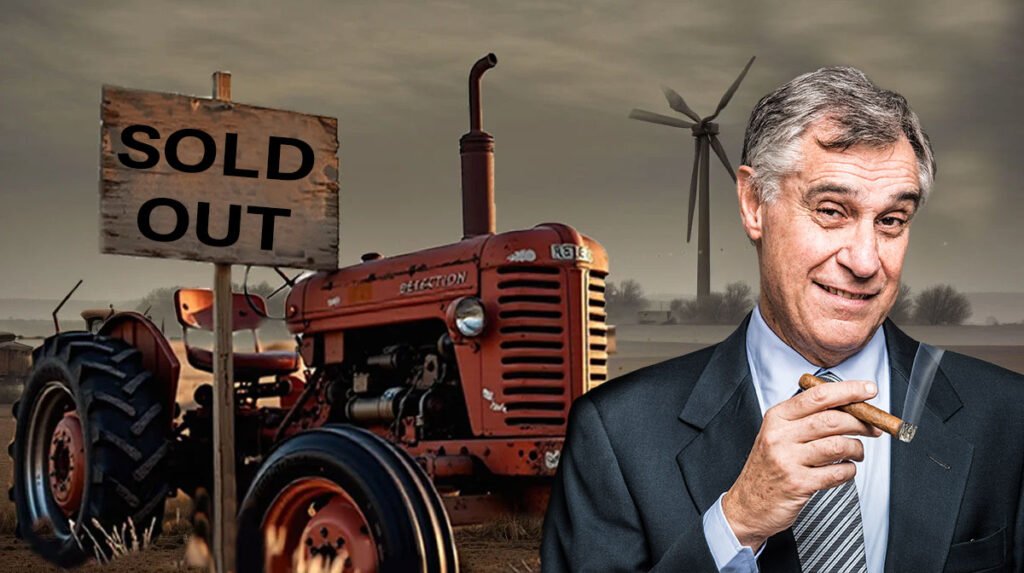
And yet. The haulier’s fuel bill rising by fifty per cent hits his employees before it hits him. It hits the price of every delivery before it hits his margin. It hits the cost of food on the shelves of a supermarket in a deprived neighbourhood before it hits the balance sheet of Irving Oil. The working-class family that cannot afford its weekly shop is downstream of the working man who cannot afford to make the delivery. Their plight is the same plight, running through the same system, generated by the same set of choices made by the same class of people at the top.
This is not complicated. It only becomes complicated when the political and media establishment works, with considerable skill and considerable interest, to ensure that it appears complicated. That a farmer with a tractor is your enemy. That a trucker blocking a motorway is a threat to the public, rather than a member of it. That the people who feel abandoned by mainstream politics and reach for unconventional protest are to be viewed with suspicion rather than recognised as the leading edge of a discontent that touches everyone who works for a living.
It is divide and conquer, and it works because we let it work.

The gilets jaunes were written off in the British press as reactionary before anyone examined what they were actually demanding, which was, at its core, a carbon tax designed so that its burden fell on rural working people rather than on the corporations and wealthy urban commuters who produce the largest share of emissions. The Dutch farming protests were framed as climate denial before anyone considered that the nitrogen regulations driving small farmers off their land were, in practice, accelerating the consolidation of Dutch agriculture into the hands of industrial agribusiness.
The Irish protesters are not climate deniers. They are people pointing out that a carbon tax without a transition infrastructure is not a climate policy. It is a revenue policy with a green label on it. That argument deserves to be heard on the left, not dismissed because it arrives in a cab.
Britain, for its part, has watched its own fuel and energy costs do comparable damage with considerably less organised response. The reasons for that are multiple and worth a separate examination. But there is something in the Irish reaction, something in the willingness to physically stop the machine and say: not this time, not without a fight, that should prompt some reflection about what has been lost in a British working-class politics so thoroughly managed, divided, and demoralised that it cannot find the common ground that Irish farmers and hauliers found in four days on a WhatsApp group.
The common ground was always there. The question is whether we are willing to stand on it.
THE OLDEST TRICK IN THE NEOLIBERAL KITBAG

At which point, Justice Minister Jim O’Callaghan reached for the oldest and most cowardly instrument available to a government that has lost the argument: the “outside actor.”
Politicians have been coming out one by one to condemn the demonstrations, with Taoiseach Micheál Martin saying the slow-moving convoys are “a wrong form of protest” and Public Expenditure Minister Jack Chambers calling the action “unacceptable and irresponsible.” The Taoiseach himself described the Whitegate blockade as “an act of national sabotage,” a remarkable formulation from a man whose government has spent years treating the mobility of working people as a revenue opportunity.
The “outside actor” framing is a political tell. It means the government cannot engage with the substance of the grievance. It means the people in the street have no legitimate complaint, only manipulation. It means that a builder who cannot afford to run his plant hire business, a farmer whose input costs have doubled, a bus operator whose margins are being crushed, all of them are not thinking for themselves. They are being directed by shadows.
It is condescension dressed as a security concern. And the people on the picket line at Whitegate know it. The movement is actively purging political opportunists from its ranks precisely to keep the focus on fuel. It is not interested in being captured by anyone with a different agenda. It is interested, with single-minded and exhausting clarity, in whether a working man or woman can afford to do their job next month.
WHO REALLY PROFITS

Let us follow the money rather than the rhetoric.
The Irish government claims a significant portion of the price of every litre of fuel through excise, VAT, and carbon tax. The carbon tax alone, which the government insists is a climate instrument, now sits close to nineteen cent on every litre of diesel. For a haulier filling a large commercial tank, this is not an environmental nudge. It is a structural overhead that makes the business of moving goods around Ireland more expensive by the week, with no commensurate investment in the rail freight or electric heavy goods infrastructure that might one day make a genuine transition possible.
Meanwhile, the energy companies were not going hungry. When the Ukraine crisis exacerbated the already spiralling gas prices through the ceiling, Ireland’s government introduced a temporary windfall tax. The solidarity contribution was calculated on seventy-five per cent of taxable profits more than twenty per cent above a baseline, and was applied for 2022 and 2023, with estimated proceeds from fossil fuel companies between two hundred million and four hundred and fifty million euros. A tidy sum. Temporary. Now expired.
While the rhetoric in Westminster focuses on “global headwinds,” the ledger tells a different story. Since the dawn of the energy crisis, energy firms have extracted over £125 billion in profit from their UK operations alone. Globally, that figure rises to a staggering half a trillion pounds since 2020. This was not a catastrophe of nature; it was a triumph of design.
Covid. Ukraine. Now Iran. The crisis changes its name every few years. The extraction never changes at all. Each new emergency arrives with its own ready-made explanation, its own sympathetic headline, its own political cover. And behind every one of them, the same companies post another record quarter while the same households choose between heating and eating.
The profits of crisis are structural and permanent. The relief measures are temporary and inadequate.
That is the pattern. The government takes its carbon tax and its excise duty forever. The solidarity contribution it asked of energy companies lasted two years and has not been renewed, even as prices surge again on the back of a new conflict in Iran. The government responded to the latest crisis by extending the fuel allowance season, reducing excise duty and suspending an oil levy, measures described by protesters as insufficient and by the Taoiseach as generous. That distance between the view from Leinster House and the view from a cab at the Whitegate gate tells you everything about who this political system is built to serve.
It did not start with Iran. It did not start with Ukraine. These events provided the occasion. The structure of extraction was always there, waiting for the next crisis to justify the next increase, while the boards of the energy majors planned their dividend payments and the revolving door between government, regulatory bodies, and the energy sector kept turning, quietly, reliably, far from the cameras. Let’s face it. These conflicts, these crises didn’t lose the energy or fuel companies’ money they profited.
THE SOLDIERS AND THE ARGUMENT
The Minister for Justice confirmed that the Defence Forces would be deployed to remove vehicles blocking critical infrastructure as the protests entered their third day. This is where analysis must be precise, because imprecision here serves the government’s preferred narrative.
The deployment of the military against economic protest is not a technical matter. It is a political threshold. When a government reaches for its armed forces to deal with people who are blocking roads because they cannot afford to run their businesses, it is making a statement about the limits of democratic patience. It is saying, in effect: we have heard your argument, we have rejected your argument, and now we will move you.
One of the protest organisers was direct in response. They have, he said, a bigger army than the state. He did not mean it as a threat of violence. He meant it as a statement of arithmetic. The protesters at Whitegate said that if gardaí and the army came to remove them, others would replace them, with hauliers, builders, farmers and contractors willing to maintain the blockade indefinitely.
Strip away the heat of that exchange and what you find is something politically important. The movement is not afraid of escalation because it understands something the government has apparently forgotten: consent is not a legal instrument. It cannot be enforced at gunpoint. A government that has to deploy soldiers to clear a fuel depot has not solved its political problem. It has announced it.
The gardaí at Whitegate, to their credit, appeared to understand this better than the minister who sent them. One Garda source said their intention was simply to remain engaged with the protesters and avoid any action that might inflame the situation, adding that “these are very decent people who have a grievance over fuel prices.” That is not the voice of an institution that believes it is facing saboteurs. That is the voice of people who live in the same country as the protesters and understand, at a human level, what is actually happening on that road in east Cork.
THE GREEN TRANSITION’S DIRTY SECRET

There is a version of the government’s argument that deserves to be taken seriously before it is dismantled. The carbon tax exists because the planet is warming, and someone has to put a price on the emissions that contribute to it. The transition to cleaner energy requires revenue. These are not dishonest positions.
The dishonesty lies in who bears the cost.
A politician in Dublin with a good salary and a Luas stop outside the office can absorb a carbon tax. A rural agricultural contractor in Westmeath, for whom a diesel engine is not a lifestyle choice but an occupational necessity, cannot. The tax is designed as if everyone has the same relationship to fossil fuels, the same access to alternatives, the same cushion to absorb the hit. They do not.
The government is levying the cost of a transition it has not built.
The infrastructure for a just transition, the rail freight capacity, the electric heavy goods vehicles at an affordable price point, the rural public transport network that would reduce car dependency, does not exist. A haulier cannot put his lorry on the bus. A farmer cannot spread slurry by remote working. The group representing the protesters stated it plainly: “this is no longer about one sector, this is about the survival of the people who keep Ireland moving.”
That is not environmentalism. It is a green veneer on the same old model: make the working class pay for the choices of the powerful, then congratulate yourself for the gesture.
WHAT CONSENT LOOKS LIKE WHEN IT RUNS OUT

There will be those who argue, with some justice, that blocking fuel depots is dangerous. That ambulances need diesel. That the people in forecourts running out of fuel did not design the energy market. These are fair points and they deserve a serious answer.
The serious answer is this: working people who have been squeezed past the point of endurance, who have attended the meetings, written the letters, voted in the elections, and watched nothing change, have very few instruments left. The withdrawal of their labour and their vehicles from the roads is one of them. It is disruptive by design, because disruption is the only language the comfortable have ever been able to hear from below.
The protesters at Whitegate allowed a truck carrying chemicals for drinking water treatment to pass. They are not vandals. They are people whose backs are against a wall, using the only leverage they have. The question is not whether their methods are tidy. The question is why it has come to this at all.
Martin Shields, a bus operator from Carrickmacross, put it plainly: “It’s a matter of time before grocery bills go up. It’s a matter of time before people are struggling and hungry, I would think.” That is not hyperbole. That is supply chain economics, understood at the level of lived experience rather than the level of a ministerial briefing note. When fuel goes up, everything goes up. The cost does not stop at the pump. It travels up through haulage rates, through farm gate prices, through the shelves of every supermarket in the country, landing finally on the kitchen tables of the very people who cannot afford it.
The government has called this protest irresponsible. It has called it sabotage. It has reached for its army. What it has not done, in any meaningful sense, is answer the question that every man and woman at Whitegate is asking: at what point does the state consider that enough has been taken from the people, the entire system is meant to work for?
The trucks are the answer. The trucks are also the question.
A government that sends soldiers to clear them rather than ministers to listen to them will find that moving the vehicles does not move the problem. The debt of political neglect does not get discharged with a court order. It accumulates, slowly and then suddenly, until the roads fill again.
Not a wheel turns, not a phone rings, not a light bulb shines without the kind permission of the working class. Ireland’s government has spent years testing that permission. The people at Whitegate, at Foynes, at Galway, on the M50 and the N7 and the ring roads of a dozen Irish towns, are simply withdrawing it.
When a government deploys its army against people who can no longer afford to work, it has not won the argument. It has confirmed it.
Enjoyed this read? I’m committed to keeping this space 100% ad-free so you can enjoy a clean, focused reading experience. Crafting these articles takes a significant amount of research and heart. If you found this helpful, please consider a “small donation” to help keep the lights on and the content flowing. Every bit of support makes a huge difference.

labourheartlands.com | Independent left-wing journalism for the working class
Support Independent Journalism Today
Our unwavering dedication is to provide you with unbiased news, diverse perspectives, and insightful opinions. We're on a mission to ensure that those in positions of power are held accountable for their actions, but we can't do it alone. Labour Heartlands is primarily funded by me, Paul Knaggs, and by the generous contributions of readers like you. Your donations keep us going and help us uphold the principles of independent journalism. Join us in our quest for truth, transparency, and accountability – donate today and be a part of our mission!
Like everyone else, we're facing challenges, and we need your help to stay online and continue providing crucial journalism. Every contribution, no matter how small, goes a long way in helping us thrive. By becoming one of our donors, you become a vital part of our mission to uncover the truth and uphold the values of democracy.
While we maintain our independence from political affiliations, we stand united against corruption, injustice, and the erosion of free speech, truth, and democracy. We believe in the power of accurate information in a democracy, and we consider facts non-negotiable.
Your support, no matter the amount, can make a significant impact. Together, we can make a difference and continue our journey toward a more informed and just society.
Thank you for supporting Labour Heartlands