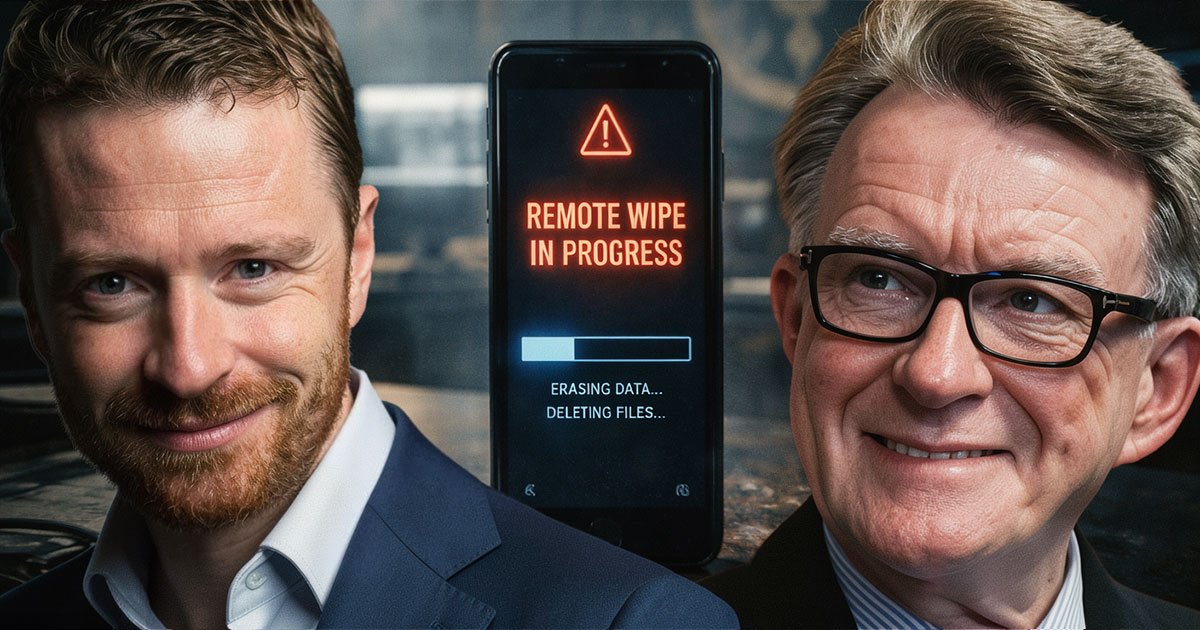
Number Ten wiped the phone. Then they asked us to believe it was stolen.
The British state can read your emails, store your browsing history, track your car by number plate, monitor your bank transfers, and log your phone’s location within metres. The Investigatory Powers Act 2016 requires telecoms companies to retain every citizen’s online activity for twelve months, accessible by the state without a warrant. Ministers have justified these extraordinary powers, repeatedly and without embarrassment, as essential for national security, crime prevention, and public safety.
We are told, in the official language of reassurance, that nothing is truly lost. Every digital interaction leaves a trace. Every message has a record. The state can find it, if it needs to.
Unless, it seems, those messages belong to the Prime Minister’s former Chief of Staff.
The phone was not lost. It was killed. By Number Ten itself.
THE TRANSCRIPT THEY CANNOT HIDE

The police record of Morgan McSweeney’s 999 call on the night of 20 October 2025 has now been published. It is worth reading with care, because what it reveals is more damaging than the original story suggested.
At 22:23, McSweeney reports that a government phone has been snatched from his hands in Pimlico by a figure on a bike. He gives chase. He fails to catch the thief. He calls Number Ten. The No. 10 security team then remotely disables the device, killing it, before any police investigation has taken place. At 22:30, McSweeney calls 999.
He does not tell the operator who he is. He does not say where he works. He describes it, simply, as a government device.
Scotland Yard logs the theft in Belgrave Street, Tower Hamlets: five miles from where it actually happened, in Belgrave Road, Pimlico. Officers try to contact McSweeney the following day. Twice. He does not respond. The case is closed for want of what police describe as ‘any realistic lines of enquiry.’ They were, they said, too busy.
Starmer’s official spokesperson said “relevant government security teams” in Downing Street were notified the same day. He refused to say whether those teams had tried to track or wipe the phone, saying only that there were “long established and robust processes to manage information security”.
Reports have said the lost phone meant some messages between McSweeney and Mandelson were lost. The spokesperson refused to say whether this was the case, while setting out that officials with government phones were obliged to record or back up relevant information such as WhatsApp messages.
“Messages only need to be kept where they relate to substantive discussions or decisions that form part of the official record,” he said. “Significant government information exchanged via these channels must be captured into government systems by copying, forwarding, screenshotting or recording its substance.”
Individuals decided how the rules applied to each communication “using their professional judgment and considering the context”, he said.
In the call transcript, McSweeney says the theft took place in Westminster. The call handler later refers to “Stepney Green park”, which is near the incorrect address, though McSweeney does not appear to recognise that.
That was October 2025. In February 2026, McSweeney resigned as Chief of Staff. In March 2026, Parliament ordered the release of the Mandelson Files. Media inquiries to the Metropolitan Police about the phone theft prompted a revelation: the address had been entered incorrectly. Five months after the event, the Met admitted the error and said it would reassess the case.
The phone’s digital contents, of course, have long since been destroyed. The No. 10 security team saw to that on the night of the theft itself.
A DETAIL THAT DEMANDS AN ANSWER

“Who controls the past controls the future. Who controls the present controls the past.”
— George Orwell, Nineteen Eighty-Four
Let us be precise about what happened, because the sequence matters enormously. McSweeney did not first call the police and then call Number Ten. He called Number Ten first, and the device was remotely killed before police were ever notified.
This is not a minor procedural point. The government’s own security apparatus destroyed the device’s data before any independent authority had a chance to secure it. There was no external intervention required, no thief needing to wipe the handset, no cloud backup mysteriously failing. The evidence was eliminated by Downing Street itself, within minutes of the theft being reported, as a matter of standard protocol.
We are told the messages on that phone are gone. We should ask who made that decision, and when, and whether anyone in authority paused to consider that those messages might constitute evidence in a developing political scandal. The answer, it appears, is that no one paused at all. Or that someone did pause, and concluded that speed was of the essence.
The Prime Minister’s Chief of Staff called 999 without identifying himself. He never returned the police’s calls. The case was closed. Nothing to see here.
THE SURVEILLANCE STATE THAT CANNOT SURVEIL ITSELF
The Party told you to reject the evidence of your eyes and ears. It was their final, most essential command.”
— George Orwell, 1984

Here is the contradiction at the heart of this scandal, and it is one that no minister has attempted to explain.
The same government that requires telecoms companies to retain every citizen’s communications data for twelve months, the same state that operates facial recognition cameras across central London, the same apparatus that can track a car, a phone, a bank transfer, cannot apparently recover the messages of the second most powerful political figure in the country.
Modern smartphones back up automatically to cloud servers. Messages are stored on the recipient’s device as well as the sender’s. Telecom providers retain metadata. Government security protocols for special advisers require that significant communications be logged into official systems. The Cabinet Office has, by its own admission, recovered some of the messages between McSweeney and Mandelson. Not all are lost. The question is which ones are.
There are, in this case, two possibilities. Either the British state is so institutionally incompetent that it cannot apply the surveillance powers it uses on ordinary citizens to its own most senior officials. Or the British state is applying precisely the discretion it always had.
Neither answer is reassuring. The first suggests the Investigatory Powers Act is a tool of selective use, deployed against the powerless and withheld from scrutiny when the powerful are concerned. The second suggests something considerably worse.
THE OTHER SIDE OF THE CONVERSATION

There is a detail in this story that has received insufficient attention. Peter Mandelson was arrested on 23 February 2026. Before that, on 6 February, police searched two of his properties. Standard procedure in a serious misconduct investigation includes the seizure of electronic devices.
McSweeney’s messages, the ones that cannot be retrieved from a remotely killed phone, were sent to someone. That someone has been in police custody. His properties have been searched. His devices, in all likelihood, are in police hands.
The claim that McSweeney’s messages are irrecoverable is a claim about one phone. It is not a claim about the entire evidentiary picture. The other side of those conversations may exist. Whether anyone in authority is looking for it, and whether they intend to tell us what they find, is a different question entirely.
Reed, Minister for Gaslighting
Political language is designed to make lies sound truthful and murder respectable, and to give an appearance of solidity to pure wind.
— George Orwell, Politics and the English Language
When the story broke, the government dispatched Housing Secretary Steve Reed to reassure the public. His answer was delivered with the particular confidence of a man who had not checked his facts. The phone, Reed told LBC, was stolen ‘months before the whole Mandelson situation even began.’ He added, elaborating beyond what the facts could bear: ‘Maybe even over a year before the whole situation arose.’
The confirmed date of the theft is 20 October 2025. The confirmed date of Mandelson’s sacking is September 2025.
The arithmetic does not require a calculator. The phone was stolen one month after the Mandelson situation had very much already begun. Reed’s claim of ‘over a year’ is not a rounding error or a misremembering. It is a statement with no relationship to the established facts.
The SNP’s Westminster leader Stephen Flynn has reported Reed to the Prime Minister’s ethics adviser, Laurie Magnus. In his letter, Flynn noted that Reed and McSweeney are long-term political allies, and that a Cabinet minister appears to have provided the public with a materially false account of a timeline that sits at the centre of an active parliamentary and criminal investigation.
The government has not corrected the record. Reed has not been required to return to the despatch box. The statement sits, uncorrected, in the public domain.
Reed said the phone was stolen ‘maybe even over a year’ before the Mandelson scandal began. The phone was stolen one month after Mandelson was sacked. Someone is not telling the truth.
There is a detail that compounds this. The Spectator has reported that the phone was stolen just days after Labour officials began to worry, internally, that a Humble Address motion would compel the release of McSweeney’s messages. One Labour source, speaking to The Times, was unambiguous: ‘If the Tories pass a humble address motion, Morgan is fucked.’ The phone disappeared in that window. The minister responsible for managing the story told the public it had disappeared long before that window existed.
Whether that is coincidence, incompetence, or something deliberate is a question that only a proper investigation can answer. But we are entitled to note that the government’s chosen method of reassurance has been to send out a minister who told the public something that is not true, and has not been corrected.
The Humble Address motion

The Humble Address motion, which compelled the release of the Mandelson Files, was an exercise of parliamentary authority of a kind rarely seen. It should not stop here.
Parliament should demand to know precisely which messages from the stolen phone cannot be recovered, and which can. It should establish whether McSweeney complied with government guidance requiring special advisers to transfer significant communications from personal or encrypted messaging apps into official systems. It should ask the Metropolitan Police why the identity of the caller was not established on the night of the theft, and why no contact was made through official Downing Street channels when two civilian calls to McSweeney went unanswered.
It should ask whether Mandelson’s devices, seized in the course of an active criminal investigation, contain the messages that McSweeney’s phone supposedly cannot yield. And it should do so before those devices are returned, cleaned, or declared beyond legal reach on grounds that, by now, should be treated with considerable suspicion.
The British state possesses formidable powers of investigation. It uses them, as we are reminded constantly, for our own protection. The test of whether those powers serve the public or the powerful is not how they operate when the target is an ordinary citizen. It is how they operate when the evidence points upward.
In the most surveilled society in British history, the one phone they cannot recover is the one that could end careers. We are asked to call this a coincidence. We should call it what it is...
Enjoyed this read? I’m committed to keeping this space 100% ad-free so you can enjoy a clean, focused reading experience. Crafting these articles takes a significant amount of research and heart. If you found this helpful, please consider a “small donation” to help keep the lights on and the content flowing. Every bit of support makes a huge difference!

Sources: Metropolitan Police statements on McSweeney phone theft (October 2025 and March 2026); parliamentary release of the Mandelson Files (March 2026); police transcript of McSweeney’s 999 call as reported by The Times and The Spectator; Investigatory Powers Act 2016; reporting on McSweeney’s resignation (February 2026); Mandelson arrest, Metropolitan Police (February 23, 2026); Cabinet Office statement on Humble Address compliance; Labour Heartlands prior reporting on the Mandelson-McSweeney-Starmer network.
Support Independent Journalism Today
Our unwavering dedication is to provide you with unbiased news, diverse perspectives, and insightful opinions. We're on a mission to ensure that those in positions of power are held accountable for their actions, but we can't do it alone. Labour Heartlands is primarily funded by me, Paul Knaggs, and by the generous contributions of readers like you. Your donations keep us going and help us uphold the principles of independent journalism. Join us in our quest for truth, transparency, and accountability – donate today and be a part of our mission!
Like everyone else, we're facing challenges, and we need your help to stay online and continue providing crucial journalism. Every contribution, no matter how small, goes a long way in helping us thrive. By becoming one of our donors, you become a vital part of our mission to uncover the truth and uphold the values of democracy.
While we maintain our independence from political affiliations, we stand united against corruption, injustice, and the erosion of free speech, truth, and democracy. We believe in the power of accurate information in a democracy, and we consider facts non-negotiable.
Your support, no matter the amount, can make a significant impact. Together, we can make a difference and continue our journey toward a more informed and just society.
Thank you for supporting Labour Heartlands