Is it a glitch in the machinery of history, or a fundamental design feature, that the most grotesque allegations of perversion always seem to orbit the same gilded centres of power?
From the fog-shrouded alleys of Victorian Whitechapel to the sterile, high-security hallways of the Southern District of New York, a single, recurring ghost haunts the British psyche: the image of the “Untouchable.” Whether it is the 19th-century whispers of Prince Albert Victor’s connection to the Ripper murders or the modern, forensic reality of Prince Andrew’s association with Jeffrey Epstein, the pattern is identical.
The pedestal is built high so that the pits beneath it remain in shadow.
For generations, the British establishment has operated on a simple principle: power is its own justification, and those born to rule are, by definition, beyond the moral constraints that govern lesser mortals. From pulpit to Parliament, from boardroom to Buckingham Palace, the elites wrap themselves in the language of duty, service, and Christian virtue while conducting their private affairs according to an entirely different moral code.

The masses are told to know their place, to respect their betters, to defer to breeding and tradition. And all the while, beneath the pomp and ceremony, beneath the claims of noblesse oblige and paternalistic concern, the powerful have preyed upon the powerless with the casual confidence of men who know the system exists to protect them.
What Victorian conspiracy theorists could only whisper about in speculation has now manifested in the digital age as documented reality.
The fog-shrouded mystery of Jack the Ripper, with its tantalising hints of royal involvement and Masonic cover-ups, has given way to the stark clarity of federal evidence files.
A prince accused not of mere association with criminality, but of direct participation in torture and murder. Not rumour, not innuendo, but allegations sitting in official government documents, treated with the bureaucratic indifference reserved for routine administrative matters.
The Architecture of Impunity
The latest Epstein file release constitutes more than 3 million pages of documents, 2,000 videos, and 180,000 images. Buried within this bureaucratic mountain is document EFTA00040577, an email exchange that reads like something from a fever dream of institutional rot.
A federal employee casually notes allegations that a member of the British royal family engaged in “sex and torture” and was “an accessory to her death as he tortured her and me to force her murder.” The response? Administrative housekeeping. “No problem at all to include me on Epstein / Maxwell notifications going forward.”
No problem at all.

Read that phrase again. Let it settle in your mind like sediment in still water. This is not the language of shock or moral urgency. This is the bureaucratic equivalent of a man being told his dry cleaning is ready. It is the sound of a system so accustomed to protecting power that it has developed its own specialised vocabulary for doing so. The woman mentioned in that email is now dead.
The prince mentioned in that email hoped for immunity with a multi-million pound settlement. The system mentioned in that email continues to function exactly as designed.

The newly released photographs show Andrew Mountbatten-Windsor (we must use his full name now, the honorifics having finally been stripped) in what can only be described as a compromising position. Multiple frames capture him on all fours above a redacted woman lying on the ground, his hand on her midsection, his face turned towards the camera. There is no context provided, no date, no identification of the woman. Just the images themselves, raw and unexplained, sitting in a federal evidence file like a grenade with the pin half-pulled.
The email exchanges are equally damning. In August 2010, Jeffrey Epstein offered to introduce “The Duke” to a 26-year-old Russian woman, describing her as “clever, beautiful, trustworthy.” Andrew responded with the eagerness of a man placing a takeaway order: “Any other information you might know about her that might be useful to know?”
This is how human beings become commodities in the minds of the powerful. Women reduced to menu items, vetted and delivered by obliging fixers.
The Continuity of Cruelty

But this is not new. It is not an aberration. It is the latest chapter in a story that stretches back through Jimmy Savile and Lord Mountbatten, through the Kincora Boys’ Home and the whispered rumours about Jack the Ripper, through every instance where institutional power chose its own survival over the safety of the vulnerable.
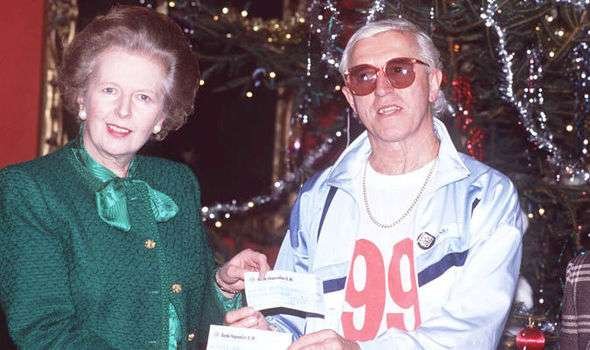
Take the case of James Wilson Vincent Savile, OBE, knighted by the Queen in 1990. For two decades, Savile enjoyed extraordinary access to the heart of the royal family. Prince Charles sought his advice on matters of public relations, asking him in a 1987 letter to help reach “parts of the country that others don’t get to.” Savile responded with a five-page dossier on crisis management, advice so valued that Charles showed it to Prince Philip, who in turn showed it to Queen Elizabeth II. The paedophile’s counsel travelled all the way to the throne.
In 1989, Charles asked Savile to meet with Prince Andrew’s then-wife Sarah Ferguson, believing she “could do with some of your straightforward common sense.” Savile was dispatched as an informal marriage counsellor between Charles and Diana. During his visits to St James’s Palace, according to former royal press secretary Dickie Arbiter, Savile would “do the rounds of the young ladies taking their hands and rubbing his lips all the way up their arms.” The staff found it creepy. Nobody stopped him.
On Savile’s 80th birthday, Charles sent him a gift and a note: “Nobody will ever know what you have done for this country, Jimmy. This is to go some way in thanking you for that.” The irony is almost too perfect to bear. We do know what Savile did for this country. The Metropolitan Police eventually put the number of his victims at 589, the vast majority under 18. He did it in hospitals, in BBC studios, in care homes, in corridors and dressing rooms and anywhere else he could corner a vulnerable child. And he did it with the implicit protection that royal approval provides, that seal of establishment legitimacy that makes people doubt their own eyes.
The Uncle’s Legacy
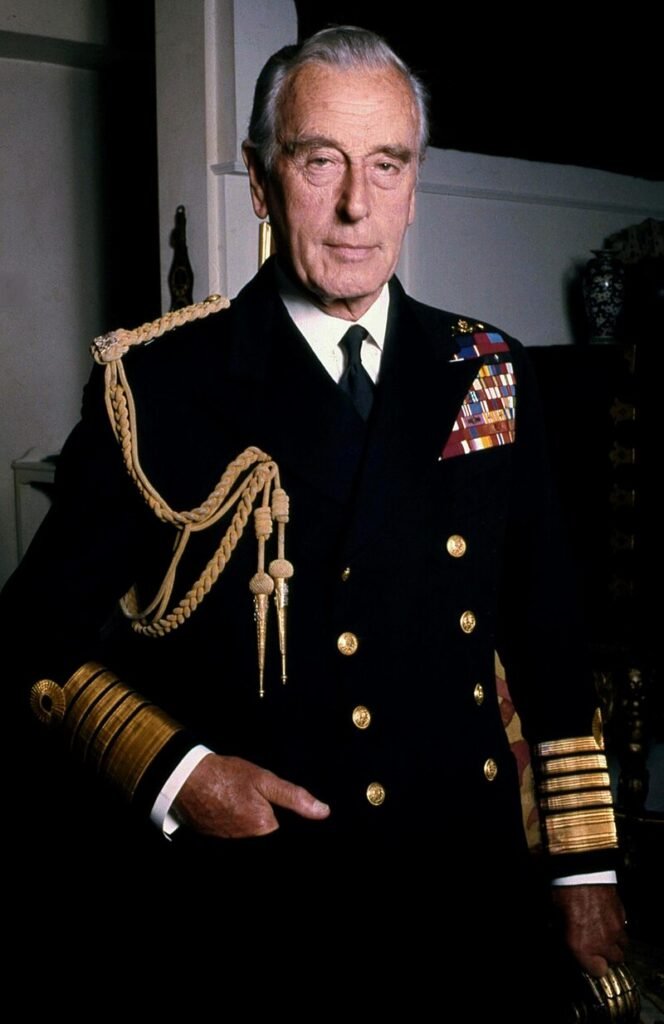
Then there is Louis Francis Albert Victor Nicholas Mountbatten, 1st Earl Mountbatten of Burma, great-uncle and mentor to the current King Charles III. Uncle Dickie, as he was known in the family. The man whose advice to the young Prince of Wales about marriage has been widely reported: enjoy your bachelor days, then marry a young and naïve girl to secure a solid married life.
In 2025, a book by investigative journalist Chris Moore presented testimony from three men who claim they were raped by Mountbatten as children at the Kincora Boys’ Home in Belfast during the 1970s. Arthur Smyth says he was 11 years old when “Uncle Dickie” abused him twice. He only learned who his attacker was two years later, watching television coverage of Mountbatten’s assassination by the IRA. Richard Kerr, then 16, remembers being driven from Kincora to Mountbatten’s castle in Mullaghmore, County Sligo, where he was taken to a darkened room. “I think the darkened room was all about denial,” Kerr recalled. “He grabbed my hand and put it on his chest. I only recognised who he was when I saw on the news that Lord Mountbatten had been killed.”
The FBI had a file on Mountbatten as far back as 1944, explicitly noting his “perversion for young boys.” MI5 allegedly obstructed multiple police investigations into Kincora. When public pressure mounted for a full judicial inquiry in 1983, MI5 ensured it was watered down. The government declared its files on Kincora so secret that they will not be fully released until 2085. Sixty years from now. Three generations. The length of time it takes for everyone involved to be safely dead.
This is the pattern. This is the system. The monarchy surrounds itself with predators, or at minimum fails to detect them despite clear warning signs, and then deploys the full apparatus of the state to ensure the damage never spreads to the institution itself. When Savile died in 2011, the BBC ran tributes. When his crimes finally emerged in 2012, Charles’s office released a statement claiming “no knowledge” of the abuse. When Mountbatten was blown up by the IRA in 1979, Margaret Thatcher said his death left “a gap that can never be filled.” When Andrew settled with Virginia Giuffre in 2022, Buckingham Palace emphasised there was “no admission of guilt.”
The Weaponisation of Status

Power does not merely protect power. It consumes those beneath it with the casual efficiency of a threshing machine. The “modelling recruitment” that lured young women into Epstein’s orbit is simply the 21st-century version of Victorian lies about secret marriages and theatrical careers. Different epoch, same predatory architecture. Promise a way up, deliver a way down.
The mention of an “expedited passport” in the newly released Epstein files is particularly instructive. It speaks to a parallel world where borders are for little people, where victims can be moved across jurisdictions with the logistical ease of freight. In this world, a prince can invite a sex trafficker to Buckingham Palace for a “private” dinner after the man has already served time for procuring a minor for prostitution. In this world, that same prince can write in an email: “Good to be free?” when his friend emerges from a 13-month jail sentence. In this world, such communications can exist for decades in government files before anyone outside the system is allowed to see them.
The new photographs released in January 2026 are disturbing precisely because they are so banal. There is no obvious criminal act captured on camera, no smoking gun that would satisfy a prosecutor. Instead, there is simply the image of a powerful man in a private moment with a woman whose face has been redacted, whose identity is unknown, whose story will never be fully told. The redaction itself becomes a metaphor. The system protects power by making its victims anonymous, interchangeable, forgettable.
The Moral Universe of the Untouchable

We must understand what these files represent. They are not simply evidence of individual depravity, though there is certainly enough of that to go around. They are evidence of a parallel moral universe where the “reputation of the institution” is a higher god than the life of a trafficked girl, where administrative tidiness matters more than justice, where powerful men accused of torture and murder are “transitioned off the case” rather than investigated.
Whether it is the “Zombie Hunter” on death row in Arizona or a prince in a palace, the common thread is the reduction of human beings to objects of use. But when the monster is poor, we execute him. When the monster is powerful, he pays settlements, is stripped of ceremonial titles (but not his wealth), and the files are sealed until everyone involved is dust.
This is not conspiracy theory. This is documented pattern, repeated across generations with such mechanical consistency that it stops being coincidence and starts being structure. In 1888, theories persisted that Jack the Ripper was protected because of Masonic connections to the royal family.
The evidence was circumstantial, but the theory took root because the British public understood in their bones that the state would hide any horror to preserve the Crown. In 2026, we do not need theories. We have flight logs. We have photographs. We have email chains discussing royal visits to private islands where “5 stunning red heads” awaited selection. We have bureaucratic chatter treating allegations of murder with the urgency usually reserved for filing system updates.

The pattern holds across time: when elite predators are finally exposed, we are asked to believe it was an aberration, a lapse in judgment, an unfortunate association. We are told the institution did not know, could not have known, acted properly when it learned the truth. But the files tell a different story. They tell us about Uncle Dickie having FBI files noting his proclivities in 1944, decades before Kincora.
They tell us about Savile’s “creepy” behaviour being noted by palace staff in the 1980s, years before his death and exposure. They tell us about Virginia Giuffre telling her story in lawsuits and interviews for years, only to be met with denials and settlements and NDAs. They tell us about a federal employee calmly agreeing to be added to email distributions about royal involvement in sex trafficking and murder as if it were routine inter-office business.
The Machinery of Cover-Up
The machinery of cover-up is not dramatic. It does not involve shadowy figures in dark rooms making sinister bargains. Instead, it operates through the bureaucratic equivalent of moss growing on stone: slow, incremental, inexorable. An investigation is “transitioned” to a new officer due to an “office move.” Files are sealed for 75 years because they might “compromise national security” or “endanger diplomatic relations.” Settlements are paid with non-disclosure clauses attached like barnacles. Titles are stripped but fortunes remain intact. Palace statements are released noting that there is “no admission of wrongdoing” and that any association with known criminals was unknowing, unwitting, unintentional.
The effect is the same regardless of the method: the powerful remain protected while their victims remain voiceless. When Virginia Giuffre died by suicide in April 2025, the news was buried in the middle pages. When Prince Andrew was finally stripped of his HRH title in October 2025, it was treated as the system working, as accountability being served. But Andrew Mountbatten-Windsor remains a wealthy man living in comfort. Ghislaine Maxwell sits in prison. Jeffrey Epstein died in his cell under circumstances that remain disputed. Virginia Giuffre is dead by her own hand. The dozens of other women whose faces were redacted in the Justice Department files remain anonymous, their stories untold, their justice undelivered.
The files released in January 2026 confirm what anyone paying attention already knew: that Epstein operated a sophisticated trafficking network with connections to the highest levels of political and social power, that these connections were known to law enforcement for years before serious action was taken, and that the system moved to protect the powerful rather than the vulnerable at every opportunity.
The Shape of the Pit
We are told to view these “scandals” as isolated events, as unfortunate lapses in an otherwise functional system. We are asked to accept that the monarchy simply had terrible luck in its choice of friends: Savile, Mountbatten, Epstein, all coincidentally predators, all coincidentally given access to the highest levels of establishment power, all coincidentally shielded from consequences for decades. At some point, the coincidences stop being credible.
What we are looking at is not a bug in the system. It is the system itself, functioning exactly as designed. Power protects power. The pedestal is built high so that the pits beneath it remain in shadow. Those pits contain the broken bodies of children from Kincora, of patients in hospitals where Savile prowled, of young women on Epstein’s island, of all the anonymous redacted faces in federal evidence files.
The monarchy has survived for centuries by adapting, by modernising just enough to avoid revolution while maintaining its essential nature. That essential nature is this: hierarchy justified by birth, power concentrated in bloodlines, the national interest defined as whatever keeps the institution intact. When that institutional interest conflicts with the safety of citizens, we have seen repeatedly which one wins.
Charles III now sits on the throne, the same Charles who sought advice from Jimmy Savile, who sent him birthday wishes signed by young William and Harry, who wrote that “nobody will ever know what you’ve done for this country.” The same Charles who maintained Savile’s friendship for two decades, who sought his counsel on crisis management, who used him as an informal marriage counsellor. The same Charles who was mentored by Uncle Dickie, who learned from him the ways of the world, who absorbed his advice about marriage and duty and the importance of maintaining appearances.
The Question of Complicity

There is no evidence that Charles knew of Savile’s crimes or Mountbatten’s proclivities. The charitable interpretation is that he was simply duped, that his advisers failed him, that the security services did not share what they knew. But at what point does wilful blindness become complicity? At what point does the determined protection of institutional reputation become participation in the cover-up?
When your brother settles a sexual abuse lawsuit for millions of pounds, when the settlement specifically avoids any admission of guilt but also avoids any trial where evidence would be heard, when palace lawyers negotiate NDAs and gag clauses, when the family strips him of his titles but not his wealth, when he remains living in royal housing on royal estates… what message does that send about the institution’s priorities?
When your great-uncle’s files remain sealed until 2085, when survivors of his abuse have to take legal action just to be heard, when MI5 papers on Kincora are locked away for three more generations, when official inquiries find “no evidence” of state complicity despite testimonies from multiple victims and admissions from intelligence whistleblowers… what does that tell you about what the state values more: truth or stability?
When photographs emerge showing your brother crouched over an unidentified woman in circumstances that raise obvious questions, when emails surface showing him eagerly accepting introductions to young women from a convicted sex offender, when federal documents casually note allegations of torture and accessory to murder but treat them as routine filing matters… at what point does “didn’t know” stop being a credible defence?
The Throne’s Shadow

The throne casts a long shadow, and in that shadow flourish things that cannot survive in sunlight. The pedophile who became a national treasure. The war hero who was also, allegedly, “king of the paedophiles” to his victims. The prince who thought nothing of maintaining close friendship with a man he knew to have been convicted of procuring a minor, whose jail sentence was so lenient it involved daily work release and whose protection was so comprehensive that a federal prosecutor who negotiated the deal later became Trump’s Labour Secretary.
These are not isolated failures. They are features of a system that places institutional preservation above human welfare, that treats the powerful as fundamentally different from the rest of us, not merely in status but in moral culpability. When working-class men commit these crimes, we throw them in the deepest dungeons and lose the key. When elite men commit these crimes, we negotiate settlements, seal files, and wait for everyone involved to die of old age before releasing the paperwork.
The philosopher Glenn Greenwald once noted that the genius of the American system is that it has made the law into something that protects the powerful from the weak rather than protecting everyone equally. The British system is more honest: it has never pretended otherwise. For centuries, the Crown has embodied the principle that some people matter more than others, that breeding determines worth, that power justifies itself simply by existing.
We Are the Prey
This is the nightmare beneath the polite surface of constitutional monarchy. It is the realisation that to those at the very top, we are not citizens. We are resources. Our children are commodities. Our suffering is an administrative matter. When the state prioritises the dignity of the throne over the lives of the discarded, it is no longer a protector. It is a cleaner, scrubbing away evidence and inconvenient truths.
The files released in January 2026 will be debated and discussed and eventually filed away themselves. Some will argue they prove nothing, that images without context are meaningless, that emails can be misinterpreted, that we must not rush to judgment. These people are correct in a narrow, legalistic sense. But they miss the forest for the trees. The point is not whether any single photograph or email constitutes proof beyond reasonable doubt of a specific crime. The point is the pattern.
Jimmy Savile died in 2011, his reputation intact, his knighthood unrevoked, tributes from the great and good flowing like wine. Only after his death did the truth emerge, and only then because the BBC’s Newsnight was finally allowed to air what many had known or suspected for years. Lord Mountbatten died in 1979, mourned by prime ministers and queens, his files sealed by MI5, his crimes hidden for another 46 years until victims found the courage and the platform to speak. Prince Andrew has been stripped of his titles but remains a wealthy man, his settlement paid, his mother’s funeral attended, his ties to the family maintained even as the public ties are cut.
What happens to their victims? Some died by suicide, like Stephen Waring from Kincora and Virginia Giuffre. Some died in obscurity, their abuse never publicly acknowledged. Some are still alive, still fighting for recognition, still trying to get the sealed files opened, still banging on closed doors. Their names, when we know them at all, appear in redacted documents and legal filings. They are the collateral damage of a system that works exactly as intended.
The Reckoning That Never Comes
There will be no reckoning. Not really. There will be reviews and inquiries and carefully worded statements expressing regret for any distress caused. There will be reforms and protocols and new oversight mechanisms. There will be solemn promises that this must never happen again, that lessons have been learned, that the institution has evolved. And in 40 or 50 years, when the next batch of files is finally unsealed, we will discover that it did happen again, that the lessons were not learned, that the evolution was cosmetic.
Because the problem is not insufficient oversight or inadequate vetting or a few bad apples. The problem is the tree itself. The problem is a system built on the premise that some human beings are fundamentally superior to others by accident of birth, that these superior beings should be shielded from the consequences that lesser mortals face, that the stability of ancient institutions matters more than the lives of individual victims.
The monarchy cannot be reformed into something that treats all citizens equally because that would require it to stop being a monarchy. The elevation of one family above all others necessarily creates the conditions for this kind of abuse. When you teach an entire nation that certain people are untouchable, you should not be surprised when they start to believe it themselves. When you build pedestals high enough to be seen from miles away, you should not be surprised at how deep and dark the pits beneath them become.
The System Protects Itself
In the coming weeks, defenders of the institution will argue that we must separate the individual from the office, that Charles should not be judged by his brother’s actions or his great-uncle’s crimes or his ill-advised friendships with predators. They will note that he has taken strong action by stripping Andrew of titles, that the family cooperated with investigations, that they cannot be expected to have known what intelligence services kept hidden.
These arguments miss the fundamental point. The reason intelligence services kept things hidden was to protect the institution. The reason investigations were delayed or watered down was to protect the institution. The reason files are sealed for three generations is to protect the institution. At every step, at every decision point, the system chose institutional preservation over truth and justice. That is not an accident or an aberration. That is the institution functioning as designed.
When a working-class man from a council estate commits these crimes, we throw the book at him. We publish his name and face. We ensure his punishment is public and severe. We do this because we want to send a message: this behaviour will not be tolerated. But when an establishment figure commits these crimes, we negotiate in private, seal the evidence, pay settlements with non-disclosure clauses, and ensure that the full truth emerges only after everyone involved is safely dead. The message we send is different: this behaviour will be managed, not punished. It will be contained, not exposed. It will be absorbed by the institution, which will outlive the scandal because institutions always do.
This is not the rule of law. This is something older and darker: the rule of those who rule. It is the recognition that certain people occupy a space above the law, not because the law explicitly exempts them (though historically it did), but because the machinery of enforcement simply doesn’t reach that high. Like a tree whose upper branches exist in a different atmospheric pressure than its roots, the very altitude of power creates a different set of rules.
The throne sits at the apex of British society. It is meant to embody our highest values, our national character, our collective identity. What does it say about those values when the throne’s shadow keeps company with podophiles and sex traffickers? What does it say about our national character when we know about these associations and do nothing? What does it say about our collective identity when we choose institutional stability over the safety of children?
These are not comfortable questions. But they are necessary ones. The alternative is to accept that some victims simply don’t matter enough, that some truths are too dangerous to speak, that some institutions are too important to threaten, regardless of the bodies they leave in their wake.
The photographs from the Epstein files will eventually fade from public consciousness. The outrage will dim. New scandals will arrive to replace old ones. The monarchy will adapt, as it always has, shedding inconvenient members while preserving its core. Charles will reign, William will wait, and the Crown will roll forward through history, accumulating new controversies that will be sealed in new files to be opened by our grandchildren’s grandchildren.
And in those future files, what will they find? Will they find evidence that we learned, that we changed, that we finally insisted on one law for all? Or will they find more of the same: more settlements, more sealed evidence, more administrative correspondence treating horror as routine, more victims whose names are redacted while their abusers are merely “transitioned off the case”?
The answer depends on what we do now. Not with Andrew Mountbatten-Windsor, who is already a spent force, stripped of his titles if not his wealth. But with the institution that protected him for so long, that still houses him, that continues to function as if the problem were individual rather than systemic.
When your only tool is a pedestal, every problem looks like a pit to be hidden. When your only principle is institutional preservation, every victim becomes acceptable collateral. When your only moral language is the language of hierarchy and tradition, the cries of the exploited become unintelligible noise.
The files are open now. The photographs are public. The emails are readable. The pattern is undeniable. The only question that remains is what we intend to do about it. Will we demand real accountability, real transparency, real change? Or will we accept another round of carefully worded statements and cosmetic reforms, another generation of sealed files, another cycle of revelations that emerge only when everyone responsible is safely beyond justice?
The pedestal stands. The pit yawns beneath it. And we must decide whether we want to live in a society that keeps building higher pedestals or one that finally fills in the pits.
When the state treats allegations of royal torture and murder as routine administrative business, it is no longer protecting citizens from monsters. It is protecting monsters from citizens. The Crown cannot be reformed into an instrument of justice because it was never designed to be one. It was designed to stand above justice, and every sealed file, every settlement with an NDA, every victim whose face is redacted while their abuser keeps his fortune, proves that design works exactly as intended.
Enjoyed this read? I’m committed to keeping this space 100% ad-free so you can enjoy a clean, focused reading experience. Crafting these articles takes a significant amount of research and heart. If you found this helpful, please consider “buying me a coffee” to help keep the lights on and the content flowing. Every bit of support makes a huge difference!

Support Independent Journalism Today
Our unwavering dedication is to provide you with unbiased news, diverse perspectives, and insightful opinions. We're on a mission to ensure that those in positions of power are held accountable for their actions, but we can't do it alone. Labour Heartlands is primarily funded by me, Paul Knaggs, and by the generous contributions of readers like you. Your donations keep us going and help us uphold the principles of independent journalism. Join us in our quest for truth, transparency, and accountability – donate today and be a part of our mission!
Like everyone else, we're facing challenges, and we need your help to stay online and continue providing crucial journalism. Every contribution, no matter how small, goes a long way in helping us thrive. By becoming one of our donors, you become a vital part of our mission to uncover the truth and uphold the values of democracy.
While we maintain our independence from political affiliations, we stand united against corruption, injustice, and the erosion of free speech, truth, and democracy. We believe in the power of accurate information in a democracy, and we consider facts non-negotiable.
Your support, no matter the amount, can make a significant impact. Together, we can make a difference and continue our journey toward a more informed and just society.
Thank you for supporting Labour Heartlands