Manufacturing Fear to Fund a War Economy
They are at it again. Can you hear the drumbeat? It is getting louder, faster, and more frantic. The establishment and their media stenographers are busy building a consensus, ramping up the fear, and preparing the ground. Preparing it for what? For the only solution they ever have: handing over more of your public money to the industrial arms complex.
We have seen this playbook before. Iraq had weapons of mass destruction. Libya threatened regional stability. Assad must go. The threat is manufactured, the fear is amplified, and the solution is presented as a patriotic duty. But let us cut through the noise and look at who is singing from this hymn sheet, and more importantly, what they stand to gain.
NATO, EU, MI6, and the MoD: The Chorus Selling You a New Forever War.

In the last 24 hours, we’ve witnessed a coordinated assault on the public consciousness by the unholy trinity of intelligence, military, and NATO leadership. The timing is too perfect, the messaging too aligned. This is not coincidence. This is orchestration.
First comes Mark Rutte, the NATO Secretary General, telling us with a straight face that “We are Russia’s next target.” Speaking in Berlin on December 11th, he warns we must prepare for a conflict “on the scale of war our grandparents and great-grandparents endured.” It is a terrifying image, designed to bypass reason and hit you straight in the gut. Russia could attack NATO “within five years,” he insists, as if he has access to Putin’s diary.
Then, today, steps in Blaise Metreweli, the new Chief of MI6. In her first public speech, she warns that “the frontline is everywhere” and speaks ominously of the “export of chaos” as if it were a Russian Amazon Prime service. She tells us her agents need to be “as fluent in Python as we are in multiple languages.” It sounds modern, technical, urgent. But strip away the tech-speak, and it is the same old story: enemies are everywhere, trust us, and we need more power to fight them.
And finally, also speaking today, Chief of Defence Staff Sir Richard Knighton. He is not just asking for soldiers; he is coming for the rest of us. He calls on “people who are not soldiers, sailors or aviators to nevertheless invest their skills and money” in building up national resilience. He talks about an “all-in mentality” and a “whole-of-society” approach. Translation: the military wants to colonise every aspect of civil life, from our universities to our rail networks, all funded by the taxpayer.
Three voices. Three days. One message: be afraid, be very afraid, and open your wallets.
The Great Contradiction
If you genuinely believe Russia has the capacity to roll through NATO countries like dominoes, you have swallowed the narrative whole. Look at the facts. If Russia is struggling to defeat Ukraine after three years of war, suffering massive losses against an army largely equipped with borrowed Western hardware, what realistic chance would it have against the combined military, economic, and industrial power of the rest of Europe?
Let us be clear about the scale here. NATO’s defence spending in 2024 stood at approximately $1.28 trillion. Russia’s entire GDP is roughly $2 trillion. They are being presented simultaneously as an existential threat to European civilisation and as a failing power bogged down in a grinding war against a single nation. You cannot have it both ways.
Either Russia is an existential threat capable of conquering Europe, or it is a conventional power that cannot decisively beat a much smaller neighbour. It cannot be both. The contradiction is not a bug in their argument; it is a feature. Clarity would invite scrutiny. Fear thrives in ambiguity.
The economic reality tells a different tale. Russia’s military spending in 2024 reached approximately $149 billion, representing 7.1% of its GDP. NATO’s combined military expenditure in the same year? $1.5 trillion. Russia is being asked to fund a military economy at near-wartime levels of 7% of GDP just to keep its forces engaged in Ukraine, while NATO collectively spends ten times as much in absolute terms, whilst devoting only 2-3% of GDP.
This is not the mighty Soviet war machine of the 1980s. And here is the crucial historical point: even at the height of the Cold War, when the Warsaw Pact commanded over 100 divisions in Central Europe against NATO’s 26, when Soviet tank armies vastly outnumbered Western forces, when the Red Army was genuinely capable of rolling across the North German Plain, it never happened. Deterrence worked. We did not wake up to Red Dawn because both sides understood the cost.
The Soviet Union at its peak, with a military genuinely designed and postured for continental conquest, never dared cross that line. Yet we are now being told to fear a Russia that cannot subdue Ukraine, a Russia spending a fraction of what NATO spends, a Russia whose equipment losses in three years exceed the total inventories of most European armies. The threat inflation is breathtaking in its dishonesty.
War is a Racket
What is actually happening is far simpler, and far more cynical. Donald Trump has pushed for a massive increase in defence spending, driving targets up from the long-standing 2% of GDP to a staggering 5%. At the NATO summit in The Hague in June 2025, allies agreed to this new target (split between 3.5% for core military spending and 1.5% for defence-related infrastructure), to be reached by 2035.
For Britain, this means an astronomical increase. Our current defence spending sits around 2.3% of GDP, approximately £65 billion. Hitting 5% would more than double that to roughly £140 billion annually. That is £75 billion per year stripped from other budgets. That is the NHS. That is education. That is housing. That is infrastructure investment.
Navy boss Gwyn Jenkins used a conference in London last week to draw attention to the rising threat of underwater attack.
“The advantage that we have enjoyed in the Atlantic since the end of the Cold War, the Second World War, is at risk. We are holding on, but not by much,” Britain’s top sea lord said.
As Thomas Aquinas wrote, “In order for a war to be just, three things are necessary. First, the authority of the sovereign. Secondly, a just cause. Thirdly, a rightful intention.”
In what appeared to be a message to spendthrift ministers, he warned: “There is no room for complacency. Our would-be opponents are investing billions. We have to step up or we will lose that advantage. We cannot let that happen.”
Every government now needs a justification to divert that public money away from crumbling schools, away from understaffed hospitals, away from housing, and funnel it into the pockets of BAE Systems, Lockheed Martin, and Raytheon. To do that, they need a credible enemy. So the threat gets inflated, the fear gets amplified, and the cheques get signed.
None of these criteria have been met. There is no just cause for ramping up to a war footing against a power with which we are not at war. Instead, they manufacture the crisis to justify another forever war economy. What is laughable, or perhaps tragic, is they think they can control it, as if the Great Game has not already been played out with disastrous consequences throughout history.
The Real Threat
I know something about nuclear deterrence. I served in the British Army’s only nuclear missile regiment, 50 Missile Regiment RA, stationed at Northumberland Barracks in Minden, Germany. We operated the MGM-52 Lance tactical nuclear missile system, equipped with W70 warheads capable of yields between 1 and 100 kilotons. Every soldier in that regiment understood, beyond any shadow of doubt, what would happen if we ever launched.

The first missile fired with a nuclear warhead in anger would have only one response: nuclear assured destruction. That was the reason why the Cold War remained cold. The outcome has never changed.
We are being sold a lie that somehow nuclear escalation with Russia can be managed, controlled, kept within acceptable bounds. Research from Princeton University estimates that a full-scale nuclear exchange between Russia and the United States would result in more than 90 million casualties within the first few hours. That is just the beginning. Studies published in Nature Food calculate that nuclear winter would follow, slashing global agricultural production by 90% within three to four years. More than 75% of the planet would face starvation within two years. The estimated death toll from the subsequent global famine runs into the billions.
This is not speculation. This is not fear-mongering. This is what we know will happen. And yet we are being told to prepare for conventional war with a nuclear power as if such a thing can exist without crossing that threshold.
The only real existential threat we face is mutually assured destruction. That has not changed since the Cold War. Russia and NATO are both nuclear powers, and that reality puts a hard ceiling on escalation whether politicians like it or not. Everything else is theatre, but the money they demand is real.
Follow the Money
This is not about security. It is about sustaining the military-industrial economy. The danger is not Russia invading Europe. The danger is our own governments using a permanent war footing as an excuse for permanent austerity at home while billions flow to defence contractors who donate generously to political parties and employ retired generals on lavish consultancy fees.
When Sir Richard Knighton tells you to “invest your money” in defence, ask yourself: why is there always money for missiles, but never enough for nurses? Why can we find £75 billion extra for weapons, but we cannot find £10 billion for the NHS? Why are we preparing for World War III instead of preparing for the crises we actually face: climate breakdown, healthcare collapse, housing shortage, infrastructure decay?
The answer is simple. War is profitable. Peace is not. Lockheed Martin does not make money from hospitals. BAE Systems does not profit from schools. The arms industry needs perpetual threat to justify perpetual spending. And so we get these coordinated performances, these manufactured moments of crisis, designed to shock us into compliance.
George Orwell wrote: “The past was alterable. The past never had been altered. Oceania was at war with Eastasia. Oceania had always been at war with Eastasia.” This is the world they are building. The enemy changes, but the war never ends. Yesterday it was Iraq. Before that, Afghanistan. Tomorrow it will be China. Today it is Russia. The faces change. The formula does not.
They Want Your Fear and Your Money

We face a choice, though they would prefer we did not realise it. We can continue to pour hundreds of billions into preparing for wars that benefit only those who sell the weapons. Or we can invest in the security that actually matters: food security, energy security, healthcare, education, housing, infrastructure that withstands climate change.
Real security means a population that is healthy, housed, educated, and employed. It means resilient communities, not resilient supply chains for ammunition. It means a country where people can afford to live, not a country preparing to die in someone else’s war.
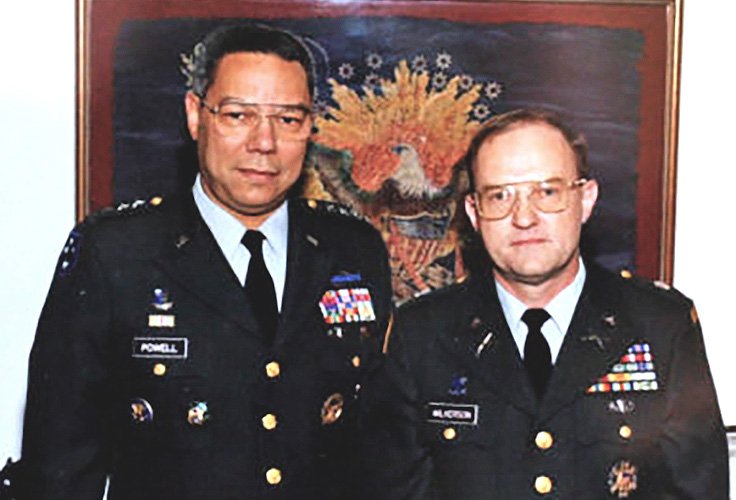
The next time one of these well-rehearsed prophets of doom tells you that Russia is coming and we need another £75 billion, remember: they said the same about Iraq’s WMDs. They were lying then. They are lying now. The only invasion you need to worry about is the invasion of your wallet by the defence industry.
In the Cold War, we understood that the bomb was not a weapon; it was a deterrent. The moment you stop believing in deterrence and start believing in escalation, you have already lost. You have accepted their logic, their fear, their endless war.
They want your fear. Give them your scepticism instead. They want your money. Demand they spend it on life, not death.

Support Independent Journalism Today
Our unwavering dedication is to provide you with unbiased news, diverse perspectives, and insightful opinions. We're on a mission to ensure that those in positions of power are held accountable for their actions, but we can't do it alone. Labour Heartlands is primarily funded by me, Paul Knaggs, and by the generous contributions of readers like you. Your donations keep us going and help us uphold the principles of independent journalism. Join us in our quest for truth, transparency, and accountability – donate today and be a part of our mission!
Like everyone else, we're facing challenges, and we need your help to stay online and continue providing crucial journalism. Every contribution, no matter how small, goes a long way in helping us thrive. By becoming one of our donors, you become a vital part of our mission to uncover the truth and uphold the values of democracy.
While we maintain our independence from political affiliations, we stand united against corruption, injustice, and the erosion of free speech, truth, and democracy. We believe in the power of accurate information in a democracy, and we consider facts non-negotiable.
Your support, no matter the amount, can make a significant impact. Together, we can make a difference and continue our journey toward a more informed and just society.
Thank you for supporting Labour Heartlands