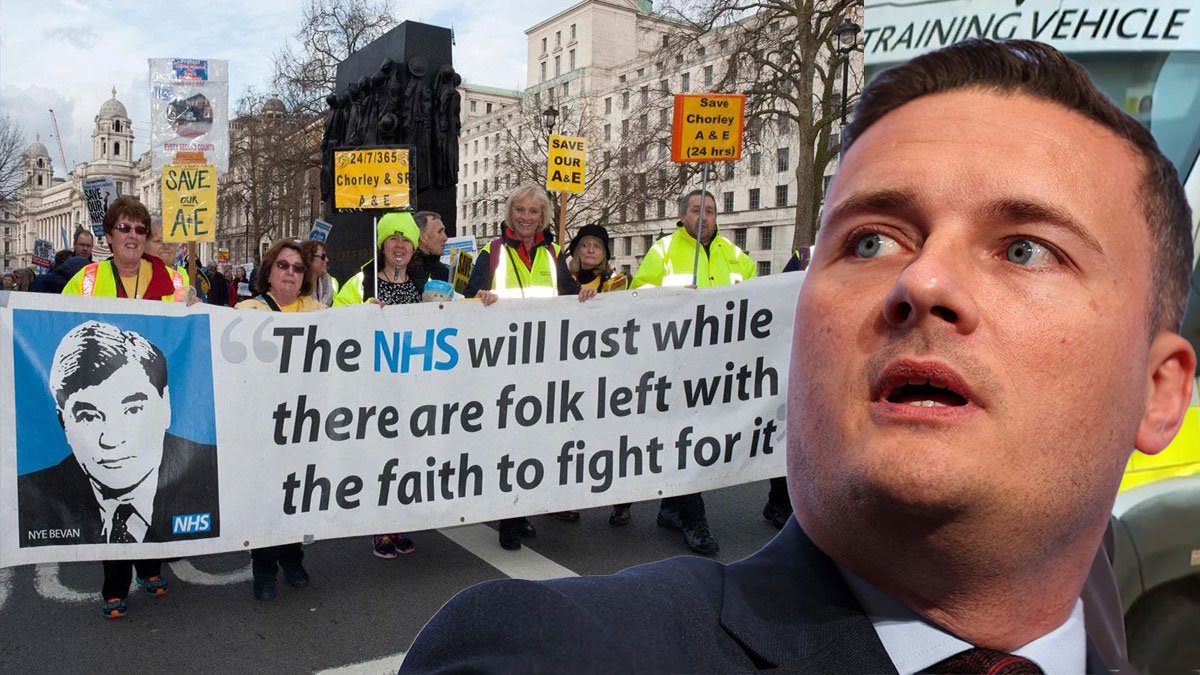
Is the British State more interested in managing the decline of its greatest institution than in actually preserving it? This morning, as resident doctors, the backbone of our hospital wards, mount the picket lines once again, the air is thick with the usual government condemnations of “disruption.” Yet, we must ask: what is more disruptive to a nation’s health than the systematic, decade-long impoverishment of the very people we trust with our lives?
The current six-day walkout, which began today, is not an act of greed; it is an act of survival for a profession that has reached its breaking point.
The Arithmetic of Erosion

The government’s latest “historic” offer of a 3.5 per cent pay increase is a masterclass in political gaslighting. With RPI inflation currently sitting at 3.6 per cent and forecast to rise, this is not a pay rise. It is a further real-terms pay cut, piled atop a mountain of historic wage erosion.
Since 2008, resident doctors have seen their pay fall by approximately 20 per cent in real terms. While the Department of Health speaks of “putting more money into pockets,” the reality for a foundation doctor is a salary that has failed to keep pace with the cost of rent, heat, and the astronomical student debt incurred to enter the service.
- The 2026/27 Award: 3.5 per cent (below the 3.6 per cent RPI).
- The Cumulative Loss: A doctor today is effectively working one day a week for free compared to their 2008 counterpart.
- The Competition Crisis: Despite the new Medical Training (Prioritisation) Act 2026, the ratio of doctors to specialist training spots remains a bottleneck that stifles career progression and fuels the exodus to Australia and New Zealand.
A Managed Collapse
The establishment argues that the NHS cannot afford pay restoration, citing a cost of £300 million per strike. This is a false economy of the highest order. We are told there is no money for the workers, yet there is always capital for the burgeoning “pockets of privatisation” and the management consultants who oversee the “modernisation” of services, a euphemism for streamlining them into oblivion.
Critics claim that these strikes harm patients. It is a potent emotional lever, but it ignores the “silent strike” happening every day: the empty rotas, the burnt-out surgeons, and the 62-day cancer targets that are missed not because of picket lines, but because of a chronic lack of staff. To blame the doctors for the waiting lists is like blaming the fire brigade for the heat of the blaze while you are busy withholding their water.
The government’s “diminishing tolerance” for industrial action is, in truth, a diminishing tolerance for the public sector itself. They seek to lock in pay erosion as the new permanent baseline, turning a vocation into a precarious trade. We are witnessing the deliberate exhaustion of a workforce to justify the eventual fire sale of the service.
The Calculated Scarcity of the Training Cap

There is a profound irony in a government that laments a shortage of doctors while simultaneously maintaining a rigid cap on the number of British students allowed to study medicine. Currently, medical school places in England are strictly rationed, not by a lack of qualified applicants, as thousands of straight-A students are rejected annually, but by a Treasury-imposed “maximum fundable limit.” For the 2026-27 academic year, this cap remains stagnated at approximately 8,126 domestic places, far below the trajectory once promised to secure our future. This artificial scarcity serves a dual purpose for the neoliberal state: it avoids the immediate “upfront” cost of training a British doctor estimated at roughly £230,000, and creates a permanent dependency on the international market.
The Ethics of the “Quick Fix”
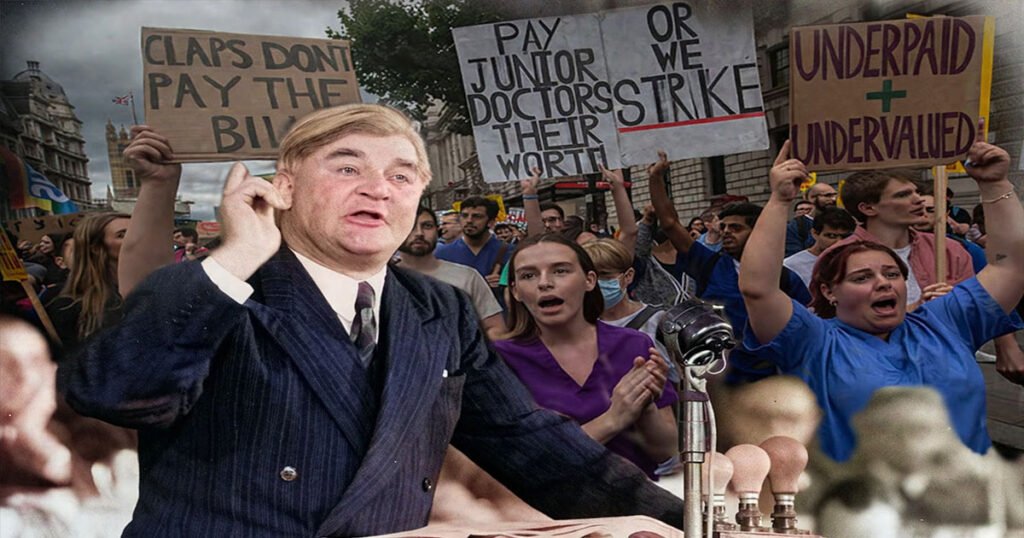
Rather than investing in our own youth, the UK has opted for a policy of intellectual asset-stripping from the Global South. We currently “import” over 40 per cent of our medical workforce from overseas, a figure that highlights a staggering moral contradiction. We are essentially parasitic on the healthcare systems of developing nations, taking doctors whose training was funded by poorer taxpayers to plug the holes left by our own domestic disinvestment. This “brain drain” is not a side effect; it is a structural necessity of a system that views human life through the cold lens of a balance sheet. It is cheaper to poach a fully-qualified physician from a “red list” country than it is to build a lecture hall in Birmingham or Leeds.
“We have traded the long-term health of the nation for the short-term convenience of the ledger, treating the medical profession like a global gig economy rather than a sovereign duty.”
Structural reform cannot begin with a pay cut. It must begin with the recognition that a doctor’s labour is not a line item to be trimmed by Treasury technocrats, but the foundational wealth of a civilised society. If we do not restore the value of the healer, we will soon find ourselves with nothing left to heal.
The government isn’t just cutting pay; they are amputating the future of the NHS.
Enjoyed this read? I’m committed to keeping this space 100% ad-free so you can enjoy a clean, focused reading experience. Crafting these articles takes a significant amount of research and heart. If you found this helpful, please consider a “small donation” to help keep the lights on and the content flowing. Every bit of support makes a huge difference.

Support Independent Journalism Today
Our unwavering dedication is to provide you with unbiased news, diverse perspectives, and insightful opinions. We're on a mission to ensure that those in positions of power are held accountable for their actions, but we can't do it alone. Labour Heartlands is primarily funded by me, Paul Knaggs, and by the generous contributions of readers like you. Your donations keep us going and help us uphold the principles of independent journalism. Join us in our quest for truth, transparency, and accountability – donate today and be a part of our mission!
Like everyone else, we're facing challenges, and we need your help to stay online and continue providing crucial journalism. Every contribution, no matter how small, goes a long way in helping us thrive. By becoming one of our donors, you become a vital part of our mission to uncover the truth and uphold the values of democracy.
While we maintain our independence from political affiliations, we stand united against corruption, injustice, and the erosion of free speech, truth, and democracy. We believe in the power of accurate information in a democracy, and we consider facts non-negotiable.
Your support, no matter the amount, can make a significant impact. Together, we can make a difference and continue our journey toward a more informed and just society.
Thank you for supporting Labour Heartlands